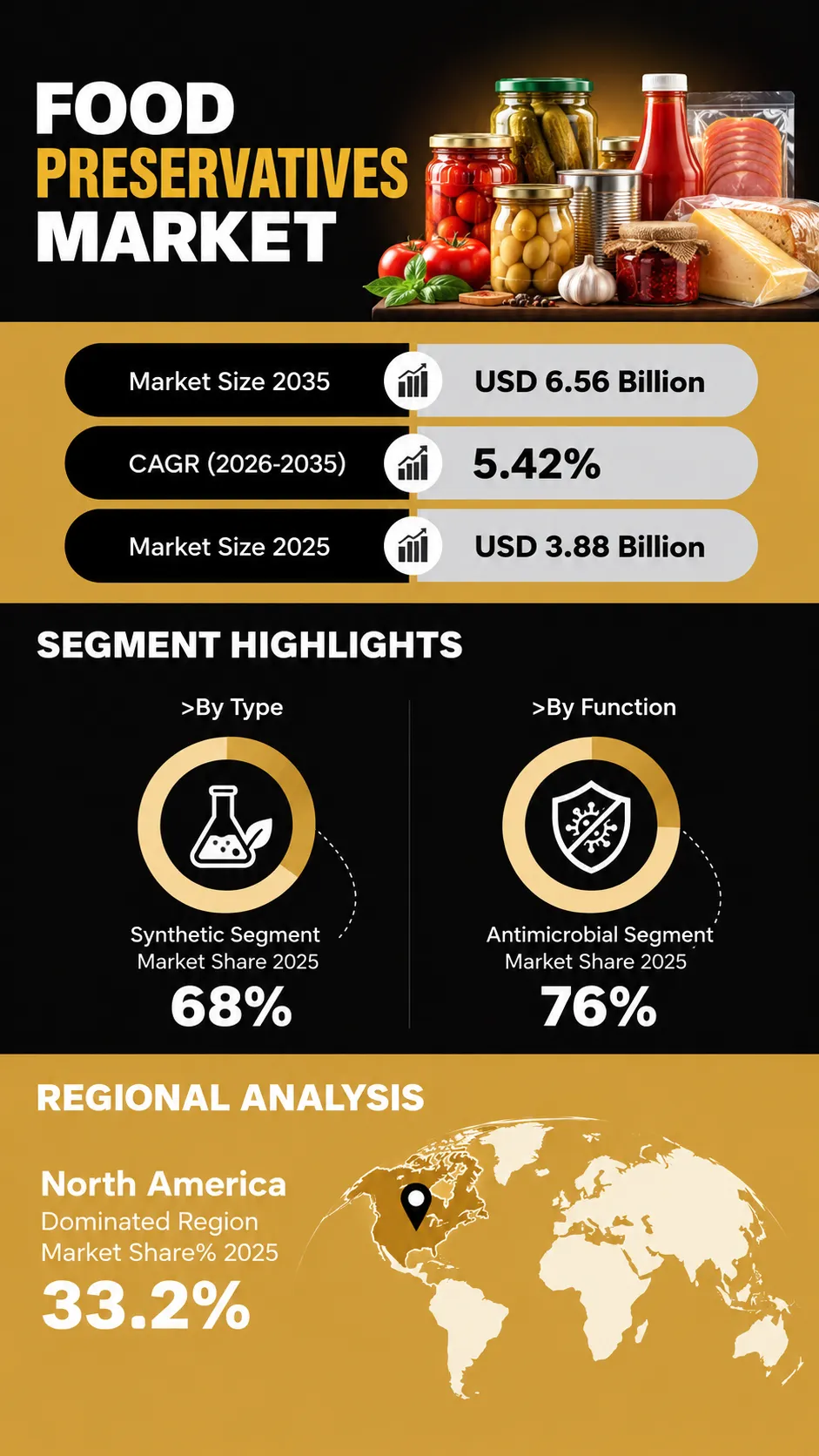
The global Food Preservatives Market is on a steady growth path through 2035, as processed food demand and clean-label reformulation continue reshaping preservation strategy across the packaged food industry. “According to a recent study by SNS Insider, the global Food Preservatives Market size valued at USD 3.88 billion in 2025, is anticipated to grow to USD 6.56 billion by 2035, registering a CAGR of 5.42% over the 2026-2035 forecast period.”
Food preservatives sit at an uncomfortable intersection of consumer preference and practical necessity, shoppers say they want fewer additives on their labels, but the shelf-stable, widely distributed food supply modern grocery retail depends on simply does not work without effective preservation. That tension is not going away, but it is reshaping which preservative systems manufacturers choose to use.
Clean-label reformulation, more than any single regulatory action, is what is driving product innovation in this category right now, as fermentation-derived and botanical preservation systems close the performance gap that used to make synthetic preservatives the only practical choice for many applications.
To Get Detailed Insights on the Food Preservatives Market – Request a Sample Report
Fermentation-Derived Systems Reshape Preservation Strategy
Where synthetic compounds like sodium benzoate and BHA once dominated by default, fermentation-derived organic acids and antimicrobial peptides are increasingly capturing formulator attention as a natural alternative that can match synthetic performance.
This shift is changing how ingredient suppliers invest in R&D, with fermentation capacity and botanical extraction expertise becoming as important a competitive asset as raw production scale used to be.
Manufacturers who can demonstrate comparable shelf-life performance from natural systems are increasingly winning reformulation contracts with brands under pressure to simplify their ingredient labels.
Key Market Findings Highlight High-Growth Segments
Synthetic preservatives held the largest share of the Food Preservatives Market in 2025, at 68%, reflecting their cost advantage and proven performance across commodity food categories.
Natural preservatives are the fastest-growing type, expanding at an 8.20% CAGR, pulled forward by clean-label expectations spreading into mainstream packaged food.
By function, antimicrobial preservatives led with 76% share in 2025, while antioxidant preservatives are growing fastest, at a 7.40% CAGR, as manufacturers target oxidative rancidity in shelf-stable snacks and packaged meat.
Meat, poultry & seafood remained the largest application at 32% share, but ready meals is climbing fastest, at a 7.95% CAGR, driven by dual-income households and urban convenience culture.
Clean-Label Credibility and Formulation Sophistication Anchor Competitive Positioning
Brands are increasingly evaluating preservative suppliers on clean-label credibility and formulation sophistication nearly as much as on cost, particularly for premium and mid-tier packaged food categories.
Investment in fermentation capacity and botanical extraction technology is becoming a genuine competitive differentiator among larger ingredient suppliers, while smaller players without that investment increasingly compete only in commodity, price-sensitive segments.
This divide is expected to sharpen further as clean-label expectations continue spreading from premium products into mainstream packaged food.
North America Leads as Middle East & Africa Grows Fastest
North America holds the largest share of global market revenue, anchored by large-scale processed food manufacturing and a well-established regulatory framework. The Middle East & Africa region, meanwhile, is growing fastest, powered by increased urbanization and cold-chain infrastructure gaps that make shelf-life extension a genuine business imperative.
Europe holds the second-largest share as well, shaped heavily by strict labeling provisions under Regulation (EU) No 1169/2011 that continue pushing formulators toward more transparent preservation systems.
Leading Companies Drive Innovation and Competition
Competition in this market centers on clean-label reformulation capability, fermentation technology, and application-specific formulation expertise nearly as much as on price, with the top five suppliers controlling a substantial share of global revenue.
Some of the major companies that operate in the global food preservatives market are Cargill, Incorporated, BASF SE, Kerry Group plc, Corbion N.V., DuPont de Nemours, Inc., DSM-Firmenich AG, Archer Daniels Midland Company, International Flavors & Fragrances Inc.
An SNS Insider Analyst Santosh Bhul commented, “Food preservatives have moved well past being a simple shelf-life afterthought, brands now need formulations that deliver genuine safety performance while reading as recognizable, naturally sourced ingredients on a label. The suppliers capturing the fastest-growing parts of this market are the ones investing in fermentation and botanical technology that closes the gap with synthetic preservatives rather than asking consumers to compromise on either safety or ingredient transparency.”
About the Author

Get in touch