
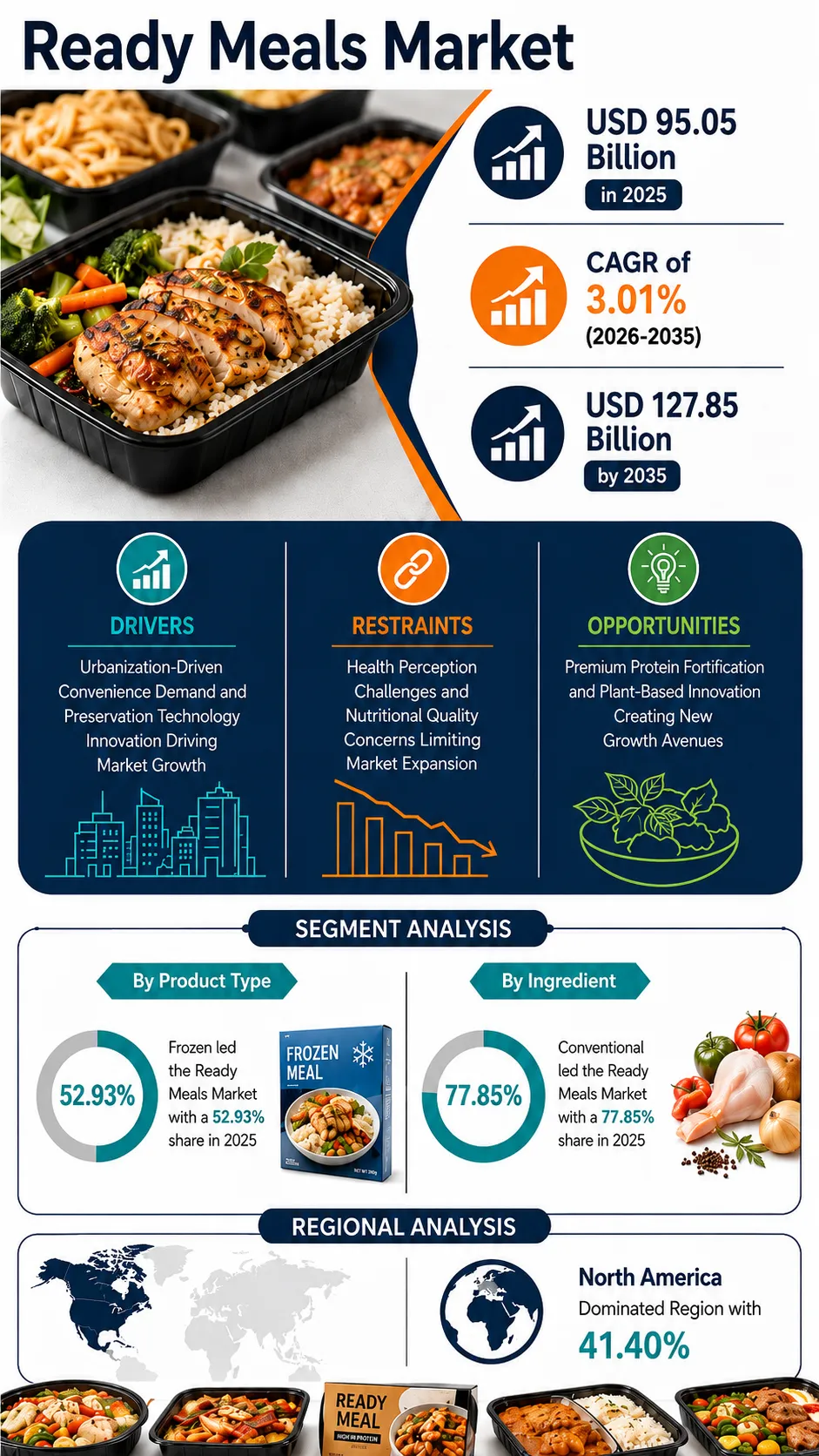
The global Ready Meals Market is set for steady expansion as consumers worldwide continue relying on convenient, precooked dining solutions. "According to a recent study by SNS Insider, the global Ready Meals Market size valued at USD 95.05 billion in 2025, is anticipated to grow to USD 127.85 billion by 2035, registering a CAGR of 3.01% over the 2026-2035 forecast period."
There have been tremendous changes within ready meals preservation and packaging technology over time due to which many manufacturers who aim at improving shelf life and nutrition can take advantage of this trend. This includes the need for more advanced, protein-fortified formulations that will provide consumers with the ability to access convenient, nutritious meals. This applies in situations where ready meals are used across household, foodservice, and institutional catering applications.
Manufacturers are constantly working hard to ensure that their ready meal products perform better than before in order to meet various needs of convenience-seeking consumers worldwide.
To Get Detailed Insights on the Ready Meals Market – Request a Sample Report
Convenient Nutritious Meal Ecosystems Create New Demand
The ready meals market has evolved from basic frozen entrees to more advanced protein-fortified and plant-based use cases. The growing investment in high-pressure processing, intelligent packaging, and cold-chain distribution for a variety of applications has required the development of more efficient and reliable production systems.
New designs of ready meals can increase nutritional density, extend shelf life, and allow for broader dietary customization. This gives manufacturers the possibility to be more effective when reaching convenience-seeking consumers and doing better product differentiation.
Ready meal manufacturers, retail partners, and food technology developers are increasingly cooperating thanks to the growing interest in developing future solutions for convenient, nutritious dining.
Key Market Findings Highlight High-Growth Segments
The frozen segment dominated all categories in the ready meals market share with a market revenue share of 52.93% in 2025 due to ease of preparation, storage, and long shelf life.
The fastest growing category is expected to be chilled ready meals which will grow at a CAGR of 5.20% through 2035. This will be possible owing to the increasing consumer preference for fresher-tasting, minimally processed options.
By ingredient, conventional formulations held the largest share of total market revenue of 77.85% in 2025 due to broader price accessibility. The free-from segment will see the fastest growth in revenue generation at a CAGR of 3.84%.
Based on meal type, non-vegetarian generated a share of 60.02% of market revenue in 2025 thanks to growing protein-based food product demand. On the other hand, vegetarian meals will be the segment recording the fastest revenue growth at a CAGR of 4.15%.
Distributive trends are changing as well. Supermarkets and hypermarkets accounted for a 41.95% revenue share in 2025. But online retail will turn out to be the fastest-growing distribution channel through 2035, on the back of cloud kitchen partnerships, home delivery convenience, and increased demand from digital-first consumers.
Nutrition, Shelf Life, and Format Innovation Gain Importance
In this regard, manufacturers have been looking at ready meal products that would make their offerings more nutritious and require less preservative dependency and be more shelf-stable.
Innovation in high-pressure processing, protein fortification, and intelligent packaging has been making it possible for companies to come up with products that can meet increasingly demanding consumer health and convenience expectations. In addition to that, increasing emphasis on plant-based formulation and free-from positioning is also making it possible for companies to find solutions that optimize consumer trust.
Such trends are likely to become even more prominent in the future.
North America Emerges as the Largest Market with 41.40% Revenue Share Amid Rising Consumer Familiarity
The North America region represented 41.40% share of global market revenue in 2025 and was the largest regional market, with the United States being the largest consumer of pre-packaged meals. In addition, Asia Pacific is expected to be the fastest-growing market during the forecast period, propelled by increasing urban workforce numbers and applications across the region's fast-growing ready meal manufacturing industries.
On the other hand, Europe represented a meaningful share of global market revenue in 2025, aided by a dense concentration of leading ready meal manufacturers and strong consumer familiarity with chilled and frozen formats.
Leading Companies Drive Innovation and Competition
The environment continues to stay very dynamic since players continue innovating on products and technologies as well as forming partnerships in order to enhance their position in the industry.
Some of the major companies that operate in the global ready meals market are Nestlé S.A., Conagra Brands, Inc., The Kraft Heinz Company, General Mills, Inc., Unilever PLC, Tyson Foods, Inc., JBS S.A., McCain Foods Limited, Nomad Foods Limited, Hormel Foods Corporation, Campbell's Company, The Kellogg Company, Ajinomoto Co., Inc., ITC Limited, Maruha Nichiro Corporation.
An SNS Insider Analyst Santosh Bhul commented, "The rapid commercialization of protein-fortified and technologically advanced ready meal formulations is creating unprecedented demand for high-performance convenience food products. Manufacturers that successfully combine nutritional density, shelf life extension, format innovation, and advanced processing capabilities will be best positioned to capitalize on emerging opportunities across frozen, chilled, and plant-based applications."
About the Author

Get in touch




