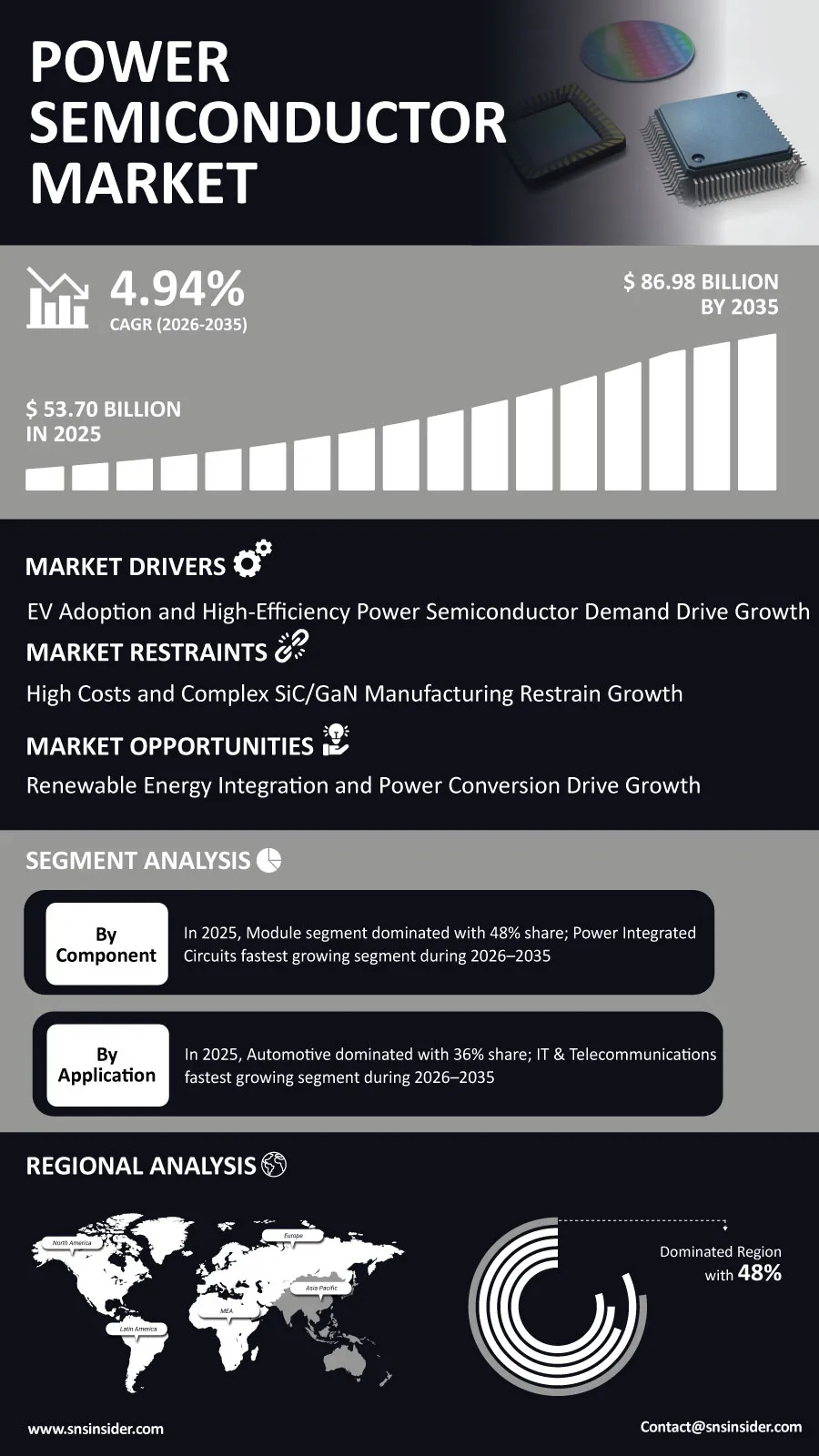
The global Power Semiconductor Market is positioned for steady expansion as industries accelerate electrification, renewable energy integration, and digital infrastructure development. “According to a recent study by SNS Insider, the global Power Semiconductor Market size valued at USD 53.70 billion in 2025, is anticipated to grow to USD 86.98 billion by 2035, registering a CAGR of 4.94% over the 2026–2035 forecast period.”
Deployment of electric vehicles, the adoption of automation in industry, and increased power demands from data centers have created a growing requirement for power conversion technologies. The importance of semiconductor components that control voltage and current is on the rise in the areas of transportation, manufacturing, telecommunication, and energy infrastructure.
Technological progress in silicon carbide and gallium nitride has also been opening up the possibilities of creating smaller and more efficient power systems. This trend has encouraged manufacturers to focus on optimizing the performance of their products.
To Get Detailed Insights on the Power Semiconductor Market – Request a Sample Report
Electrification and Renewable Energy Investments Create New Growth Opportunities
Electric mobility is creating a demand for power semiconductors needed in various components, such as inverters and chargers in automobiles. The increasing adoption of power devices in automobiles is contributing to the development of a more efficient car and supporting efficient charging facilities.
Deployment of renewable energy sources is another area that is playing a major role in driving the growth of the market. Semiconductor components for managing varying power loads are required in solar power inverters, wind power conversion, smart grids, and energy storage. On the other hand, growing investments in cloud computing, 5G, and industrial automation are opening up new avenues.
Despite high costs associated with production of wide bandgap semiconductors and supply issues, the growing investments in the production of semiconductors are going to help the market grow.
Key Market Insights Highlight Shifting Demand Patterns
By component, power semiconductor modules accounted for approximately 48% of global market revenue in 2025. Their ability to integrate multiple power devices into compact assemblies supports deployment across electric vehicles, industrial drives, and renewable energy equipment. Power integrated circuits are projected to be the fastest-growing component segment as demand increases for compact electronics combining power regulation and control functions.
Based on application, automotive segment held around 36% revenue share in 2025, driven by electrification across passenger vehicles and commercial transportation. IT and telecommunications are expected to register the fastest growth through 2035, supported by data center expansion, cloud computing, and the deployment of advanced communication networks.
By material, silicon segment dominated with 62% share in 2025, benefiting from established manufacturing processes, broad availability, and competitive production costs. Silicon carbide is projected to grow the fastest as electric vehicle powertrains, fast-charging infrastructure, and renewable energy systems increasingly require devices capable of operating efficiently at high voltages and temperatures.
In terms of voltage range, medium-voltage devices held around 45% of market revenue in 2025, supported by widespread use in industrial equipment, automotive systems, and power distribution. High-voltage semiconductors are projected to experience the fastest growth as grid infrastructure, renewable energy installations, and high-power charging applications expand.
Advanced Semiconductor Technologies Reshape Energy Management
There is more emphasis by manufacturers today on enhancing power density, heat management, and switching efficiency to fit the needs of current electronic equipment. SiC and GaN materials are becoming popular as they will lower power losses for certain applications with the help of their high-performance characteristics, but their use will depend on costs and special needs.
In addition, growth in AI computing platforms leads to interest in efficient power supply in data centers. Together with electrification of industries and intelligent energy management systems, these trends lead suppliers of semiconductors to create specialized products.
Asia Pacific Maintains Over 48% Market Share as North America Strengthens Manufacturing Investment
The Asia Pacific region is likely to retain its position as the leading regional market and generate more than 48% of total revenue in 2025. This region is forecast to show the highest rate of growth at 6.5% until 2035. Advanced capabilities in electronics manufacturing, growing production of electric vehicles, and increasing installations of renewables in China, Japan, South Korea, and Taiwan drive its market performance.
The North America region enjoys benefits of semiconductor research and development, manufacturing, and demand from the electric mobility and data centers industry. Europe creates demand through automotive electrification and industrial energy efficiency. Latin America and MEA offer potential for renewables, telecommunications, and infrastructure development projects.
Industry Participants Prioritize Capacity Expansion and Innovation
Power Semiconductor Market Competition is focused on production facilities, efficiency of devices, technology, and business relationships. Firms are engaged in developing new material solutions, production facilities, and semiconductor solutions for specific applications of automotive, industrial, and energy clients.
Key companies operating in the global Power Semiconductor Market include Infineon Technologies, ON Semiconductor, Mitsubishi Electric, Toshiba Corporation, STMicroelectronics, Texas Instruments, Vishay Intertechnology, Fuji Electric, NXP Semiconductors, Renesas Electronics, ABB Ltd., Broadcom Inc., Wolfspeed, ROHM Semiconductor, Hitachi Energy, Semikron, Littelfuse, Microchip Technology, Analog Devices, and Delta Electronics.
An SNS Insider analyst Sushant Kadam commented, “Electrification, renewable energy deployment, and growing data center power requirements are creating sustained demand for efficient semiconductor technologies. Manufacturers that strengthen production capabilities and advance silicon carbide, gallium nitride, and integrated power management solutions will be positioned to address evolving requirements across automotive, industrial, and energy applications.”
About the Author

Get in touch