
Advanced Ceramics Market Report Scope & Overview:
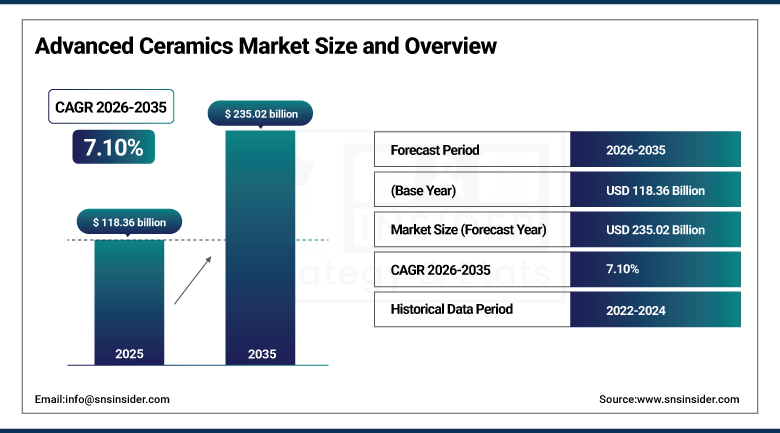
The Advanced Ceramics Market was valued at USD 118.36 Billion in 2025 and is expected to reach USD 235.02 Billion by 2035, growing at a CAGR of 7.10% from 2026 to 2035.
Advanced ceramics, alternatively designated as engineering ceramics, technical ceramics, or high-performance ceramics, are inorganic, non-metallic materials processed at high temperatures from chemically refined raw material inputs to produce components. Whose exceptional combinations of thermal stability, mechanical hardness, chemical inertness, electrical insulation or conductivity, and biocompatibility provide performance capabilities that metals, polymers, and conventional ceramics cannot achieve in the demanding operating environments of modern industrial, electronic, medical, and aerospace applications. The defining characteristic that distinguishes advanced ceramics from traditional ceramics used in tableware, tiles, and sanitary ware is the precise control of chemical composition, microstructure, and processing conditions that advanced ceramic manufacturing maintains. Throughout the synthesis, forming, sintering, and finishing operations whose outcomes determine the specific combination of physical and functional properties that each advanced ceramic product delivers to its application.
⮞Morgan Advanced Materials announced a strategic partnership with a leading aerospace manufacturer in August 2025 to develop advanced ceramic components for next-generation aircraft, targeting the turbine engine and structural thermal barrier applications where silicon nitride and CMC components' superior temperature capability enables engine operating temperatures above the metallurgical limits of nickel superalloys, improving thermal efficiency and reducing fuel consumption in commercial and military aircraft whose economic and environmental performance is directly tied to thermodynamic cycle temperature.
To Get more information on Advanced Ceramics Market - Request Free Sample Report
Advanced Ceramics Market Trends
-
Silicon carbide ceramics are witnessing strong adoption in EV power electronics for higher efficiency and thermal performance.
-
Additive manufacturing is enabling production of complex, high-performance ceramic components.
-
AI-driven material design is accelerating ceramic microstructure optimization and product development.
-
Green hydrogen and fuel cell technologies are creating new demand for advanced ceramic materials.
-
Ceramic matrix composites are gaining traction in aerospace engines to improve fuel efficiency and high-temperature performance.
U.S. Advanced Ceramics Market Outlook
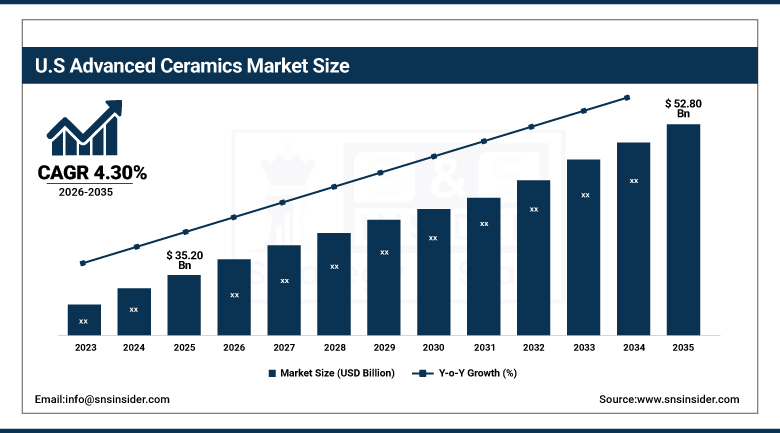
The U.S. Advanced Ceramics Market was valued at approximately USD 35.20 Billion in 2025 and is expected to reach approximately USD 52.80 Billion by 2035, growing at a CAGR of approximately 4.30%.
The United States is the world's most commercially significant national advanced ceramics market within the broader North American region, anchored by the domestic semiconductor manufacturing sector's high-purity process chamber ceramic component requirements. The aerospace and defense industry's expanding CMC and structural ceramic adoption in hypersonic vehicle thermal protection systems and military aero-engine components, and the growing biomedical ceramics market whose dental implant, orthopedic bearing surface, and spinal fusion cage applications sustain premium pricing for biocompatible zirconia and alumina ceramic products. The CHIPS Act's semiconductor manufacturing investment programme is creating growing domestic demand for the high-purity alumina, quartz, and silicon carbide ceramic components used inside semiconductor process equipment whose domestic production location at new TSMC, Intel, and Samsung facilities creates supply chain security requirements that domestic advanced ceramic suppliers including CoorsTek and II-VI Materials are positioned to serve.
⮞CoorsTek Inc. announced an expansion of its silicon carbide ceramic production capacity in 2025 to serve growing demand from semiconductor wafer fabrication equipment manufacturers whose etch and CVD process chamber component requirements include silicon carbide focus rings, chamber liners, and electrode assemblies whose demand scale is proportional to the global CHIPS Act-driven fab construction investment. The expansion included new sintering furnace capacity and process control system upgrades that improve silicon carbide component dimensional consistency and surface finish quality, addressing the increasingly stringent flatness and roughness specifications that advanced semiconductor process equipment manufacturers impose on ceramic focus ring and shower head components at sub-5 nanometre node process tools.
Advanced Ceramics Market Segment Analysis
-
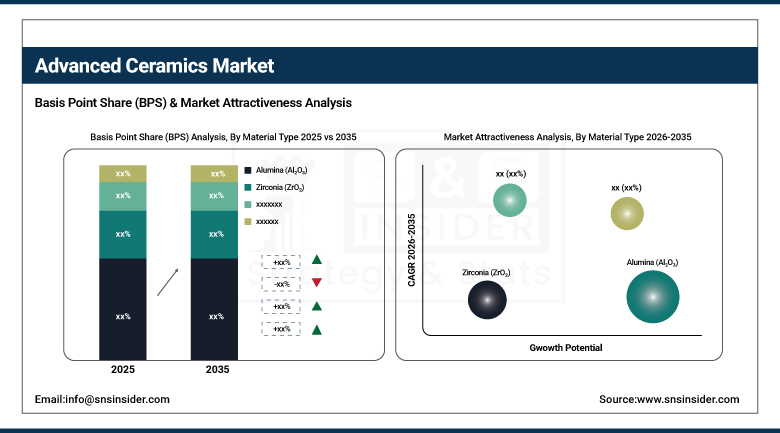
By Material Type, the alumina segment dominated the Advanced Ceramics market with approximately 35.00% revenue share in 2025, while the titanate segment is the fastest growing material type at a CAGR of 7.80% during 2026 to 2035.
-
By Product Type, the monolithic ceramics segment dominated the Advanced Ceramics market with approximately 80.60% revenue share in 2025, while the ceramic matrix composites segment is the fastest growing product type during 2026 to 2035.
-
By Application, the electroceramics segment dominated the Advanced Ceramics market in 2025, while the bioceramics segment is growing fastest at a CAGR of approximately 8.77% during 2026 to 2035.
-
By End Use Industry, the electrical & electronics segment dominated the Advanced Ceramics market in 2025, while the medical & healthcare segment is the fastest growing end use at a CAGR of approximately 11.84% during 2026 to 2035.
By Material Type, alumina dominates, titanate grows fastest
Alumina retained the dominant material type position with approximately 35.00% of Advanced Ceramics market revenue in 2025, reflecting its commercial deployment across the broadest range of advanced ceramic applications including semiconductor process chamber components, medical implant substrates, electrical insulating components, wear-resistant mechanical parts, and refractory lining materials whose combined consumption creates the largest aggregate alumina advanced ceramics demand of any material type. Alumina's combination of abundant raw material availability, well-established processing technology, and the widest property range achievable through microstructure control from pure corrosion-resistant bodies through high-toughness transformation-toughened grades sustains its commercial dominance across applications spanning the full spectrum from commodity industrial ceramics through premium medical and electronic grades.
Titanate is growing fastest at 7.80% CAGR as barium titanate multilayer ceramic capacitors in EV battery management electronics, smartphone power circuits, and 5G base station filter components collectively create rapidly expanding titanate demand, while lead-free potassium sodium niobate titanate development for sonar transducers and piezoelectric actuators creates additional growth in premium titanate applications.
⮞In April 2026, Kyocera expanded its U.S. fine-ceramics manufacturing capabilities with a new cold isostatic press at its Hendersonville, North Carolina, facility, supporting production of larger oxide-ceramic components, including alumina and zirconia parts, for demanding industrial applications.
By End Use, electrical & electronics dominates, medical grows fastest
Electrical and electronics retained the dominant end use industry position through the enormous volume of ceramic components consumed in semiconductor manufacturing equipment, multilayer ceramic capacitors in consumer electronics, electronic substrate and packaging materials, and piezoelectric actuators and sensors in industrial and consumer applications. The global multilayer ceramic capacitor market alone, with annual production volumes exceeding one trillion units, represents the world's largest single advanced ceramics application by unit volume whose value sustains the ceramic electronic components sector's dominant position in the market.
Medical and healthcare is growing fastest at approximately 11.84% CAGR through the expanding adoption of bioceramic orthopaedic implants, zirconia-toughened alumina femoral heads for total hip replacement, zirconia dental implants and crowns, and bioceramic spinal fusion cages whose patient outcome advantages including reduced wear debris, improved diagnostic imaging compatibility, and superior long-term biocompatibility versus metallic and polymeric alternatives are supported by growing clinical evidence.
⮞In May 2026, CeramTec announced that it would present advanced ceramic substrate solutions at PCIM Expo 2026 in Nuremberg, Germany, highlighting materials designed for high-performance power electronics applications that require reliable electrical insulation and thermal management.
Regional Analysis
|
Region |
Major Country |
Share within Region, 2025 (%) |
|---|---|---|
|
North America |
United States |
84.73% |
|
Europe |
Germany |
27.84% |
|
Asia Pacific |
China |
42.84% |
|
Middle East & Africa |
UAE |
22.84% |
|
Latin America |
Brazil |
43.84% |
North America Advanced Ceramics Market Insights
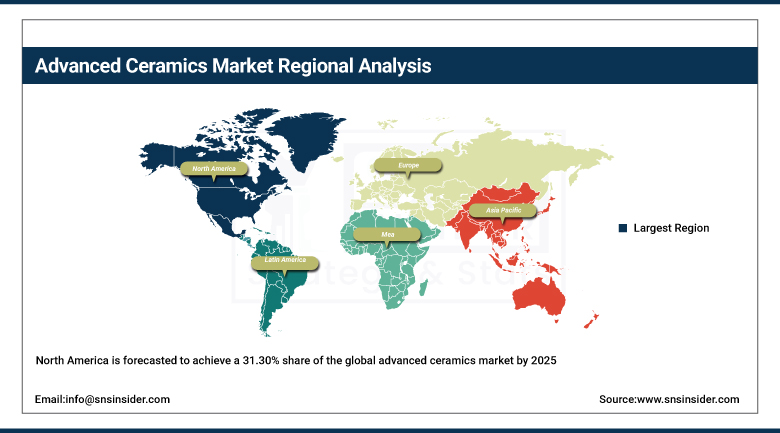
North America is forecasted to achieve a 31.30% share of the global advanced ceramics market by 2035, growing at above-global-average rate driven by semiconductor manufacturing expansion, aerospace CMC deployment, and medical ceramics growth. The United States accounts for approximately 84.73% of regional revenue, with demand concentrated in the semiconductor process equipment sector, aerospace and defence advanced materials, and biomedical ceramics. CoorsTek, McDanel Advanced Ceramic Technologies, and II-VI Materials serve the domestic market alongside Kyocera and CeramTec's North American operations.
⮞In December 2025, General Atomics announced plans to expand domestic manufacturing of silicon carbide ceramic fibers and ceramic matrix composites, developing scalable production processes intended to reduce material costs and dependence on foreign supply chains for advanced energy, turbine, and aerospace applications.
Get Customized Report as per Your Business Requirement - Enquiry Now
Europe Advanced Ceramics Market Insights
Europe held a significant share of global advanced ceramics revenues in 2025. Germany accounts for approximately 27.84% of European revenues through CeramTec GmbH's technical ceramics manufacturing, Schunk Group's carbon and ceramic products, the domestic automotive industry's ceramic sensor and catalytic substrate demand, and Germany's medical device industry's bioceramic component procurement. Saint-Gobain's European advanced ceramics operations serve the aerospace, energy, and industrial markets across France, Germany, and the United Kingdom.
⮞In November 2025, Bosch Advanced Ceramics announced its transition into the Sintokogio Group, establishing a new ownership structure intended to support long-term growth and investment in additive manufacturing of technical ceramics for industrial applications.
Asia Pacific Advanced Ceramics Market Insights
Asia Pacific dominated the global advanced ceramics market in 2025, holding approximately 54.00% of global revenues through the concentration of consumer electronics manufacturing, semiconductor fabrication, and automotive production. China accounts for approximately 42.84% of Asia Pacific revenues through its dominant position in multilayer ceramic capacitor production, growing semiconductor manufacturing investment, and domestic advanced ceramics manufacturers including Sinocera Piezotronics and Yixing Xin Peng Ceramics. Japan contributes through Kyocera Corporation's world-leading technical ceramics portfolio and Murata Manufacturing's electronic ceramics. South Korea contributes through Samsung Electro-Mechanics' MLCC production.
⮞In April 2026, TDK Corporation and Nippon Chemical Industrial established TDK-NCI Advanced Materials Co., Ltd. in Japan to accelerate the development of ceramic materials and manufacturing processes for multilayer ceramic capacitors, strengthening capabilities in electronic component materials.
MEA & Latin America Advanced Ceramics Market Insights
Middle East and Latin America represent growing Advanced Ceramics markets where energy sector investment and industrial modernization are creating demand. The UAE leads MEA revenues of the regional total through its energy sector's ceramic component requirements for petrochemical processing, the regional aerospace maintenance and repair industry's ceramic component procurement, and the advanced manufacturing investment in Abu Dhabi's industrial free zones. Brazil leads Latin American revenues of the regional total through its automotive industry's ceramic sensor demand, energy sector applications, and growing biomedical ceramics market.
⮞In June 2025, Frasle Mobility announced plans to acquire full ownership of its brake-pad manufacturing facility in Sorocaba, Brazil, consolidating domestic production capacity and concentrating manufacturing of its Ceramaxx ceramic brake-pad line at the site.
Market Dynamics
Growth Drivers: Electric vehicle power electronics expansion driving silicon carbide and alumina ceramic demand and semiconductor manufacturing investment creating process chamber ceramic component procurement.
The global electric vehicle transition represents the most commercially significant single demand driver for advanced ceramics whose application scope spans SiC power semiconductor substrates and components, alumina electronic substrate and packaging materials in battery management electronics, zirconia oxygen sensors in electric powertrain thermal management systems, and silicon nitride bearing components in electric motor support and transmission assemblies. Each additional million EVs produced annually creates proportional advanced ceramics demand across multiple components whose combined per-vehicle ceramic content at premium grades represents substantial revenue growth for advanced ceramics producers whose EV application portfolio is diversified across the vehicle's multiple ceramic application points.
The global semiconductor manufacturing investment programme, whose combined CHIPS Act and equivalent national legislation investments exceed USD 450 billion through 2030, creates the most concentrated capital equipment procurement period in semiconductor history whose process chamber ceramic component requirements sustain above-market growth in semiconductor grade advanced ceramics through the construction and equipment installation period.
⮞In September 2026, Kyocera completed its Nagasaki Isahaya manufacturing plant in Japan, an investment planned at approximately JPY 68 billion through March 2029 to manufacture fine ceramic components for semiconductor equipment and semiconductor packages, with full-scale operations scheduled for spring 2027.
Restraints: High fabrication and processing costs for advanced ceramics relative to metallic and polymer alternatives and the technical complexity of machining and joining ceramic components creating design adoption barriers.
Advanced ceramics' inherent brittleness and sensitivity to tensile stress create design challenges for structural applications whose static and dynamic loading requirements must be carefully managed through component geometry optimization, residual stress control during sintering, and surface finish management to achieve the required structural reliability. The machining of sintered dense ceramics using diamond-tipped grinding tools is substantially more expensive than machining of metallic alternatives, with ceramic machining costs 5 to 20 times higher per unit volume removed than equivalent metallic part machining, creating cost barriers for complex-geometry ceramic components whose near-net-shape forming and minimum post-sintering machining are required to achieve economic competitiveness.
Joining ceramics to metallic assemblies requires specialized active metal brazing, glass seal, or ceramic-to-metal bonding technologies whose process control requirements and assembly handling protocols create manufacturing complexity that limits ceramic adoption in joined assemblies where metallic alternatives are more readily manufacturable.
Opportunities: Ceramic additive manufacturing enabling geometrically complex medical implants and aerospace components and solid-state battery ceramic electrolyte materials represent premium growth opportunities.
Additive manufacturing of advanced ceramics using photocurable ceramic resin stereolithography, binder jetting, and extrusion-based processes is enabling the production of geometrically complex bioceramic bone scaffolds, dental prosthetics with individualised anatomical geometry, and turbine component internal cooling channel designs that conventional powder pressing and slip casting cannot achieve, creating a new market segment whose per-component value substantially exceeds equivalent conventionally processed parts through the design flexibility premium and reduced post-processing cost at small batch sizes. Solid-state battery development using ceramic electrolyte materials including lithium lanthanum zirconate garnet, LLZO, and lithium phosphorus oxynitride, LIPON, thin film electrolytes is positioning advanced ceramics at the centre of the next-generation battery technology transition whose commercial success would create ceramic electrolyte demand proportional to global battery production volume.
⮞In April 2025, QuantumScape and Murata Manufacturing entered the first phase of an agreement to explore high-volume manufacturing of ceramic separator films for QuantumScape's solid-state lithium-metal battery technology, creating a potential manufacturing pathway for ceramic materials used in next-generation batteries.
Recent Developments:
-
2025: Morgan Advanced Materials announced a strategic partnership with a leading aerospace manufacturer to develop advanced ceramic components for next-generation aircraft, targeting turbine engine CMC applications where silicon nitride and CMC components enable engine operating temperatures exceeding nickel superalloy metallurgical limits.
-
2025: CoorsTek Inc. expanded silicon carbide ceramic production capacity to serve growing demand from semiconductor wafer fabrication equipment manufacturers for process chamber focus rings, liners, and electrode assemblies at advanced node process tools.
-
2025: CeramTec GmbH expanded its medical ceramics portfolio with new bioceramic orthopaedic implant components using zirconia-toughened alumina offering superior flexural strength and scratch resistance for total hip and knee replacement bearing surface applications.
Advanced Ceramics Market Key Players are:
-
Kyocera Corporation
-
CoorsTek Inc.
-
3M Company
-
CeramTec GmbH
-
Morgan Advanced Materials PLC
-
Saint-Gobain Performance Ceramics
-
Murata Manufacturing Co. Ltd.
-
NGK Spark Plug Co. Ltd.
-
AGC Ceramics Co. Ltd.
-
Ferrotec Holdings Corporation
-
Elan Technology
-
McDanel Advanced Ceramic Technologies
-
Nishimura Advanced Ceramics Co. Ltd.
-
Ortech Advanced Ceramics
-
Paul Rauschert GmbH & Co. KG
-
Schunk Group
-
II-VI Materials Inc.
-
Maruwa Co. Ltd.
-
Sinocera Piezotronics Co. Ltd.
-
Roper Technologies (CPI Aerostructures)
Advanced Ceramics Market Report Scope:
| Report Attributes | Details |
|---|---|
| Market Size in 2025 | USD 118.36 Billion |
| Market Size by 2035 | USD 235.02 Billion |
| CAGR | CAGR of 7.10% From 2026 to 2035 |
| Base Year | 2025 |
| Forecast Period | 2026-2035 |
| Historical Data | 2022-2024 |
| Report Scope & Coverage | Market Size, Segments Analysis, Competitive Landscape, Regional Analysis, DROC & SWOT Analysis, Forecast Outlook |
| Key Segments | • By Material Type (Alumina (Al₂O₃), Zirconia (ZrO₂), Titanate, Silicon Carbide (SiC), Silicon Nitride (Si₃N₄), Ferrite, Aluminum Nitride (AlN), Others) • By Product Type (Monolithic Ceramics, Ceramic Matrix Composites (CMCs), Ceramic Coatings, Advanced Ceramic Powders) • By Application (Structural Ceramics, Bioceramics, Electroceramics, Ceramic Wear Parts, Ceramic Armor & Ballistics, Others) • By End Use Industry (Electrical & Electronics, Automotive, Aerospace & Defense, Medical & Healthcare, Energy & Environment, Industrial Machinery, Others) |
| Regional Analysis/Coverage | North America (US, Canada), Europe (Germany, UK, France, Italy, Spain, Russia, Poland, Rest of Europe), Asia Pacific (China, India, Japan, South Korea, Australia, ASEAN Countries, Rest of Asia Pacific), Middle East & Africa (UAE, Saudi Arabia, Qatar, South Africa, Rest of Middle East & Africa), Latin America (Brazil, Argentina, Mexico, Colombia, Rest of Latin America). |
| Company Profiles | Kyocera Corporation, CoorsTek Inc., 3M Company, CeramTec GmbH, Morgan Advanced Materials PLC, Saint-Gobain Performance Ceramics, Murata Manufacturing Co. Ltd., NGK Spark Plug Co. Ltd., AGC Ceramics Co. Ltd., Ferrotec Holdings Corporation, Elan Technology, McDanel Advanced Ceramic Technologies, Nishimura Advanced Ceramics Co. Ltd., Ortech Advanced Ceramics, Paul Rauschert GmbH & Co. KG, Schunk Group, II-VI Materials Inc., Maruwa Co. Ltd., Sinocera Piezotronics Co. Ltd., and Roper Technologies (CPI Aerostructures) |

Frequently Asked Questions
The alumina segment dominated the Advanced Ceramics Market with approximately 35.00% revenue share in 2025.
The Advanced Ceramics Market was valued at USD 118.36 Billion in 2025.
Asia Pacific dominated the Advanced Ceramics Market in 2025, holding approximately 54.00% of global revenues.
The Advanced Ceramics Market is expected to grow at a CAGR of 7.10% from 2026 to 2035.
The primary growth factors are electric vehicle power electronics expansion driving silicon carbide and alumina ceramic component demand, semiconductor manufacturing investment creating process chamber ceramic procurement, ceramic matrix composite adoption in aerospace hot section components enabling higher engine efficiency.
