
AI in VFX Market Report Scope & Overview:
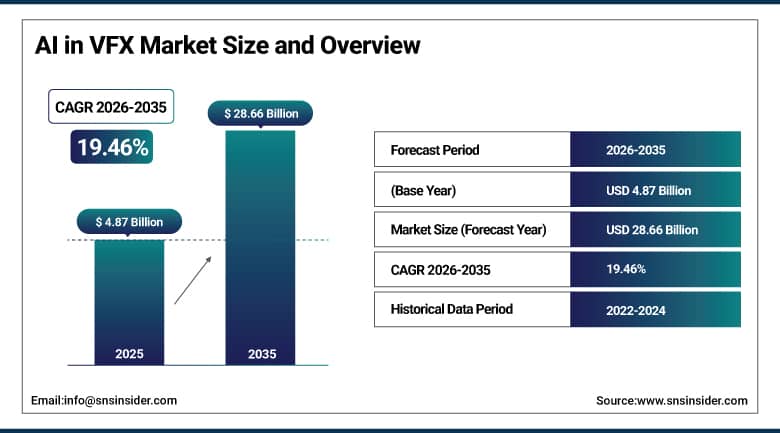
The AI in VFX Market was valued at USD 4.87 billion in 2025 and is expected to reach USD 28.66 billion by 2035, growing at a CAGR of 19.46% from 2026-2035.
AI in VFX Market is growing rapidly due to rising demand for high-quality visual content, automation of complex VFX workflows, and adoption of AI-powered tools in film, television, gaming, and advertising. Increasing investments in real-time rendering, cloud-based solutions, and immersive production technologies are accelerating efficiency, reducing costs, and enabling scalable creative output across global studios
For example, NVIDIA’s AI-driven Omniverse platform accelerates VFX rendering by 4× for films, including Disney productions, and is used by over 50,000 enterprises such as ILM and Weta Digital.
Adobe Firefly generative AI manages more than 1 billion VFX assets monthly, automating inpainting and compositing with up to 90% accuracy improvements in post-production workflows.
AI in VFX Market Size and Forecast
-
Market Size in 2025: USD 4.87 Billion
-
Market Size by 2035: USD 28.66 Billion
-
CAGR: 19.46% from 2026 to 2035
-
Base Year: 2025
-
Forecast Period: 2026–2035
-
Historical Data: 2022–2024
To Get more information On AI in VFX Market - Request Free Sample Report
AI in VFX Market Trends
-
Rising demand for high-quality visual effects in films, gaming, and advertising is driving the AI in VFX market.
-
Growing adoption of AI-powered tools for animation, rendering, and compositing is boosting production efficiency.
-
Expansion of cloud-based and real-time VFX solutions is enhancing collaboration and scalability.
-
Increasing focus on cost reduction, faster project turnaround, and creative flexibility is shaping adoption trends.
-
Advancements in deep learning, computer vision, and procedural generation are improving realism and visual storytelling.
-
Rising investment in film, gaming, and virtual production technologies is fueling market growth.
-
Collaborations between VFX studios, AI software developers, and entertainment companies are accelerating innovation and global adoption.
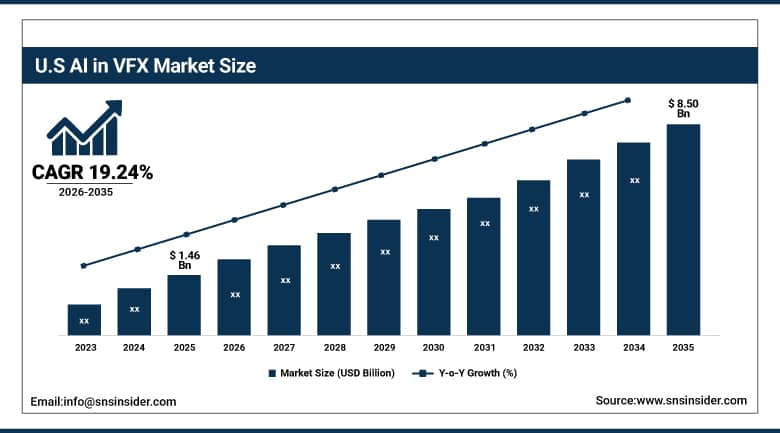
The U.S. AI in VFX Market was valued at USD 1.46 billion in 2025 and is expected to reach USD 8.50 billion by 2035, growing at a CAGR of 19.24% from 2026-2035.
U.S. AI in VFX Market is growing due to the presence of major studios, high adoption of AI-driven tools, advanced technological infrastructure, and increasing demand for high-quality content in film, television, gaming, and digital media.
For instance, AWS Thinkbox Deadline Cloud has helped Netflix reduce VFX rendering costs by 70% for U.S. productions through on-demand GPU scaling, enabling more efficient and flexible TV production pipelines.
AI in VFX Market Growth Drivers:
-
Expanding use of real-time rendering and virtual production technologies is increasing reliance on intelligent VFX automation tools
Real-time rendering and virtual production techniques are transforming how visual effects are created and integrated. AI enhances real-time environments by enabling intelligent lighting adjustments, physics-based simulations, character movement prediction, and dynamic scene generation. These capabilities allow directors and artists to visualize final outputs instantly during production. Growing adoption of game engines, virtual sets, and immersive production methods across film, television, and advertising is increasing demand for AI-enabled VFX workflows. Intelligent automation improves creative flexibility, reduces post-production dependency, and supports interactive storytelling, making AI a foundational technology within modern visual effects ecosystems.
For example, Unity’s real-time VFX Graph with ML integration supports dynamic character prediction in AR productions, reducing iteration times by 60% for advertising.
AWS Deadline Cloud automates scalable rendering for Netflix series, cutting costs by 70% via GPU clusters, while Autodesk Flow Production Tracking leverages AI for virtual set management, boosting workflow efficiency by 40% in Hollywood pipelines.
AI in VFX Market Restraints:
-
High implementation costs and infrastructure complexity are limiting widespread adoption of advanced artificial intelligence technologies among small studios
Deploying AI-based VFX solutions requires substantial investment in high-performance hardware, cloud infrastructure, software licenses, and skilled professionals. Smaller and mid-sized studios often struggle with these financial and technical barriers. AI models demand powerful GPUs, large datasets, and continuous system upgrades to maintain performance. Additionally, integrating AI tools into existing pipelines can disrupt workflows and increase short-term costs. Budget constraints and uncertain return on investment discourage many studios from fully adopting AI-driven VFX solutions, slowing overall market penetration despite clear long-term benefits.
For example, NVIDIA reports that Omniverse GPU requirements start at RTX 4090 (USD 1,600+) with A100 cloud instances costing USD 2.49/hour, totaling over USD 50K annually for continuous VFX training beyond most indie budgets.
Adobe Firefly enterprise licenses start at USD 4.14 per user/month, excluding specialized model training datasets valued at USD 100K+.
AWS Deadline Cloud GPU clusters can scale to USD 10K/month for complex renders, requiring DevOps expertise often scarce in studios with fewer than 20 artists.
AI in VFX Market Opportunities:
-
Integration of artificial intelligence with immersive technologies like AR VR and metaverse platforms is unlocking new creative possibilities
The convergence of AI with augmented reality, virtual reality, and metaverse environments is reshaping visual storytelling. AI-driven VFX enables real-time character animation, environment generation, and interactive visual experiences. As immersive platforms gain traction in entertainment, marketing, education, and virtual collaboration, demand for intelligent VFX solutions continues to rise. AI enhances realism, personalization, and interactivity within immersive worlds. This technological convergence opens new revenue streams for VFX studios and software providers, expanding applications beyond traditional film and gaming into emerging digital ecosystems.
For example, Meta’s Horizon Worlds uses AI for dynamic avatar generation, serving over 300,000 monthly active users with real-time VFX enhancements via Quest headsets.
Unity’s AR Foundation, powered by ML models, supports over 2 million AR projects, generating interactive scenes five times faster for marketing campaigns, while Epic Games’ Unreal Engine integrates AI-driven metaverse tools for advertising, enabling real-time scene adaptation across more than 10 million projects.
AI in VFX Market Segment Highlights
-
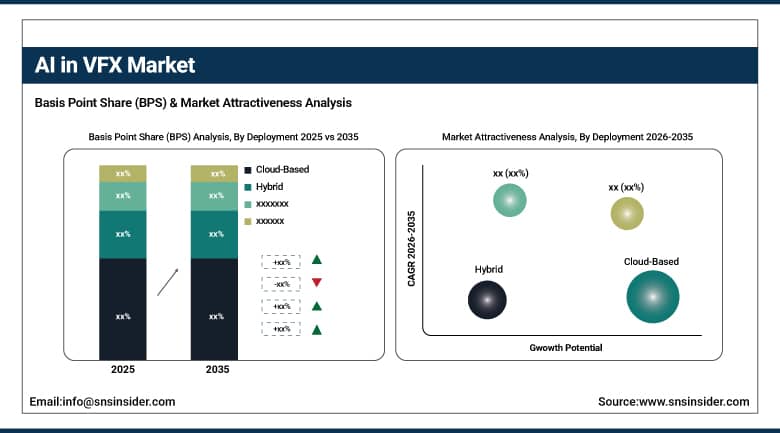
By Deployment, Cloud dominated with ~56% share in 2025; Cloud fastest growing (CAGR)
-
By End User, Visual Effects Studios dominated with ~32% share in 2025; Animation Studios fastest growing (CAGR)
-
By Technology, Deep Learning dominated with ~31% share in 2025; Motion Capture fastest growing (CAGR)
-
By Application, Film and Television dominated with ~35% share in 2025; Video Games fastest growing (CAGR)
AI in VFX Market Segment Analysis
By Deployment, Cloud deployment led the AI in VFX Market and is projected to grow at the fastest CAGR
Cloud segment dominated the AI in VFX Market in 2025 and is expected to grow at the fastest CAGR from 2026 to 2035 due to its scalability, flexibility, and cost-efficiency. Cloud-based AI solutions enable studios to access high-performance computing, large storage, and collaborative workflows without heavy upfront infrastructure investment. It supports real-time rendering, remote collaboration, and on-demand resource allocation, making it ideal for both large studios and emerging creators. This drives widespread adoption and rapid growth across the VFX industry.
By End User, Visual Effects Studios led the Market, while Animation Studios is expected to grow at the fastest CAGR
Visual Effects Studios segment dominated the AI in VFX Market in 2025 due to extensive use of artificial intelligence for rotoscoping, compositing, simulation, and rendering across high-budget projects. Large studios possess strong financial capacity, advanced infrastructure, and skilled talent, enabling early adoption of AI tools to enhance productivity, reduce timelines, and maintain cinematic quality standards.
Animation Studios segment is expected to grow at the fastest CAGR from 2026 to 2035 as increasing demand for animated content across streaming platforms, advertising, and gaming accelerates AI adoption. Artificial intelligence simplifies character animation, facial expressions, lip-syncing, and background generation, allowing studios to scale production efficiently while meeting rising global demand for animated storytelling.
By Technology, Deep Learning dominated the market, with Motion Capture projected to register the fastest growth
Deep Learning segment dominated the AI in VFX Market in 2025 because it delivers high accuracy in image recognition, facial animation, physics simulation, and scene reconstruction. Its ability to process large datasets enables realistic visual effects, automated asset creation, and predictive rendering, making deep learning models essential across complex VFX pipelines and premium production environments.
Motion Capture segment is expected to grow at the fastest CAGR from 2026 to 2035 due to rising demand for realistic character movements in films, games, and virtual productions. AI-enhanced motion capture reduces manual cleanup, improves real-time tracking accuracy, and supports immersive experiences, driving adoption across interactive and performance-driven visual content creation.
By Application, Film and Television held the largest share, while Video Games are expected to grow at the fastest CAGR
Film and Television segment dominated the AI in VFX Market in 2025 driven by massive content production, high visual complexity, and growing investments from studios and streaming platforms. Artificial intelligence accelerates post-production, enhances visual realism, and controls costs, making it indispensable for meeting tight release schedules and audience expectations.
Video Games segment is expected to grow at the fastest CAGR from 2026 to 2035 as real-time graphics, open-world environments, and immersive gameplay gain importance. AI-powered VFX supports dynamic animations, realistic physics, procedural environments, and real-time rendering, enabling developers to deliver visually rich, interactive experiences across platforms.
AI in VFX Market Regional Analysis
North America AI in VFX Market Insights
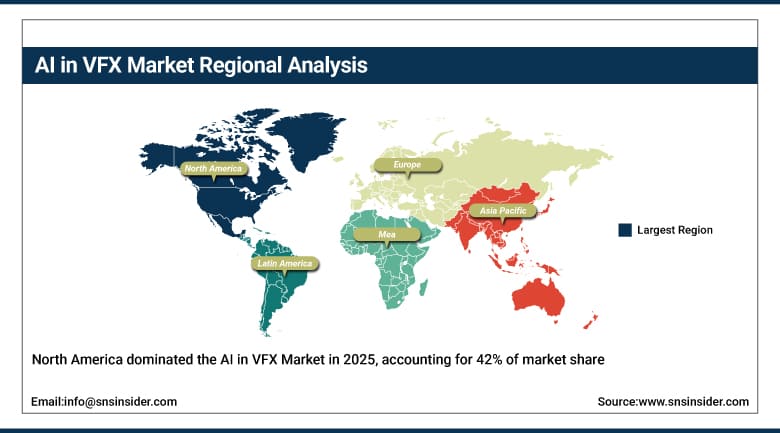
North America dominated the AI in VFX Market with the highest revenue share of about 42% in 2025 due to the presence of major VFX studios, advanced technological infrastructure, and strong investment in AI-driven production tools. The region benefits from a skilled workforce, high adoption of real-time rendering, and early integration of AI in visual effects pipelines. Continuous content demand from film, television, and gaming sectors further strengthens North America’s leading position in the market.
Get Customized Report as per Your Business Requirement - Enquiry Now
Asia Pacific AI in VFX Market Insights
Asia Pacific is expected to grow at the fastest CAGR of about 20.64% from 2026 to 2035 driven by rising investments in film, animation, and gaming industries, expanding digital content consumption, and increasing adoption of AI-powered VFX solutions. Emerging economies are enhancing infrastructure, promoting creative talent, and encouraging collaborations with global studios. Growing demand for cost-effective production, cloud-based workflows, and immersive experiences fuels rapid market expansion in the region.
Europe AI in VFX Market Insights
Europe held a significant position in the AI in VFX Market in 2025 due to the presence of established VFX studios, strong technological expertise, and supportive government initiatives promoting digital media. The region focuses on high-quality content production for film, television, and advertising. Increasing adoption of AI-driven tools for automation, real-time rendering, and visual effects enhancement, along with collaborations with global studios, contributes to steady market growth across Europe.
Middle East & Africa and Latin America AI in VFX Market Insights
Middle East & Africa and Latin America held growing positions in the AI in VFX Market in 2025 due to increasing investments in media, entertainment, and digital content production. Rising adoption of AI-powered VFX tools, collaborations with international studios, developing infrastructure, and cost-effective production capabilities are driving growth. Both regions are leveraging automation, real-time rendering, and enhanced visual effects workflows to meet the rising demand for high-quality content across film, gaming, and advertising sectors.
AI in VFX Market Competitive Landscape:
Adobe
Adobe is a leading creative software provider, offering industry-standard tools for digital media, including Photoshop, Premiere Pro, After Effects, and Adobe Experience Cloud. The company integrates AI-driven capabilities through Adobe Firefly and generative AI models to streamline content creation, enhance animation and VFX workflows, and enable predictive design. Adobe continuously innovates in creative technology, empowering creators and enterprises to accelerate production, deliver immersive experiences, and scale digital content efficiently.
-
2025 – Adobe launched AI workflow features in Premiere Pro 25.2 and After Effects 25.2, including Firefly-powered Generative Extend and advanced motion design tools at NAB 2025.
-
2024 – Adobe partnered with NVIDIA to co-develop generative AI models for Creative Cloud apps and integrated Firefly into workflows.
-
2023 – Adobe introduced AI-enhanced Creative Cloud tools, including Roto Brush AI and Firefly generative features, improving animation and VFX workflows.
Autodesk
Autodesk is a global leader in 3D design, engineering, and entertainment software, including Maya, Flame, and 3ds Max. The company integrates AI and generative tools to accelerate VFX, animation, and production workflows for creators, studios, and enterprise users. Autodesk focuses on accessibility with freemium tools, workflow automation, and AI-driven animation technologies, fostering innovation in creative industries and enabling efficient content generation at scale.
-
2025 – Autodesk launched freemium access to Autodesk Flow Studio, an AI-driven VFX and animation toolset, lowering barriers for creators.
-
2024 – Autodesk announced AI workflows and generative tools for artists in Maya and Flame at SIGGRAPH 2024.
-
2023 – Autodesk acquired Wonder Dynamics, bringing AI-powered automation for character animation and VFX into its ecosystem.
NVIDIA
NVIDIA is a leading technology company specializing in GPUs, AI platforms, and developer tools for graphics, gaming, and content creation. NVIDIA’s RTX AI ecosystem supports generative AI workflows, AI-driven digital humans, and foundation models for creators. The company empowers artists and developers with high-performance computing, microservices, and AI acceleration, enabling advanced content generation, simulation, and real-time VFX production across creative industries globally.
-
2025 – NVIDIA launched AI Foundation Models and NIM microservices for RTX AI PCs to accelerate generative AI workflows and digital humans in content creation.
Epic Games
Epic Games is a leading interactive entertainment company known for Unreal Engine, Fortnite, and ecosystem services for developers. The company integrates AI technologies to create realistic NPCs, voice interactions, and immersive metaverse experiences, supporting creators with tools for VFX, animation, and interactive content. Epic emphasizes open marketplaces, collaborative ecosystems, and generative AI workflows to enhance game development, digital storytelling, and cross-platform creative projects.
-
2025 – Epic Games revealed the Persona Device at State of Unreal 2025, enabling AI-driven NPCs with customizable personalities and voice interactions in Fortnite.
-
2024 – Epic launched Fab, a unified marketplace for stock 3D content, VFX, and materials to support creators.
AI in VFX Market Key Players
-
Adobe Inc.
-
Epic Games Inc.
-
NVIDIA Corporation
-
Foundry Visionmongers Ltd.
-
Weta Digital Ltd.
-
Framestore Ltd.
-
Industrial Light & Magic
-
Digital Domain Holdings Ltd.
-
Rodeo FX Inc.
-
BOT VFX
-
Blur Studio
-
Animal Logic Pty Ltd.
-
Metaphysic
-
Rebellion
-
Technicolor SA
-
Tippett Studio Inc.
-
Deep Voodoo
-
Wonder Dynamics
| Report Attributes | Details |
|---|---|
| Market Size in 2025 | USD 4.87 Billion |
| Market Size by 2035 | USD 28.66 Billion |
| CAGR | CAGR of 19.46% From 2026 to 2035 |
| Base Year | 2025 |
| Forecast Period | 2026-2035 |
| Historical Data | 2022-2024 |
| Report Scope & Coverage | Market Size, Segments Analysis, Competitive Landscape, Regional Analysis, DROC & SWOT Analysis, Forecast Outlook |
| Key Segments | • By End User(Visual Effects Studios, Production Companies, Animation Studios, Game Developers, Design Firms) • By Technology(Machine Learning, Deep Learning, Computer Vision, Natural Language Processing, Motion Capture) • By Application(Film and Television, Video Games, Architecture and Design, Advertising and Marketing, Medical and Scientific Visualization) • By Deployment(On-Premises, Cloud-Based, Hybrid) |
| Regional Analysis/Coverage | North America (US, Canada), Europe (Germany, UK, France, Italy, Spain, Russia, Poland, Rest of Europe), Asia Pacific (China, India, Japan, South Korea, Australia, ASEAN Countries, Rest of Asia Pacific), Middle East & Africa (UAE, Saudi Arabia, Qatar, South Africa, Rest of Middle East & Africa), Latin America (Brazil, Argentina, Mexico, Colombia, Rest of Latin America). |
| Company Profiles | Adobe Inc., Autodesk Inc., Epic Games Inc., NVIDIA Corporation, Foundry Visionmongers Ltd., Weta Digital Ltd., Framestore Ltd., Industrial Light & Magic, Pixomondo, Digital Domain Holdings Ltd., Rodeo FX Inc., BOT VFX, Blur Studio, Animal Logic Pty Ltd., Metaphysic, Rebellion, Technicolor SA, Tippett Studio Inc., Deep Voodoo, Wonder Dynamics |
Frequently Asked Questions
North America dominated the AI in VFX Market in 2025 due to major studios, advanced infrastructure, skilled workforce, and high adoption of AI tools.
Visual Effects Studios segment dominated the AI in VFX Market in 2025.
Rising demand for high-quality visual effects, automation of complex workflows, real-time rendering, and cloud-based solutions are key growth drivers.
The AI in VFX Market was valued at USD 4.87 billion in 2025, reflecting increasing use of AI-powered VFX tools and automation.
North America dominated the AI in VFX Market in 2025 due to major studios, advanced infrastructure, skilled workforce, and high adoption of AI tools
