
Ambient Light Sensor Market Report Scope & Overview:
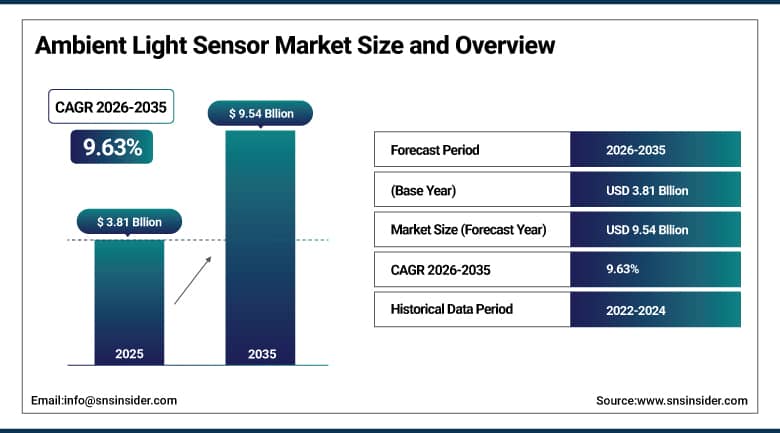
The Ambient Light Sensor Market was valued at USD 3.81 billion in 2025 and is expected to reach USD 9.54 billion by 2035, growing at a CAGR of 9.63% from 2026–2035.
The ambient light sensor market is witnessing steady growth in the global market owing to rising demand for smart devices. Increasing adoption of smartphones and tablets is boosting integration. Growing automotive interior lighting systems are supporting market expansion. Manufacturers are focusing on energy efficient display optimization technologies. Rising demand for IoT and connected devices is driving innovation. Increasing use in consumer electronics and automotive applications is further accelerating market adoption.
According to the ITU and OECD digital economy indicators, smartphone penetration is over 85% in developed nations, with more than 6.9 billion mobile subscriptions globally as of 2025, resulting in widespread adoption of ambient light sensors in display optimization technologies. According to the IEA building efficiency data, intelligent lighting systems can cut down the electricity usage by 10-20% in commercial buildings via automatic light adjustment. The U.S. Department of Energy states that occupancy and light-sensing controls have already been deployed in over 60% of new commercial building constructions in developed countries.
To Get More Information On Ambient Light Sensor Market - Request Free Sample Report
Ambient Light Sensor Market Trends
-
Widespread acceptance of smartphones, tablets, and wearable devices is leading to higher use of ambient light sensors for automatic dimming.
-
Increased emphasis on energy-saving devices is encouraging vendors to integrate low-energy sensors into consumer electronics products around the world.
-
Rapid growth of the IoT system and connectivity of devices is fueling the use of ambient light sensors in smart applications.
-
Higher acceptance of electric vehicles and autonomous vehicles is fueling the adoption of intelligent lights and cabin control systems.
-
Growing interest in passenger comfort and safety is fostering the use of ambient light sensors in automobile infotainment systems.
-
Increased government encouragement to adopt EVs and smart mobility solutions is propelling long-term growth prospects for sensor vendors worldwide.
U.S. Ambient Light Sensor Market Outlook
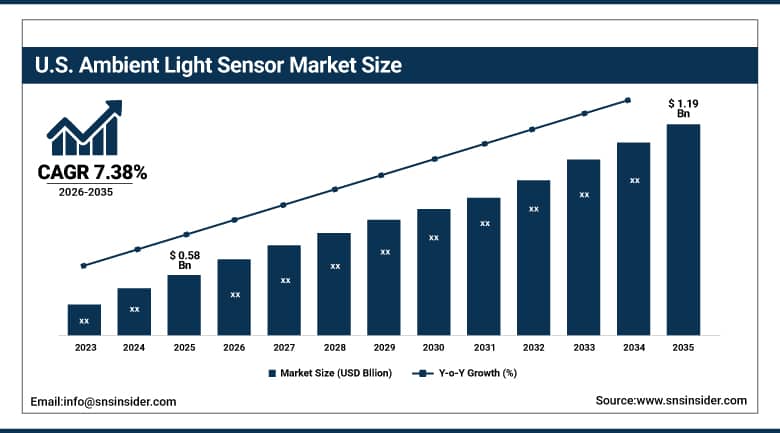
The U.S. Ambient Light Sensor Market was valued at USD 0.58 billion in 2025 and is expected to reach around USD 1.19 billion by 2035, growing at a CAGR of 7.38% from 2026–2035.
The U.S. ambient light sensor market is expanding steadily owing to strong demand for smart electronics. Increasing penetration of smartphones and wearable devices is supporting market growth. Rising adoption of advanced automotive lighting systems is driving application expansion. Growth in IoT enabled devices is further accelerating demand. Manufacturers are focusing on miniaturized and energy efficient sensor technologies. Increasing integration in consumer electronics and automotive systems is strengthening market penetration.
According to the U.S. Department of Energy and NIST Semiconductor Reporting, ambient light sensors have been integrated into consumer electronic devices such as mobile phones and computers at more than 95% worldwide level for automatic brightness adjustment. On the other hand, according to the ENERGY STAR initiative of the U.S. Environmental Protection Agency, the use of such sensor-based systems in building construction will result in energy savings of 20% to 60%.
Ambient Light Sensor Market Segment Analysis
-
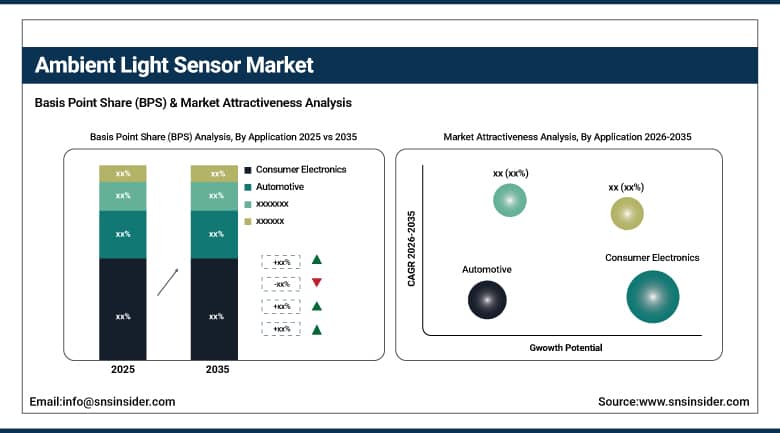
By Application, consumer electronics dominated the market with 61.42% share in 2025; while automotive is the fastest growing segment with CAGR of 13.97% during 2026 to 2035.
-
By Sensor Type, photodiode dominated the market with 58.33% share in 2025; while phototransistor is the fastest growing segment with CAGR of 16.25% during 2026 to 2035.
-
By Technology, digital dominated the market with 71.26% share in 2025 and it is also fastest growing segment with CAGR of 9.73% during 2026 to 2035.
-
By End Use, residential dominated the market with 54.63% share in 2025; while industrial is the fastest growing segment with CAGR of 17.14% during 2026 to 2035.
By Application, consumer electronics dominated the ambient light sensor market, while automotive is the fastest growing segment.
The Consumer Electronics segment held the dominated share of revenues in the ambient light sensor market in 2025 owing to extensive usage in smartphones, tablets, laptops and wearable devices. Growing preference for automatic brightness adjustment and energy efficiency of displays is adding impetus to its growth. Increasing penetration of IoT enabled consumer devices is also aiding the segment's growth. Miniaturization of sensors and cost-effective manufacturing processes are leading to their extensive use among consumer electronics manufactures around the world.
The Automotive segment is estimated to be the fastest growing segment during 2026-2035 due to increasing adoption of ADAS and smart lighting solutions in the automotive sector. Increasing requirement for automatic headlamp control, dashboard brightness control and cabin user comfort is increasing their usage in the segment. Growth in electric vehicles and autonomous driving capabilities is aiding the growth of the segment. Increasing focus on energy efficient lighting and enhanced safety features is adding impetus to their growth.
By Sensor Type, photodiode dominated the ambient light sensor market, while phototransistor is the fastest growing segment.
Photodiode segment accounted for the dominated revenue share of the ambient light sensor market in 2025. The key factor contributing to the success is the higher accuracy, faster response time, and low power consumption. Photodiodes are extensively used in smartphones, tablets, and automotive displays due to their ability to detect ambient light accurately. Reliability and cost effectiveness are the other factors responsible for the dominance of photodiodes in the market.
Phototransistor segment is anticipated to witness the fastest CAGR during the forecast period from 2026 to 2035. Key factors driving the growth of phototransistor segment include rising application in consumer electronics and smart devices. Higher sensitivity and amplification capacity of the phototransistors drive the segment. Growing demand for IoT-based products and automotive lights systems propels the growth of the segment. Manufacturers focus on development of miniaturized sensors.
By Technology, digital dominated the ambient light sensor market and is also the fastest growing segment.
The Digital segment is the dominated in terms of revenue and holds the biggest share in 2025. Its large size can be attributed to its wide usage in smartphones, tablets, laptops and automotive displays. Growth in demand for Automatic Brightness Control and energy-efficient screens is enhancing the deployment. Moreover, the increasing usage of the Internet of Things (IoT) based smart devices and systems is helping to increase demand further. Digital sensors are preferred by manufacturers because of better accuracy, smaller size and easy integration.
The digital segment is projected to witness the fastest CAGR between 2026 and 2035 because of the rising adoption of advanced systems in the automotive sector and consumer electronics industry. The increasing demand for AI-based devices and ecosystems is fueling the growth. The high accuracy, low power requirement and real-time response offered by these sensors is enhancing their usage.
By End Use, residential dominated the ambient light sensor market, while industrial is the fastest growing segment.
The residential sector led the Vitreoretinal Surgery Devices market with the dominated revenue share in 2025, owing to the increasing trend towards home-based post-surgical treatment of the eye condition. The increasing number of aging populations along with the high prevalence rate of retinal disease conditions is adding to the demand for advanced and minimally invasive surgery devices. The growing ophthalmic infrastructure in the outpatient setting is also fueling the adoption in developed healthcare systems across the globe.
The industrial sector is anticipated to register the fastest CAGR between 2026 and 2035, attributed to increasing automation and R&D activities in the industry. The rapid growth in the number of laboratories and advanced testing facilities for ophthalmic studies is driving the demand for advanced and accurate instruments. The increasing adoption of automated quality control systems in the manufacture of medical devices is aiding in the penetration of the industry in emerging markets.
Regional Analysis
|
Region |
Major Country |
Share within Region, 2025(%) |
|---|---|---|
|
North America |
United States |
61.85% |
|
Europe |
Germany |
27.20% |
|
Asia Pacific |
China |
43.80% |
|
Middle East & Africa |
UAE |
17.60% |
|
Latin America |
Brazil |
47.30% |
Asia Pacific Ambient Light Sensor Market Insights.
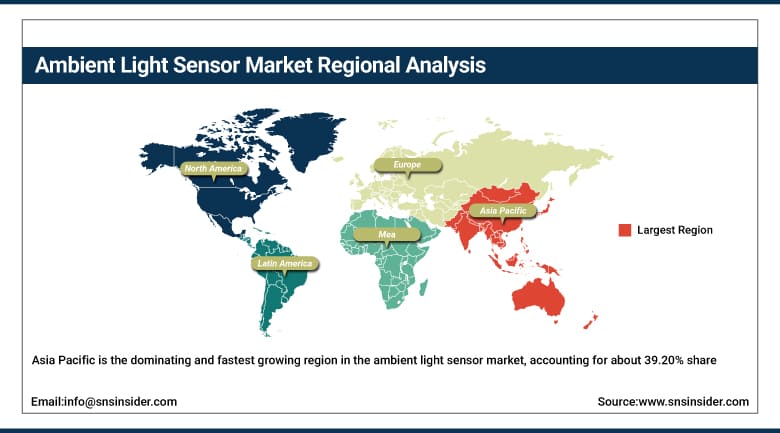
Asia Pacific is the dominating and fastest growing region in the ambient light sensor market, accounting for about 39.20% share and registering a CAGR of about 11.30% during 2026–2035. Rapid industrialization and rising smartphone production are driving strong demand across China, India, Japan, South Korea, and Southeast Asia. Expanding consumer electronics manufacturing and export activities are boosting market growth. Increasing adoption of smart devices and automotive electronics is further accelerating demand. Growth in semiconductor fabrication hubs is supporting large scale supply expansion.
According to data reflected in the ITU ICT Development Index 2025 and regional telecom insights, the APAC region commands the largest global share of smartphone subscriptions, with smartphone penetration rates scaling past 80% in advanced economies like China, South Korea, and Japan. Furthermore, global semiconductor market data shows that Asia-Pacific commands nearly 60% of the total global semiconductor revenue demand, a massive volume heavily driven by its robust consumer electronics manufacturing hub alongside expanding automotive and AI infrastructure segments.
Get Customized Report as Per Your Business Requirement - Enquiry Now
North America Ambient Light Sensor Market Insights.
North America ambient light sensor market in 2025 is driven by strong demand from consumer electronics and automotive applications. The region benefits from advanced semiconductor manufacturing capabilities and high adoption of smart devices. Increasing integration of sensors in smartphones and wearable devices is significantly strengthening product penetration. Expansion of automotive ambient lighting systems is accelerating demand. A strong focus on IoT enabled technologies further reinforces market growth across the region.
As per the Manufacturing & Electronics indicators released by the U.S. Department of Energy and the U.S. Census Bureau, North America is a leading market in terms of global semiconductor design and sophisticated sensor integration, accounting for more than 90% of American households using smart gadgets that have ambient light sensing capabilities in order to perform display and power management functions in 2025. According to ENERGY STAR, the smart lighting system equipped with automatic brightness control features can cut down lighting energy consumption by up to 35%.
Europe Ambient Light Sensor Market Insights.
Europe ambient light sensor market is characterized by stable growth in 2025 owing to strong demand for energy efficient and automotive smart systems. Key countries include Germany, France, United Kingdom, and Italy. Rising preference for connected vehicles and smart lighting systems is driving adoption. Increasing focus on energy saving regulations is boosting demand. Growth in industrial automation and consumer electronics sectors is further supporting market expansion. Strict EU semiconductor and sustainability regulations are encouraging innovation in sensor technologies.
As per the European Commission’s 2025 eco-design regulations mandate for smartphones and tablets, integration of digital ambient light sensors is accelerating to optimize display energy efficiency. Globally, the digital ambient light sensor segment leads the market with a 58% share, driven by its precision and compatibility with modern OLED displays. While North America commands the largest regional footprint at 31.3%, European adoption is heavily driven by German automotive adaptive systems. These specialized components drastically improve environmental lux detection accuracy while reducing device display power consumption by 15% or more
Middle East & Africa and Latin America Ambient Light Sensor Market Insights.
The Middle East & Africa along with Latin America regions are witnessing steady growth due to rising smartphone penetration and automotive digitization. Key contributing countries include Brazil, Mexico, UAE, Saudi Arabia, and South Africa. Increasing demand for smart consumer electronics is driving adoption. Growth in automotive infotainment systems and wearable devices is further supporting market expansion. Rising retail penetration and imported electronics are boosting regional demand.
According to ITU and World Bank data, active mobile internet usage exceeds 70% in Latin America and sits near 50% in Sub-Saharan Africa, driving smart device adoption. The IEA notes that while LEDs dominate global sales, expanding sensor-driven efficient lighting remains a priority for emerging economies. This transition is highly concentrated by demographic trends; UN DESA statistics show that Latin America is over 80% urbanized, compared to roughly 43% in Africa, accelerating the regional demand for connected urban infrastructure.
Market Dynamics
Growth Drivers: Smart device penetration and increasing demand for automatic brightness control in consumer electronics and displays.
The increasing use of smartphones, tablets, wearables, and smart televisions is increasingly contributing to the adoption of ambient light sensors. The sensors aid in optimizing the brightness of screens and ensuring efficiency in battery life. An increasing demand for energy-efficient devices is contributing to the adoption of ambient light sensors in consumer electronic products. Increasingly, manufacturers are integrating compact low-power sensors in new devices. Growth of the IoT ecosystem is also contributing to widespread adoption.
According to the GSMA Mobile Economy reports, there are over 5.8 billion unique mobile subscribers globally, representing roughly 70% of the world’s population. Parallel hardware data shows that to optimize power grids and maximize battery efficiency, ambient light sensors for adaptive brightness control have become a near-universal hardware standard in smartphones. Furthermore, reflecting global digital acceleration, the OECD Digital Economy Outlook highlights that over 90% of member countries have now deployed unified national digital strategies to govern green technology and connected consumer markets.
Restraints: Interference from external light conditions and performance limitations in extreme environmental settings.
The use of ambient light sensors has been hindered by the problem of inaccuracies caused by reflection and shadowing and fast-changing light sources. Inaccuracy brought about by poor performance in outdoor conditions hampers their use in automobiles and industrial settings. Inaccuracies in the reading of ambient light could be caused by dust and temperature differences, which lower the effectiveness of the sensors. The calibration problem makes it hard to have consistent output from various sensors.
Opportunities: Rising adoption of advanced automotive electronics and electric vehicles creating new sensor deployment opportunities.
The need for smart lighting and interior control in electric cars and autonomous vehicles calls for highly sophisticated sensors. Ambient light sensors are critical in adapting the dashboard light and energy-saving lighting control. The increasing interest in improving passenger comfort and safety is encouraging their usage in premium automobiles. With rising digitalization and entertainment systems in automobiles, applications are broadening. Support from governments to promote the use of EVs is fueling their demand. There lies great growth potential for sensor companies in the coming years.
Driven by UNECE frameworks under the European General Safety Regulation, advanced driver assistance systems are now equipped on over 80% of modern European passenger cars. In parallel, NHTSA monitoring confirms that sensor-based crash avoidance technologies are standard on over 95% of new U.S. light vehicles. These converging global safety mandates directly drive the automotive demand for ambient light sensors to dynamically regulate adaptive headlights, high-efficiency digital cockpit displays, and cabin environment systems.
Recent Developments
-
2026: ams-OSRAM AG launched the AS6223 poppy-seed-sized temperature sensor for continuous health monitoring in wearable smart devices.
-
2025: Analog Devices, Inc. announced the OpenGMSL Association in June to revolutionize future in-vehicle connectivity and high-speed data transmission.
-
2025: Infineon Technologies AG acquired Marvell Technology’s automotive Ethernet division for $2.5 billion to strengthen its networking portfolio. 2024: ROHM Co., Ltd. successfully launched the industry’s smallest CMOS operational amplifier to support advanced miniaturization in electronics.
Ambient Light Sensor Market Key Players are:
-
ams-OSRAM AG
-
Analog Devices, Inc.
-
Broadcom Inc.
-
NXP Semiconductors N.V.
-
STMicroelectronics N.V.
-
Infineon Technologies AG
-
ON Semiconductor Corporation
-
Texas Instruments Incorporated
-
Vishay Intertechnology, Inc.
-
Sharp Corporation
-
ROHM Co., Ltd.
-
Everlight Electronics Co., Ltd.
-
Lite-On Technology Corporation
-
Melexis NV
-
Renesas Electronics Corporation
-
Silicon Laboratories Inc.
-
Microchip Technology Inc.
-
Bourns, Inc.
-
Omron Corporation
-
Honeywell International Inc
Ambient Light Sensor Market Report Scope:
| Report Attributes | Details |
|---|---|
| Market Size in 2025 | USD 3.81 Billion |
| Market Size by 2035 | USD 9.54 Billion |
| CAGR | CAGR of 9.63% From 2026 to 2035 |
| Base Year | 2025 |
| Forecast Period | 2026-2035 |
| Historical Data | 2022-2024 |
| Report Scope & Coverage | Market Size, Segments Analysis, Competitive Landscape, Regional Analysis, DROC & SWOT Analysis, Forecast Outlook |
| Key Segments | • By Application (Consumer Electronics, Automotive, Others) • By Sensor Type (Photodiode, Photoresistor, Phototransistor) • By Technology (Analog, Digital) • By End Use (Residential, Commercial, Industrial, Others) |
| Regional Analysis/Coverage | North America (US, Canada), Europe (Germany, UK, France, Italy, Spain, Russia, Poland, Rest of Europe), Asia Pacific (China, India, Japan, South Korea, Australia, ASEAN Countries, Rest of Asia Pacific), Middle East & Africa (UAE, Saudi Arabia, Qatar, South Africa, Rest of Middle East & Africa), Latin America (Brazil, Argentina, Mexico, Colombia, Rest of Latin America). |
| Company Profiles | ams-OSRAM AG, Analog Devices, Inc., Broadcom Inc., NXP Semiconductors N.V., STMicroelectronics N.V., Infineon Technologies AG, ON Semiconductor Corporation, Texas Instruments Incorporated, Vishay Intertechnology, Inc., Sharp Corporation, ROHM Co., Ltd., Everlight Electronics Co., Ltd., Lite-On Technology Corporation, Melexis NV, Renesas Electronics Corporation, Silicon Laboratories Inc., Microchip Technology Inc., Bourns, Inc., Omron Corporation, Honeywell International Inc. |

Frequently Asked Questions
The ambient light sensor market was valued at USD 3.81 billion in 2025.
The consumer electronics segment dominated the market in 2025 due to widespread use in smartphones laptops tablets and wearable devices globally.
The major growth factors include rising adoption of smartphones tablets and wearable devices increasing demand for automatic brightness control energy efficient displays automotive lighting systems IoT expansion and smart sensor integration globally.
