
Automatic Pill Dispenser Market Report Scope & Overview:
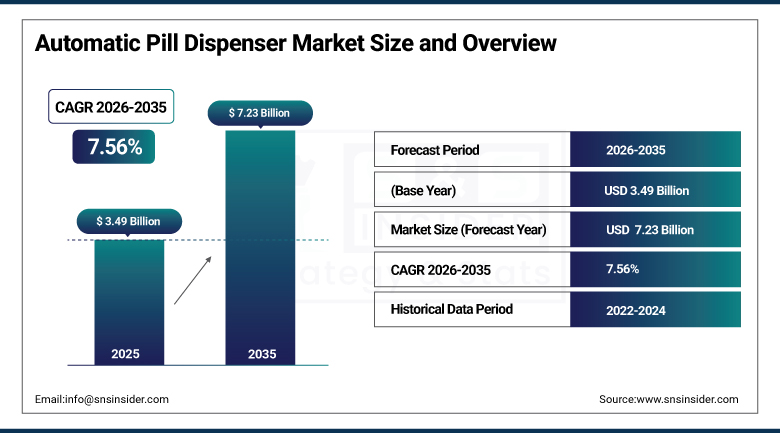
The Automatic Pill Dispenser Market was valued at USD 3.49 Billion in 2025 and is expected to reach USD 7.23 Billion by 2035, growing at a CAGR of 7.56% from 2026-2035.
The Automatic Pill Dispenser Market growth is being driven primarily by an aging global population with rising rates of polypharmacy, growing prevalence of dementia and other neurodegenerative disorders that compromise medication self-management, and expanding adoption of telehealth and remote patient monitoring that relies on connected dispensing devices to verify adherence. Hospitals continue to deploy centralized and decentralized automated dispensing cabinets to reduce medication errors and improve inpatient safety, while home healthcare providers and family caregivers increasingly turn to smart, IoT-enabled dispensers that send real-time adherence alerts. Continued integration of artificial intelligence into predictive dispensing, growing payer support for out-of-hospital chronic care, and rising manufacturer investment in cloud-connected caregiver platforms are collectively reinforcing this market's position as a durable, technology-led segment of the wider medication management industry.
In December 2025, when Omnicell, Inc. announced the launch of Omnicell Titan XT, a transformational, enterprise version of its automated dispensing systems powered by the company's OmniSphere cloud platform. The launch was designed to deliver greater pharmacy control and nursing confidence as part of Omnicell's broader roadmap toward a fully connected, autonomous medication management ecosystem spanning nursing floors and additional care areas.
To Get more information On Automatic Pill Dispenser Market - Request Free Sample Report
Automatic Pill Dispenser Market Trends
- Growing integration of artificial intelligence into predictive dispensing and adherence forecasting platforms.
- Rising adoption of smart, IoT-enabled home dispensers offering real-time caregiver adherence tracking.
- Expanding deployment of high-capacity automated dispensing systems within academic medical centers.
- Increasing manufacturer focus on cloud-connected platforms unifying hospital and home medication management.
- Rising demand for modular dispenser systems supporting complex, multi-medication dosing schedules.
U.S. Automatic Pill Dispenser Market Outlook
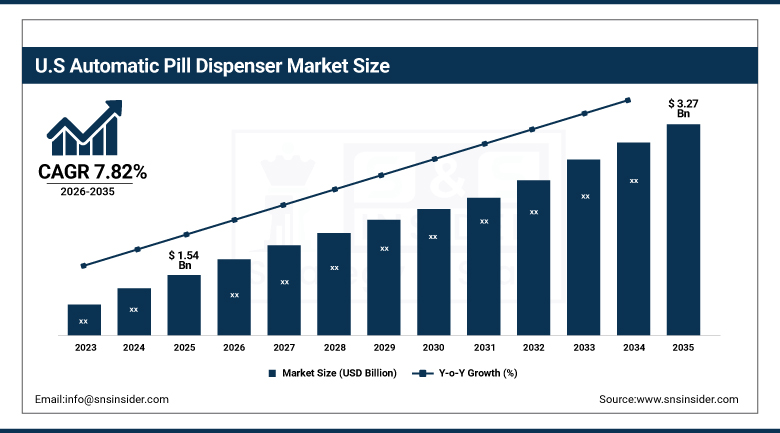
The U.S. Automatic Pill Dispenser Market was valued at USD 1.54 Billion in 2025 and is expected to reach USD 3.27 Billion by 2035, growing at a CAGR of 7.82% from 2026-2035.
The U.S. Automatic Pill Dispenser Market growth continues to be reinforced by a large and growing population of older adults managing multiple chronic conditions, rising caregiver reliance on remote monitoring technology, and continued hospital investment in automated dispensing cabinets to meet regulatory expectations for medication safety. Home-focused device makers continue to expand subscription-based dispenser offerings bundled with caregiver mobile applications, while institutional suppliers deepen partnerships with health systems seeking to standardize dispensing technology across multiple facilities. Growing insurer and Medicare Advantage interest in covering adherence technology as a chronic care management tool further supports domestic market expansion, positioning U.S. suppliers to serve an increasingly broad mix of institutional and home-based customers nationwide.
In January 2024, Hero Health, Inc. partnered with AARP to offer exclusive discounts on its smart automatic pill dispenser, a device that stores, sorts, and dispenses medications while providing reminders and personalized adherence reports to both patients and caregivers. The partnership was designed to broaden access to medication adherence technology among aging Americans through AARP's extensive member network.
Automatic Pill Dispenser Market Segment Analysis
- By Type, the Centralized Automated Dispensing Systems segment dominated the Automatic Pill Dispenser Market with approximately 64.73% share in 2025, while the Decentralized/Smart Home Dispensers segment is the fastest growing with a CAGR of approximately 9.00%.
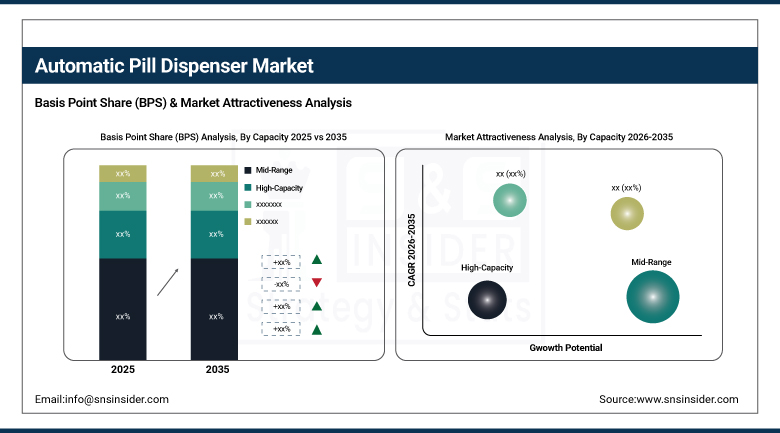
- By Capacity, the Mid-Range segment dominated the Automatic Pill Dispenser Market with approximately 44.13% share in 2025, while the High-Capacity segment is the fastest growing with a CAGR of approximately 10.33%.
- By Technology, the Electronic-Alarm segment dominated the Automatic Pill Dispenser Market with approximately 42.24% share in 2025, while the AI-Assisted Predictive segment is the fastest growing with a CAGR of approximately 11.78%.
- By Application, the Hospital Pharmacies segment dominated the Automatic Pill Dispenser Market with approximately 71.53% share in 2025, while the Home Healthcare segment is the fastest growing with a CAGR of approximately 11.57%.
- By Distribution Channel, the Pharmacy Chains segment dominated the Automatic Pill Dispenser Market with approximately 41.77% share in 2025, while the Online Retail segment is the fastest growing with a CAGR of approximately 9.35%.
By Type, Centralized Automated Dispensing Systems Dominates the Automatic Pill Dispenser Market and Decentralized Dispensers Grows Fastest
Centralized Automated Dispensing Systems will continue to be the leading type in the Automatic Pill Dispenser Market owing to their widespread presence at hospitals and institutional pharmacies, which demand high-capacity and secure storage of medications from a single location. Centralized systems enjoy a long history of compatibility with hospital pharmacies' inventory management processes, and this makes them the standard equipment specification in such facilities.
Decentralized dispensers have emerged as the most rapidly growing type, riding on the rising demand for patient proximity-based medication management, not just at decentralized locations in hospitals but even in homes. With payers now backing up chronic disease treatment outside hospitals, decentralized dispensers will be geared toward portable connected devices, making them a challenge to central dispensers' dominance in the forecast period.
By Capacity, Mid-Range Dominates the Automatic Pill Dispenser Market and High-Capacity Grows Fastest
Mid-range units remain the dominant capacity category within the Automatic Pill Dispenser Market, characterized by their balance of storage volume and cost that suits the majority of community hospitals and mid-sized care facilities. This segment benefits from broad compatibility with standard pharmacy workflows, reinforcing mid-range units as the practical default across most institutional deployments.
High-capacity machines are emerging as the fastest-growing capacity category, driven by academic medical centers and large integrated health systems consolidating multi-site medication distribution into centralized, high-volume hubs. As these institutions prioritize operational efficiency at scale, this segment focuses on maximizing storage density and throughput, positioning high-capacity systems to capture a growing share of large-facility procurement, particularly as multi-hospital networks standardize on a single dispensing platform across their affiliated campuses.
By Technology, Electronic-Alarm Dominates the Automatic Pill Dispenser Market and AI-Assisted Predictive Grows Fastest
Electronic-alarm dispensers have been the leading technology segment in the Automatic Pill Dispenser Market owing to their reliable performance along with simple reminder capabilities that make it suitable for the largest number of patients. In addition, such technology is affordable compared to other sophisticated solutions; thus, the electronic-alarm segment helps maintain the position of this technology as the easiest way to use automatic pill dispensers both institutionally and domestically.
AI-assisted predictive dispensers have become the fastest-growing technology segments due to the rising interest among caregivers and medical professionals in devices capable of predicting the cases of medication non-adherence and helping to avoid adverse health outcomes. The development of machine learning models will contribute to the provision of personalized forecasts of adherence; thus, the adoption of AI-assisted automatic dispensers will continue to increase both institutionally and at home.
By Application, Hospital Pharmacies Dominates the Automatic Pill Dispenser Market and Home Healthcare Grows Fastest
Hospital pharmacies remain the dominant application within the Automatic Pill Dispenser Market, reflecting systemic efforts to reduce medication errors and improve inpatient safety across acute care facilities. This segment benefits from regulatory and accreditation pressure that continues to push hospitals toward automated dispensing as a standard of care, reinforcing hospital pharmacies as the largest application category by a wide margin.
Home healthcare is emerging as the fastest-growing application, driven by expanding telehealth adoption and payer willingness to reimburse adherence technology as part of chronic care management programs. As care delivery continues shifting outside traditional facility walls, this segment focuses on caregiver-facing mobile applications and remote monitoring integration, positioning home healthcare to close the gap with institutional application settings as reimbursement pathways for adherence technology continue to mature across major payers.
By Distribution Channel, Pharmacy Chains Dominates the Automatic Pill Dispenser Market and Online Retail Grows Fastest
Pharmacy chains continue to dominate the distribution channel for the Automatic Pill Dispenser Market owing to their well-established relationship with the manufacturer and extensive network that facilitates the sale through institutional as well as consumer channel. The distribution channel is favored owing to the recommendation made by pharmacists for these devices to the patients. Online retail has emerged as the fastest-growing distribution channel owing to the subscription model where the devices are sold to consumers along with the software as well as customer service.
This channel is primarily focused on the easy purchase and delivery at consumers' homes through the direct marketing by device manufacturers to the caregiver and children of aged patients. With more and more adult children managing the purchase of such devices for their elderly parents, the online retail distribution channel has the potential to gain market share among the consumer channels.
Regional Analysis
|
Region |
Major Country |
Share within Region, 2025 (%) |
|
North America |
United States |
90.10% |
|
Europe |
Germany |
30.60% |
|
Asia Pacific |
China |
38.60% |
|
Latin America |
Brazil |
36.60% |
|
Middle East & Africa |
United Arab Emirates |
32.60% |
North America Automatic Pill Dispenser Market Insights
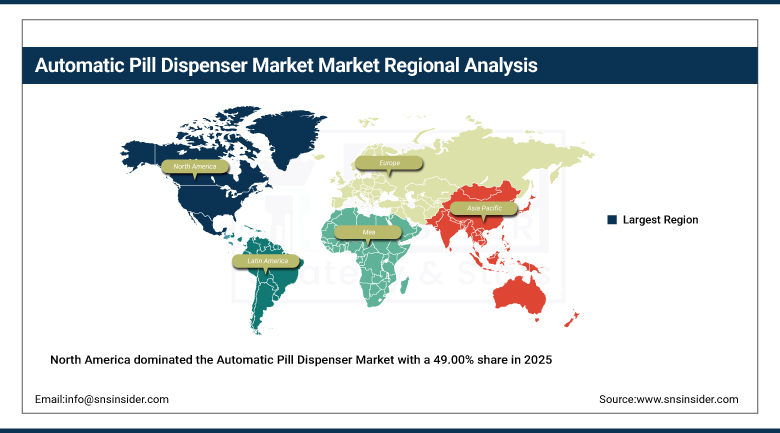
North America dominated the Automatic Pill Dispenser Market with a 49.00% share in 2025. The region's leadership is underpinned by a large aging population with high rates of polypharmacy, well-established hospital automation infrastructure, and strong payer support for remote patient monitoring and chronic care management programs. The United States shapes the substantial majority of regional demand, supported by a dense concentration of both institutional device manufacturers and direct-to-consumer smart dispenser brands.
Canada contributes additional regional demand, driven by comparable demographic pressures and provincial health system investment in hospital medication safety technology. Continued growth in Medicare Advantage coverage for adherence technology and ongoing hospital automation upgrades are expected to keep the region in the lead through the forecast period, even as growth in percentage terms trails faster-scaling markets in Asia Pacific expanding hospital infrastructure from a considerably smaller existing base.
Get Customized Report as per Your Business Requirement - Enquiry Now
Asia Pacific Automatic Pill Dispenser Market Insights
Asia Pacific is projected to be the fastest-growing region, registering a CAGR of 9.07% during 2026-2035, supported by rapidly expanding hospital infrastructure, rising healthcare expenditure, and a fast-growing elderly population across the region's largest economies. China anchors a substantial share of regional activity, combining large-scale hospital construction with growing domestic manufacturing capacity for both institutional and home dispensing devices.
Japan contributes significant additional regional depth given its exceptionally high proportion of elderly residents and well-established culture of adopting assistive medical technology, while India and South Korea add further scale through expanding private hospital networks and growing consumer awareness of home medication management devices. Continued regional investment in hospital automation and aging-in-place technology further reinforces Asia Pacific's position as the fastest-growing global market for automatic pill dispensers.
Europe Automatic Pill Dispenser Market Insights
Europe represents a significant portion of the global market due to publicly financed health systems which continuously spend on hospital automation to minimize errors related to medication and comply with patient safety regulations. Germany drives regional demand with its extensive network of hospitals as well as its focus on pharmaceutical safety standards, aided by an established set of institutions providing automation equipment for both government-owned and privately owned hospitals.
The United Kingdom and France make notable additions to regional demand with the NHS and French public hospitals increasingly deploying automated dispensing cabinets for medication safety efforts. The continued push in Europe towards aging in place policies ensures that there is consistent demand for adherence technology in homes, especially among Nordic nations which are currently experimenting with distributing connected dispensers publicly for the elderly population residing alone.
MEA & Latin America Automatic Pill Dispenser Market Insights
The Middle East & Africa region continues to grow in strategic importance, with demand concentrated in Gulf Cooperation Council markets such as the United Arab Emirates and Saudi Arabia, where large-scale hospital construction projects increasingly specify automated dispensing systems as standard infrastructure. South Africa anchors demand on the African continent, supported by its comparatively more developed private hospital sector and a growing base of urban pharmacy chains introducing automated dispensing as a differentiated service offering.
Latin America's market is anchored by Brazil, which accounts for the majority of regional demand on the strength of its large public and private hospital network and growing adoption of automated dispensing cabinets in urban medical centers. Mexico contributes additional regional volume as private hospital operators increasingly invest in medication safety technology to meet accreditation standards.
Market Dynamics
Growth Drivers: Aging Population and Telehealth Integration
The increase in aging population and hence the increase in polypharmacy is the key factor driving growth as more elderly people suffer from several chronic illnesses thus making it important for them to have structured and automated tools to enable them to take their medicines correctly. Additionally, there is an increase in the number of people suffering from dementia and other neurological diseases that significantly impair the ability of the patient to manage complicated medication regimes without the help of technology.
Increasing use of telemedicine and remote patient monitoring forms another key factor contributing to growth as connected dispensers become increasingly a source of evidence on adherence for telemedicine programs. Increase in the investments made by hospitals in automated dispensers to minimize medicine administration errors and ensure safety of the patient is also a key growth factor for the market.
Restraints: High Device Costs and Integration Complexity
High upfront device and subscription costs represent a significant restraint, as many smart home dispensers carry recurring monthly fees that can strain the budgets of elderly patients on fixed incomes, limiting adoption despite documented adherence benefits. This dynamic particularly affects lower-income households, where the value proposition of adherence technology must compete against more immediate financial priorities.
Integration complexity within institutional settings presents a further restraint, as hospitals deploying centralized and decentralized dispensing systems must invest in interoperability with existing pharmacy information systems and electronic health records. This requires suppliers to sustain substantial ongoing investment in integration engineering to maintain compatibility across the diverse technology environments found in different health systems, a burden that falls disproportionately on smaller suppliers competing against established institutional vendors.
Opportunities: AI-Driven Adherence Forecasting and Modular System Design
The continuing integration of artificial intelligence into the area of predictive dispensing is another great opportunity for vendors that are creating predictive dispensing solutions because there will be a new demand coming from institutional and in-home care providers. There is a trend that the vendors see the predictive dispensing via AI as an actual competitive advantage rather than just a feature.
Creating modular dispenser systems for complex multi-medication dosing schedules is another way to expand. Such modular dispenser systems with caregiver programmable dosing and multi-medication capabilities can take advantage of increased demand from patients taking increasingly complex medication regimens. This design direction remains a growing opportunity in consumer and institutional products alike, as the number of people using many different drugs rises among the oldest age groups.
Recent Developments:
- 2025: Omnicell, Inc. expanded its medication management solutions portfolio with advanced automation technologies designed for pharmacies, healthcare facilities, and home medication management applications, broadening the company's reach beyond its traditional institutional dispensing base.
- 2026: MedMinder Systems, Inc. expanded its automated medication management solutions with enhanced smart pill dispensing technologies, including remote monitoring and digital health integration features designed to improve medication adherence for elderly and chronic care patients.
Automatic Pill Dispenser Market Key Players are:
- Omnicell, Inc.
- Hero Health, Inc.
- MedMinder Systems, Inc.
- Capsa Healthcare
- Becton, Dickinson and Company
- Swisslog Healthcare
- ARxIUM, Inc.
- McKesson Corporation
- Koninklijke Philips N.V.
- Yuyama Co., Ltd.
- ScriptPro LLC
- Talyst, Inc.
- PillDrill, Inc.
- e-pill Medication Reminders
- InstyMeds Corporation
- MedaCube
- Parata Systems, LLC
- Medipense Inc.
- Baxter International Inc.
- Tunstall Healthcare Group Ltd.
Automatic Pill Dispenser Market Report Scope:
| Report Attributes | Details |
|---|---|
| Market Size in 2025 | USD 3.49 Billion |
| Market Size by 2035 | USD 7.23 Billion |
| CAGR | CAGR of 7.56% From 2026 to 2035 |
| Base Year | 2025 |
| Forecast Period | 2026-2035 |
| Historical Data | 2022-2024 |
| Report Scope & Coverage | Market Size, Segments Analysis, Competitive Landscape, Regional Analysis, DROC & SWOT Analysis, Forecast Outlook |
| Key Segments | • By Type (Centralized Automated Dispensing Systems, Decentralized Dispensers, Others) • By Capacity (Mid-Range and High-Capacity) • By Technology (Electronic-Alarm and AI-Assisted Predictive) • By Application (Hospital Pharmacies, Home Healthcare, and Retail Pharmacies) • By Distribution Channel (Pharmacy Chains, Online Retail, Others) |
| Regional Analysis/Coverage | North America (US, Canada), Europe (Germany, UK, France, Italy, Spain, Russia, Poland, Rest of Europe), Asia Pacific (China, India, Japan, South Korea, Australia, ASEAN Countries, Rest of Asia Pacific), Middle East & Africa (UAE, Saudi Arabia, Qatar, South Africa, Rest of Middle East & Africa), Latin America (Brazil, Argentina, Mexico, Colombia, Rest of Latin America). |
| Company Profiles | Omnicell, Inc.; Hero Health, Inc.; MedMinder Systems, Inc.; Capsa Healthcare; Becton, Dickinson and Company; Swisslog Healthcare; ARxIUM, Inc.; McKesson Corporation; Koninklijke Philips N.V.; Yuyama Co., Ltd.; ScriptPro LLC; Talyst, Inc.; PillDrill, Inc.; e-pill Medication Reminders; InstyMeds Corporation; MedaCube; Parata Systems, LLC; Medipense Inc.; Baxter International Inc.; Tunstall Healthcare Group Ltd. |

Frequently Asked Questions
Key players include Omnicell, Hero Health, MedMinder Systems, Capsa Healthcare, Becton Dickinson, Swisslog Healthcare, ARxIUM, McKesson, Philips, and Yuyama, among others.
Continued integration of artificial intelligence into predictive dispensing and the development of modular systems supporting complex, multi-medication dosing schedules represent the two most significant opportunities shaping the market's next phase of growth.
Growth is primarily driven by the surging aging population and associated rise in polypharmacy, combined with growing prevalence of dementia and expanding adoption of telehealth and remote patient monitoring.
By Application, Hospital Pharmacies dominated the market with approximately 71.53% share in 2025, reflecting systemic efforts to reduce medication errors and improve inpatient safety across acute care facilities.
North America dominated the market with a 49.00% share in 2025, supported by a large aging population and strong payer support for remote patient monitoring, led by the United States.
