
Biochip for Single-Cell Analysis market report scope & overview:
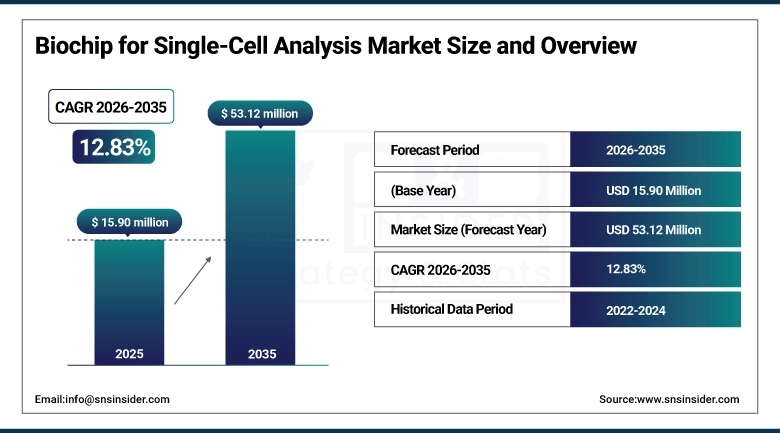
The Biochip for Single-Cell Analysis Market size is valued at USD 15.90 Billion in 2025 and is expected to reach USD 53.12 Billion by 2035 and grow at a CAGR of 12.83% over the forecast period 2026-2035.
The market for biochip for single-cell analysis is anticipated to witness high growth owing to the increasing requirement of a high-throughput and accurate cellular analysis in research, drug discovery, and diagnostics applications. The increasing emphasis on personalized medicine, cancer research and immunology are expected to fuel the uptake of single-cell biochip techniques. Technological advances in microfluidics, lab-on-a-chip technology, next-generation sequencing (NGS), and flow cytometry are driving sensitivity and precision of diagnostics tools, accelerating the speed of analyses, as well as enabling scaling up for widespread adoption in laboratories or clinical settings.
Industry studies indicate that approximately 67% of the single‑cell analysis market is for research use, suggesting that the majority need for biochips in single‑cell workflows is due to research and academic use rather than solely clinical diagnostic as researchers apply these technologies to cancer, immunology and drug discovery studies.
Market Size and Forecast:
-
Market Size in 2025: USD 15.90 Billion
-
Market Size by 2035: USD 53.12 Billion
-
CAGR: 12.83% from 2026 to 2035
-
Base Year: 2025
-
Forecast Period: 2026–2035
-
Historical Data: 2022–2024
To Get more information on Biochip for Single-Cell Analysis Market - Request Free Sample Report
Biochip for Single-Cell Analysis Market Trends:
-
Microfluidics & Lab-on-Chip – Platforms enabling precise single-cell handling, higher throughput, and reduced sample and reagent use.
-
Personalized Medicine – Biochips support tailored diagnostics and therapies, especially in cancer and rare diseases.
-
NGS-Enabled Biochips – Next-generation sequencing integration allows detailed genomic and transcriptomic analysis at the single-cell level.
-
Portable & Point-of-Care Systems – Miniaturized biochips enable rapid testing outside traditional laboratory settings.
-
AI & Data Analytics – Artificial intelligence and machine learning improve accuracy and speed in analyzing complex single-cell data.
U.S. Specialty Biochip for Single-Cell Analysis Market Insights:
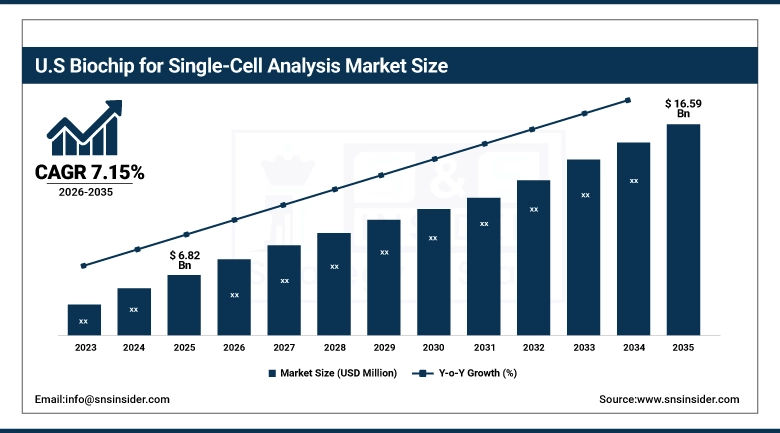
The U.S. Biochip for Single-Cell Analysis Market size is USD 6.82 Billion in 2025 and is expected to reach USD 16.59 Billion by 2035, growing at a CAGR of 7.15% over the forecast period of 2026-2035.
The market for single-cell analysis U.S. specialty biochip is witnessing a high growth due to increasing demand from research institutions, biotechnology and pharmaceutical companies. Precision, throughput, and data accuracy are being increased with developments in microfluidics and lab-on-chip platforms, as well as NGS-based biochip analyses. These are trends driving the use of AVPs. The rise in emphasis on personal medicine, cancer and immunology research is also contributing to their adoption. Due to high R&D investments, strategic partnerships and government support on diagnostics and precision healthcare, the US is emerging as one of the major centers for single-cell biochip innovation in the market.
Biochip for Single-Cell Analysis Market Growth Drivers:
-
Rising Demand for High-Throughput Single-Cell Analysis
The global Biochip for Single-Cell Analysis market is driven by rising demand for high-throughput and accurate cellular analysis in drug discovery, research, clinical diagnostics. Advances in microfluidics, lab-chip devices, and NGS-based biochips have facilitated a quicker identification of single cell profiles with improved sensitivity. Industry surveys have shown that more than 65% of market penetration is driven by research and pharmaceutical applications, demonstrating the importance of biochips in characterizing cellular heterogeneity. Moreover, increasing spotlight on personalized medicine and immuno-oncology also drives growth of the market.
Biochip for Single-Cell Analysis Market Growth Restraints:
-
High Cost and Complex Data Management
Market growth is limited by the expensive nature of sophisticated biochip instruments and consumables, which makes it difficult for smaller laboratories and developing countries to afford them. Although many platforms rely on complex infrastructure, expert personnel and powerful computational resources in their capacity to handle and interpret the complexity of single-cell data, they are slow to implement. It is estimated from studies that around 40% of prospective end-users perceive high costs and technical research-data barriers as some of the main obstacles to utilization. Furthermore, protocol standardization issues and regulatory ambiguity related to clinical applications continue to stifle market growth.
Biochip for Single-Cell Analysis Market Growth Opportunities:
-
Expansion in Personalized Medicine and Multi-Omics Integration
There are broad prospects owing to the increasing applications of biochips in personalized medicine, cancer research and immunology studies as well as multi-omics analysis. Combining genomics, transcriptomics, proteomics and metabolomics in a single platform provides an unprecedented cellular panoramic view to open new dimensions of drug discovery and precision diagnostics. Industry research confirms investment in single-cell multi-omics is growing at a rate of more than 18% per year suggesting significant future uptake. Growing partnerships between biotech companies, universities and medical centers will have future growth prospects in developed and emerging territories.
Biochip for Single-Cell Analysis Market Segment:
-
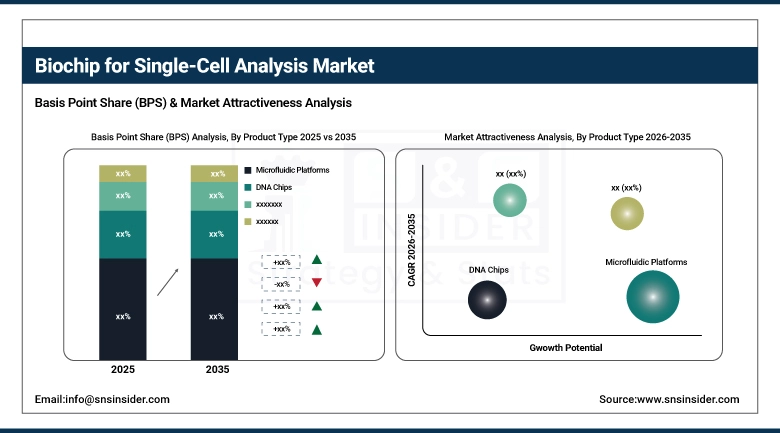
By Product Type: In 2025, microfluidic platforms dominated with 50% share; protein biochips are the fastest-growing segment during 2026–2035.
-
By Technology: In 2025, microarrays dominated with 45% share; NGS-enabled biochips are the fastest-growing segment during 2026–2035.
-
By Application: In 2025, research & drug discovery dominated with 55% share; immunology & oncology studies are the fastest-growing segment during 2026–2035.
-
By End User: In 2025, academic & research laboratories dominated with 60% share; hospitals & diagnostic laboratories are the fastest-growing segment during 2026–2035.
Biochip for Single-Cell Analysis Market Segment Analysis:
By Product Type: Microfluidic Platforms Lead as Protein Biochips Expand Rapidly.
Microfluidic platforms account for the top share of Biochip for Single-Cell Analysis market because these have high throughput, accurate single-cell manipulation and require less sample and reagents. Research, clinical diagnostics and drug discovery applications commonly employ these platforms as an option of choice for academic and pharmaceutical laboratories.
The market for protein biochips is rapidly increasing, with growing need in proteomics, biomarker identification, and immunology. Improvements in detection modalities, automation and miniaturization are driving increased use particularly for oncology and personalized medicine uses.
By Technology: Microarrays Lead as NGS-Enabled Biochips Accelerate.
Microarrays are the most used technology for it is already traditionally exploited in gene expression analysis, shows high reproducibility as well as compatibility with laboratory processes. They are widely exploited in diagnosis and research and represent a fundamental technology of the single-cell biochip application.
NGS-integrated biochips are also fast-advancing (as NGS) due to the capability of high-resolution genomic and transcriptomic profiling at the single-cell level. Increasing interest in precision medicine, multi-omics research and studies of complex diseases is also helping NGS platforms to be adopted more rapidly.
By Application: Research & Drug Discovery Lead as Immunology & Oncology Expands.
The market has been dominated by the segment of research & drug discovery, which is witness to high demand from pharmaceutical companies and academic institutes based on new therapy discovery, cell heterogeneity comprehension, and drug candidate optimization.
Immunology and immune-oncology are burgeoning fields partly due to new focus on cancer research, immunoprofiling and personalized therapeutic approaches. Single-cell bio-chips enable precise study of immune cell populations and tumor heterogeneity, thus promoting faster breakthroughs in these burgeoning research fields.
By End User: Academic & Research Laboratories Lead as Hospitals & Diagnostic Laboratories Expand.
Academic and research laboratories are the largest end-user as biochips are widely used in carrying out basic research, translational studies, and drug development programs. These organizations spend a great deal on high-end single-cell analysis systems that are designed to handle samples in bulk.
Hospitals and diagnostic laboratories have seen significant growth due to the increasing demand for precision diagnostics, clinical research and personalised medicine applications. Single-cell biochips: technologies and applications Single-cell biochips are an inherently scalable, accurate and cost-effective way to profile patients and discover biomarkers in clinics.
Biochip for Single-Cell Analysis Market Regional Analysis:
North America Biochip for Single-Cell Analysis Market Insights:
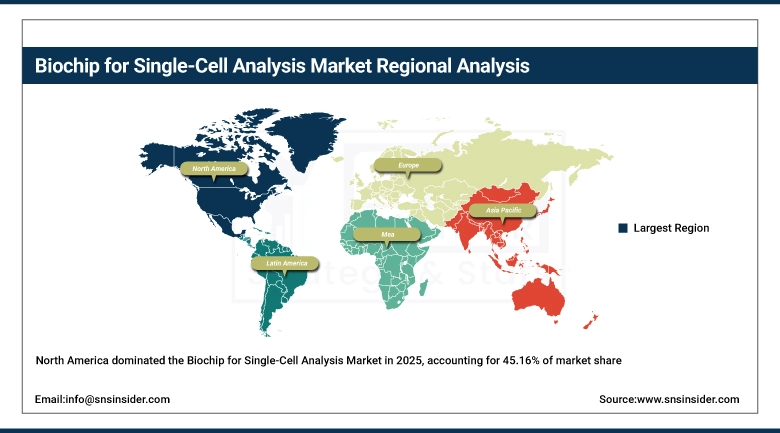
In 2025, North America’s Biochip for Single-Cell Analysis Market accounting for the highest regional revenue share of approximately 45.16% in 2025. Superiority of North America is due to established research facilities, biotechnology and pharmaceutical industries, developed infrastructure for research and higher necessity for advanced laboratory technologies have resulted in the larger investments made into the single cell biochip platforms. Advanced technologies microfluidics-lab-on-chip-technology next-generation sequencing (NGS)-AI-based data analysis systems enabled high-throughput and accurate cellular detection.
Get Customized Report as per Your Business Requirement - Enquiry Now
U.S. and Canada Biochip for Single-Cell Analysis Market insights:
North America, led by the U.S. and Canada biochip for single-cell analysis market share owing to better research facilities, faster adoption of microfluidic and NGS-based biochips and large biotech & pharma presence. Supporting factors include government funding, clinical research projects and academic-industry partnerships that enable high-throughput, accurate single-cell analysis opportunities as well as fast-growing regional markets.
Asia Pacific Biochip for Single-Cell Analysis Market Insights:
Asia Pacific represents a high-growth region for the Biochip for Single-Cell Analysis market, registering a CAGR of 18.06% during 2026–2035. This high growth is attributed to the rapid expansion of biotechnology research, increasing adoption of single-cell analysis in clinical diagnostics and drug discovery, and growing investments by pharmaceutical and academic institutions for developing new biochip platforms. Rapidly expanding healthcare infrastructure in the region of Asia Pacific and increasing number of research laboratories with an increasing demand for high throughput and accurate cellular analysis are the key factor driving the market in this region. Further, strong government initiatives, industry-academia-based collaborations and developments in microfluidics, NGS analytics and AI-driven analytics are also driving market growth over 2026-2035.
Europe Biochip for Single-Cell Analysis Market Insights:
Europe currently holds a significant share on the Biochip for Single-Cell Analysis market owing to its huge and well-developed biotechnology and pharmaceutical industry, research infrastructure and strong adoption of innovative lab technologies. The area has government funding programs, academic-industry partnerships and efforts to promote precision medicine/cancer research. Moreover, with the progressing microfluidics, lab-on-chip systems, NGS-enabled biochips, and AI-driven analytics have fostered its acceptance thus allowing the high-throughput yet accurate single-cell analysis as well as relatively steady market growth throughout 2026–2035.
Latin America Biochip for Single-Cell Analysis Market Insights:
The Latin America biochip for single-cell analysis market is expected to witness moderate growth, which can be attributed to a rise in the number of investments during R&D activities in biotechnology, increasing healthcare infrastructure and adoption of advanced laboratory technologies in countries like Brazil and Mexico. The area can also draw on government commitment to precision medicine and the research, as well as partnerships between academia and industry. In addition, development of microfluidics and lab-on-chip platforms as well as AI-assisted analytics, are driving the adoption forward and ensuring all-round market growth between 2026–2035.
Middle East and Africa Biochip for Single-Cell Analysis Market Insights:
The Middle East & Africa region is witnessing growing adoption of Biochip for Single-Cell Analysis, driven by increasing investments in healthcare infrastructure, biotechnology research, and precision medicine initiatives. Countries such as Saudi Arabia, UAE, and South Africa are expanding research facilities and clinical laboratories to support advanced diagnostics and drug discovery. Additionally, collaborations between academic institutions and industry players, along with advancements in microfluidics, lab-on-chip platforms, and AI-driven analytics, are accelerating market adoption, supporting steady growth during 2026–2035.
Biochip for Single-Cell Analysis Market Competitive Landscape:
Thermo Fisher Scientific is a leading global provider of biochip and single‑cell analysis solutions, offering a comprehensive portfolio of instruments, reagents, and integrated workflows used across research, clinical, and biopharma settings. Known for strong distribution networks, cutting‑edge microfluidics and multi‑omics platforms, and collaborations with key industry players, Thermo Fisher supports high‑throughput and precise cellular analysis worldwide.
-
In 2025: Thermo Fisher entered a strategic collaboration with Oxford Nanopore Technologies to integrate long‑read sequencing into single‑cell workflows, enhancing full‑length transcriptome analysis.
Illumina, Inc. is a major innovator in sequencing and single‑cell biochip markets, renowned for high‑accuracy genomic and multi‑omics platforms that support expansive research and clinical applications. Its technologies are widely adopted for scalable, reliable single‑cell and spatial analysis across research institutions and diagnostics, driving deeper biological insights.
-
In 2025: Illumina expanded its multiomics portfolio with new roadmap technologies spanning genomics, spatial, and single‑cell analysis to unlock deeper biological
10x Genomics is a leading single‑cell analysis company focused on advanced genomic and spatial biology platforms that enable high‑resolution profiling of individual cells. Its Chromium and Visium systems are widely used in research for oncology, immunology, and neuroscience, supported by strong industry partnerships.
-
In 2025: 10x Genomics initiated a collaboration with Dana‑Farber Cancer Institute to advance tumor single‑cell and spatial profiling and establish a CLIA‑certified lab for clinical research applications.
Biochip for Single-Cell Analysis Market Key Players:
-
Thermo Fisher Scientific
-
Illumina Inc.
-
10x Genomics
-
Bio-Rad Laboratories
-
Becton Dickinson (BD)
-
Danaher Corporation
-
Agilent Technologies
-
QIAGEN
-
Merck KGaA (MilliporeSigma)
-
Standard BioTools (formerly Fluidigm)
-
Takara Bio Inc.
-
Oxford Nanopore Technologies
-
Cytek Biosciences
-
Sartorius AG (Cellenion)
-
Parse Biosciences
-
Mission Bio Inc.
-
Namocell
-
RareCyte Inc.
-
Precigenome LLC
-
Dolomite Bio
| Report Attributes | Details |
|---|---|
| Market Size in 2025 | USD 15.90 Billion |
| Market Size by 2035 | USD 53.12 Billion |
| CAGR | CAGR of 12.83% From 2026 to 2035 |
| Base Year | 2025 |
| Forecast Period | 2026-2035 |
| Historical Data | 2022-2024 |
| Report Scope & Coverage | Market Size, Segments Analysis, Competitive Landscape, Regional Analysis, DROC & SWOT Analysis, Forecast Outlook |
| Key Segments | • By Product Type: (DNA Chips, Microfluidic Platforms, ) •By Technology : (Microarrays, Next-Generation Sequencing (NGS) Enabled Biochips, Flow Cytometry) •By Application: (Clinical Diagnostics , Research & Drug Discovery, Immunology & Oncology Studies) •By End User: (Biotechnology & Pharmaceutical Companies, Academic & Research Laboratories, Hospitals & Diagnostic Laboratories) |
| Regional Analysis/Coverage | North America (US, Canada), Europe (Germany, UK, France, Italy, Spain, Russia, Poland, Rest of Europe), Asia Pacific (China, India, Japan, South Korea, Australia, ASEAN Countries, Rest of Asia Pacific), Middle East & Africa (UAE, Saudi Arabia, Qatar, South Africa, Rest of Middle East & Africa), Latin America (Brazil, Argentina, Mexico, Colombia, Rest of Latin America). |
| Company Profiles | Thermo Fisher Scientific, Illumina Inc., 10x Genomics, Bio-Rad Laboratories, Becton Dickinson (BD), Danaher Corporation, Agilent Technologies, QIAGEN, Merck KGaA (MilliporeSigma), Standard BioTools (formerly Fluidigm), Takara Bio Inc., Oxford Nanopore Technologies, Cytek Biosciences, Sartorius AG (Cellenion), Parse Biosciences, Mission Bio Inc., Namocell, RareCyte Inc., Precigenome LLC, Dolomite Bio |
Frequently Asked Questions
North-America dominated the Biochip for Single-Cell Analysis market in 2025.
The Microfluidic Lab-on-Chip segment dominated the Biochip for Single-Cell Analysis market, driven by its high precision in single-cell isolation, growing adoption in genomics and oncology research.
The key drivers of the Biochip for Single-Cell Analysis market are the rising demand for precision medicine, increasing focus on cancer and genomics research, technological advancements in microfluidics and sequencing.
The market was valued at USD 15.90 Billion in 2025 and is projected to reach USD 53.12 Billion by 2035.
The Biochip for Single-Cell Analysis market is expected to grow at a CAGR of 12.83% during 2026-2035.
