
Bioequivalence Studies Market Report Scope & Overview:
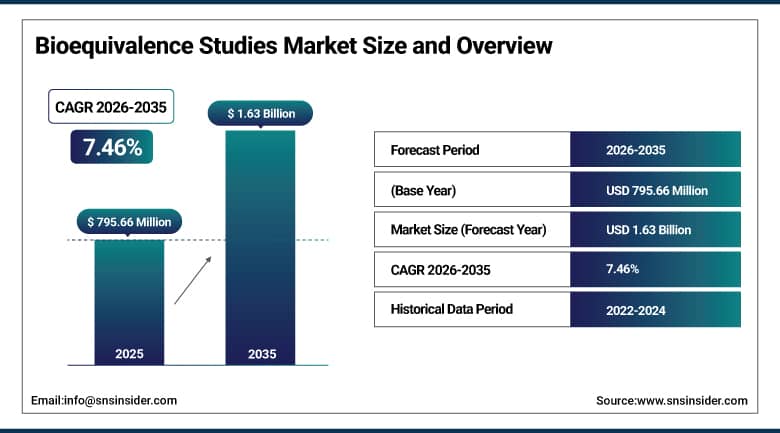
The Bioequivalence Studies Market was valued at USD 795.66 Million in 2025 and is expected to reach USD 1.63 Billion by 2035, growing at a CAGR of 7.46% from 2026-2035.
The Bioequivalence Studies Market is expanding steadily as generic and biosimilar filings rise across every major regulatory region. Sponsors must show that a copy product delivers the same drug exposure as its reference. Demand therefore tracks patent expiries and abbreviated application volumes. Contract research organizations capture most of this work because they combine clinical units with validated bioanalytical laboratories. Harmonized guidelines are reducing duplicate studies and improving design consistency. Health systems favor lower cost medicines, which keeps generic launches on a strong path. Asia Pacific units continue to add beds for global filings. Complex injectables and modified release products add technical depth and raise the value of each study program.
⮞For instance, in September 2025, the Association for Accessible Medicines reported that generic and biosimilar medicines filled 3.9 billion U.S. prescriptions in 2024. Such volume keeps sponsors dependent on bioequivalence evidence to support every new generic filing.
To Get More Information On Bioequivalence Studies Market - Request Free Sample Report
Bioequivalence Studies Market Trends:
-
Adoption of harmonized ICH M13A design standards for immediate release oral products
-
Rising outsourcing of clinical pharmacology work to Asia Pacific research organizations
-
Growth in complex generics such as injectables and modified release formulations
-
Biosimilar development lifting demand for comparative pharmacokinetic programs
-
Wider use of biowaivers and in vitro evidence to limit clinical study volume
U.S. Bioequivalence Studies Market Outlook:
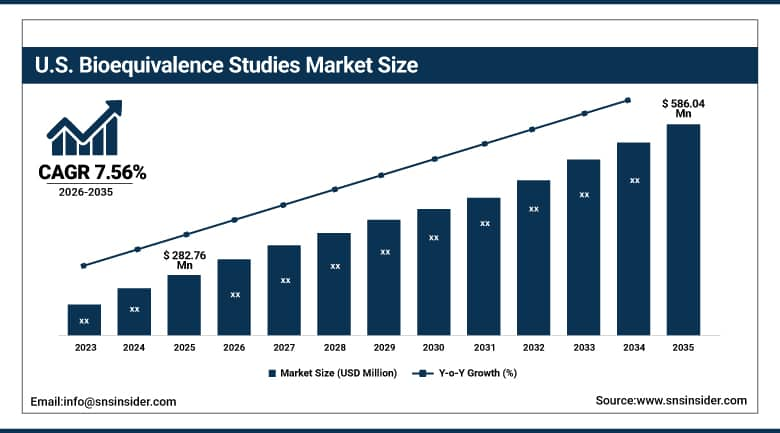
The U.S. Bioequivalence Studies Market was valued at USD 282.76 Million in 2025 and is expected to reach USD 586.04 Million by 2035, growing at a CAGR of 7.56% from 2026-2035.
The U.S. Bioequivalence Studies Market is anchored by the largest generic drug approval pipeline in the world. Abbreviated new drug applications require comparative pharmacokinetic data for most oral products. Sponsors place studies with clinical units in New Jersey, Missouri, Florida, and Texas as well as with offshore partners. Product specific guidances published by federal regulators shape protocol design for hundreds of reference drugs. Complex generics such as injectables and inhalation products raise study complexity. Employers and payers favor generic substitution, which sustains filing volumes. Competition among clinical research organizations centers on bed capacity, bioanalytical turnaround, and inspection history. These factors keep study placements in the United States steady.
⮞In October 2025, the U.S. Food and Drug Administration announced an ANDA prioritization pilot that links faster review to pivotal bioequivalence testing performed in the United States. The pilot raises the strategic value of onshore clinical pharmacology units.
Bioequivalence Studies Market Segment Analysis:
-
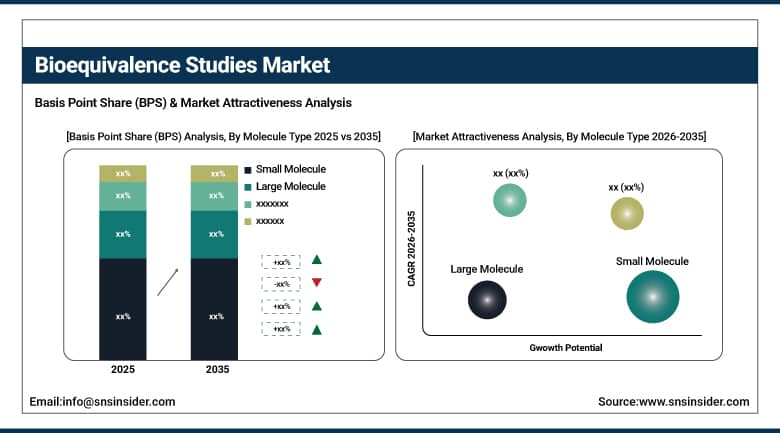
By Molecule Type, the Small Molecule segment dominated the Bioequivalence Studies Market with approximately 59.80% share in 2025, while the Large Molecule segment is the fastest growing with a CAGR of approximately 8.06%.
-
By Dosage Form, the Solid Oral segment dominated the Bioequivalence Studies Market with approximately 53.90% share in 2025, while the Parenteral segment is the fastest growing with a CAGR of approximately 7.86%.
-
By Therapeutic Area, the Oncology segment dominated the Bioequivalence Studies Market with approximately 26.65% share in 2025, while the Neurology segment is the fastest growing with a CAGR of approximately 7.76%.
-
By Study Type, the In Vivo segment dominated the Bioequivalence Studies Market with approximately 64.40% share in 2025, while the In Vitro segment is the fastest growing with a CAGR of approximately 8.20%.
By Molecule Type, Small Molecule Dominates the Bioequivalence Studies Market and Large Molecule Grows Fastest
Small molecule drugs anchor study demand because most generic approvals still involve chemically synthesized oral products. Established reference drugs in cardiovascular, central nervous system, and anti-infective categories continue to lose exclusivity, and each loss opens a window for several copy products. Study designs for these compounds are well defined, which allows sponsors to run crossover trials in healthy volunteers with predictable timelines. Clinical units therefore schedule these programs in high volume and compete on throughput and bioanalytical precision. Guidance documents from major agencies provide product specific direction and reduce protocol risk for first time filers in emerging markets.
Large molecule programs are advancing faster as biosimilar pipelines mature. Comparative pharmacokinetic studies for monoclonal antibodies and other biologics require specialized immunoassay and anti drug antibody capabilities. Sponsors in Europe, India, and South Korea are building portfolios against expiring biologic reference products. Each program carries a higher cost per study and a longer analytical development period than a small molecule filing. Regulators continue to refine immunogenicity expectations, which keeps demand for experienced providers high. Laboratories that invest in ligand binding assays and larger bioanalytical teams are positioned to win these contracts. Cell line based assays and extended sampling schedules lengthen timelines.
⮞In January 2026, the European Medicines Agency reported that 41 of the medicines it recommended for approval in 2025 were biosimilars. This pipeline of biologic copies creates direct demand for comparative pharmacokinetic evidence.
By Dosage Form, Solid Oral Dominates the Bioequivalence Studies Market and Parenteral Grows Fastest
Tablets and capsules account for the bulk of study programs because solid oral products dominate generic prescribing. Immediate release formulations follow a harmonized study framework, which allows sponsors to reuse protocol templates across filings. Fasted and fed crossover designs in healthy volunteers remain the standard format, and this favors providers with large clinical units. Pricing pressure in the category pushes sponsors toward low cost jurisdictions and high volume sites. Providers add dosing beds and automate sample processing to hold turnaround times as study counts rise. Sponsors often bundle several strengths into a single protocol to protect margins and shorten submission timelines.
Injectable formulations are gaining pace because complex products are attracting generic entrants. Liposomal, depot, and suspension products often need patient based or pharmacodynamic studies instead of simple volunteer crossovers. This increases the clinical expertise required and limits the pool of qualified sites. Sponsors treat these programs as higher value filings with fewer competitors. Regulators publish detailed guidance for sterile injectables, which shapes study planning from the first protocol draft. Providers with infusion capability and strong clinical pharmacology staff gain an advantage in winning these contracts. Complexity also extends analytical method development, which raises the entry barrier for newer providers.
⮞In January 2026, Frontage Laboratories announced an expansion of its early phase capacity with a 160 bed Phase I unit in Secaucus, New Jersey, designed for high volume bioequivalence studies. The unit adds dosing capacity at a time when patent expiries sustain demand for solid oral generic programs.
By Therapeutic Area, Oncology Dominates the Bioequivalence Studies Market and Neurology Grows Fastest
Cancer medicines drive drug development due to the end of patents and the availability of oral targeted medications that become generics. Tailored designs of cytotoxic drugs along with studies on patients instead of healthy subjects are required from regulatory agencies. This increases development time and qualifications of the test site. Oncology specialists are in demand to conduct studies on these medicines. The increase in the number of cancers helps maintain a stable flow of copycat applications due to the growing population of treated people and interest of payers in cheaper treatments. Oral kinase and hormonal agents represent the major part of such pipeline.
Neurology is growing faster as generic versions of antiepileptic, antipsychotic, and neurodegenerative therapies reach the market. Narrow therapeutic index drugs in this area call for tight bioanalytical control and replicate designs. Sponsors favor providers with proven data integrity because small variability can affect approval outcomes. Aging populations raise treatment volumes and increase payer attention to substitution. Extended release formulations add further study complexity and keep specialized clinical pharmacology teams in demand across the major generic manufacturing hubs. Memory and movement disorder therapies also contribute as long acting oral versions approach their exclusivity limits, which keeps neurology programs prominent in sponsor pipelines.
⮞In September 2025, the World Health Organization Prequalification Programme inspected the bioequivalence studies conducted by Vimta Labs on praziquantel and found acceptable compliance. Such inspections let sponsors of therapies for neglected diseases rely on qualified clinical sites for therapeutic area programs.
By Study Type, In Vivo Dominates the Bioequivalence Studies Market and In Vitro Grows Fastest
Studies in volunteers or patients remain the regulatory standard for demonstrating therapeutic equivalence of most oral products. Agencies expect measured drug concentrations, and this requires clinical units with qualified medical staff and validated bioanalytical laboratories. Study conduct involves screening, dosing, serial sampling, and statistical analysis under good clinical practice. Because every new generic of a systemically acting drug needs this evidence, volumes follow the filing calendar. Inspection outcomes from agencies in the United States, Europe, and the World Health Organization shape how sponsors select partners. Bioanalytical validation follows regulatory method guidelines, and sample integrity controls are audited closely.
Laboratory based approaches are gaining ground as regulators accept biowaivers and dissolution based evidence for additional strengths and selected product classes. Harmonized guidance on additional strength waivers lowers the number of clinical studies needed for a dossier. Sponsors use dissolution profiling, permeability assessment, and in vitro in vivo correlation to limit cost and subject exposure. Laboratories with advanced dissolution and modeling capability benefit from this trend. Clinical studies remain central, so growth in this area complements rather than replaces volunteer based work. Modeling teams also use physiologically based simulations to justify waivers, which supports demand for laboratory and computational services.
⮞As of 31 December 2025, Lambda Therapeutic Research reported 746 operational beds for clinical pharmacology work. Large dosing capacity of this kind underpins the volunteer based studies that remain the regulatory standard.
Regional Analysis:
|
Region |
Major Country |
Share within Region, 2025 (%) |
|---|---|---|
|
North America |
United States |
85.55% |
|
Europe |
Germany |
22.74% |
|
Asia Pacific |
India |
34.18% |
|
Latin America |
Brazil |
44.73% |
|
Middle East & Africa |
Saudi Arabia |
27.91% |
North America Bioequivalence Studies Market Insights
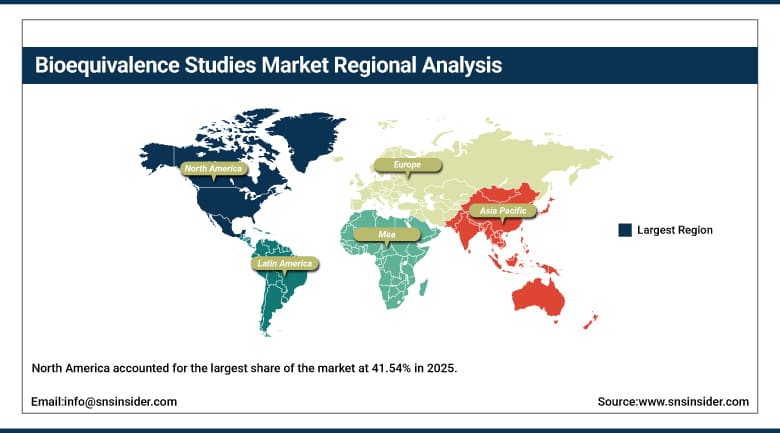
North America accounted for the largest share of the market at 41.54% in 2025, supported by the volume of generic filings and a dense network of clinical pharmacology units. The United States dominates regional demand through the abbreviated pathway, while Canada contributes through its own review system and growing contract capacity. Sponsors value the proximity of experienced bioanalytical laboratories and regulatory consultants. Inspection history and data integrity carry weight in site selection, and providers with clean records win repeat work. Several mid sized and large providers operate multiple clinics in the region, which allows sponsors to scale programs across sites.
Policy direction increasingly favors local testing capacity. Federal programs that link review speed to U.S. based pivotal studies are encouraging sponsors to bring programs onshore. This supports investment in new clinic space and bioanalytical expansion. Canadian regulators align with international harmonized guidance, which simplifies multinational dossiers. Complex generics and biosimilar development sustain a pipeline of higher value programs. Competition among providers focuses on bed availability, recruitment speed, and analytical turnaround, and these factors are shaping the next wave of capacity investment. Sponsors also value access to patient populations for studies that require patients instead of volunteers.
⮞Health Canada announced that bioequivalence studies in submissions filed after 27 December 2025 must comply with the ICH M13A guideline. The requirement aligns Canadian dossiers with the standards used by other major regulators.
Get Customized Report as Per Your Business Requirement - Enquiry Now
Europe Bioequivalence Studies Market Insights
Europe market is driven by a mature generic sector, centralized and national review routes, and an expanding biosimilar portfolio. Germany, the United Kingdom, France, Spain, and Italy generate most of the regional demand. Sponsors run studies locally to satisfy reviewers who value consistent European data, although many also place programs in lower cost Eastern European and Asian sites. Procurement policies favor generic substitution and sustain filing activity across health systems. Cost pressure in Western Europe pushes some sponsors toward Central and Eastern European units, where regulatory acceptance is comparable and operating costs are lower.
Regulatory evolution shapes the competitive landscape. A harmonized design guideline now supersedes parts of earlier European text and gives sponsors a common reference across member states. The United Kingdom runs parallel consultations after Brexit, and sponsors track both tracks closely. Clinical units differentiate through bioanalytical depth, recruitment for complex formulations, and multi site coordination. Biosimilar launches in oncology and immunology add programs that require specialized assays, and these programs support higher revenue per study for experienced providers. Outsourcing to specialist laboratories remains common for assays that need dedicated platforms.
⮞In May 2025, the Medicines and Healthcare products Regulatory Agency opened a consultation on the ICH M13B guideline for additional strength biowaivers, which ran until July 2025. The outcome affects how many separate studies a generic dossier needs in the United Kingdom.
Asia Pacific Bioequivalence Studies Market Insights
Asia Pacific is the fastest growing region with an expected CAGR of 8.13% from 2026 to 2035, led by India and followed by China, Taiwan, Thailand, and South Korea. Indian clinical units supply a large share of the global generic pipeline because of lower operating cost, large volunteer pools, and long experience with international inspections. Regional regulators recognize overseas centers through published lists, and this strengthens cross border outsourcing. China is raising generic quality standards through consistency evaluation, which stimulates local study activity. Thailand and Taiwan have built dedicated bioequivalence units that serve both regional and international submissions.
Capacity additions remain a defining feature of the region. Providers are adding beds, automating sample handling, and expanding bioanalytical teams to serve sponsors in the United States, Europe, and the Middle East. Japan maintains a mature generic market with rigorous standards, while Southeast Asian countries are strengthening local review capacity. Compliance history is a decisive selection factor because several international agencies publish inspection findings. Providers with clean audit records and multi region accreditation secure larger programs and longer term agreements. Rising pharmaceutical exports from the region sustain a steady need for supporting studies.
⮞In April 2025, India's Central Drugs Standard Control Organisation made registration mandatory for contract research organizations under the New Drugs and Clinical Trials Rules. The requirement formalizes oversight of sites that run bioavailability and bioequivalence studies.
MEA & Latin America Bioequivalence Studies Market Insights
Latin America consists of Brazil and Mexico, both of which have regulatory bodies requiring certification or authorization of centers to conduct the studies used for the registration of the products. Brazil is working towards harmonization with international guidelines, while Mexico has an authorized interchangeability units list and is revising its technical standard. The regional demand is linked to the generic substitution policy and the public procurement policy. Service providers in Sao Paulo, Campinas, and Monterrey support local registration and are attracting international sponsors looking for diversified facilities. Lack of bed availability due to high demand hampers expansion, although regulatory standards are getting better.
⮞In September 2024, Brazil's health regulator ANVISA issued RDC 926, which requires certified centers for bioequivalence studies and sets a two year certification validity. The rule creates a formal gatekeeping system for local and foreign study sites.
The Middle East and Africa region is developing capacity in relation to approval lists from the Gulf Cooperation Council and clinics in Egypt and Jordan. The Kingdom of Saudi Arabia approves centers both foreign and local for regional registration, and Jordan has established centers for bioequivalence testing to support manufacturers in the region. Egypt has been revising its national guideline to be consistent with international guidelines. Manufacturing initiatives by the region are helping develop more capacity in the region. Capacity is mainly available in the Gulf region, Egypt, and Jordan, hence giving opportunity for the establishment of new units due to increased pharmaceutical manufacture.
⮞In June 2026, the Egyptian Drug Authority issued the fourth edition of its guidelines for conducting bioequivalence studies, effective from 1 July 2026. The update aligns national requirements with international practice and supports local registration programs.
Market Dynamics:
Growth Drivers: Rising Generic Penetration and Patent Expiries Drive Growth in the Bioequivalence Studies Market
Generic medicines now fill the large majority of prescriptions in mature markets and continue to gain share in emerging ones. Payers and governments rely on them to contain pharmaceutical spending, and this creates a persistent pipeline of abbreviated filings. Every filing for a systemically acting product needs comparative exposure data, which converts policy support for generics into study demand. Patent expiries on high revenue drugs concentrate filings in specific years and lead sponsors to book clinical capacity well ahead of time. Emerging economies are also widening access to chronic disease therapies through generic channels.
Biosimilar development adds a second layer of demand. Comparative pharmacokinetic and immunogenicity programs for biologic copies are larger and more complex than oral generic studies. Sponsors in India, South Korea, and Europe are advancing portfolios that need experienced clinical pharmacology partners. Regulators continue to publish product specific guidance that tells sponsors which studies are expected, which lowers uncertainty and speeds planning. Together these factors keep order books full for established providers and support new unit investments. Longer program durations for biologics also increase the revenue each project contributes. Biosimilar sponsors often run several comparative studies per molecule.
⮞In July 2026, the Japan Generic Medicines Association reported that generics reached 89.7% of prescription volume in fiscal 2025, which ended in March 2026. Such penetration shows how sustained policy support builds a large installed base of generic products.
Restraints: High Study Costs and Compliance Failures Restrain Growth in the Bioequivalence Studies Market
Bioequivalence programs require substantial investment in clinical units, validated bioanalytical methods, and qualified medical staff. Costs rise further for narrow therapeutic index drugs, highly variable compounds, and biologics, where replicate designs and larger cohorts are standard. Sponsors under price pressure often delay or cancel low margin filings, which reduces study counts in competitive product categories. Shortages of skilled bioanalytical chemists add recruitment cost and limit the speed of capacity expansion. Clinical units must also maintain large volunteer databases and retention programs, which increases fixed costs during periods when study volumes fall. Margin pressure therefore remains a structural feature for providers competing mainly on price.
Regulatory scrutiny of data integrity creates a second constraint. Agencies have rejected studies from sites with serious findings, and sponsors then repeat work at their own expense. Accreditation lists issued by national authorities show that certification can lapse, which limits the pool of sites available for a given registration. Scarcity of reference listed drugs in some markets also delays study starts. These factors raise risk premiums for sponsors and favor providers with strong inspection histories while limiting entry for smaller operators. Sponsors respond by diversifying across several providers.
⮞In November 2024, the Saudi Food and Drug Authority posted its list of bioequivalence centers approved for GCC submissions, which names 52 centers and includes some with expired approval status. Lapsed approvals illustrate how compliance management restricts the usable supply of study sites.
Opportunities: Complex Generics and Cross Border Outsourcing Create Opportunities in the Bioequivalence Studies Market
Long acting injectables, inhalation products, ophthalmic formulations, and topical products present premium study opportunities. Many of these products need clinical endpoint or pharmacodynamic studies instead of routine crossover designs. Fewer providers can run them, which supports higher pricing and longer relationships. Sponsors seeking differentiated filings in less crowded categories are expected to commission more of this work as patent cliffs approach for specialty drugs. Topical products in dermatology and ophthalmology often rely on clinical endpoint studies with larger patient cohorts, which raises the value of each program. Providers that build specialist recruitment networks for these indications can secure a defensible position.
Cross border outsourcing offers a second opportunity. Regulators in Southeast Asia, the Gulf, and Latin America publish lists of recognized foreign centers, which opens markets to qualified providers in India, Thailand, Jordan, and Taiwan. Providers that secure multi agency approvals can serve several registrations from one study. Digital data capture, automated sample handling, and model informed approaches further improve efficiency. Companies that combine capacity with regulatory expertise can convert these developments into multi year contracts. Mid sized generic manufacturers without in house clinics are natural customers for these services. Regional approval lists reward transparency and audit readiness.
⮞As of September 2026, Malaysia's National Pharmaceutical Regulatory Agency recognizes 42 foreign bioequivalence centers across India, Thailand, Taiwan, Indonesia, and Jordan. Such lists let qualified providers serve registrations in additional markets without building local sites.
Recent Developments:
In June 2026, Celerion agreed to a majority stake sale to the investment firm THL, with H.I.G. Capital as the seller, as reported by trade media. The company reports more than 6,000 clinical studies and over 1,000 employees.
In May 2026, ICON plc announced a new 69,500 square foot clinical research unit in San Antonio, Texas, as part of its U.S. early phase expansion.
As of April 2025, QPS listed bioavailability and bioequivalence capacity of 240 beds in Missouri, 138 in India, 106 in Miami, and 40 in Taiwan in its generic product development brochure.
In August 2026, Altasciences announced a further expansion of its North American bioanalytical footprint. Bioanalytical laboratories analyze the plasma samples generated in pharmacokinetic studies, so added capacity supports faster reporting for bioequivalence programs.
Bioequivalence Studies Market Key Players are:
-
Veeda Clinical Research
-
Lambda Therapeutic Research
-
Cliantha Research
-
Vimta Labs
-
Frontage Laboratories
-
Celerion
-
QPS
-
Altasciences
-
ICON plc
-
Accutest Research Laboratories
-
Axis Clinicals
-
Lifesan Clinical Research
-
Aizant Drug Research Solutions
-
Spinos Life Science
-
Amaris Clinical
-
Citus Research
-
Avant Santé Research Center
-
Synvia
-
International Bio Service
-
ACDIMA
Bioequivalence Studies Market Report Scope:
| Report Attributes | Details |
|---|---|
| Market Size in 2025 | USD 795.66 Million |
| Market Size by 2035 | USD 1.63 Billion |
| CAGR | CAGR of 7.46% From 2026 to 2035 |
| Base Year | 2025 |
| Forecast Period | 2026-2035 |
| Historical Data | 2022-2024 |
| Report Scope & Coverage | Market Size, Segments Analysis, Competitive Landscape, Regional Analysis, DROC & SWOT Analysis, Forecast Outlook |
| Key Segments | • By Molecule Type (Small Molecule and Large Molecule) • By Dosage Form (Solid Oral, Parenteral, Topical, and Others) • By Therapeutic Area (Oncology, Neurology, Metabolic Disorders, Hematology, Immunology, and Others) • By Study Type (In Vivo and In Vitro) |
| Regional Analysis/Coverage | North America (US, Canada), Europe (Germany, UK, France, Italy, Spain, Russia, Poland, Rest of Europe), Asia Pacific (China, India, Japan, South Korea, Australia, ASEAN Countries, Rest of Asia Pacific), Middle East & Africa (UAE, Saudi Arabia, Qatar, South Africa, Rest of Middle East & Africa), Latin America (Brazil, Argentina, Mexico, Colombia, Rest of Latin America). |
| Company Profiles | Veeda Clinical Research, Lambda Therapeutic Research, Cliantha Research, Vimta Labs, Frontage Laboratories, Celerion, QPS, Altasciences, ICON plc, Accutest Research Laboratories, Axis Clinicals, Lifesan Clinical Research, Aizant Drug Research Solutions, Spinos Life Science, Amaris Clinical, Citus Research, Avant Santé Research Center, Synvia, International Bio Service, ACDIMA |

Frequently Asked Questions
Key players in the market include Veeda Clinical Research, Lambda Therapeutic Research, Celerion, QPS, Frontage Laboratories, Altasciences, and ICON plc, among others.
Key opportunities include premium programs for complex generics such as long acting injectables and inhalation products, and cross border outsourcing as regulators recognize qualified foreign study centers.
Rising generic and biosimilar filings are the major growth factor. Patent expiries and policy support for lower cost medicines require comparative exposure evidence for every new filing, which sustains study demand.
The Small Molecule segment dominated the market in 2025 with approximately 59.80% share, as most generic approvals still involve chemically synthesized oral products.
North America dominated the market in 2025 with approximately 41.54% share, supported by a large generic filing pipeline and a dense network of clinical pharmacology units.
