
Biometrics as a Service Market Report Scope & Overview:
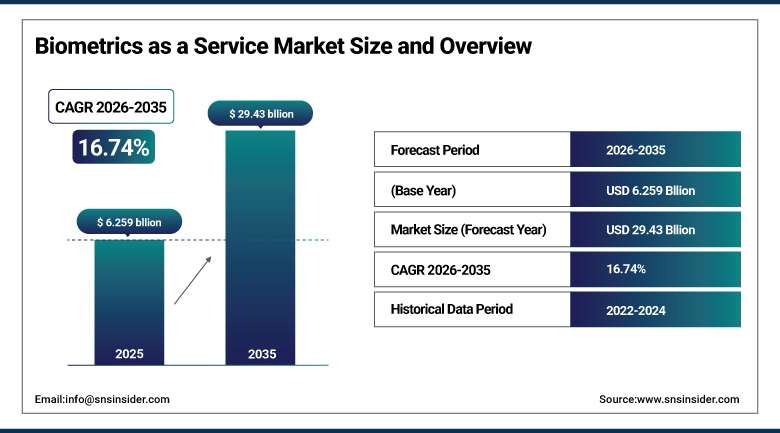
The Biometrics as a Service Market was valued at USD 6.259 Billion in 2025 and is expected to reach USD 29.43 Billion by 2035, growing at a CAGR of 16.74% from 2026 to 2035.
The Biometrics as a Service (BaaS) Market is growing due to increasing need for digital identity verification, threats to cybersecurity, and usage of cloud-based solutions for authentication. Enterprises in sectors like banking, governmental institutions, healthcare, and retail are adopting biometric technologies to increase security and avoid identity fraud. The growth of digital banking services and need for remote access solutions is also contributing to the adoption process. Furthermore, developments in AI, facial recognition, multimodal biometrics, and cloud technology allow scaling of biometric solutions, thus contributing to the market growth.
Thales Group expanded its SafeNet Trusted Access platform with hybrid cloud biometric verification capability in 2025, allowing government clients and financial institutions to store biometric templates locally within sovereign data environments while leveraging cloud-native matching APIs for scalable verification workloads, directly addressing the GDPR and national data sovereignty requirements that had prevented European government clients from adopting pure public cloud biometric verification.
Market Size and Forecast:
-
Market Size in 2026E: USD 7.31 Billion
-
Market Size by 2035: USD 29.43 Billion
-
CAGR: 16.74% from 2026 to 2035
-
Fastest Growing Region: Asia Pacific
-
Largest Region: North America
To Get more information Biometrics as a Service Market - Request Free Sample Report
Biometrics as a Service Market Trends:
-
Rising demand for secure digital identity verification driving adoption of Biometrics as a Service (BaaS) solutions across banking, healthcare, and government sectors
-
Growing use of cloud-based biometric platforms enabling scalable, cost-effective, and flexible authentication services for enterprises
-
Increasing integration of artificial intelligence and machine learning enhancing facial recognition, fingerprint analysis, and fraud detection accuracy
-
Expanding adoption of biometric authentication in mobile applications, digital payments, and remote access systems improving security and user convenience
-
Continuous advancements in privacy-preserving technologies and encryption methods strengthening trust, compliance, and secure deployment of biometric services
U.S. Biometrics as a Service Market Outlook:
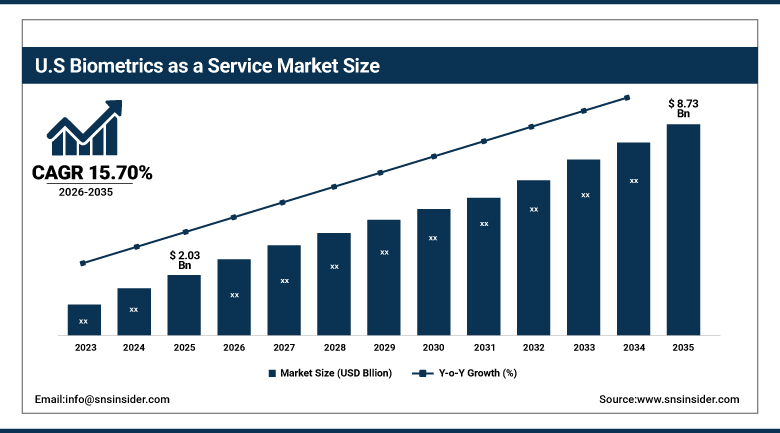
The U.S. Biometrics as a Service Market was valued at approximately USD 2.03 Billion in 2025 and is expected to reach approximately USD 8.73 Billion by 2035, growing at a CAGR of approximately 15.70%.
The United States is the world's largest BaaS market within the dominant North American region, driven by the domestic concentration of leading BaaS platform providers including iProov, Jumio, Daon, BioCatch, Aware Inc., and the North American operations of IDEMIA, Thales, and NEC, the most extensive enterprise passwordless authentication adoption programme propelled by FIDO Alliance's WebAuthn standard integration in enterprise identity platforms, and the progressive federal government investment in biometric identity verification under the GSA's login.gov digital identity programme and the TSA's biometric boarding programme whose combined deployment scale creates biometric verification infrastructure at the public sector scale.
NEC Corporation expanded its biometric solutions portfolio in July 2025 by acquiring a startup specialising in AI-driven biometric analytics, reinforcing NEC's NeoFace facial recognition technology's competitive position with advanced analytics capabilities that identify behavioural patterns and environmental context factors affecting verification accuracy in enterprise and government deployment scenarios.
Biometrics as a Service Market Segment Analysis:
-
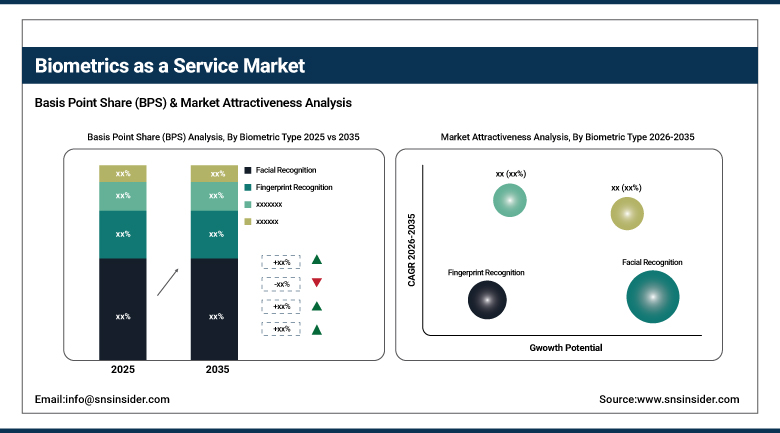
By Biometric Type, Facial Recognition segment dominated the Biometrics as a Service (BaaS) Market in 2025 with 38% share; Multimodal Biometrics segment is the fastest growing segment.
-
By Authentication Mode, Multi-Factor Authentication segment dominated the market in 2025 with 62% share; Single-Factor Authentication segment is the fastest growing segment.
-
By Application, Identity & Access Management segment dominated the Biometrics as a Service (BaaS) Market in 2025 with 35% share; Fraud Detection & Prevention segment is the fastest growing segment.
-
By End User, BFSI segment dominated the market in 2025 with 30% share; Healthcare segment is the fastest growing segment.
By Biometric Type, Facial Recognition segment dominates the Biometrics as a Service (BaaS) Market, Multimodal Biometrics segment expected to grow fastest
The Facial Recognition segment dominated the Biometrics as a Service (BaaS) Market in 2025 owing to its extensive usage in the security, authentication, and identity verification applications. The Facial recognition enables contactless identification, ease of use, and faster processing that makes it ideal for use in banking, government services, retail, and enterprises. Rising demand for digital identities, increased security features, and remote verification systems has driven the demand for the segment. Continuous developments in artificial intelligence, image processing, and cloud biometric platform contribute to segment dominance.
The Multimodal Biometrics segment is the fastest growing in the Biometrics as a Service (BaaS) Market because of the rising demand for secure and reliable authentication solutions that use more than one biometric techniques. Combining facial recognition, fingerprints, voice, and other biometric identifiers helps in enhancing accuracy and lowering risks of identity frauds. Increasing cybersecurity concerns, adopting advanced access control systems, and digital services are driving the demand for the segment.
By Authentication Mode, Multi-Factor Authentication segment dominates the Biometrics as a Service (BaaS) Market, Single-Factor Authentication segment expected to grow fastest
The Multi-Factor Authentication segment dominated the Biometrics as a Service (BaaS) Market in 2025 owing to rising threats related to cyber-attacks and identity security concerns. A combination of biometric authentication with another mode of authentication ensures security and lowers the risks of any sort of unauthorized access. Multi-factor solutions are adopted by organizations operating in the finance sector, enterprises, and governments to protect sensitive information. The increasing number of digital transactions, cloud computing, and regulatory compliance needs fuel the growth of advanced authentication solutions.
The Single-Factor Authentication segment is the fastest growing driven by rising adoption of convenient, affordable biometric authentication solutions by SMBs and consumers. Single-factor authentication involves fast, convenient verification of an individual's identity without requiring any other form of authentication. Increasing use of smartphones, growing adoption of mobile applications, and growing demand for a user-friendly experience contribute to the growth of this segment. Growth in biometric accuracy and availability of services via the cloud also contribute to the growth of the single-factor authentication segment.
By Application, Identity & Access Management segment dominates the Biometrics as a Service (BaaS) Market, Fraud Detection & Prevention segment expected to grow fastest
The Identity & Access Management segment dominated the Biometrics as a Service (BaaS) Market in 2025 owing to the surging demand for reliable user authentication and access management solutions from businesses. Companies are utilizing biometrics solutions for controlling the access of their employees, securing their sensitive systems, and ensuring more efficient security management. The increasing trend of digitalization and cloud computing, along with rising need for more advanced identity verification solutions, is fueling the growth of the segment.
The Fraud Detection & Prevention segment is the fastest growing in the Biometrics as a Service (BaaS) Market on account of increasing cases of financial frauds, identity thefts, and cybersecurity threats. Businesses are increasingly employing biometric solutions for verifying the identity of the users and preventing any kind of fraud transactions. Increasing adoption of biometrics solutions among banks, digital payment solutions, and online services providers is fuelling the demand for better solutions in the segment.
By End User, BFSI segment dominates the Biometrics as a Service (BaaS) Market, Healthcare segment expected to grow fastest
The BFSI segment dominated the Biometrics as a Service (BaaS) Market in 2025 owing to the rising need for secure customer authentication and digital banking protection against fraudulent activities. Financial organizations are implementing biometric solutions to ensure transaction security and for customer verification and regulatory compliance. Increased usage of online banking, mobile banking, and other forms of digital financial services have increased the need for identity verification techniques. Continuous investments in the development of cybersecurity infrastructure have added further momentum to the dominance of the segment.
The Healthcare segment is the fastest growing in the Biometrics as a Service (BaaS) Market owing to the increasing demand for patient identification, secure electronic health records, and enhanced healthcare data security. Healthcare providers are adopting biometric solutions to minimize identity errors and improve access control to digital healthcare services. Increasing adoption of telemedicine and connected healthcare platforms along with stringent regulations related to patient privacy are boosting the growth of the segment.
Regional Analysis:
|
Region |
Major Country |
Share within Region, 2025 (%) |
|---|---|---|
|
North America |
United States |
84.73% |
|
Europe |
Germany |
24.73% |
|
Asia Pacific |
India |
22.84% |
|
Middle East & Africa |
UAE |
22.84% |
|
Latin America |
Brazil |
43.84% |
North America Biometrics as a Service Market Insights
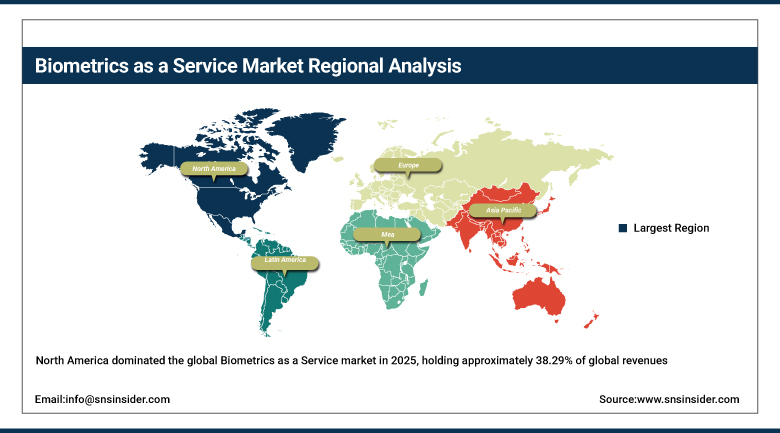
North America dominated the global Biometrics as a Service market in 2025, holding approximately 38.29% of global revenues. The United States accounts for approximately 84.73% of regional revenue through the domestic headquarters of leading BaaS providers and the extensive enterprise passwordless authentication and financial services digital onboarding deployment base. Canada contributes meaningful supplementary North American demand through its digital identity investment at federal and provincial programme levels and financial services biometric authentication adoption.
Get Customized Report as per Your Business Requirement - Enquiry Now
Europe Biometrics as a Service Market Insights
Europe held approximately 22.00% of global Biometrics as a Service revenues in 2025. Germany accounts for approximately 24.73% of European revenues through its enterprise technology adoption and domestic biometric identity research ecosystem. The eIDAS 2.0 European digital identity wallet framework is creating structured demand for BaaS providers capable of delivering EU-compliant biometric verification integrated with the European Digital Identity architecture. The United Kingdom, France, and the Netherlands contribute meaningful European demand through their financial services and government digital identity programmes.
Asia Pacific Biometrics as a Service Market Insights
Asia Pacific is the fastest-growing regional Biometrics as a Service market, projected to expand at a CAGR of approximately 23.06% through 2031 and maintaining above-average growth through 2035. India accounts for approximately 22.84% of Asia Pacific revenues through Aadhaar's world-leading biometric identity infrastructure, RBI's Video-KYC biometric authentication rules enabling remote banking, and DigiYatra's airport biometric boarding expansion. China is growing at approximately 19.3% CAGR through government-backed biometric verification infrastructure investment. Japan and South Korea contribute meaningful regional demand through their digital identity and financial services biometric adoption.
MEA & Latin America Biometrics as a Service Market Insights
Middle East and Latin America represent growing Biometrics as a Service markets where digital identity programmes and financial inclusion initiatives are creating BaaS adoption. The UAE leads MEA revenues at approximately 22.84% of the regional total through its advanced digital government services, Emirates ID biometric integration, and Saudi Arabia's SDAIA-certified biometric service requirements creating compliance-driven adoption. Brazil leads Latin American revenues at approximately 43.84% of the regional total through its large financial services digital transformation, Banco Central do Brasil's PIX payment system biometric verification, and the Brazilian population's high smartphone penetration enabling mobile biometric authentication.
Market Dynamics:
Growth Drivers: Digital KYC onboarding and government identity programs are accelerating large-scale BaaS adoption globally
The global financial services industry's progressive transition from in-branch to digital account opening is creating a structurally large and growing BaaS demand whose scale is proportional to the volume of digital onboarding transactions whose regulatory KYC compliance requires identity verification at a biometric confidence level that document scanning alone cannot reliably achieve. Anti-money laundering regulations in major financial markets mandate that remote customer onboarding achieve equivalent identity assurance to in-person verification, a requirement whose practical implementation requires biometric liveness detection and identity document comparison that BaaS platforms deliver as a cloud API call integrated within digital onboarding customer journeys.
Government digital identity infrastructure programmes including national digital ID wallets, biometric passport issuance, and benefits access verification each require biometric verification at population scale whose transaction volume and geographic distribution create demand for the elastic cloud processing that BaaS architecture provides.
Restraints: Privacy regulations and surveillance concerns create compliance challenges for biometric service providers
Biometric data's special category status under GDPR, CCPA, and equivalent national data protection frameworks creates specific consent, purpose limitation, and data retention obligations whose compliance management adds legal and operational complexity to BaaS deployments that conventional cloud SaaS procurement does not encounter. The combination of GDPR biometric data processing prohibition absent explicit consent and public health necessity or legitimate interest legal basis, BIPA's biometric data disclosure and written consent requirements in Illinois, and similar state-level requirements in Texas, Washington, and New York creates a US multi-jurisdiction compliance matrix whose management requires dedicated legal analysis at each state of BaaS consumer deployment. Public concern about facial recognition's potential for mass surveillance and algorithmic bias creates reputational risk for organisations deploying visible facial biometric systems in public-facing commercial contexts.
Opportunities: Passwordless authentication and AI fraud prevention solutions offer premium BaaS growth opportunities
Enterprise passwordless authentication, whose adoption is accelerating following the Cybersecurity and Infrastructure Security Agency's guidance recommending phishing-resistant MFA including biometric authentication as the preferred multi-factor credential type for protecting high-value systems, creates a structurally growing BaaS demand at the enterprise IT security layer that is proportional to the global workforce's digital device count. Each enterprise employee replaced from password authentication to biometric device-native authentication represents a BaaS integration deployment point whose recurring per-authentication transaction revenue accumulates proportionally with enterprise workforce headcount and authentication event frequency.
AI-powered identity fraud prevention using behavioural biometrics, device intelligence, and transaction pattern analysis creates a premium BaaS fraud detection service layer whose value justification is measured in fraud loss prevention rather than authentication cost, enabling premium pricing relative to pure authentication verification services.
Recent Developments:
-
2025: Thales Group expanded SafeNet Trusted Access with hybrid cloud biometric verification enabling government and financial institution clients to store biometric templates locally under sovereign data requirements while accessing cloud-native matching APIs, addressing GDPR biometric data residency compliance for European regulated entities.
-
2025: Singapore's HTX launched next-generation multimodal biometric airport clearance integrating face, iris, and fingerprint for on-the-move scanning, demonstrating operational BaaS-enabled multimodal identity verification at high-throughput border processing.
-
2025: NEC Corporation expanded its biometric solutions portfolio by acquiring an AI-driven biometric analytics startup, and iProov reported growing adoption of its NIST-validated Genuine Presence Assurance technology in U.S. financial services digital onboarding.
Biometrics as a Service Market Key Players are:
-
Microsoft Corporation
-
Google LLC
-
IBM Corporation
-
NEC Corporation
-
Thales Group
-
Fingerprint Cards AB
-
IDEMIA (OT-Morpho)
-
AWARE, Inc.
-
Daon, Inc.
-
Nuance Communications (Microsoft)
-
BioCatch Ltd.
-
FaceTec (ZoOm)
-
Authenteq
-
HYPR Corp.
-
Recognize
-
SecurID (formerly RSA SecurID)
-
Veridium Ltd.
-
Sensory, Inc.
Biometrics as a Service Market Report Scope:
| Report Attributes | Details |
|---|---|
| Market Size in 2025 | USD 6.259 Billion |
| Market Size by 2035 | USD 29.43 Billion |
| CAGR | CAGR of 16.74% From 2026 to 2035 |
| Base Year | 2025 |
| Forecast Period | 2026-2035 |
| Historical Data | 2022-2024 |
| Report Scope & Coverage | Market Size, Segments Analysis, Competitive Landscape, Regional Analysis, DROC & SWOT Analysis, Forecast Outlook |
| Key Segments | • By Biometric Type (Fingerprint Recognition, Facial Recognition, Iris Recognition, Voice Recognition, Palm & Vein Recognition, Multimodal Biometrics) • By Authentication Mode (Single-Factor Authentication, Multi-Factor Authentication) • By Application (Identity & Access Management, Fraud Detection & Prevention, Attendance & Workforce Management, Mobile & Web Authentication, Border Control & Law Enforcement) • By End User (BFSI, Government & Defense, Healthcare, IT & Telecom, Retail & E-commerce, Education, Travel & Transportation) |
| Regional Analysis/Coverage | North America (US, Canada), Europe (Germany, UK, France, Italy, Spain, Russia, Poland, Rest of Europe), Asia Pacific (China, India, Japan, South Korea, Australia, ASEAN Countries, Rest of Asia Pacific), Middle East & Africa (UAE, Saudi Arabia, Qatar, South Africa, Rest of Middle East & Africa), Latin America (Brazil, Argentina, Mexico, Colombia, Rest of Latin America). |
| Company Profiles | Microsoft Corporation, Google LLC, Amazon Web Services (AWS), IBM Corporation, NEC Corporation, Thales Group, Fingerprint Cards AB, IDEMIA (OT-Morpho), HID Global, AWARE, Inc., Daon, Inc., Nuance Communications (Microsoft), BioCatch Ltd., FaceTec (ZoOm), Authenteq, HYPR Corp., Recognize, SecurID (formerly RSA SecurID), Veridium Ltd., Sensory, Inc. |
Frequently Asked Questions
The Biometrics as a Service Market is expected to grow at a CAGR of 16.74% from 2026 to 2035.
The Biometrics as a Service Market was valued at USD 6.259 Billion in 2025.
Digital KYC, government identities, passwordless authentication, multimodal biometrics, and eIDAS frameworks are driving BaaS market growth.
The Facial Recognition segment dominated the Biometrics as a Service Market.
North America dominated the Biometrics as a Service Market in 2025.
