
Boiler Combustion Chamber Market Report Scope & Overview:
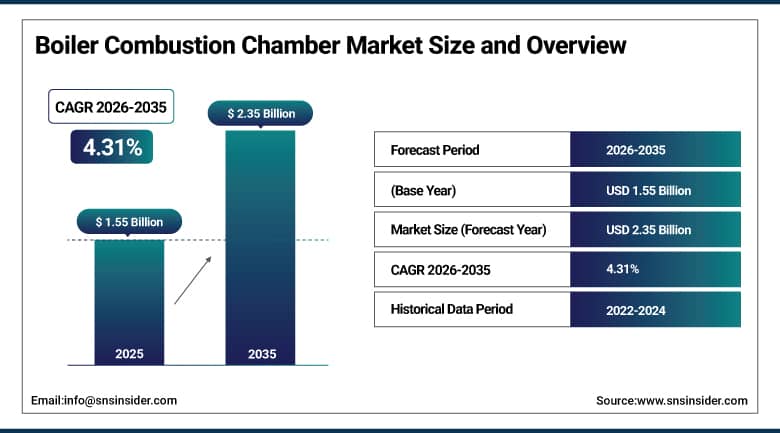
Boiler Combustion Chamber Market was valued at USD 1.55 billion in 2025 and is expected to reach USD 2.35 billion by 2035, growing at a CAGR of 4.31% from 2026-2035.
The Boiler Combustion Chamber Market is witnessing growth as result of increasing demand for energy efficient boilers, improved fuel utilization, and lower emissions across industrial and power generation applications. The need for modern combustion chambers is increasing as old boilers are upgraded and new industrial infrastructure is built. The use of biomass and natural gas as fuel sources, together with increased automation, digital controls and combustion technologies, have made boiler processes efficient, controllable and environmental friendly. Increasing expenditure on power generation and industrial upgrades, energy savings and emission reducing technologies is also driving the market growth. Innovations in combustion technology, refractories, fuel sources, and monitoring systems have improved the thermal efficiency, reliability and performance of boilers.
In September 2024, the U.S. Department of Energy (DOE) updated its Purchasing Energy-Efficient Boilers guidance, specifying efficiency requirements for commercial boilers and emphasizing combustion efficiency, thermal efficiency, precise air-fuel ratio control, oxygen trim systems, and modulating burners to improve boiler performance and reduce energy consumption.
To Get More Information On Boiler Combustion Chamber Market - Request Free Sample Report
Boiler Combustion Chamber Market Trends
-
Growing demand for industrial steam, process heat, and power generation across energy-intensive industries.
-
Rising adoption of high-efficiency and low-emission combustion technologies to improve fuel efficiency and reduce emissions.
-
Continued adoption of energy-efficient boilers and advanced combustion technologies improving fuel utilization and reducing emissions.
-
Increasing integration of automation, digital controls, and real-time monitoring for improved combustion control and boiler performance.
-
Expanding use of biomass and alternative fuels to improve fuel flexibility and reduce dependence on conventional fossil fuels.
Boiler Combustion Chamber Market Outlook
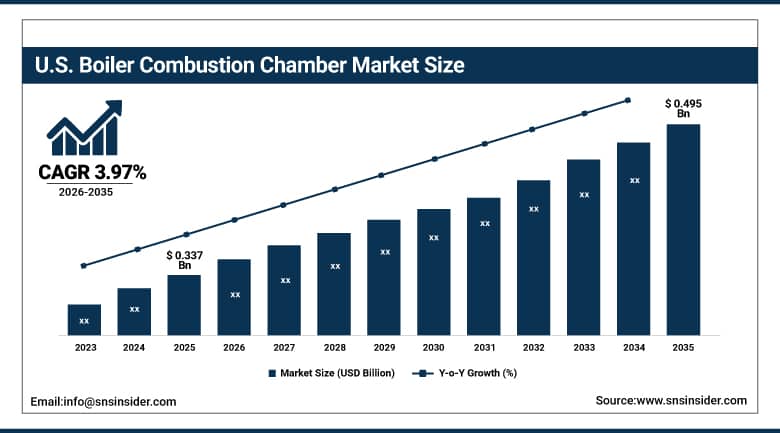
The U.S. Boiler Combustion Chamber Market was valued at USD 0.337 Billion in 2025 and is expected to reach USD 0.495 Billion by 2035, growing at a CAGR of 3.97% from 2026-2035.
U.S. growth of Boiler Combustion Chamber Market will remain supported by continuous industrial boiler replacement and modernization, increasing demand for energy-efficient and low-emission combustion systems, and the adoption of advanced combustion control and monitoring technologies. On the demand side, it is to be noted that domestic demand will get a boost from gas-fired systems still being the largest fuel segment, while the fastest growing application segment in the modelled market is industrial applications. The latter will be driven by increasing industrial process-heat needs, retrofitting of ageing boiler systems and adoption of automation, digital controls and energy-efficient combustion technologies.
In January 2025, the U.S. Department of Energy announced more than USD 136 million for 66 industrial technology projects focused on reducing energy demand and improving productivity across energy- and emissions-intensive industries, supporting continued investment in advanced industrial heating and energy-efficiency technologies.
Boiler Combustion Chamber Market Segment Analysis
-
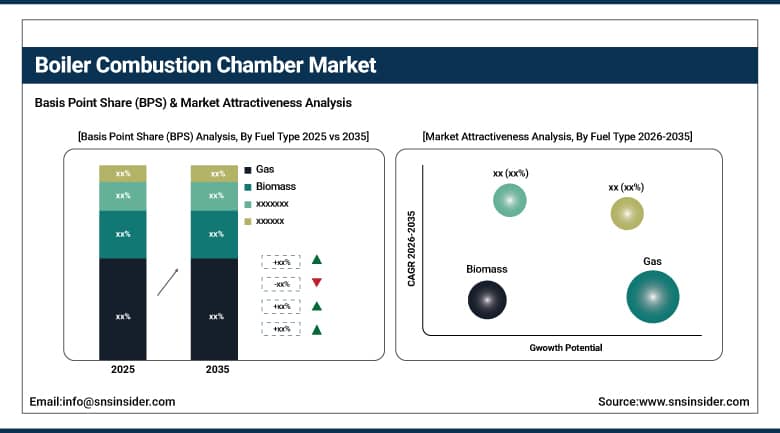
By Fuel Type, the Gas segment dominated the Boiler Combustion Chamber Market with approximately 40.10% share in 2025, while Biomass is the fastest growing with a CAGR of approximately 5.67%.
-
By Design Type, the Dry Bottom segment dominated the Boiler Combustion Chamber Market with approximately 75.80% share in 2025, while Dry Bottom is the fastest growing with a CAGR of approximately 4.66%.
-
By Material Type, the Castable segment dominated the Boiler Combustion Chamber Market with approximately 44.00% share in 2025, while Castable is the fastest growing with a CAGR of approximately 5.00%.
-
By Application, the Residential segment dominated the Boiler Combustion Chamber Market with approximately 44.10% share in 2025, while Power Generation is the fastest growing with a CAGR of approximately 6.01%.
-
By Technology, the Subcritical segment dominated the Boiler Combustion Chamber Market with approximately 42.10% share in 2025, while Ultra-Supercritical is the fastest growing with a CAGR of approximately 6.03%.
-
By End Use Industry, the Chemical & Petrochemical segment dominated the Boiler Combustion Chamber Market with approximately 27.30% share in 2025, while Pulp & Paper is the fastest growing with a CAGR of approximately 7.12%.
By Fuel Type, Gas dominates and Biomass grows fastest.
Gas constitutes the dominating segment in the Boiler Combustion Chamber Market due to the widespread adoption of natural gas-fired boiler systems across industrial and power generation applications, supported by the demand for efficient combustion, reliable fuel supply, and lower emissions compared with more carbon-intensive fuels. The demand for gas-fired combustion chambers is supported by increasing focus on energy efficiency, modernization of ageing boiler systems, and adoption of advanced combustion control technologies.
Biomass constitutes the fastest growing segment in the Boiler Combustion Chamber Market due to increasing interest in renewable and lower-carbon fuel sources, along with the growing adoption of biomass-fired boiler systems in industrial heating and power generation applications. Initiatives to reduce dependence on traditional fossil fuels, fuel diversification and the use of renewable and locally available biomass resources for heat and power generation are driving the biomass segment.
By Design Type, Dry Bottom dominates the Boiler Combustion Chamber Market and grows fastest.
Dry Bottom constitutes the dominating segment in the Boiler Combustion Chamber Market due to its widespread adoption across industrial and power generation boiler systems, supported by its suitability for conventional combustion processes and relatively straightforward operation and maintenance requirements. Increasing demand for reliable boiler systems, modernization of existing installations and the need for efficient combustion under diverse operating conditions are some of the issues supporting the adoption of dry bottom combustion chambers.
Dry Bottom constitutes the fastest growing segment in the Boiler Combustion Chamber Market due to continued investments in efficient boiler systems and the replacement and upgrading of aging combustion equipment. The segment is driven by rising adoption of advanced combustion controls, improved fuel-air management and refractory solutions that enhance combustion efficiency, operational reliability and maintenance performance.
By Material Type, Castable dominates and grows fastest.
Castable constitutes the dominating segment in the Boiler Combustion Chamber Market due to its widespread adoption as a flexible and durable refractory solution for boiler combustion chamber applications. Castable materials are compatible with many combustion chamber geometries, and provide thermal protection and insulation under high temperature operating conditions. The ease with which castable materials can be installed, repaired and maintained is helping to drive their uptake in industrial boiler systems.
Castable constitutes the fastest growing segment in the Boiler Combustion Chamber Market due to increasing demand for durable refractory solutions that can withstand high temperatures and demanding combustion conditions. The segment is driven by an increasing need to reduce boiler maintenance requirements, improve refractory service life and improve operational reliability. Advances in castable formulations and installation techniques continue to support their use for modern boiler combustion chamber applications.
By Application, Power Generation dominates and Industrial grows fastest.
Power Generation constitutes the dominating segment in the Boiler Combustion Chamber Market due to the extensive use of boiler systems for steam generation and electricity production across power generation facilities. The demand for reliable electricity supply, expansion and modernization of power infrastructure, and the need to improve boiler efficiency and fuel utilization are the major factors driving the demand for combustion chambers in power generation applications.
Industrial constitutes the fastest growing segment in the Boiler Combustion Chamber Market due to increasing demand for process heat and steam across manufacturing industries, including chemical and petrochemical, food and beverage, metallurgy, pharmaceuticals, and pulp and paper. The industrial segment is driven by the replacement of ageing boiler systems, increasing adoption of energy-efficient combustion technologies and increasing investments in automation, combustion control and low-emission boiler systems.
By Technology, Subcritical dominates and Ultra-Supercritical grows fastest.
Subcritical constitutes the dominating in the Boiler Combustion Chamber Market due to its widespread deployment across conventional power generation facilities and its established operating infrastructure. The demand for subcritical technology based combustion chambers is driven by the continued use of subcritical boiler systems in existing power plants, where reliability, established technology and low cost operation are pertinent.
Ultra-Supercritical constitutes the fastest growing segment in the Boiler Combustion Chamber Market due to the increasing focus on higher thermal efficiency, improved fuel utilization, and reduced emissions from coal-fired power generation. The segment is supported by investments in next generation power generation technologies, upgrades to existing facilities and the installation of highly-efficient boiler systems capable of operating at higher temperatures and pressures.
By End Use Industry, Chemical & Petrochemical dominates and Pulp and Paper grows fastest.
Chemical & Petrochemical constitutes the dominating segment in the Boiler Combustion Chamber Market due to the extensive use of boiler systems for process steam, heating, and energy-intensive operations across chemical and petrochemical facilities. Rising demand for reliable process heat, expansion of chemical manufacturing capacity and modernization of existing industrial boiler systems are driving the demand for combustion chambers in this segment.
Pulp & Paper constitutes the most fastest growing segment in the Boiler Combustion Chamber Market due to the increasing need for process steam and heat across pulp and paper manufacturing operations. The segment is driven by investments in energy-efficient boiler systems, rising adoption of biomass and other alternative fuels, and efforts to enhance energy utilization and reduce operating costs across paper production facilities.
Regional Analysis
|
Region |
Major Country |
Share within Region, 2025 (%) |
|---|---|---|
|
North America |
United States |
82.50% |
|
Asia Pacific |
China |
45.30% |
|
Europe |
United Kingdom |
32.80% |
|
Latin America |
Brazil |
38.60% |
|
Middle East & Africa |
Israel |
41.20% |
North America Boiler Combustion Chamber Market Insights.
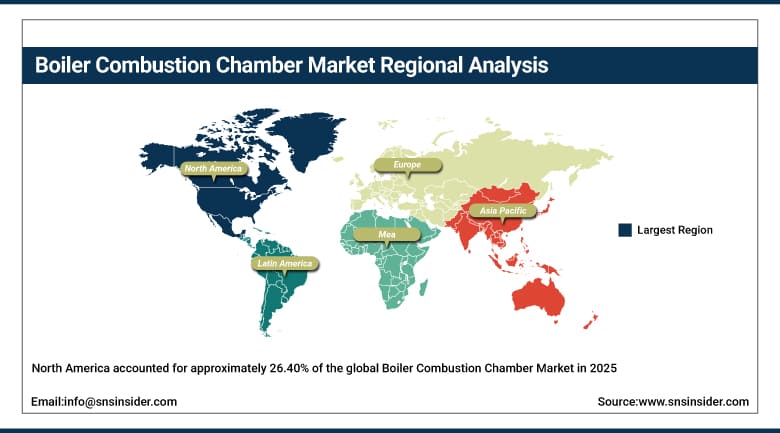
North America accounted for approximately 26.40% of the global Boiler Combustion Chamber Market in 2025, driven by continued investment in industrial boiler modernization, replacement of aging boiler systems, demand for energy-efficient combustion technologies, and the adoption of advanced combustion control and monitoring systems. The United States accounts for the substantial majority of regional demand, reflecting its large industrial base, well-established power generation infrastructure and ongoing investments in boiler efficiency and emissions reduction technologies.
Canada contributes additional regional demand through industrial heating requirements, process industries, and ongoing modernization of boiler systems. Technological developments in combustion systems such as improved fuel-air control, digital monitoring, automation, and low-emission technologies, further establish North America as a prime regional market for boiler combustion chambers.
Get Customized Report as Per Your Business Requirement - Enquiry Now
Asia Pacific Boiler Combustion Chamber Market Insights.
Asia Pacific is anticipated to witness the highest CAGR of approximately 4.78% among all regional segments of the Boiler Combustion Chamber Market throughout the forecast period from 2026 to 2035, supported by increasing industrialization, expansion of manufacturing and power generation capacity, and rising demand for efficient boiler systems across the region. China will make the largest contribution among all countries in the region. This is due to its large industrial base, expanding power generation infrastructure and continued investments in energy efficient and modern boiler systems.
The contribution Japan will be supported by industrial modernization, energy-efficiency initiatives, and the replacement of ageing boiler systems, India will have a growing contribution in terms of expanding industrial and power generation activities, increasing infrastructure investments and rising demand for efficient combustion technologies.
Europe Boiler Combustion Chamber Market Insights
Europe represents a significant regional market for boiler combustion chamber technology, anchored by the region's established industrial manufacturing sector and its focus on energy-efficient boiler systems. Germany's share within the European market reflects its strong industrial base, established chemical and manufacturing industries, and continued investment in modern boiler technologies and combustion efficiency improvements.
France and the United Kingdom contribute additional regional demand, supported by established industrial sectors and ongoing modernization of commercial and industrial boiler systems. Continued European investment in energy efficiency, emissions reduction, industrial modernization, and cleaner fuel technologies supports steady regional demand for advanced boiler combustion chamber technology.
MEA & Latin America Boiler Combustion Chamber Market Insights
The Middle East & Africa remains an increasing area of strategic significance, with demand arising from countries such as the United Arab Emirates, which is investing in industrial infrastructure, energy efficiency, and modern boiler systems to support expanding industrial activities. Markets within the Gulf Cooperation Council add to regional demand because of investments in power generation, manufacturing, and energy-intensive industries.
In Latin America, the Boiler Combustion Chamber Market is led by Brazil, which represents a major share of regional demand owing to its established industrial sector and growing adoption of efficient boiler technologies. Expansion of manufacturing, food processing, pulp and paper, and power generation activities is gradually supporting increased regional demand for modern combustion chamber systems.
Market Dynamics
Growth Drivers: Energy Efficiency Demand and Aging Boiler Infrastructure Modernization
Rising demand for energy-efficient boiler systems and the modernization of aging industrial infrastructure represent primary growth drivers for the Boiler Combustion Chamber Market, as industries continue investing in advanced boiler systems to improve fuel utilization, thermal efficiency, and operational reliability. This dynamic is further bolstered by the rising use of advanced combustion technologies such as improved air-fuel control, automated combustion management and emissions monitoring systems that improve boiler performance in power generation and industrial applications.
Replacement and upgrading of aging boiler equipment provide an additional significant source of demand, as industries seek to improve combustion efficiency, reduce maintenance requirements, and comply with increasingly stringent emissions standards. With the increased use of natural gas, biomass and other cleaner fuels, industrial and power generation facilities will continue to move to more efficient, lower-emission combustion systems, which will also grow the market.
Restraints: High Maintenance Costs and Operational Complexity
High maintenance costs associated with boiler combustion chambers represent a significant restraint on the Boiler Combustion Chamber Market, as regular inspection, refractory maintenance, component replacement, and combustion-system servicing can increase operating expenses for industrial and power generation facilities. As boiler infrastructure ages, it can require more frequent maintenance and cause unexpected downtime, adding further operational risks and costs for industries that rely on steady steam and heat production.
The complexity of integrating advanced combustion control, emissions-monitoring, and automation systems adds further challenges for operators, as specialized technical expertise and periodic maintenance are required to ensure consistent performance. As boiler infrastructure ages, it may require more frequent maintenance and cause unexpected downtime, adding further operational risks and costs for industries relying on steady steam and heat production.
Opportunities: Automated Combustion Advancements and Energy-Efficient Boiler Technologies
The Boiler Combustion Chamber Market is experiencing high growth in CAGR owing to the advancement of automated combustion systems. The industries are adopting intelligent control technologies to optimize combustion conditions and improve the performance of boilers. Automatic monitoring and control could result in better air-fuel management and even stable combustion together with rapid response under varying loads. This could assist industrial users to ensure they are using their energy efficiently and reducing their losses including thermal output.
A further opportunity for manufacturers of combustion chambers is the development of energy efficient boiler technologies as industries look for solutions that may improve thermal performance and allow cleaner and more flexible operations. Modern combustion chambers and boilers, coupled with better monitoring and fuel management technologies, will improve the efficiency of the whole system. The modernization of thermal equipment in industrial plants will provide an opportunity for suppliers of modern solutions in the area of combustion technology to meet new market demands.
Recent Developments:
-
2025: Mitsubishi Heavy Industries developed ammonia single-fuel burners for coal-fired boilers, supporting ammonia fuel conversion, stable combustion, and emissions reduction.
-
2025: Cardiff University and Net Zero Innovation Institute demonstrated 100% ammonia combustion at 500 kW using an Integrated Cracking Burner.
-
2026: Energy and AI researchers developed a multimodal system for combustion stability diagnosis in 660 MWth coal-fired boilers using operational data and flame images.
Boiler Combustion Chamber Market Equipment & Machinery Key Players
-
Babcock & Wilcox Enterprises, Inc.
-
Mitsubishi Heavy Industries, Ltd.
-
General Electric Company
-
Bosch Industriekessel GmbH
-
Thermax Limited
-
Siemens Energy AG
-
Cleaver-Brooks, Inc.
-
Viessmann Werke GmbH & Co. KG
-
John Wood Group PLC
-
Hurst Boiler & Welding Company, Inc.
-
Foster Wheeler AG (Wood Group)
-
SAACKE GmbH
-
Alstom SA
-
Rex Materials, Inc.
-
Yanmar Holdings Co., Ltd.
-
Toshiba Corporation
-
Doosan Enerbility Co., Ltd.
-
Clyde Bergemann Power Group
-
AC Boilers S.p.A.
-
Thermo Dynamics
Boiler Combustion Chamber Market Report Scope:
| Report Attributes | Details |
|---|---|
| Market Size in 2025 | USD 1.55 Billion |
| Market Size by 2035 | USD 2.35 Billion |
| CAGR | CAGR of 4.31% From 2026 to 2035 |
| Base Year | 2025 |
| Forecast Period | 2026-2035 |
| Historical Data | 2022-2024 |
| Report Scope & Coverage | Market Size, Segments Analysis, Competitive Landscape, Regional Analysis, DROC & SWOT Analysis, Forecast Outlook |
| Key Segments | • Fuel Type (Biomass, Coal, Gas, Oil) • Design Type (Dry Bottom, Wet Bottom) • Material Type (Castable, Insulation, Refractory) • Application (Commercial, Industrial, Power Generation, Residential) • Technology (Subcritical, Supercritical, Ultra-Supercritical) • End Use Industry (Chemical & Petrochemical, Food & Beverage, Metallurgy, Pharmaceuticals, Pulp & Paper) • Region |
| Regional Analysis/Coverage | North America (US, Canada), Europe (Germany, UK, France, Italy, Spain, Russia, Poland, Rest of Europe), Asia Pacific (China, India, Japan, South Korea, Australia, ASEAN Countries, Rest of Asia Pacific), Middle East & Africa (UAE, Saudi Arabia, Qatar, South Africa, Rest of Middle East & Africa), Latin America (Brazil, Argentina, Mexico, Colombia, Rest of Latin America). |
| Company Profiles | Babcock & Wilcox Enterprises, Inc., Mitsubishi Heavy Industries, Ltd., General Electric Company, Bosch Industriekessel GmbH, Thermax Limited, Siemens Energy AG, Cleaver-Brooks, Inc., Viessmann Werke GmbH & Co. KG, John Wood Group PLC, Hurst Boiler & Welding Company, Inc., Foster Wheeler AG (Wood Group), SAACKE GmbH, Alstom SA, Rex Materials, Inc., Yanmar Holdings Co., Ltd., Toshiba Corporation, Doosan Enerbility Co., Ltd., Clyde Bergemann Power Group, AC Boilers S.p.A., Thermo Dynamics |
