
Cardiac Mapping Systems Market Report Scope & Overview
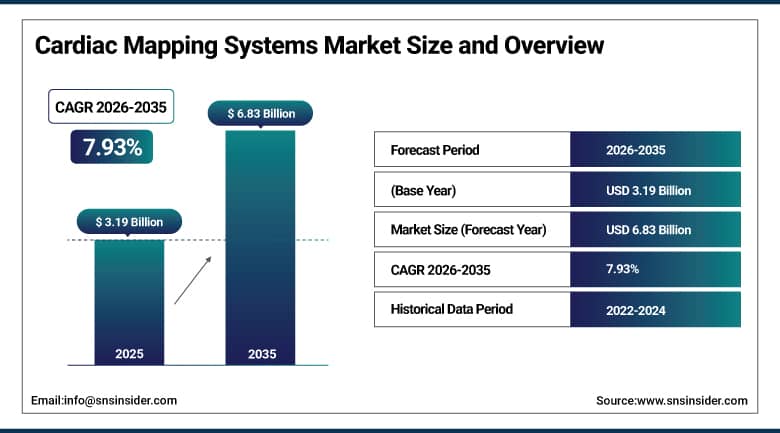
The Cardiac Mapping Systems Market was valued at USD 3.19 Billion in 2025 and is projected to reach USD 6.83 Billion by 2035, expanding at a CAGR of 7.93% from 2026 to 2035.
Factors such as the growing incidences of cardiac arrhythmias, increasing uptake of catheter ablation procedures, and ongoing innovations in three-dimensional electro-anatomical mapping technologies are responsible for the market growth. Introduction Health care providers are increasingly adopting high-precision cardiac mapping systems to increase procedure accuracy, reduce fluoroscopy exposure and improve treatment outcomes in complex electrophysiology procedures. The market is growing globally due to increasing investments in infrastructure for cardiovascular care, increasing number of electrophysiology laboratories and increasing need for minimally invasive cardiac interventions.
In March 2026, Biosense Webster announced the expansion of its CARTO™ mapping ecosystem with advanced AI-enabled workflow enhancements for complex electrophysiology procedures. Abbott’s EnSite™ X platform, which was improved in September 2025 with enhanced mapping and interoperability, is used to perform advanced cardiac ablation procedures.
To Get More Information On Cardiac Mapping Systems Market - Request Free Sample Report
Market Trends
-
Increasing adoption of high-density three-dimensional cardiac mapping systems for enhanced procedural precision and complex arrhythmia localization.
-
Growing integration of artificial intelligence into electrophysiology workflows to improve mapping accuracy and clinical decision-making.
-
Rising demand for minimally invasive catheter ablation procedures supported by advanced real-time cardiac mapping technologies.
-
Expanding utilization of cloud-enabled electrophysiology data platforms for seamless data sharing and workflow optimization.
-
Increasing investments in next-generation cardiac imaging and mapping technologies to enhance treatment outcomes and procedural efficiency.
U.S. Cardiac Mapping Systems Market Outlook
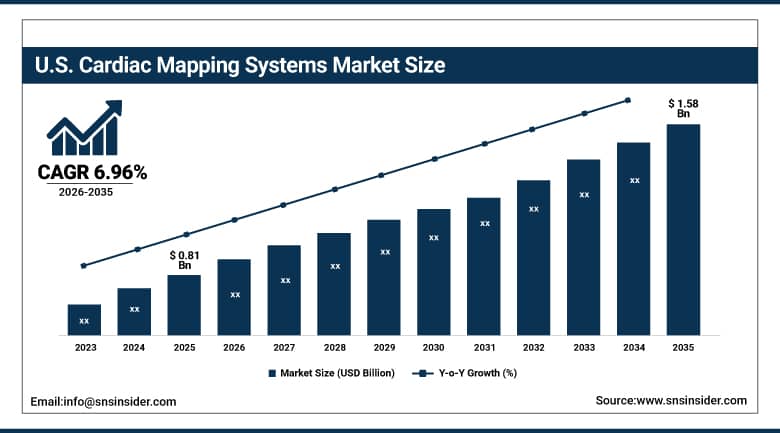
The U.S. Cardiac Mapping Systems Market was valued at approximately USD 0.81 Billion in 2025 and is expected to reach approximately USD 1.58 Billion by 2035, growing at a CAGR of approximately 6.96% from 2026 to 2035.
Market growth is being driven by a number of factors, including the rising incidence of atrial fibrillation and other cardiac arrhythmias, the increasing demand for minimally invasive catheter ablation procedures, and ongoing innovation in electrophysiology technology. Hospital and heart centres are investing more in high-density 3D mapping systems, AI-assisted navigation platforms and integrated electrophysiology labs to improve accuracy and patient outcomes in procedures. Increasing adoption of advanced cardiac imaging technologies, rising healthcare expenditure and favorable reimbursement policies are expected to drive the long-term growth of the market in the United States.
Boston Scientific to Expand Clinical Use of Its FARAPULSE™ Pulsed Field Ablation System with Advanced Cardiac Mapping to Improve Atrial Fibrillation Treatment Workflows in U.S. Electrophysiology Centres in 2026. In 2025, Medtronic further expanded its electrophysiology portfolio with the addition of the Affera™ Mapping and Ablation System and advanced catheter technologies, which allow for enhanced mapping accuracy and procedural efficiency for complex arrhythmia procedures.
Cardiac Mapping Systems Market Segment Analysis
-
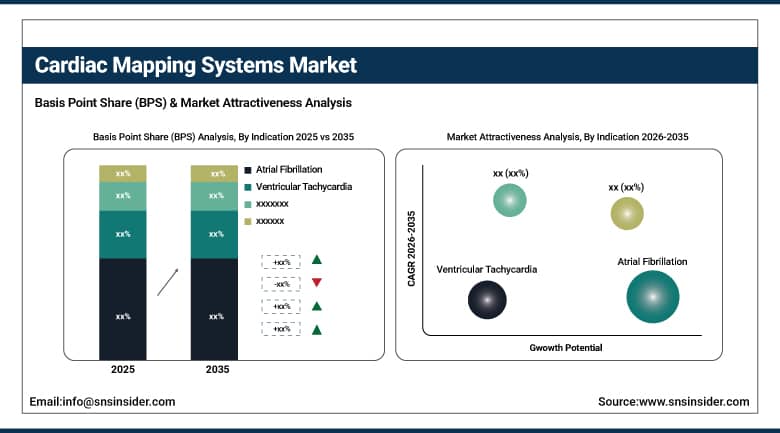
By Indication, Atrial Fibrillation dominated the Cardiac Mapping Systems Market with 46.80% share in 2025, while Ventricular Tachycardia is the fastest growing indication segment from 2026 to 2035.
-
By Product Type, Electroanatomical Mapping Systems dominated the Cardiac Mapping Systems Market with 48.30% share in 2025, while Non-Contact Mapping Systems are the fastest growing product segment from 2026 to 2035.
-
By End User, Hospitals dominated the Cardiac Mapping Systems Market with 56.40% share in 2025, while Specialty Cardiac Clinics are the fastest growing end-user segment from 2026 to 2035.
-
By Technology, Magnetic Mapping Systems dominated the Cardiac Mapping Systems Market with 44.70% share in 2025, while AI-Integrated Mapping Systems are the fastest growing technology segment from 2026 to 2035.
By Indication, Atrial Fibrillation dominates, Ventricular Tachycardia grows fastest
Atrial Fibrillation dominated the Cardiac Mapping Systems Market in 2025 and accounted for approximately 46.80% revenue share. Rising global prevalence of atrial fibrillation, increasing catheter ablation procedures, and growing preference for minimally invasive treatment approaches continue driving adoption of advanced cardiac mapping technologies. Healthcare providers increasingly utilize high-density mapping systems to improve procedural precision and long-term clinical outcomes.
Ventricular Tachycardia is projected to witness the fastest CAGR during the forecast period owing to increasing diagnosis of complex ventricular arrhythmias and growing adoption of advanced electrophysiology procedures. Continuous innovation in high-resolution mapping technologies and increasing investments in complex arrhythmia treatment continue strengthening commercialization opportunities across ventricular tachycardia management.
By Product Type, Electroanatomical Mapping Systems dominate, Non-Contact Mapping Systems grow fastest
Electroanatomical Mapping Systems dominated the Cardiac Mapping Systems Market in 2025 and held approximately 48.30% revenue share. The adoption of three-dimensional visualization technologies, precise catheter navigation and real-time electrophysiology mapping has increased, which has helped in its widespread utilization across hospitals and cardiac centres. The demand for accurate localization of complex arrhythmias and the increasing efficiency of procedures have also promoted the commercialization opportunities of electroanatomical mapping technologies across global electrophysiology ecosystems.
Non-Contact Mapping Systems are expected to register the fastest CAGR during the forecast period, owing to the increasing demand for fast chamber mapping and shorter procedure time. Continued advances in high resolution imaging, AI-assisted signal processing and next generation electrophysiology platforms are expanding commercialization opportunities in non-contact cardiac mapping technologies. Further, growing adoption of minimally invasive cardiac interventions is supporting long term segment growth.
By End User, Hospitals dominate, Specialty Cardiac Clinics grow fastest
Hospitals dominated the Cardiac Mapping Systems Market in 2025 and held approximately 56.40% revenue share. Most electrophysiology procedures are still performed in large hospitals due to the availability of advanced infrastructure, specialized cardiac care teams, and comprehensive cardiovascular treatment services. Growing investments in hybrid operating rooms and electrophysiology laboratories further supported the market leadership across the globe.
Specialty Cardiac Clinics are anticipated to record fastest CAGR owing to increasing outpatient electrophysiology procedures and growing availability of specialized cardiac care. The increasing use of technology to enable minimally invasive procedures and the rising patient preference for dedicated cardiovascular centres continue to drive commercialization opportunities within specialty cardiac clinics.
By Technology, Magnetic Mapping Systems dominate, AI-Integrated Mapping Systems grow fastest
Magnetic Mapping Systems dominated the Cardiac Mapping Systems Market in 2025 and accounted for approximately 44.70% revenue share. The technology enables better catheter location accuracy, better navigation accuracy and better visualization during complex electrophysiology procedures. Ongoing technological innovations and adoption by advanced cardiac care centres further strengthen opportunities worldwide.
AI-Integrated Mapping Systems are anticipated to grow at the fastest CAGR due to the increasing adoption of artificial intelligence for automated signal interpretation, procedural optimization, and clinical decision support. The commercialization of AI-enabled cardiac mapping technologies across the globe continues to be driven by growing investments in intelligent electrophysiology platforms and digital healthcare transformation.
Regional Analysis
|
Region |
Major Country |
Share within Region, 2025 (%) |
|---|---|---|
|
North America |
United States |
78.85% |
|
Europe |
Germany |
27.90% |
|
Asia Pacific |
China |
42.60% |
|
Middle East |
Saudi Arabia |
34.10% |
|
Latin America |
Brazil |
46.80% |
North America Cardiac Mapping Systems Market Insights
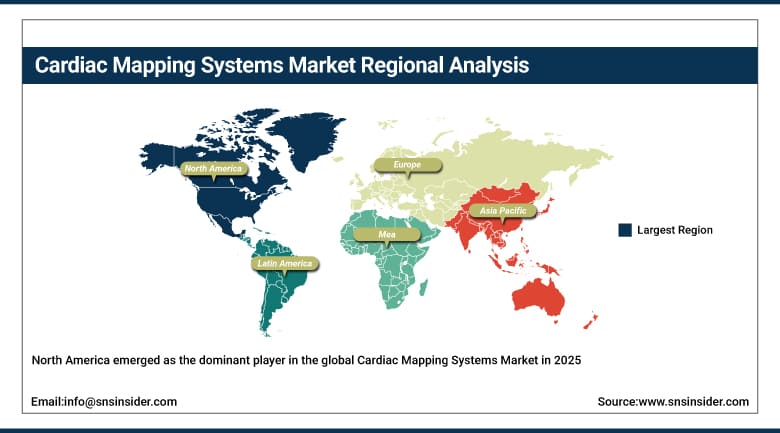
North America emerged as the dominant player in the global Cardiac Mapping Systems Market in 2025 and contributed around 32.22% to the global revenues. There are established electrophysiology labs in the region, increased utilization of catheter ablation procedures and continued investment in advanced cardiac imaging technologies. Healthcare providers are continually adopting AI-enabled mapping platforms, high-density electroanatomical systems and minimally invasive cardiac intervention technologies to improve procedural accuracy and patient outcomes.
The growing number of investments in cardiovascular research, positive reimbursement policies, and strong collaboration between medical device manufacturers and healthcare organizations are fueling the sustained growth of the market. North America is projected to witness commercialization of advanced cardiac mapping technologies driven by the adoption of digital electrophysiology platforms, cloud-based workflow integration and next-generation mapping systems.
Get Customized Report as Per Your Business Requirement - Enquiry Now
Europe Cardiac Mapping Systems Market Insights
In Europe, the trend of cardiac mapping systems continues to be strong with the growth of electrophysiology services, increasing diagnosis of cardiac arrhythmias, and growing use of minimally invasive cardiac procedures. Providers are investing in technologically advanced mapping platforms that improve procedural efficiency and support precision-guided catheter ablation. The regional market is being further strengthened by ongoing innovation in cardiovascular medical devices.
Increasing modernization of hospital infrastructure, growing government support for cardiovascular disease management and rising collaboration between research organizations and medical device manufacturers continue driving demand for advanced electrophysiology technologies. The region is projected to experience a steady growth over the forecast period, as healthcare systems continue to improve access to innovative solutions for cardiac treatment.
Asia Pacific Cardiac Mapping Systems Market Insights
The Asia Pacific is projected to experience the fastest growth over the forecast period due to the increasing healthcare infrastructure, rising burden of cardiovascular diseases, and investments in advanced electrophysiology services. Hospitals are constantly upgrading their capabilities with the use of next generation cardiac mapping technologies and minimally invasive treatment procedures. Growing awareness about the early diagnosis of arrhythmia is supporting market growth.
The region continues to grow on the strength of rising healthcare spending, greater investment in medical technology and the increasing availability of specialized cardiac care centres. The government initiatives towards healthcare modernization and rising collaborations between global medical device manufacturers and regional healthcare providers are likely to drive opportunities across Asia Pacific.
Middle East & Africa & Latin America Cardiac Mapping Systems Market Insights
In Middle East and Latin America, increasing prevalence of cardiovascular disease and increasing access to advanced electrophysiology procedures will drive the use of more cardiac mapping systems as healthcare is modernized. Healthcare providers are making significant investments in state-of-the-art cardiac catheterization labs and diagnostic technologies to enhance the quality of care and outcomes from procedures.
Rising healthcare investments, increasing physician training programmes and expanding partnerships with global medical device makers continue to boost the market. The increased adoption of minimally invasive cardiovascular therapies and better hospital infrastructure are likely to drive the long-term demand for advanced cardiac mapping systems in both the regions.
Market Dynamics
Growth Drivers: Rising prevalence of cardiac arrhythmias and increasing catheter ablation procedures
The growing incidence of atrial fibrillation, ventricular tachycardia and other cardiac rhythm disorders is driving the demand for advanced cardiac mapping systems. Electrophysiology laboratories are growing in size and three-dimensional electro anatomical mapping technologies are being adopted by healthcare providers around the world to improve procedural accuracy, reduce fluoroscopy exposure and improve patient outcomes during complex catheter ablation procedures.
Furthermore, the market growth is supported by the continuous development of AI-assisted mapping platforms, high-density mapping catheters and real-time visualization technologies. Increasing opportunities for cardiac mapping system manufacturers across the globe can be attributed to rising healthcare investments, increasing awareness regarding minimally invasive cardiac treatments, and growing adoption of precision-guided electrophysiology procedures.
Restraints: High equipment costs and shortage of skilled electrophysiologists
The high cost of acquisition, installation and maintenance of advanced cardiac mapping systems are still major barriers especially for smaller hospitals and healthcare facilities in developing regions. Large capital investments are often a barrier to technology adoption and a constraint on the growth of electrophysiology services in cost-conscious health care systems.
There is also a shortage of experienced electrophysiologists and trained clinical professionals, thus limiting the broader use of sophisticated mapping technologies. Global demand for advanced cardiac rhythm management solutions is increasing, but long physician training requirements, procedural complexity and limited availability of specialized electrophysiology centres continue to slow adoption.
Opportunities: AI-enabled mapping technologies and expanding electrophysiology infrastructure
The increasing integration of artificial intelligence, cloud computing and advanced analytics into cardiac mapping platforms is creating huge opportunities for next-generation electrophysiology solutions. These innovations enhance the accuracy of mapping, automate workflow processes, reduce procedure times and improve physician decision making during complex cardiac interventions.
In addition, the expansion of electrophysiology laboratories, increased investments in cardiovascular healthcare infrastructure and increased adoption of pulsed field ablation technologies are creating new growth opportunities. The global cardiac mapping systems market is expected to witness long-term commercialization backed by the increasing demand for personalized cardiac treatment, precision-guided procedures, and minimally invasive therapies.
Recent Developments
-
2026: Boston Scientific expanded the commercial rollout of its FARAPULSE™ Pulsed Field Ablation System, strengthening integration with advanced cardiac mapping technologies to improve complex electrophysiology procedures.
-
2026: Johnson & Johnson MedTech (Biosense Webster) introduced new AI-enabled workflow enhancements for the CARTO™ 3 System, improving electroanatomical mapping efficiency and catheter navigation during cardiac ablation procedures.
-
2025: Medtronic expanded clinical adoption of its Affera™ Mapping and Ablation System, strengthening integrated mapping and ablation capabilities for treating complex cardiac arrhythmias.
-
2025: Abbott enhanced its EnSite™ X EP System with advanced omnipolar mapping software, improving real-time cardiac visualization and procedural precision during electrophysiology interventions.
Key Players
-
Johnson & Johnson MedTech
-
Abbott Laboratories
-
Boston Scientific Corporation
-
Medtronic plc
-
Koninklijke Philips N.V.
-
GE HealthCare Technologies Inc.
-
Siemens Healthineers AG
-
MicroPort Scientific Corporation
-
Biotronik SE & Co. KG
-
Stereotaxis Inc.
-
Acutus Medical, Inc.
-
Lepu Medical Technology
-
CathVision ApS
-
Japan Lifeline Co., Ltd.
-
Baylis Medical Technologies
-
Kardium Inc.
-
Imricor Medical Systems
-
BioSig Technologies, Inc.
-
Osypka AG
-
CoreMap Ltd
Cardiac Mapping Systems Market Report Scope:
| Report Attributes | Details |
|---|---|
| Market Size in 2025 | USD 3.19 Billion |
| Market Size by 2035 | USD 6.83 Billion |
| CAGR | CAGR of 7.93% from 2026 to 2035 |
| Base Year | 2025 |
| Forecast Period | 2026-2035 |
| Historical Data | 2022-2024 |
| Report Scope & Coverage | Market Size, Segments Analysis, Competitive Landscape, Regional Analysis, DROC & SWOT Analysis, Forecast Outlook |
| Key Segments | • By Product Type (Electroanatomical Mapping Systems, Basket Catheter Mapping Systems, Contact Mapping Systems, Non-Contact Mapping Systems) • By Indication (Atrial Fibrillation, Atrial Flutter, Ventricular Tachycardia, Supraventricular Tachycardia, Other Arrhythmias) • By End User (Hospitals, Cardiac Catheterization Laboratories, Ambulatory Surgical Centers, Specialty Cardiac Clinics) • By Technology (Magnetic Mapping Systems, Impedance-Based Mapping Systems, Hybrid Mapping Systems, AI-Integrated Mapping Systems) |
| Regional Analysis/Coverage | North America (US, Canada, Mexico), Europe (Eastern Europe [Poland, Romania, Hungary, Turkey, Rest of Eastern Europe] Western Europe] Germany, France, UK, Italy, Spain, Netherlands, Switzerland, Austria, Rest of Western Europe]), Asia Pacific (China, India, Japan, South Korea, Vietnam, Singapore, Australia, Rest of Asia Pacific), Middle East & Africa (Middle East [UAE, Egypt, Saudi Arabia, Qatar, Rest of Middle East], Africa [Nigeria, South Africa, Rest of Africa], Latin America (Brazil, Argentina, Colombia, Rest of Latin America) |
| Company Profiles | Johnson & Johnson MedTech (Biosense Webster), Abbott Laboratories, Boston Scientific Corporation, Medtronic plc, Koninklijke Philips N.V., GE HealthCare Technologies Inc., Siemens Healthineers AG, MicroPort Scientific Corporation, Biotronik SE & Co. KG, Stereotaxis Inc., Acutus Medical, Inc., Lepu Medical Technology, CathVision ApS, Japan Lifeline Co., Ltd., Baylis Medical Technologies, Kardium Inc., Imricor Medical Systems, BioSig Technologies, Inc., Osypka AG, CoreMap Ltd. |
Frequently Asked Questions
The increasing prevalence of cardiac arrhythmias, rising catheter ablation procedures, and growing adoption of advanced three-dimensional electroanatomical mapping technologies are major factors driving market growth globally.
Electroanatomical Mapping Systems dominated the market in 2025 due to their superior mapping accuracy, real-time visualization capabilities, and widespread use in complex electrophysiology procedures.
North America dominated the Cardiac Mapping Systems Market in 2025 due to advanced electrophysiology infrastructure, increasing adoption of minimally invasive cardiac procedures, and continuous technological innovation in cardiac mapping systems.
