
Cell Tracing and Tracking Test Market Report Scope & Overview:
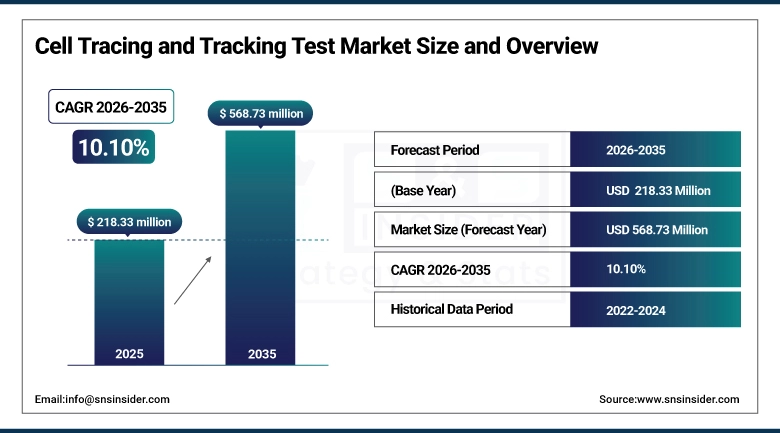
The Cell Tracing and Tracking Test Market size is estimated at USD 218.33 Million in 2025 and is expected to reach USD 568.73 Million by 2035, growing at a CAGR of 10.10% over the forecast period of 2026-2035.
The analysis report for the Cell Tracing & Tracking Test Market provides insights into the market dynamics, technology developments, and major research applications. The growth in the cell tracing and tracking test market is attributed to increased investments in cell research, growth in cell and gene therapies, increased need for regenerative medicine, and increased use of advanced imaging and labeling technologies. These services play an important role in cell migration, cell proliferation, and cell lineage studies in oncology, stem cell therapy, immunology, and drug discovery.
In 2025, over 1.8 million experiments focused on cell lineage tracing, stem cell monitoring, and immune cell tracking, reflecting widespread adoption of advanced tracking technologies across academia, biotechnology companies, and CROs.
Market Size and Forecast:
-
Market Size in 2025: USD 218.33 Million
-
Market Size by 2035: USD 568.83 Million
-
CAGR: 10.10% from 2026 to 2035
-
Base Year: 2025
-
Forecast Period: 2026–2035
-
Historical Data: 2022–2024
To Get more information on Cell Tracing and Tracking Test Market - Request Free Sample Report
Cell Tracing and Tracking Test Market Trends:
-
Tailored cell tracking solutions are advancing cell therapy, regenerative medicine, immuno‑oncology, and stem cell research.
-
Advanced fluorescent labeling, genetic barcoding, and live-cell imaging technologies are enabling real-time monitoring of cell migration, proliferation, and differentiation.
-
AI-powered image analysis, automated imaging systems, and high-throughput screening are improving large-scale cellular data analysis and experimental efficiency.
-
Integrated workflow platforms combining sample preparation, cell labeling, imaging, and bioinformatics are supporting comprehensive and reproducible cell tracking studies.
-
Rising demand for non-invasive tracking probes, multimodal imaging, and long-term lineage tracing is enhancing monitoring of transplanted and engineered cells.
-
Standardized analytical methods and validated imaging protocols, supported by regulatory agencies and research organizations, are strengthening data reproducibility and clinical translation of cell-based therapies.
U.S. Cell Tracing and Tracking Test Market Insights:
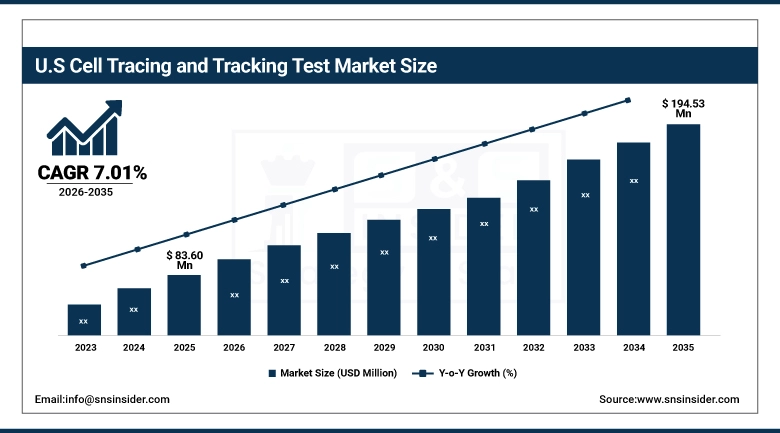
The U.S. Cell Tracing & Tracking Test Market is estimated at USD 83.60 million in 2025 and is projected to reach around USD 194.53 million by 2035, growing at a CAGR of 7.01% during 2026–2035. The United States leads the Cell Tracing and Tracking Test market, supported by strong life sciences funding, growing cell and gene therapy development, and a robust network of advanced imaging providers and CROs.
Cell Tracing and Tracking Test Market Growth Drivers:
-
Growing Number of Drug Discovery Activities and Advancements in Imaging and Labelling Techniques are Driving the Cell & Gene Therapy Manufacturing Services Market Growth
Cell Tracing and Tracking Test are changing the way personalized medicine, regenerative medicine, and drug development are carried out. In fact, almost 60% of drug development relies on this technology to enhance the efficacy and safety of drugs. Advancements in cell labeling and imaging have enabled more accurate results, while live cell imaging through confocal microscopy is being utilized in 45% of the labs to track real-time images. This technology has enabled scientists to achieve breakthroughs in cancer therapy, immunology, and stem cell therapy, which are redefining medicine and helping to achieve the next generation of cures through precise and targeted drugs.
For instance, in 2025, live-cell imaging adoption increased significantly across research laboratories. Advanced platforms such as Molecular Devices’ ImageXpress HCS.ai gained wider use. Market Restraints for Cell Tracing and Tracking Service
Cell Tracing and Tracking Test Market Restraints:
-
Costly Imaging and Labeling Infrastructure Limits Growth in Cell Tracing and Tracking Market
However, the high costs of advanced imaging and labeling technology are posing a notable restraint in the cell tracing and tracking service market, as these services require the use of advanced technology, including live cell imaging systems, confocal microscopes, and high-precision labeling reagents, which require a huge capital investment. In addition, the operational costs of these services are also contributing to the overall cost, which is a notable restraint in the cell tracing and tracking service market, especially in the developing regions.
Cell Tracing and Tracking Test Market Opportunities:
-
Growing Use of 3D Cell Models Boosts Demand for Cell Tracking Services
The growing use of 3D cell culture models is also generating more demand for Cell Tracing and Tracking Test. This is due to, unlike the flat and traditional cell culture systems, the 3D cell culture system allows scientists to study the movement and development of cells in a more natural environment. This requires the use of special services for the tracking of the cells. With the increasing use of the 3D cell culture system for the testing of drugs and the study of diseases and regeneration, the demand for cell tracking services is also increasing.
For instance, Harvard Stem Cell Institute tracks neural cell migration in brain organoids, Novartis monitors cancer cells in 3D tumor models, and the MIT Koch Institute observes immune cell interactions in tissue cultures.
Cell Tracing and Tracking Test Market Segment:
-
By Technology, Fluorescent Labeling held the largest market share of 41.28% in 2025, while Genetic & Molecular Markers are expected to grow at the fastest CAGR of 11.26% during 2026–2035.
-
By Application, Oncology and Research dominated with 36.74% market share in 2025, whereas Regenerative Medicine is projected to record the fastest CAGR of 11.83% through 2026–2035.
-
By Procedure Type, Short-Term Cell Tracking accounted for the highest market share of 57.19% in 2025, while Long-Term Cell Tracking is expected to grow at the fastest CAGR of 10.92% during the forecast period.
-
By Product Type, Cell Tracing Dyes held the largest market share of 29.63% in 2025, while Magnetic/Nanoparticle Labeling Reagents are anticipated to expand at the fastest CAGR of 12.14% through 2026–2035.
-
By End-User, Academic & Research Institutions held the largest share of 38.46% in 2025, while Pharma & Biotech Companies are expected to grow at the fastest CAGR of 11.37% during the forecast period.
Cell Tracing and Tracking Test Market Segment Analysis:
By Application Area, Oncology and Cancer Research Dominates the Market:
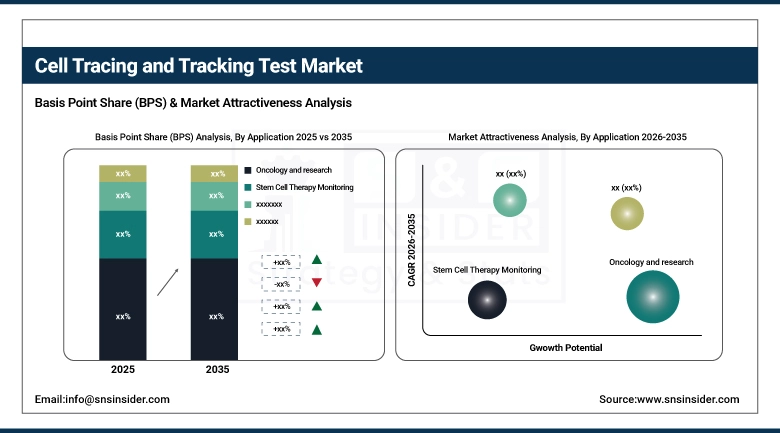
The Oncology and Cancer Research segment accounted for the largest market share in the Cell Tracing and Tracking Test market. This is attributed to the increasing incidence of cancer cases and the growing research on cancer development, metastasis, and treatment. Cell tracing and tracking tests are widely employed in cancer research. Although research is also being conducted in stem cell therapy, immunology, regenerative medicine, infectious disease research, and drug discovery, the large volume of research in oncology is maintaining the market segment's position.
By Procedure Type, Short-Term Cell Tracking Dominates the Market:
Short-Term Cell Tracking leads the market share of Cell Tracing and Tracking Tests, as this technique is highly utilized in drug screening studies, where cells need to be traced within minutes or hours. Its compatibility with high-throughput live cell imaging systems used in pharmaceutical and biotechnology labs is a strong driver for this technique.
Even though Long-Term Cell Tracking is gaining popularity in tracking cell proliferation, differentiation, and lineage studies, especially in stem cell biology, its market share is limited due to longer time periods required to carry out experiments.
By End User, Pharmaceutical and Biotechnology Companies Dominate While Academic and Research Institutions Grow Rapidly:
The segment of Pharmaceutical and Biotechnology Companies held the highest market share in the Cell Tracing and Tracking Test market owing to their high adoption of these technologies for drug discovery, cell therapy development, and clinical research. High R&D expenses, growing clinical trials, and the need for tracking cellular responses during cell therapy development are expected to remain key growth drivers for the market in this segment. These companies are increasingly adopting advanced cell tracking technologies for evaluating the effectiveness of treatments, understanding cellular responses, and developing targeted therapies, thus maintaining their market leadership.
By Product Type, Cell Tracing Dyes Dominate While Magnetic/Nanoparticle Labeling Reagents Grow Rapidly:
The Cell Tracing Dyes segment is leading, driven by the use of products in cell migration, proliferation, and differentiation studies. The ease of use, combined with the flexibility of the products with regard to imaging, is a major factor for the segment being a preferred choice for academic and biotechnology research.
Magnetic/Nanoparticle Labeling Reagents are the fastest-growing segment, owing to the recent breakthroughs in nanotechnology, and the need for accurate in vivo cell tracking in regenerative medicine studies.
Market Regional analysis for cell tracing and tracking:
North America Cell Tracing and Tracking Test Market Insights:
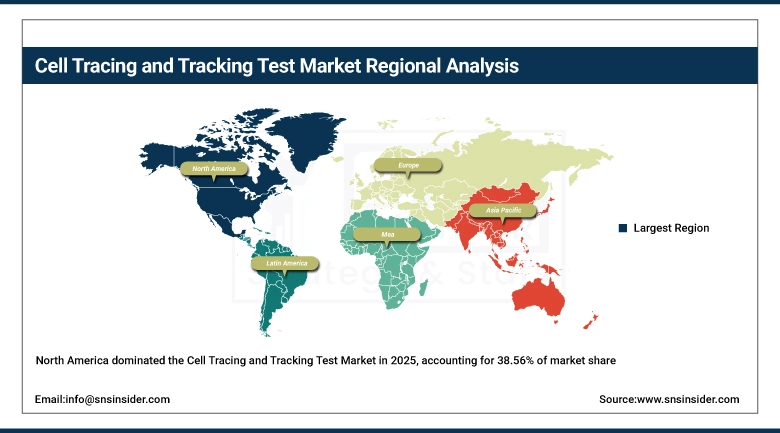
North America holds a major share in the Cell Tracing and Tracking Test Market, with a total market share of 38.56% in 2025. This is owing to a well-established biotechnology and pharmaceutical industry, high R&D spending, and the presence of research hubs in the United States and Canada. The growing research in cancer, stem cell therapies, and regenerative medicine, and government grants from the NIH, also boost the market.
Get Customized Report as per Your Business Requirement - Enquiry Now
United States Cell Tracing and Tracking Test Market Insights
The United States is a lucrative market for Cell Tracing and Tracking Test, with a well-established biotechnology and pharmaceutical industry, and high research funding. The country also boasts a large number of clinical trials, advanced imaging technologies, and an increasing cell and gene therapies market. Academic centers, CROs, and biotechnology companies are adopting advanced cell analysis technologies.
Europe Cell Tracing and Tracking Test Market Insights
Europe is a significant area for cell tracing and tracking-related research and development, owing to its well-established biotechnology infrastructure and active R&D scene, in addition to a rising trend in university and pharmaceutical company collaborations. Europe also benefits from well-equipped R&D facilities and a rising trend in regenerative medicine, stem cell-related research, and oncology-related R&D. Countries such as Germany, the UK, and France are significant in this area and contribute to the adoption and development of advanced cell labeling and tracking technologies in R&D sectors.
Germany Cell Tracing and Tracking Test Market Insights
Germany is one of the key hubs for cell tracing and tracking research in Europe, with a well-developed biomedical infrastructure and government-funded life sciences programs. Stem cell research, oncology research, and regenerative medicine are key areas of research in Germany, which is resulting in the increased adoption of advanced cell labeling and imaging technologies.
Asia Pacific Cell Tracing and Tracking Test Market Insights
Asia Pacific is emerging as a region with a growing rate at a CAGR of 13.16% during the forecast period of 2026-2035, for cell tracing and tracking research, owing to the increasing biotechnology sector and the growth of the biomedical sector. The increasing interest in stem cell research, regenerative medicine, and advanced life sciences is boosting the adoption of cell analysis technologies. Countries such as China, Japan, India, and Korea are enhancing their infrastructure and promoting innovation in cell analysis technologies.
China Cell Tracing and Tracking Test Market Insights
China is witnessing rapid development in cell tracing and tracking due to increased investments in biotechnology and government support for innovation in this area. There is a rise in stem cell research and cell therapy development, which is driving the need for cell analysis technologies. There is a rise in cell research institutes and biotechnology companies that are boosting this trend in China.
Latin America, Middle East & Africa Cell Tracing and Tracking Test Market Insights
Latin America and the Middle East & Africa are gradually expanding in cell tracing and tracking research, supported by improving research infrastructure and growing biotechnology activities. Increasing participation in international research collaborations and rising demand for advanced cell analysis technologies are encouraging adoption. Countries such as Brazil, Mexico, the UAE, and South Africa are emerging as important centres for biomedical research and laboratory innovation in these regions.
Cell Tracing and Tracking Test Market Competitive Landscape:
Thermo Fisher Scientific Inc. is a leading company in the field of providing solutions for the conduct of life sciences research, including a variety of fluorescent dyes and cell labeling tools for the tracking and tracing of cells. The company is committed to the integration of advanced imaging solutions with molecular labeling tools for the conduct of pharmaceutical, clinical, and academic research. The company’s product line also includes advanced cell analysis tools and live cell imaging solutions that allow for the precise monitoring of cell behavior and interactions in drug discovery, cancer, and regenerative medicine research, leading to advancements in the field of precision medicine.
-
In March 2025, Thermo Fisher Scientific expanded its cell imaging portfolio by introducing advanced live-cell analysis solutions designed to improve real-time tracking of cellular behavior in drug discovery and disease research.
Merck KGaA (operating as MilliporeSigma in North America) is a key player offering a broad portfolio of cell labeling reagents, molecular probes, and live-cell imaging tools used in cell tracing and tracking applications. The company supports advanced life-science research through technologies that enable precise monitoring of cell migration, proliferation, and differentiation in regenerative medicine and immunology studies. Its product portfolio is widely utilized by academic research institutes, biotechnology companies, and pharmaceutical organizations to improve experimental accuracy and reproducibility. In addition, the company continues to invest in innovative cell analysis technologies and advanced imaging solutions to support complex cellular research and translational biomedical studies.
-
In June 2025, Merck expanded its cell analysis product line with new fluorescent labeling solutions aimed at improving accuracy in long-term cell tracking experiments.
PerkinElmer Inc. (now part of Revvity) is known for its advanced imaging and cell analysis technologies used in biomedical research. The company offers fluorescence and bioluminescence imaging solutions that help researchers track cell behavior, migration, and molecular interactions in both in vitro and in vivo studies. Its portfolio also includes reagents and assay systems that support cell-based research, drug discovery, and life science applications. The company focuses on innovation and strategic collaborations to advance cellular analysis and biomedical discoveries, while also strengthening its capabilities in high-content screening, imaging informatics, and integrated cell analysis platforms
-
In October 2025s, PerkinElmer strengthened its cell imaging capabilities by enhancing its high-content screening systems, supporting improved cellular analysis for pharmaceutical and biotechnology companies.
Cell Tracing and Tracking Test Market Key Players:
-
Thermo Fisher Scientific Inc.
-
Merck KGaA
-
Danaher Corporation
-
Bio-Rad Laboratories Inc.
-
Agilent Technologies Inc.
-
Sartorius AG
-
QIAGEN N.V.
-
PerkinElmer Inc.
-
Becton Dickinson and Company
-
Beckman Coulter Inc.
-
Miltenyi Biotec B.V. & Co. KG
-
Abcam plc
-
Lonza Group AG
-
Cell Signaling Technology Inc.
-
Standard BioTools Inc.
-
PromoCell GmbH
-
STEMCELL Technologies Inc.
-
BioLegend Inc.
-
Creative Bioarray
-
Takara Bio Inc.
| Report Attributes | Details |
|---|---|
| Market Size in 2025 | USD 218.33 Million |
| Market Size by 2035 | USD 568.73 Million |
| CAGR | CAGR of 10.10% From 2026 to 2035 |
| Base Year | 2025 |
| Forecast Period | 2026-2035 |
| Historical Data | 2022-2024 |
| Report Scope & Coverage | Market Size, Segments Analysis, Competitive Landscape, Regional Analysis, DROC & SWOT Analysis, Forecast Outlook |
| Key Segments | • By Product Type (Cell Tracing Dyes, Cell Labeling Reagents, Reporter Gene Labeling Systems, Cell Tracking Assay Kits, Magnetic/Nanoparticle Labeling Reagents, Others) • By Technology Type (Fluorescent Labeling Techniques, MRI Tracers, Genetic & Molecular Markers, Bioluminescent/Chemiluminescent Labels, Nanoparticle-based Tracers, Others) • By Procedure Type (Short-Term Cell Tracking, Long-Term Cell Tracking) • By Application Area (Oncology & Cancer Research, Stem Cell Therapy Monitoring, Immunology & Infectious Disease Research, Drug Discovery & Development, Others) • By End-User (Academic & Research Institutions, Pharmaceutical & Biotechnology Companies, Hospitals & Diagnostic Labs, Contract Research Organizations (CROs)) |
| Regional Analysis/Coverage | North America (US, Canada), Europe (Germany, UK, France, Italy, Spain, Russia, Poland, Rest of Europe), Asia Pacific (China, India, Japan, South Korea, Australia, ASEAN Countries, Rest of Asia Pacific), Middle East & Africa (UAE, Saudi Arabia, Qatar, South Africa, Rest of Middle East & Africa), Latin America (Brazil, Argentina, Mexico, Colombia, Rest of Latin America). |
| Company Profiles | Thermo Fisher Scientific Inc., Merck KGaA, Danaher Corporation, Bio-Rad Laboratories Inc., Agilent Technologies Inc., Sartorius AG, QIAGEN N.V., PerkinElmer Inc., Becton, Dickinson and Company, Beckman Coulter Inc., Miltenyi Biotec B.V. & Co. KG, Abcam plc, Lonza Group AG, Cell Signaling Technology Inc., Standard BioTools Inc., PromoCell GmbH, STEMCELL Technologies Inc., BioLegend Inc., Creative Bioarray, Takara Bio Inc. |
Frequently Asked Questions
The Cell Tracing and Tracking Tests Market is projected to grow at a CAGR of around 10.10% during 2026–2035.
The market is estimated at around USD 218.33Million in 2025 and is projected to reach USD 568 Million by 2035.
Growth is driven by increasing stem cell and regenerative medicine research, rising demand for advanced cell analysis technologies, growing oncology studies, and biotechnology R&D activities.
The Fluorescent Labeling segment dominated during the projected period.
North America dominated the Cell Tracing and Tracking Tests Market in 2025.
