
Cleaning Robot Market Report Scope & Overview:
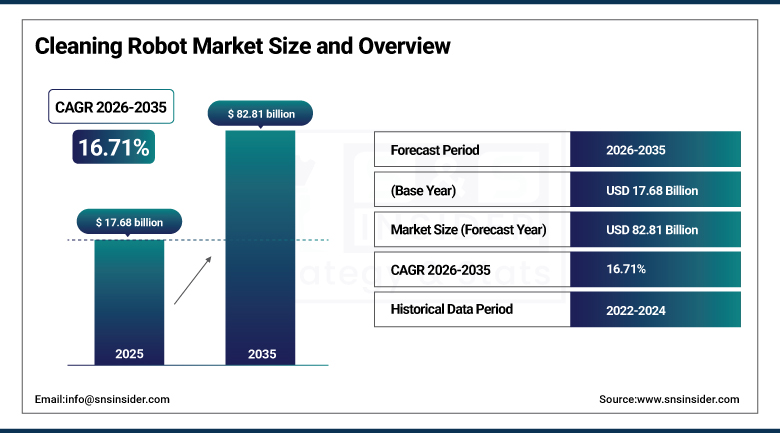
The Cleaning Robot Market was valued at USD 17.68 Billion in 2025 and is projected to reach USD 82.81 Billion by 2035, expanding at a CAGR of 16.71% during the forecast period 2026–2035.
The global Cleaning Robot market is witnessing substantial growth owing to the rapid adoption of smart home ecosystems, AI-enabled navigation systems, and autonomous cleaning technologies. The growing consumer demand for automated household maintenance, rising labour costs across commercial cleaning operations, and the expansion of connected IoT infrastructure are further motivating manufacturers to commercialise advanced robotic cleaning platforms combined with LiDAR mapping, AI-enabled obstacle recognition, and cloud-connected control systems. Increasing investments in industrial automation and hospitality automation are also fuelling the growth of the market across the globe.
During 2025-2026, several robotic cleaning manufacturers increased the deployment of AI-powered self-emptying cleaning robots with intelligent room mapping and adaptive navigation technologies in residential and commercial areas.
To Get more information on Cleaning Robot Market - Request Free Sample Report
Cleaning Robot Market Trends:
-
Increasing integration of AI-powered navigation and real-time obstacle detection systems.
-
Rising adoption of LiDAR-enabled robotic vacuum and floor mopping platforms.
-
Expansion of smart home ecosystems integrated with voice-assisted cleaning automation.
-
Growing commercialization of robotic cleaning systems across hospitality, healthcare, and industrial sectors.
-
Increasing investments in cloud-connected predictive maintenance and remote fleet monitoring technologies.
U.S. Cleaning Robot Market Size Outlook:
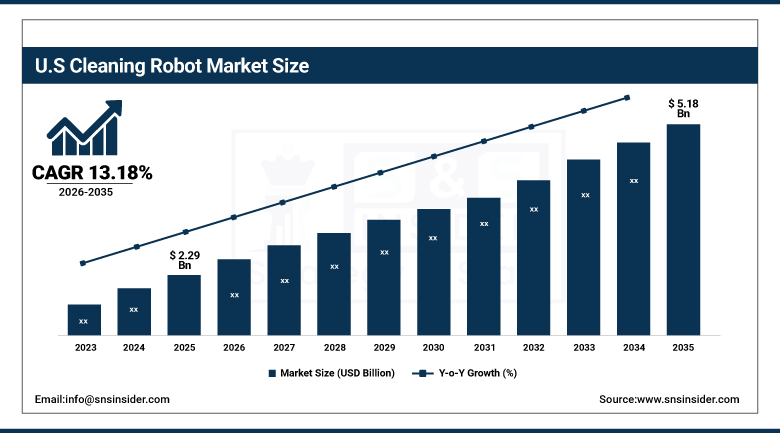
The U.S. Cleaning Robot Market was valued at USD 2.29 billion in 2025 and is expected to reach approximately USD 5.18 billion by 2035, expanding at a CAGR of 13.18% during 2026–2035.
High penetration of smart home devices, swift uptake of AI-enabled home automation devices, and rising demand for autonomous cleaning systems in residential and commercial segments are expected to drive the growth of the U.S. cleaning robots market. Robotic vacuum cleaner with LiDAR navigation, intelligent mapping and voice assistant compatibility is increasingly being deployed by commercial facilities, healthcare infrastructure, hospitality operators and residential consumers to enhance operational efficiency and reduce dependency on human labour. Strong market expansion continues to be supported by rising investments in connected living infrastructure and robotic automation ecosystem.
Several U.S.-based robotic appliance companies launched next-generation AI-powered floor cleaning robots integrated with advanced object recognition and cloud-enabled remote monitoring capabilities in 2026.
Cleaning Robot Market Segment Analysis:
-
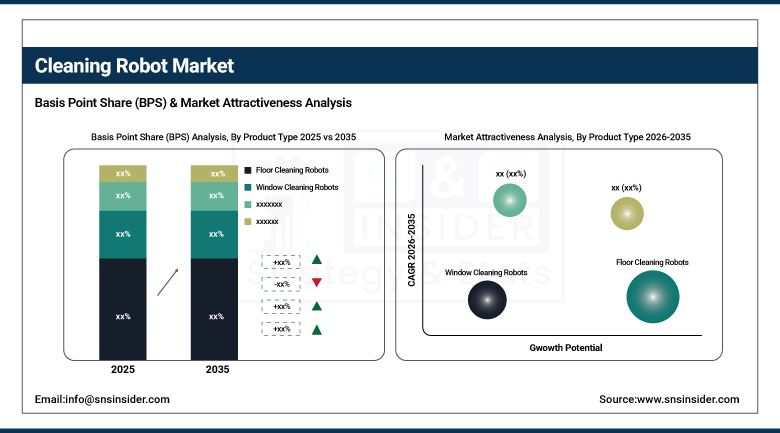
By Product Type, floor cleaning robots (vacuum & mop) dominated the market with 62.00% share in 2025, while commercial & industrial cleaning robots are projected to witness the fastest growth with 19.81% CAGR during the forecast period.
-
By Technology, LiDAR navigation dominated the market with 44.00% share in 2025, while AI & sensor fusion navigation is projected to witness the fastest growth with 20.91% CAGR during the forecast period.
-
By End User, residential dominated the market with 68.00% share in 2025, while commercial is projected to witness the fastest growth with 19.34% CAGR during the forecast period.
By Product Type, floor cleaning robots (vacuum & mop) dominated, while commercial & industrial cleaning robots are fastest-growing.
The floor cleaning robots (vacuum & mop) segment held the largest revenue share of 62.00% in 2025 due to high demand from consumers for autonomous floor maintenance systems integrated with smart home ecosystems. Increasing acceptance of robotic vacuum cleaners with AI-powered mapping, self-charging, and real-time navigation technologies is helping commercial expansion across the globe. The segment is also driven by increasing urbanization and growing preference for labor-saving connected appliances.
However, commercial & industrial cleaning robots are expected to record the fastest CAGR of 19.81% during the forecast period due to increasing automation across warehouses, airports, healthcare facilities, retail centers, and hospitality infrastructure. Several robotic automation vendors introduced AI-enabled industrial cleaning robots with embedded fleet management platforms, autonomous route optimization and predictive maintenance analytics for large-scale commercial environments in 2025-2026. Smart home adoption growth is driving floor cleaning robot growth and industrial automation growth is driving commercial robotic cleaning demand.
By Technology, LiDAR navigation dominated, while AI & sensor fusion navigation are fastest-growing.
LiDAR navigation segment dominated the market and accounted for 44.00 % revenue share in 2025 due to its high spatial mapping precision, robust obstacle detection and improved navigation features within complex indoor settings. More manufacturers are incorporating LiDAR-enabled SLAM technologies into premium robotic cleaning platforms to enhance cleaning efficiency, route planning, and autonomous mobility performance. The segment’s adoption continues to be driven by strong consumer preference for precision-based cleaning automation. LiDAR ensures precise navigation efficiency while AI-powered sensor fusion improves autonomous decision-making and obstacle detection.
The AI & sensor fusion navigation is anticipated to record the highest CAGR of 20.91% during the forecast period, due to the growing integration of AI-powered cameras, ultrasonic sensors, infrared sensing, and adaptive machine learning algorithms in the robotic cleaning systems. Several robotic appliance manufacturers launched next-generation AI-navigation cleaning robots with real-time environmental learning and dynamic obstacle avoidance technologies for the market in 2026.
By End User, residential dominated, while commercial is fastest-growing.
The residential segment held the largest market share of 68.00% in 2025. This is due to the increasing adoption of smart home appliances, rising disposable income, and growing demand for automated household cleaning systems across the globe. The advent of smartphone connectivity, voice assistants and AI-based room-mapping technologies have further driven consumers’ adoption of robotic vacuum and mopping solutions to improve convenience at home and reduce manual cleaning efforts. Residential was the largest contributor and commercial the fastest growing residential demand is driven by smart living trends while automated cleaning efficiency solutions are rapid adopters in commercial facilities.
The commercial segment is anticipated to have the highest CAGR of 19.34% during the forecast period, driven by the growing labor shortages, increasing automation in operations and the rising adoption of robotic cleaning systems in hospitals, malls, offices and hospitality infrastructure. In 2025-2026, several facility management companies increased deployment of autonomous floor-cleaning robots with cloud-based monitoring and centralized fleet control systems.
Regional Analysis:
|
Region |
Major Country |
Share within Region, 2025 (%) |
|---|---|---|
|
North America |
United States |
91.00% |
|
Europe |
Germany |
24.00% |
|
Asia Pacific |
China |
35.00% |
|
Middle East & Africa |
UAE |
5.00% |
|
Latin America |
Brazil |
5.00% |
North America Cleaning Robot Market Insights
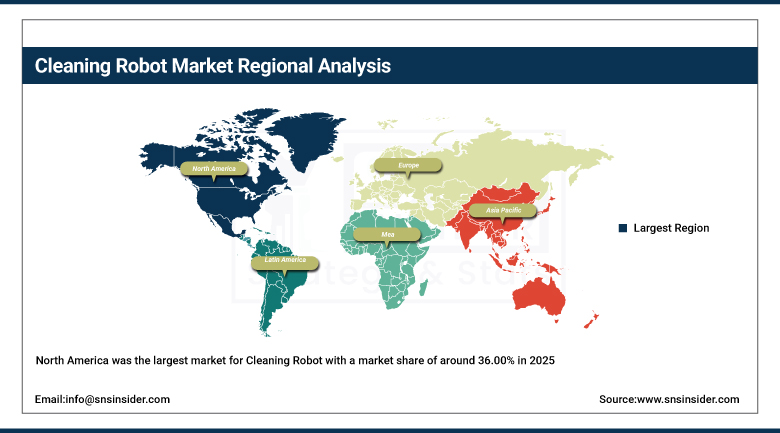
North America was the largest market for Cleaning Robot with a market share of around 36.00% in 2025, owing to high penetration of smart homes, strong consumer purchasing power, and fast commercialisation of AI-enabled robotic appliances in the U.S. and Canada. Robotic cleaning technologies with LiDAR navigation, cloud connectivity and intelligent automation features are becoming popular among commercial operators and residential users alike for improved operational efficiency and ease of use. Growth of regional markets is led by expansion of connected home infrastructure and increased adoption of service robotics.
In 2026, a number of North American robotics firms sped up the commercialisation of AI-based autonomous cleaning systems with predictive maintenance analytics and smart home connectivity platforms.
Get Customized Report as per Your Business Requirement - Enquiry Now
Europe Cleaning Robot Market Insights
Europe dominated the market with a 24.00% share in 2025 due to growing demand for automated home appliances, increasing adoption of smart cleaning technologies, and strong investments in the industrial automation infrastructure. Increasing deployment of robotic cleaning systems across residential properties, healthcare facilities, retail spaces, and hospitality sectors to enhance labour efficiency and operational productivity is a key trend across countries including Germany, France and the UK. Robotic cleaning rollouts are speeding up across residential and industrial sites, fuelled by the drive for sustainability and labour cost pressures. The increasing penetration of smart homes and investments in commercial automation continue to drive the adoption of advanced robotic cleaning technology.
European robotic appliance manufacturers increased deployment of AI-assisted navigation technologies coupled with advanced indoor mapping and adaptive cleaning automation systems in 2025-2026.
Asia Pacific Cleaning Robot Market Insights
Asia Pacific is expected to be the fastest growing regional market due to rapid urbanisation, growing adoption of smart appliances, expanding middle class consumer base and increasing investments in robotics manufacturing infrastructure across China, Japan, South Korea and India. Regional manufacturers are aggressively commercialising affordable AI-enabled robotic vacuum cleaners with advanced navigation technologies and cloud-connected automation features. The growth in e-commerce and connected home ecosystems further accelerates technology adoption throughout the region. Rapid urbanisation and expansion of consumer electronics manufacturing are driving the demand of AI powered cleaning robots.
In 2026, a number of Asia Pacific robotic appliance manufacturers increased their production capacity for AI-based smart cleaning robots, equipped with intelligent navigation and real-time environmental sensing technologies.
Middle East & Africa and Latin America Cleaning Robot Market Insights
The Middle East & Africa market is witnessing moderate growth due to increasing investments in smart infrastructure, rising hospitality automation and increased deployment of autonomous cleaning technologies across airports, commercial facilities and premium residential developments. Robotic facility maintenance solutions are adopted by countries such as UAE and Saudi Arabia to improve operational efficiency and reduce the reliance on manual labour. Growing hospitality infrastructure and commercial modernisation are fuelling the increasing adoption of automated robotic cleaning systems.
Latin America held a share of around 5.00% of the market in 2025 due to the rise in the adoption of smart home technologies, growing urban household automation, and the rising demand for affordable robotic vacuum cleaners in Brazil and Mexico. The growth of regional markets is also facilitated by the expansion of online retail channels and the connected consumer appliance ecosystems.
Market Dynamics:
Growth Drivers: Rise in adoption of smart home automation and AI-enabled robotics technologies.
The growth of smart home ecosystems and connected consumer appliances are driving significant demand for robotic cleaning technologies globally. As consumers increasingly embrace the adoption of AI-powered robotic vacuum cleaners using LiDAR navigation, intelligent mapping and automated charging technologies to improve convenience and operational efficiency. Commercial facilities are also using robotic cleaning platforms to improve labor productivity and reduce operating costs. Continuous advances in machine learning, real-time navigation and autonomous sensing are further accelerating the market growth. Rising connected home ecosystems and AI integration significantly boost robotic cleaning performance and consumer adoption.
In 2025-2026, a number of robotic appliance manufacturers released AI-powered adaptive cleaning systems that included cloud-based environmental learning and predictive navigation functionalities.
Restraints: Cost of product and navigation constraints in complex environments.
The technology is moving fast, but high upfront costs of advanced robotic cleaning systems continue to be a barrier to adoption in price sensitive consumer segments and small commercial facilities. Manufacturers and users are also encountering constraints in operations because of the difficulty in navigating, limitations on battery power, problems in mapping multi-floor buildings and challenges in dealing with cluttered environments. Maintenance costs and software integration challenges are also hurdles to wider commercialization in developing economies. High product costs and operational limitations in cluttered environments remain barriers to wider market penetration.
By 2026, some manufacturers of robotic appliances had focused on enhancing the accuracy of AI navigation and the energy efficiency of the robot to address the operational limitations faced by the robot in dynamic indoor environments.
Opportunities: Growth of commercial automation and cloud-connected robotic ecosystems.
The use of cleaning robots in hospitals, hotels and warehouses and commercial buildings has increased due to robotic automation, which opens strong growth opportunities for cleaning robot manufacturers across the globe. Companies are also integrating AI-powered fleet management systems, predictive maintenance analytics and cloud-connected automation platforms to robotic cleaning ecosystems to extend their operations and centralize monitoring capabilities. Labor shortages are on the rise and investments in autonomous facility management technologies are increasing which also supports long-term growth potential. Commercial automation and cloud connected robotic ecosystems expansion Cloud-enabled fleet management and commercial automation are driving growth opportunities for intelligent robotic cleaning platforms.
Several commercial robotics vendors launched cloud-enabled robotic cleaning platforms with centralized monitoring, remote diagnostics and AI-based autonomous route optimization capabilities by 2025.
Recent Developments:
-
2026: iRobot Corporation introduced next-generation AI-enabled robotic vacuum systems integrated with precision mapping and advanced object recognition technologies.
-
2026: Ecovacs Robotics expanded commercialization of autonomous commercial cleaning robots equipped with cloud-based fleet management and adaptive navigation capabilities.
-
2025: Samsung Electronics launched AI-powered robotic cleaning appliances integrated with smart home ecosystem connectivity and real-time environmental sensing technologies.
-
2025: Xiaomi Corporation accelerated deployment of LiDAR-enabled robotic vacuum cleaners featuring automated mop washing and intelligent route optimization systems.
Cleaning Robot Market Key Players are:
-
iRobot Corporation
-
Ecovacs Robotics Co., Ltd.
-
Samsung Electronics Co., Ltd.
-
LG Electronics Inc.
-
Xiaomi Corporation
-
Panasonic Holdings Corporation
-
Dyson Limited
-
SharkNinja Inc.
-
Roborock Technology Co., Ltd.
-
Nilfisk Group
-
Kärcher International
-
Tennant Company
-
SoftBank Robotics Group Corp.
-
Avidbots Corp.
-
Neato Robotics Inc.
-
Alfred Kärcher SE & Co. KG
-
Miele & Cie. KG
-
Haier Smart Home Co., Ltd.
-
Eureka Forbes Ltd.
-
BISSELL Inc.
Cleaning Robot Market Report Scope:
| Report Attributes | Details |
|---|---|
| Market Size in 2025 | USD 17.68 Billion |
| Market Size by 2035 | USD 82.81 Billion |
| CAGR | CAGR of 16.71% From 2026 to 2035 |
| Base Year | 2025 |
| Forecast Period | 2026-2035 |
| Historical Data | 2022-2024 |
| Report Scope & Coverage | Market Size Analysis, Revenue Forecasting, Segment Analysis, Competitive Landscape, Regional Analysis, Retail Automation Assessment, Smart Checkout Technology Trends, AI-Enabled Retail Infrastructure Analysis, DROC & SWOT Analysis, Investment Trends, Supply Chain Evaluation, Consumer Transaction Technology Assessment, and Future Market Opportunity EvaluationChain Evaluation, Industrial Packaging Demand Analysis, Sustainability Assessment, DROC & SWOT Analysis, Regulatory Framework Analysis, Innovation Benchmarking, and Future Market Opportunity Evaluation |
| Key Segments | • By Product Type (Floor Cleaning Robots (Vacuum & Mop), Window Cleaning Robots, Commercial & Industrial Cleaning Robots) • By Technology (LiDAR Navigation, Vision-Based Navigation, AI & Sensor Fusion Navigation) • By End User (Residential, Commercial, Industrial) |
| Regional Analysis/Coverage | North America (US, Canada), Europe (Germany, UK, France, Italy, Spain, Russia, Poland, Rest of Europe), Asia Pacific (China, India, Japan, South Korea, Australia, ASEAN Countries, Rest of Asia Pacific), Middle East & Africa (UAE, Saudi Arabia, Qatar, South Africa, Rest of Middle East & Africa), Latin America (Brazil, Argentina, Mexico, Colombia, Rest of Latin America). |
| Company Profiles | iRobot Corporation, Ecovacs Robotics Co., Ltd., Samsung Electronics Co., Ltd., LG Electronics Inc., Xiaomi Corporation, Panasonic Holdings Corporation, Dyson Limited, SharkNinja Inc., Roborock Technology Co., Ltd., Nilfisk Group, Kärcher International, Tennant Company, SoftBank Robotics Group Corp., Avidbots Corp., Neato Robotics Inc., Alfred Kärcher SE & Co. KG, Miele & Cie. KG, Haier Smart Home Co., Ltd., Eureka Forbes Ltd., BISSELL Inc. |
Frequently Asked Questions
The Cleaning Robot Market was valued at USD 17.68 billion in 2025.
The market is projected to reach USD 82.81 billion by 2035.
The market is expected to expand at a CAGR of 16.71% during the forecast period.
North America dominated the global market owing to strong smart home adoption and increasing investments in AI-enabled robotic automation technologies.
Floor Cleaning Robots (Vacuum & Mop) accounted for the largest revenue share of 62.00% in 2025.
