
Clock Jitter Cleaners Market Report Scope & Overview:
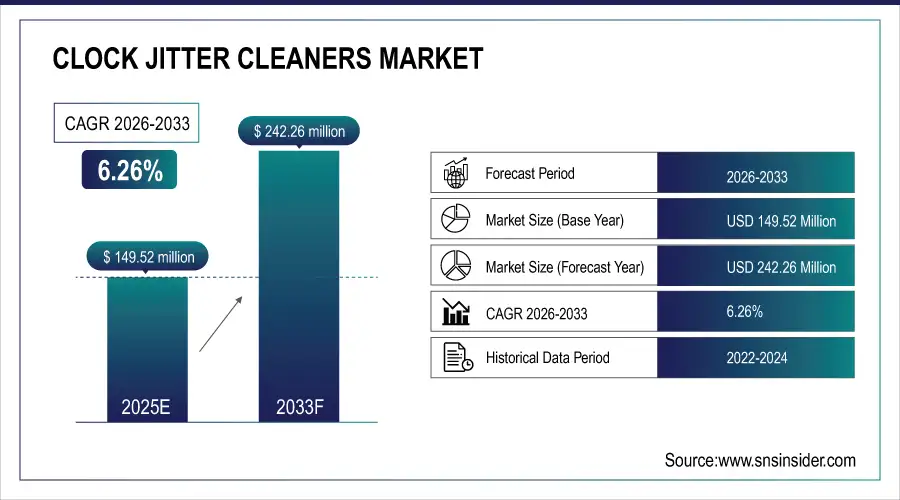
The Clock Jitter Cleaners Market size was valued at USD 149.52 Million in 2025E and is projected to reach USD 242.26 Million by 2033, growing at a CAGR of 6.26% during 2026-2033.
The Clock Jitter Cleaners Market is growing due to increasing demand for high-speed communication systems, data centers, and advanced semiconductor devices. Rising adoption of 5G, AI, and IoT technologies, which require precise timing and low signal distortion, is driving the need for reliable jitter-cleaning solutions across networking and electronics applications.
Market Size and Forecast:
-
Market Size in 2025E USD 149.52 Million
-
Market Size by 2033 USD 242.26 Million
-
CAGR of 6.26% From 2026 to 2033
-
Base Year 2024
-
Forecast Period 2026-2033
-
Historical Data 2021-2024
To Get more information on Clock Jitter Cleaners Market - Request Free Sample Report
Key Clock Jitter Cleaners Market Trends
-
Increasing deployment of 5G and next-generation broadband networks driving demand for precise timing solutions.
-
Rapid adoption of high-performance computing (HPC), AI, and advanced semiconductor devices requiring stable clock signals.
-
Growing emphasis on low-latency, high-frequency trading, and real-time data processing in financial, healthcare, and industrial sectors.
-
Expansion of IT infrastructure and IoT adoption in emerging regions such as Asia-Pacific and Latin America.
-
Integration of clock jitter cleaners into automotive, aerospace, and defense systems, along with development of compact, energy-efficient devices for consumer electronics.
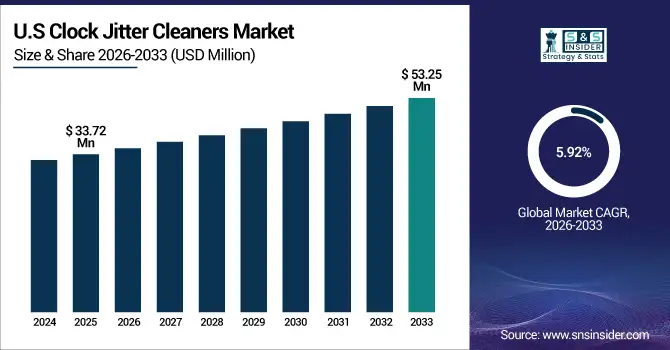
The U.S. Clock Jitter Cleaners Market size was valued at USD 33.72 Million in 2025E and is projected to reach USD 53.25 Million by 2033, growing at a CAGR of 5.92% during 2026-2033. The U.S. Clock Jitter Cleaners Market is growing due to rising deployment of 5G networks, advanced data centers, and high-performance computing systems, which demand precise timing and low signal distortion for enhanced network reliability and efficient electronic operations.
Clock Jitter Cleaners Market Growth Drivers:
-
Rising Demand For High Speed Networks HPC AI And Real Time Data Drives Clock Jitter Cleaners Growth
The global Clock Jitter Cleaners Market is primarily driven by the increasing demand for high-speed communication networks, including 5G and next-generation broadband infrastructure. As telecom operators and data centers upgrade their systems, the need for precise timing solutions to minimize signal distortion and maintain data integrity has surged. Additionally, the rapid adoption of advanced semiconductor devices, high-performance computing (HPC), and AI-based applications fuels market growth, as these technologies require highly stable clock signals for efficient operation. The growing emphasis on low-latency, high-frequency trading, and real-time data processing in financial, healthcare, and industrial sectors further contributes to the rising demand for clock jitter cleaning solutions globally.
In semiconductor networking components, there is a clear shift toward technologies requiring ultra-low jitter. For example, in 2024 over 70% of data centers reportedly upgraded their timing circuitry to support bandwidths above 400 Gbps.
Clock Jitter Cleaners Market Restraints:
-
High Costs Integration Complexity And Alternative Technologies Restrain Clock Jitter Cleaners Market Adoption Growth
The Clock Jitter Cleaners Market faces restraints due to high component and manufacturing costs, which can limit adoption in cost-sensitive applications. Additionally, the complexity of integrating jitter-cleaning solutions into existing systems, coupled with competition from alternative timing technologies, may slow widespread deployment across certain industries and regions.
Clock Jitter Cleaners Market Opportunities:
-
Emerging Regions Automotive Aerospace Drive Clock Jitter Cleaners Market Growth Compact Efficient Devices Expand Applications
The market presents significant opportunities in emerging regions such as Asia-Pacific and Latin America, where expanding IT infrastructure and adoption of 5G and IoT networks are creating a robust demand for reliable timing solutions. Moreover, the integration of clock jitter cleaners into automotive electronics, aerospace, and defense systems opens new avenues for growth, as these sectors increasingly rely on precise and low-noise timing for safety-critical applications. The development of compact, energy-efficient, and cost-effective jitter cleaner devices also provides opportunities for manufacturers to target small-scale electronics and consumer devices, expanding the market’s reach across diverse applications.
In automotive electronics, deployment surged in 2023: the automotive sector consumed roughly 300 million timing‑device units globally, representing ~15 % of all timing device shipments.
Clock Jitter Cleaners Market Segment Analysis
-
By Product Type, Standalone jitter cleaners / clock generators dominated with 40.25% in 2025E, and FPGA/SoC embedded IP cores (clock recovery & mitigation) is expected to grow at the fastest CAGR of 7.19% from 2026 to 2033.
-
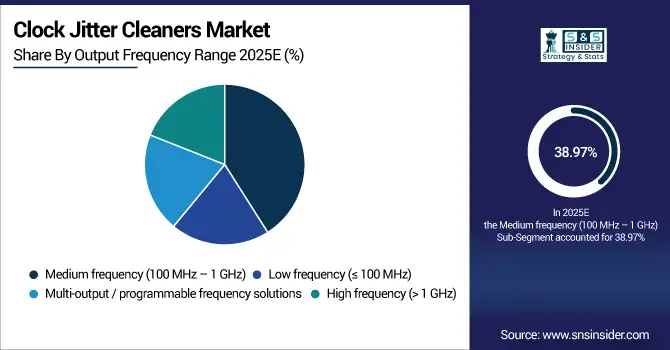
By Output Frequency Range, Medium frequency (100 MHz – 1 GHz) dominated with 38.97% in 2025E, and Multi-output / programmable frequency solutions is expected to grow at the fastest CAGR of 7.35% from 2026 to 2033.
-
By Application, Telecommunications & Networking (including 5G fronthaul/backhaul) dominated with 37.86% in 2025E, and Data Centers & Cloud Infrastructure (synchronization, timing distribution) is expected to grow at the fastest CAGR of 6.85% from 2026 to 2033.
-
By End User, Original Equipment Manufacturers (OEMs) — network, server, and instrument makers dominated with 46.56% in 2025E, and Hyperscalers & Large Data Center Operators is expected to grow at the fastest CAGR of 6.94% from 2026 to 2033.
By Product Type, Standalone Jitter Cleaners Dominate Market FPGA SoC Embedded IP Cores Drive Fastest Growth High Speed Systems
In the Clock Jitter Cleaners Market, standalone jitter cleaners and clock generators are projected to dominate in 2025 due to their widespread adoption in telecom and data center applications. Meanwhile, FPGA/SoC embedded IP cores for clock recovery and mitigation are expected to register the fastest CAGR from 2026 to 2032, driven by increasing integration of high-speed digital systems and demand for low-latency performance.
By Output Frequency Range, Medium Frequency Solutions Lead Market Multi Output Programmable Devices Drive Fastest Growth Advanced Timing Applications
In the Clock Jitter Cleaners Market, medium-frequency solutions (100 MHz – 1 GHz) are expected to dominate in 2025, driven by their extensive use in communication and computing systems. Meanwhile, multi-output and programmable frequency solutions are projected to witness the fastest CAGR from 2026 to 2032, fueled by growing demand for flexible, high-performance timing solutions in advanced electronic applications.
By Application, Telecommunications Dominate Market Data Centers Achieve Fastest Growth Through High Speed Cloud Synchronization Demand
In the Clock Jitter Cleaners Market, the Telecommunications & Networking segment, including 5G fronthaul and backhaul, is expected to dominate in 2025 due to rapid network expansions. Meanwhile, the Data Centers & Cloud Infrastructure segment, focusing on synchronization and timing distribution, is projected to achieve the fastest CAGR from 2026 to 2032, driven by increasing cloud adoption and high-speed data requirements.
By End User, OEMs Lead Market Growth Hyperscalers Drive Fastest CAGR Through High Precision Synchronization Demand
In 2025E, Original Equipment Manufacturers (OEMs) including network, server, and instrument makers dominate the Clock Jitter Cleaners market due to their extensive integration of timing solutions. From 2026–2032, Hyperscalers and Large Data Center Operators are expected to witness the fastest CAGR, driven by escalating demand for high-precision synchronization and low-latency performance in cloud and hyperscale infrastructures.
Clock Jitter Cleaners Market Report Analysis
North America Clock Jitter Cleaners Market Insights
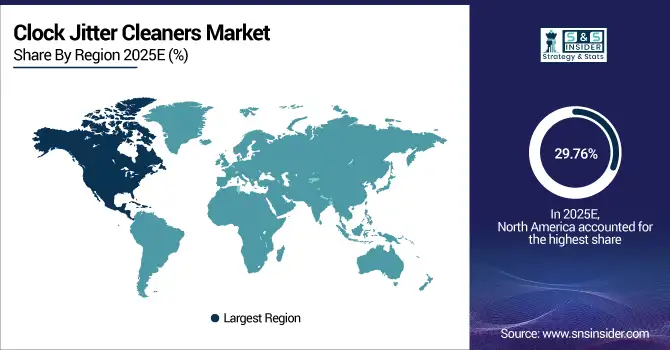
In 2025E, North America holds a 29.76% share of the Clock Jitter Cleaners market, driven by advanced telecom infrastructure, widespread adoption of data centers, and investments in high-precision timing solutions. Strong demand from network, server, and instrument OEMs supports market growth, ensuring enhanced synchronization, reduced latency, and improved performance across industrial and IT sectors.
Get Customized Report as per Your Business Requirement - Enquiry Now
U.S. Clock Jitter Cleaners Market Insights
The U.S. Clock Jitter Cleaners market is driven by robust telecom and data center infrastructure, high OEM adoption, and growing demand for precise timing solutions. Advanced network deployments and hyperscale data center expansion further propel market growth and innovation.
Europe Clock Jitter Cleaners Market Insights
In 2025E, Europe accounts for 19.21% of the Clock Jitter Cleaners market, driven by its mature telecom networks and increasing deployment of data center technologies. Rising investments in high-precision timing solutions across industrial and IT infrastructure sectors further bolster market growth, supporting enhanced network performance, reduced latency, and reliable synchronization for advanced communication and computing applications.
Germany Clock Jitter Cleaners Market Insights
In 2025E, Germany dominates the European Clock Jitter Cleaners market, driven by its advanced industrial and IT infrastructure, robust telecom networks, and significant investments in high-precision timing solutions, ensuring reliable synchronization and enhanced performance across data centers and communication systems.
Asia Pacific Clock Jitter Cleaners Market Insights
In 2025E, Asia Pacific dominates the Clock Jitter Cleaners market with a 36.88% share, driven by rapid digitalization, expanding data centers, and growing telecom infrastructure. The region is expected to register the fastest CAGR of 6.77% from 2026 to 2032, fueled by increasing demand for high-precision timing solutions.
China Clock Jitter Cleaners Market Insights
In Asia Pacific, China dominates the Clock Jitter Cleaners market, supported by its rapidly expanding data center infrastructure, advanced telecom networks, and significant investments in high-precision timing solutions, driving strong demand across industrial, IT, and communication sectors.
Latin America (LATAM) and Middle East & Africa (MEA) Clock Jitter Cleaners Market Insights
In 2025E, Latin America and MEA hold a smaller share of the Clock Jitter Cleaners market, driven by emerging telecom networks and gradual adoption of data center technologies. Investments in industrial and IT infrastructure, along with growing demand for precise timing solutions, are expected to support steady regional growth.
Competitive Landscape for Clock Jitter Cleaners Market:
Silicon Labs is a leading semiconductor company specializing in timing, clocking, and connectivity solutions. In the Clock Jitter Cleaners market, it offers high-precision, low-jitter clock generators and distribution ICs, enabling reliable synchronization across telecom, data center, and industrial applications.
- In November 2025, Silicon Labs announced a major expansion of its timing IC portfolio adding “more than 100 clock generation and distribution products” to support cost‑sensitive, high-volume consumer, enterprise, communications and embedded applications.
Analog Devices (ADI) is a global semiconductor leader providing high-performance analog, mixed-signal, and digital signal processing solutions. In the Clock Jitter Cleaners market, ADI delivers low-jitter clock generators and timing ICs, supporting precise synchronization for telecom, data center, and industrial systems.
- In October 2024, ADI released ADIsimCLK Version 1.70.11, which added a simulation model for its new low‑jitter clock generator AD9528 helping designers predict phase noise and jitter precisely for ADI’s clock‑distribution and generation products.
Clock Jitter Cleaners Market Key Players:
Some of the Clock Jitter Cleaners Market Companies
- Silicon Labs
- Texas Instruments
- Analog Devices
- Microchip Technology
- Renesas Electronics
- Skyworks Solutions
- Integrated Device Technology (IDT)
- Qualcomm
- Broadcom
- Infineon Technologies
- NXP Semiconductors
- Maxim Integrated
- Rohm Semiconductor
- STMicroelectronics
- Murata Manufacturing
- Epson Electronics
- ON Semiconductor
- Kyocera AVX
- Abracon
- Pericom
| Report Attributes | Details |
|---|---|
| Market Size in 2025E | USD 149.52 Million |
| Market Size by 2033 | USD 242.26 Million |
| CAGR | CAGR of 6.26% From 2026 to 2033 |
| Base Year | 2024 |
| Forecast Period | 2026-2033 |
| Historical Data | 2021-2024 |
| Report Scope & Coverage | Market Size, Segments Analysis, Competitive Landscape, Regional Analysis, DROC & SWOT Analysis, Forecast Outlook |
| Key Segments | • By Product Type (Standalone jitter cleaners / clock generators, Clock management ICs (PLL / VCXO integrated), FPGA/SoC embedded IP cores (clock recovery & mitigation), and Modular / rack-mounted timing modules) • By Output Frequency Range (Low frequency (≤ 100 MHz), Medium frequency (100 MHz – 1 GHz), High frequency (> 1 GHz), and Multi-output / programmable frequency solutions) • By Application (Telecommunications & Networking (including 5G fronthaul/backhaul), Data Centers & Cloud Infrastructure (synchronization, timing distribution), Consumer & Industrial Electronics (broadcast, imaging, instrumentation), and Aerospace, Defense & Test & Measurement) • By End User (Original Equipment Manufacturers (OEMs) — network, server, and instrument makers, Hyperscalers & Large Data Center Operators, System Integrators & Value-Added Resellers (VARs), and Research Institutes, Calibration & Test Laboratories) |
| Regional Analysis/Coverage | North America (US, Canada), Europe (Germany, UK, France, Italy, Spain, Russia, Poland, Rest of Europe), Asia Pacific (China, India, Japan, South Korea, Australia, ASEAN Countries, Rest of Asia Pacific), Middle East & Africa (UAE, Saudi Arabia, Qatar, South Africa, Rest of Middle East & Africa), Latin America (Brazil, Argentina, Mexico, Colombia, Rest of Latin America). |
| Company Profiles | Silicon Labs, Texas Instruments, Analog Devices, Microchip Technology, Renesas Electronics, Skyworks Solutions, IDT, Qualcomm, Broadcom, Infineon Technologies, NXP Semiconductors, Maxim Integrated, Rohm Semiconductor, STMicroelectronics, Murata Manufacturing, Epson Electronics, ON Semiconductor, Kyocera AVX, Abracon, Pericom |

Frequently Asked Questions
Asia Pacific dominated the Clock Jitter Cleaners Market in 2025E.
Standalone jitter cleaners / clock generators segment dominated the Clock Jitter Cleaners Market.
Growing demand for high-precision timing solutions in telecom, data centers, and industrial applications drives the Clock Jitter Cleaners market.
The Clock Jitter Cleaners Market size was USD 149.52 Million in 2025E and is expected to reach USD 242.26 Million by 2033.
The Clock Jitter Cleaners Market is expected to grow at a CAGR of 6.26% from 2026-2033.
