
Coagulation Analyzer Market Report Scope & Overview:
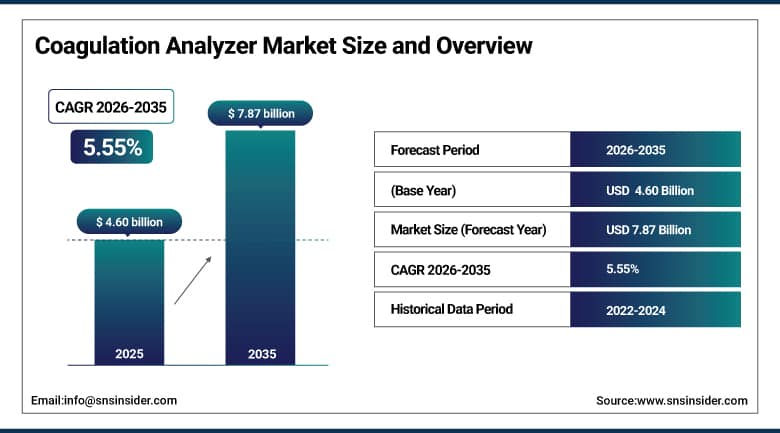
The Coagulation Analyzer Market Size is valued at USD 4.60 Billion in 2025 and is projected to reach USD 7.87 Billion by 2035, growing at a CAGR of 5.55% during the forecast period 2026–2035.
The Coagulation Analyzer Market report highlights potential growth areas in the field of hemostasis testing and diagnosis. These growth drivers include the increasing incidence of blood disorders, the rising number of surgical procedures, increased demands for automation in diagnostic processes, improvements in health care facilities, and increased focus on early disease detection and surveillance.
Coagulation analyzers supported over 2.5 billion tests in 2025, driven by rising blood disorders, increasing surgeries, and growing demand for routine hemostasis testing.
To Get More Information On Coagulation Analyzer Market - Request Free Sample Report
Coagulation Analyzer Market Trends:
-
Increasing prevalence of coagulation disorders and cardiovascular diseases is driving demand for routine and specialized hemostasis testing across clinical settings.
-
Rising surgical procedures and trauma cases are accelerating the need for rapid coagulation assessment and perioperative monitoring.
-
Technological advancements in optical and electrochemical detection methods are enhancing test accuracy, sensitivity, and multi-parameter analysis capabilities.
-
Expansion of diagnostic laboratories and healthcare infrastructure in emerging markets is boosting accessibility to coagulation testing services.
-
Integration of coagulation analyzers with laboratory information systems (LIS) and digital platforms is streamlining workflow management and data tracking.
-
Increasing demand for point-of-care coagulation testing is enabling faster clinical decision-making in emergency and critical care settings.
-
Growing focus on early disease detection and anticoagulant therapy monitoring is supporting consistent utilization of coagulation analyzers.
U.S. Coagulation Analyzer Market Insights:
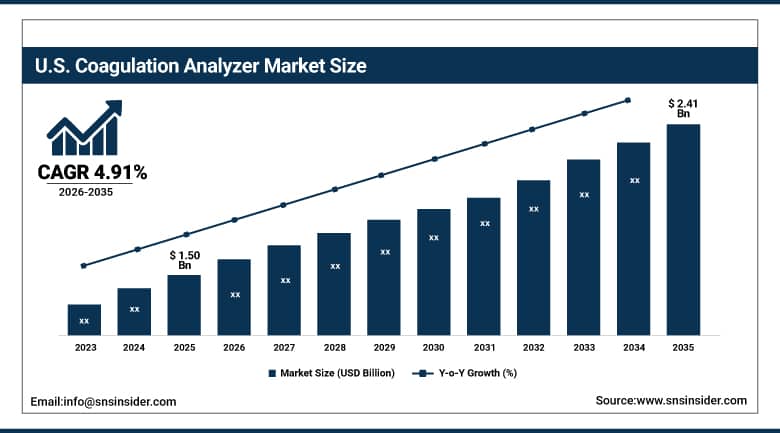
The U.S. Coagulation Analyzer Market is projected to grow from USD 1.50 Billion in 2025 to USD 2.41 Billion by 2035, at a CAGR of 4.91%. The driving forces behind growth include the increased prevalence of cardiovascular diseases, increased number of surgeries, increasing use of automated diagnostic tests, growing surveillance of anti-coagulant treatment, and improved health care infrastructure facilitating large volume of coagulation tests.
Coagulation Analyzer Market Growth Drivers:
-
Rising burden of cardiovascular disorders and surgeries driving demand for accurate coagulation diagnostics.
The increasing prevalence of heart diseases, hemorrhage conditions, and the growing number of surgeries drive the market for Coagulation Analyzers. With thrombosis, hemophilia, and stroke becoming more prevalent, there is an increase in the demand for coagulation testing methods that can provide accurate results within a short period of time. More hospitals and diagnostics labs are resorting to using analyzers for regular coagulation tests and perioperative testing. Furthermore, the increasing use of anticoagulants also drives the market for coagulation tests.
Over 60% of coagulation tests in 2025 were linked to cardiovascular conditions and surgical procedures, driving analyzer demand.
Coagulation Analyzer Market Restraints:
-
High cost of advanced analyzers and reagents limiting adoption in small and resource-constrained laboratories.
Cost is one major limitation that faces the Coagulation Analyzer Market due to the high prices of advanced analyzers and reagents. High costs of fully automated coagulation analyzer machines make them hard to access for small laboratories and healthcare institutions located in underdeveloped countries. The costs of maintaining and calibrating the machines together with that of buying new reagents also add to the burden of expenses. Lack of trained personnel to handle advanced equipment may hinder their adoption.
Coagulation Analyzer Market Opportunities:
-
Expanding point-of-care testing and emerging markets creating strong growth potential for portable coagulation solutions.
The increasing need for coagulation tests at point-of-care, along with the penetration of new markets, presents many potential areas for market expansion. The availability of portable and easy-to-use devices allows fast testing at emergency departments, ICUs, and distant sites, helping doctors to take well-informed decisions. Moreover, investments in improving healthcare infrastructure and increasing health expenditure in underdeveloped countries have enhanced the provision of diagnostic tests. Firms are focusing on economical and small-sized equipment, providing new avenues for growth.
Point-of-care coagulation testing accounted for over 25% of total testing volume in 2025, driven by rapid diagnostics adoption.
Coagulation Analyzer Market Segmentation Analysis:
-
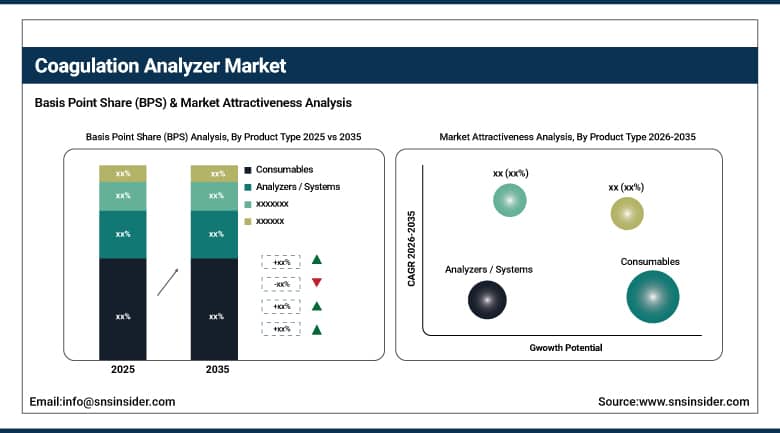
By Product Type, Consumables dominated the Coagulation Analyzer Market with a 64.28% share in 2025, while Analyzers / Systems are expected to grow at the fastest CAGR of 6.12% during 2026–2035.
-
By Automation Type, Fully Automated systems accounted for the largest market share of 71.36% in 2025 and are projected to register the fastest CAGR of 6.48% through 2026–2035, driven by high-throughput laboratory adoption.
-
By Technology, Optical technology held the highest market share of 58.19% in 2025, whereas Electrochemical systems are anticipated to grow at the fastest CAGR of 6.73% during the forecast period due to improved sensitivity and rapid detection.
-
By Test Type, Prothrombin Time (PT) dominated with a 34.67% market share in 2025, while D-Dimer testing is expected to expand at the fastest CAGR of 7.21% owing to rising demand for thrombosis and clot detection.
-
By End User, Hospitals led the market with a 52.84% share in 2025, whereas Diagnostic Laboratories are projected to grow at the fastest CAGR of 6.39% through 2026–2035 due to increasing outsourcing of diagnostic testing.
By Product Type, Consumables Dominated While Analyzers / Systems Is Fastest Growing:
Consumables segment dominated the market owing to continuous need of reagents, calibrators and test strips required during coagulation testing. Products had a consistently high normal demand which was greater than 1.6 billion units expended in 2025 as tests were directed at hospitals and diagnostic center routinely.
Analyzers / Systems is the fastest growing segment attributed to the rising trend in automation technology, digitalization, and improved efficiencies in work processes. More than 420,000 installations of analyzers have been reported, indicating a substantial level of commitment toward sophisticated diagnostic systems.
By Automation Type, Fully Automated Dominated While Fully Automated Is Fastest Growing:
Fully Automated segment dominated the market as they are more precise while needing less human intervention and can be easily incorporated into large-scale lab work setups. They conducted over 1.9 billion tests in 2025, largely propelled by hospitals' central laboratories and large-capacity diagnostic centers.
Fully Automated are also the fastest growing segment as labs increasingly adopt AI-supported automation, faster timeframes, and fewer errors. Around 65,000 new installations of fully automated solutions were deployed, highlighting the trend of moving away from semi-automation.
By Technology, Optical Dominated While Electrochemical Is Fastest Growing:
Optical segment dominated the market owing to its inherent reliability, accuracy, and wide acceptance in PT and aPTT tests. The segment was estimated to underpin more than 1.4 billion coagulation tests in 2025, thereby reaffirming its popularity as the prevalent technique employed.
Electrochemical is the fastest growing segment driven by developments in miniaturization, point-of-care tests (POCT), and speed of response to urgent tests. Almost 280,000 electrochemical tests have been performed using decentralized testing, reflecting its wide acceptance among the population.
By Test Type, Prothrombin Time (PT) Dominated While D-Dimer Is Fastest Growing:
Prothrombin Time (PT) segment dominated the market due to its common use in the management of anticoagulant drugs and liver health evaluation. In 2025, the number exceeded 620 million tests, which was the highest among all other coagulation assays.
D-Dimer is the fastest growing segment due to the increasing incidence of thrombosis, pulmonary embolism, and cardiovascular diseases. More than 210 million tests for D-Dimer have already been carried out, indicating an increasing need for emergency diagnosis.
By End User, Hospitals Dominated While Diagnostic Laboratories Is Fastest Growing:
Hospitals segment dominated the market due to large volumes of patients, the urgency of emergency treatment, and perioperative coagulation monitoring needs. By 2025, they had performed more than 1.8 billion coagulation tests owing to critical care department and surgery department needs.
Diagnostic Laboratories are the fastest growing segment due to the increasing trend of outsourcing test processes and the expansion of the centralized laboratory system. More than 500,000 diagnostic laboratories have been helping increase test volume due to factors such as automation and cost efficiency.
Coagulation Analyzer Market Regional Analysis:
North America Coagulation Analyzer Market Insights:
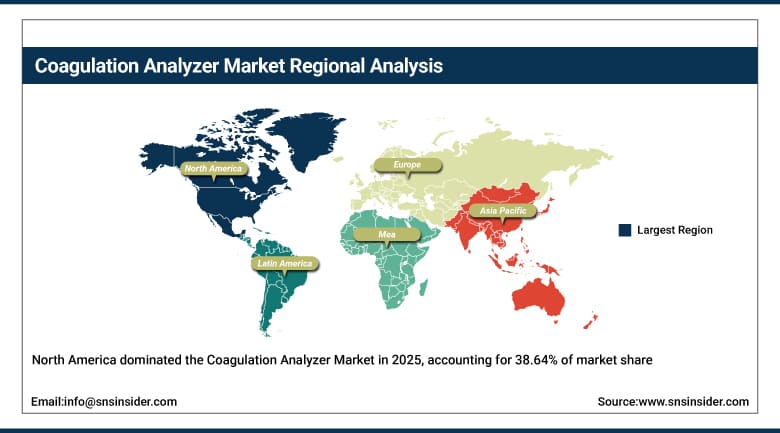
The North America region has managed to carve out a prominent position in the Coagulation Analyzer Market due to their dominant market share of 38.64%, owing to the region’s efficient healthcare systems and strong diagnostic laboratories. The North America region derives benefits from the availability of automation in coagulation analyzers, favorable reimbursement programs, and abundance of qualified laboratory technicians. Further, growing prevalence of cardiovascular disease, increasing incidence of surgeries, and increased application of anticoagulants have been contributing greatly toward the growth of the market.
Get Customized Report as Per Your Business Requirement - Enquiry Now
U.S. Coagulation Analyzer Market Insights:
The U.S. Coagulation Analyzer Market is attributed to the high incidences of cardiovascular disorders, bleeding disorders, and an increase in surgical procedures. The market has also been supported by modern hospitals, high adoption rates of automation, positive reimbursement scenarios, and digitized laboratory systems which contribute to accurate testing.
Asia-Pacific Coagulation Analyzer Market Insights:
The Asia-Pacific Coagulation Analyzer Market is the fastest-growing regional segment, with regards to the coagulation analyzer market, with an estimated CAGR of 7.24%. The reasons behind this rapid growth include increasing prevalence rates of cardiovascular and hematological diseases, rising number of surgeries, and rising need for accurate diagnostic tests. Rising innovations in the health care industry, such as new hospitals and introduction of automated analyzers also have a positive impact on this market.
India Coagulation Analyzer Market Insights:
The India Coagulation Analyzer Market include increasing cases of cardiovascular diseases and hemorrhage, higher number of surgeries, and rising demand for efficient diagnostics. Important drivers behind the growth of the market in the country are increasing health care facilities, quick adoption of automated analyzers, strong development of the laboratory network, and increased awareness about early disease detection.
Europe Coagulation Analyzer Market Insights:
Europe is a prominent Coagulation Analyzer Market region, due to its sophisticated healthcare facilities along with extensive use of diagnostic equipment. Several factors support the prominence of Europe in this market segment including the presence of an aging population, increased prevalence of heart-related ailments and thrombosis along with a high number of surgeries performed regularly. Awareness of early diagnosis of diseases along with the increasing usage of anticoagulants also drives the market.
Germany Coagulation Analyzer Market Insights:
The Germany Coagulation Analyzer Market attributed to its well-developed health care sector, well-equipped labs, and the extensive application of automated diagnostic tools. Factors driving its growth include the rising incidence of cardiovascular and coagulation disorders, increasing number of surgeries, and rising need for anticoagulant monitoring.
Latin America Coagulation Analyzer Market Insights:
The Latin America Coagulation Analyzer Market is growing due to an increase in the prevalence of cardiovascular diseases, rise in surgeries, and improvement in health care infrastructure in countries such as Brazil, Mexico, and Argentina. Other factors contributing to the growth of the market include development of lab networks and increased use of automated analyzers.
Middle East and Africa Coagulation Analyzer Market Insights:
The Middle East & Africa Coagulation Analyzer Market is driven by increasing incidences of cardiovascular diseases, an increase in surgical interventions, and enhanced healthcare infrastructures in nations such as the United Arab Emirates, Saudi Arabia, and South Africa. In addition to that, expansion of hospitals and the use of automated diagnostic equipment are expected to drive growth further.
Coagulation Analyzer Market Competitive Landscape:
Roche Diagnostics is one of the most dominant players in the Coagulation Analyzer market, supplying highly advanced hemostasis test systems that are commonly used in many hospitals and laboratories around the world. Roche retains its leadership by using state-of-the-art automation technology, effective distribution channels, and constant innovations in laboratory technologies. The company's line of coagulation tests are known for their high levels of precision and scalability in high volume tests. The continued leadership is maintained by significant investment in digital diagnostics and increasing types of coagulation tests.
-
In March 2025, Roche Diagnostics expanded its coagulation portfolio by enhancing its automated hemostasis systems with improved assay accuracy, workflow efficiency, and laboratory integration, strengthening its leadership in high-throughput diagnostic solutions across clinical settings.
Siemens Healthineers possesses a significant market position in the Coagulation Analyzer Market due to its well-integrated diagnostics platform and lab automation technology solutions. The company has made a reputation for itself in terms of offering highly reliable coagulation analyzers, providing accuracy, effectiveness, and full compatibility with lab information systems. Through its strategy focusing on integrated diagnostics involving software, hardware, and services, Siemens has consolidated its market position further. Its presence, strong ties with hospitals, and continuous innovation have enabled it to achieve widespread use in central labs.
-
In May 2025, Siemens Healthineers advanced its coagulation diagnostics portfolio by upgrading integrated laboratory systems to improve automation, data connectivity, and operational efficiency, reinforcing its strong position in large-scale hospital and diagnostic laboratory networks.
The Sysmex Corporation is considered one of the dominant players in hematology and hemostasis diagnostics due to its dominance in the Coagulation Analyzer Market due to sophisticated analysis equipment. The company is famous for the quality of its automatic coagulation analyzers that can perform standard and special analyses in the laboratory. Sysmex maintains its position in the market through constant innovation in diagnosis accuracy, strong research and development, and connectivity through a distribution network. The company focuses on improving efficiency and providing an extensive list of tests.
-
In December 2025, Sysmex Corporation launched advanced automated coagulation analyzers designed to deliver improved precision, faster turnaround time, and expanded test menus, strengthening its global presence in hospital and mid-sized diagnostic laboratories.
Coagulation Analyzer Market Key Players:
Some of the Coagulation Analyzer Market Companies are:
-
Roche Diagnostics
-
Siemens Healthineers
-
Sysmex Corporation
-
Werfen (Instrumentation Laboratory)
-
Abbott Laboratories
-
Beckman Coulter (Danaher Corporation)
-
Diagnostica Stago
-
Thermo Fisher Scientific
-
Helena Laboratories Corporation
-
Nihon Kohden Corporation
-
HORIBA Medical
-
Grifols S.A.
-
Haemonetics Corporation
-
Medtronic Plc
-
Sekisui Diagnostics
-
CoaguSense Inc.
-
Maccura Biotechnology
-
Beijing Succeeder Technology Inc.
-
Erba Mannheim (Erba Diagnostics)
-
Randox Laboratories
| Report Attributes | Details |
|---|---|
| Market Size in 2025 | USD 4.60 Billion |
| Market Size by 2035 | USD 7.87 Billion |
| CAGR | CAGR of 5.55% From 2026 to 2035 |
| Base Year | 2025 |
| Forecast Period | 2026-2035 |
| Historical Data | 2022-2024 |
| Report Scope & Coverage | Market Size, Segments Analysis, Competitive Landscape, Regional Analysis, DROC & SWOT Analysis, Forecast Outlook |
| Key Segments | • By Product Type (Analyzers / Systems, Consumables) • By Automation Type (Fully Automated, Semi-Automated) • By Technology (Optical, Mechanical, Electrochemical) • By Test Type (Prothrombin Time (PT), Activated Partial Thromboplastin Time (aPTT), D-Dimer, Fibrinogen, Others) • By End User (Hospitals, Diagnostic Laboratories, Others) |
| Regional Analysis/Coverage | North America (US, Canada), Europe (Germany, UK, France, Italy, Spain, Russia, Poland, Rest of Europe), Asia Pacific (China, India, Japan, South Korea, Australia, ASEAN Countries, Rest of Asia Pacific), Middle East & Africa (UAE, Saudi Arabia, Qatar, South Africa, Rest of Middle East & Africa), Latin America (Brazil, Argentina, Mexico, Colombia, Rest of Latin America). |
| Company Profiles | Roche Diagnostics, Siemens Healthineers, Sysmex Corporation, Werfen (Instrumentation Laboratory), Abbott Laboratories, Beckman Coulter (Danaher Corporation), Diagnostica Stago, Thermo Fisher Scientific, HORIBA Medical, Nihon Kohden Corporation, Grifols S.A., Haemonetics Corporation, Mindray Medical, Helena Laboratories Corporation, Sekisui Diagnostics, Randox Laboratories, Bio-Rad Laboratories, Erba Mannheim, Maccura Biotechnology, Trivitron Healthcare |

Frequently Asked Questions
The Coagulation Analyzer Market is projected to grow at a CAGR of 5.55% during 2026–2035.
The market is valued at USD 4.60 Billion in 2025 and is projected to reach USD 7.87 Billion by 2035.
Growth is driven by rising cardiovascular and bleeding disorders, increasing surgeries, demand for automated diagnostics, expanding healthcare infrastructure, and focus on early disease detection and anticoagulant monitoring.
By Product Type, Consumables dominated with 64.28% share, while Analyzers / Systems are expected to grow at the fastest CAGR of 6.12% during 2026–2035.
North America dominated with 38.64% share in 2025, while Asia-Pacific is the fastest-growing region, projected to expand at a CAGR of 7.24% during 2026–2035.
