
Cognitive Analytics Market Report Scope & Overview:
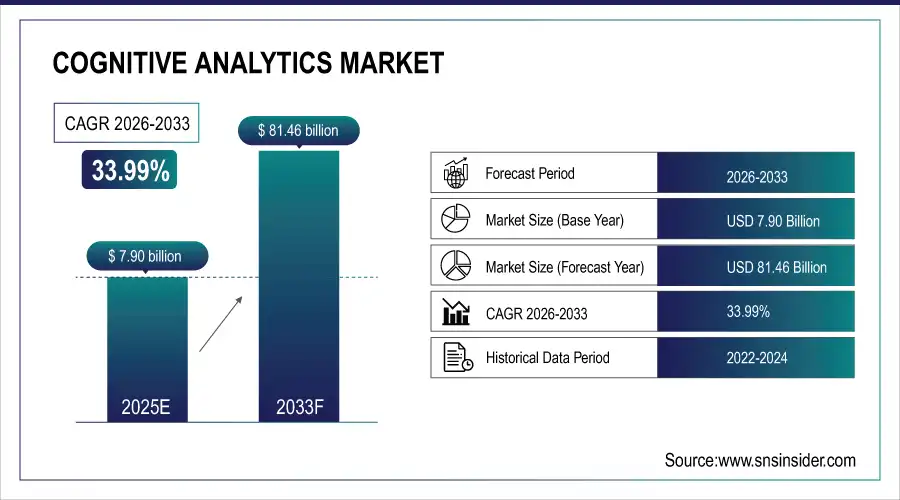
Cognitive Analytics Market was valued at USD 7.90 billion in 2025E and is expected to reach USD 81.46 billion by 2033, growing at a CAGR of 33.99% from 2026-2033.
The Cognitive Analytics Market is growing rapidly due to increasing adoption of artificial intelligence and machine learning across enterprises, rising demand for data-driven decision making, and the need for real-time insights. Organizations leverage cognitive analytics for customer management, fraud detection, operational efficiency, and predictive insights. Cloud adoption, digital transformation initiatives, and investments in AI technologies across industries further accelerate market expansion, driving significant growth.
IBM Watson delivers cognitive insights to clients across 170+ countries, enabling BFSI organizations to automate decision-making processes, improve efficiency, and reduce operational costs by approximately 30% globally.
Cognitive Analytics Market Size and Forecast
-
Market Size in 2025: USD 7.90 Billion
-
Market Size by 2033: USD 81.46 Billion
-
CAGR: 33.99% from 2026 to 2033
-
Base Year: 2025E
-
Forecast Period: 2026–2033
-
Historical Data: 2022–2024
To Get more information On Cognitive Analytics Market - Request Free Sample Report
Cognitive Analytics Market Trends
-
Rising demand for data-driven insights and advanced decision-making is driving the cognitive analytics market.
-
Growing adoption of AI, machine learning, and natural language processing is enhancing predictive and prescriptive capabilities.
-
Expansion across BFSI, healthcare, retail, and manufacturing sectors is fueling market growth.
-
Integration with big data platforms, cloud computing, and business intelligence tools is improving operational efficiency.
-
Increasing focus on customer experience, fraud detection, and risk management is shaping adoption trends.
-
Advancements in real-time analytics, automated reasoning, and self-learning systems are enhancing solution effectiveness.
-
Collaborations between analytics providers, enterprises, and technology vendors are accelerating innovation and global market penetration.
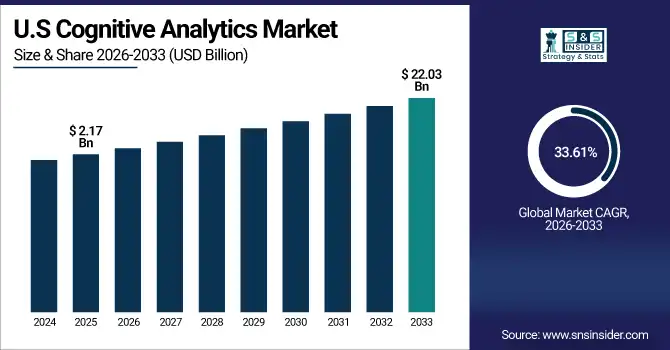
U.S. Cognitive Analytics Market was valued at USD 2.17 billion in 2025E and is expected to reach USD 22.03 billion by 2033, growing at a CAGR of 33.61% from 2026-2033.
The U.S. Cognitive Analytics Market is growing due to high AI adoption, advanced digital infrastructure, strong enterprise investments, increasing demand for data-driven decision making, cloud integration, and the need for real-time insights across multiple industries.
For example, Salesforce Einstein CRM integrates cognitive analytics across over 150,000 U.S. organizations, enhancing sales forecasting accuracy to 87% through real-time customer intelligence.
Cognitive Analytics Market Growth Drivers:
-
Rising enterprise focus on data-driven decision-making using AI-powered insights across complex business operations and customer interaction environments
Growing volumes of structured and unstructured data across enterprises demand advanced analytical tools capable of mimicking human reasoning and contextual understanding. Organizations increasingly rely on cognitive analytics to extract actionable insights, predict outcomes, and automate decision-making processes. Integration of artificial intelligence, machine learning, and natural language processing enables real-time analysis of customer behavior, operational patterns, and market trends. Businesses seek competitive advantages through faster insights, improved accuracy, and reduced manual analysis. Cognitive analytics enhances personalization, risk assessment, fraud detection, and strategic planning.
For example, AWS SageMaker drives personalized marketing campaigns by analyzing petabytes of consumer behavior, resulting in a 25% revenue uplift for e-commerce platforms, while Salesforce Einstein processes customer interactions for over 150,000 organizations, improving sales forecasting precision to 87% through real-time pattern recognition.
Cognitive Analytics Market Restraints:
-
Shortage of skilled professionals capable of managing AI-driven analytics systems and interpreting complex cognitive model outputs effectively
Limited availability of trained data scientists, AI engineers, and analytics professionals restricts effective utilization of cognitive analytics platforms. Organizations struggle to recruit talent with expertise in machine learning, natural language processing, and advanced statistical modeling. Skill gaps hinder system configuration, model optimization, and accurate interpretation of insights. Inadequate expertise can lead to misaligned outcomes, reduced trust in analytics results, and underutilization of deployed solutions. Training internal teams requires time and financial investment.
Cognitive Analytics Market Opportunities:
-
Growing demand for real-time analytics and personalized customer experiences across digital channels using intelligent data interpretation tools
Expanding digital transformation initiatives create strong opportunities for cognitive analytics adoption across customer-centric industries. Businesses seek real-time insights to understand customer intent, preferences, and behavior across multiple touchpoints. Cognitive analytics enables advanced personalization, sentiment analysis, and predictive engagement strategies. Retail, banking, healthcare, and media organizations leverage intelligent analytics to improve customer satisfaction, retention, and lifetime value. Integration with omnichannel platforms supports dynamic recommendations and proactive service delivery.
For example, Qualtrics reports 73% of customers actively engage with AI interactions, with 86% willing to share additional data for transparent personalization, while Zoom’s interaction analytics indicates 90% of CX leaders value real-time sentiment tracking, achieving a 26.7% revenue uplift through proactive service delivery.
Cognitive Analytics Market Segment Highlights
-
By Enterprise Type, Large Enterprises dominated with ~61% share in 2025; Small & Medium Enterprises fastest growing (CAGR).
-
By Application, Customer Management dominated with ~31% share in 2025; Fraud Detection & Security fastest growing (CAGR).
-
By End-user, BFSI dominated with ~28% share in 2025; Retail fastest growing (CAGR).
-
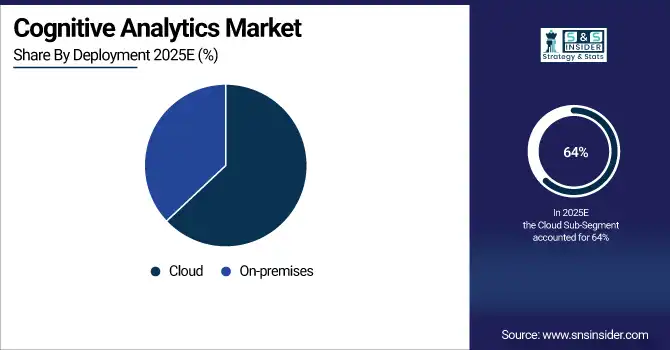
By Deployment, Cloud dominated with ~64% share in 2025; Cloud fastest growing (CAGR).
Cognitive Analytics Market Segment Analysis
By Enterprise Type, Large enterprises dominated the Market, while SMEs are expected to grow at the fastest CAGR
Large enterprises dominated the Cognitive Analytics Market in 2025 due to massive data volumes complex business processes and strong digital maturity. These organizations invest heavily in AI driven analytics to support strategic decision making risk management customer intelligence and operational optimization while leveraging existing IT infrastructure and skilled analytics teams.
Small and medium enterprises are expected to grow fastest from 2026 to 2033 as cloud based cognitive analytics lowers entry barriers. Affordable subscription models ease deployment while enabling SMEs to access advanced insights automate decisions enhance customer engagement and compete effectively without large upfront investments or specialized technical resources.
By Application, Customer Management led the market, with Fraud Detection & Security projected to grow at the fastest CAGR
Customer management dominated the market in 2025 as enterprises focused on improving customer experience and retention. Cognitive analytics enables real time behavior analysis personalization sentiment detection and predictive engagement. Growing digital interactions and demand for data driven marketing strategies increased adoption across industries prioritizing customer centric growth and long term relationship management.
Fraud detection and security is projected to grow fastest from 2026 to 2033 due to rising cyber threats digital payments and sophisticated fraud techniques. Cognitive analytics strengthens real time anomaly detection behavioral monitoring and predictive risk analysis helping organizations prevent losses meet compliance requirements and protect sensitive data assets.
By End-user, BFSI dominated the market, while the Retail segment is expected to grow at the fastest CAGR
BFSI dominated the Cognitive Analytics Market in 2025 because of heavy dependence on advanced analytics for fraud prevention credit risk assessment regulatory compliance and customer profiling. High transaction volumes structured data availability and continuous technology investments accelerate adoption of cognitive analytics across banking financial services and insurance operations.
Retail is expected to grow fastest from 2026 to 2033 as companies adopt cognitive analytics for demand forecasting dynamic pricing inventory optimization and personalized promotions. Rapid ecommerce expansion omnichannel strategies and real time consumer data usage drive strong demand for intelligent analytics to improve profitability and customer experience.
By Deployment, Cloud deployment led the market and is expected to grow at the fastest rate f
Cloud deployment dominated the Cognitive Analytics Market in 2025 and is expected to grow at the fastest rate from 2026 to 2033 due to its scalability flexibility and cost efficiency. Organizations increasingly adopt cloud platforms to process large data volumes deploy AI models rapidly and access real time insights. Cloud based cognitive analytics reduces infrastructure investment supports remote access enables seamless integration and allows continuous updates making it ideal for enterprises and growing businesses seeking faster deployment and operational agility.
Cognitive Analytics Market Regional Analysis
North America Cognitive Analytics Market Insights
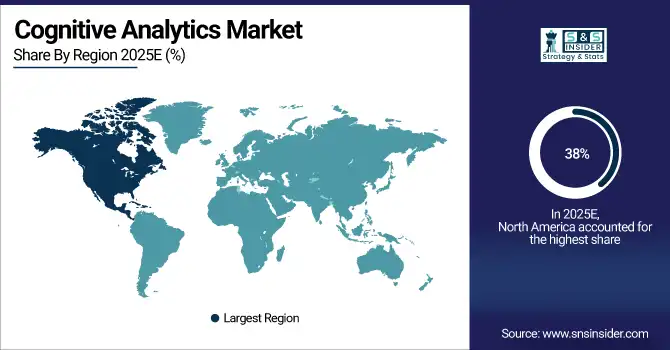
North America dominated the Cognitive Analytics Market with the highest revenue share of about 38% in 2025 due to early adoption of artificial intelligence advanced cloud infrastructure and strong presence of major technology providers. Enterprises across five key sectors including BFSI healthcare retail government and IT invest heavily in cognitive analytics for decision making fraud detection and customer intelligence. High data maturity skilled workforce continuous innovation spending and rapid integration of AI driven analytics solutions reinforce regional dominance and large scale commercial deployment across diverse enterprise environments.
Get Customized Report as per Your Business Requirement - Enquiry Now
Asia Pacific Cognitive Analytics Market Insights
Asia Pacific is expected to grow at the fastest CAGR of about 15.22% from 2026 to 2033 driven by rapid digital transformation expanding data volumes and rising AI investments. Adoption across five major industries such as retail BFSI manufacturing telecom and healthcare accelerates demand. Increasing cloud penetration government digital initiatives growing startup ecosystems and cost effective analytics solutions enable enterprises to adopt cognitive analytics for efficiency personalization risk management and competitive advantage across developing and developed economies.
Europe Cognitive Analytics Market Insights
Europe holds a significant position in the Cognitive Analytics Market due to strong regulatory focus on data governance and increasing adoption of artificial intelligence across enterprises. Organizations leverage cognitive analytics to enhance compliance risk management customer insights and operational efficiency. Growing investments in digital transformation cloud adoption and AI research across industries such as BFSI manufacturing healthcare and retail continue to support steady market expansion across the region.
Middle East & Africa and Latin America Cognitive Analytics Market Insights
Middle East & Africa and Latin America are witnessing growth in the Cognitive Analytics Market driven by digital transformation, rising AI adoption, and cloud infrastructure expansion. Governments and enterprises invest in smart city projects, banking, healthcare, and ecommerce. Increasing data generation, focus on operational efficiency, customer engagement, fraud detection, and personalized services accelerate adoption across multiple industries, supporting steady market expansion and enhanced decision-making capabilities in both regions.
Cognitive Analytics Market Competitive Landscape:
Google LLC
Google Cloud is a global leader in AI-driven analytics and cloud-based data solutions. Its BigQuery and Looker platforms empower enterprises to automate data engineering, discovery, and insight generation. Google integrates generative AI and geospatial analytics to enhance decision-making, optimize operations, and deliver actionable intelligence. With its autonomous data-to-AI platform, Google supports analytics across industries, enabling scalable AI adoption, real-time insights, and integration of location and environmental data for smarter business strategies.
-
2025 – Google Cloud expanded AI-driven analytics in BigQuery, automating discovery, engineering, and insight generation across the data lifecycle.
-
2025 – Google Maps Platform added geospatial analytics with generative AI to support location-based decision-making and developer insights.
-
2024 – Google Cloud introduced generative AI analytics innovations to automate analytics tasks and surface actionable insights.
-
2023 – Google highlighted AI integrations across BigQuery, Looker, and data analytics at Cloud Next ’23, enabling AI-powered insight workflows.
Oracle Corporation
Oracle provides enterprise analytics solutions that unify AI, data, and business intelligence. Oracle Analytics Cloud and Fusion Data Intelligence platforms enable natural-language queries, augmented analytics, and AI-assisted workflows, helping organizations gain deeper insights from complex datasets. The Oracle Intelligent Data Lake and generative AI capabilities support predictive modeling, automated data processing, and decision intelligence across business functions, enhancing analytical efficiency, scalability, and integration with enterprise systems.
-
2025 – Oracle unveiled Oracle Analytics AI Assistant for Fusion Data Intelligence, enabling natural-language conversations with business data for richer insights.
-
2025 – Oracle Analytics Cloud enhancements introduced augmented analytics and AI features for seamless workflow integration.
-
2024 – Oracle launched Intelligent Data Lake & generative AI-powered analytics within Oracle Data Intelligence Platform, unifying data and AI workflows.
-
2023 – Oracle added generative AI capabilities to Oracle Analytics Cloud to simplify complex data analysis.
SAS Institute Inc.
SAS Institute is a leader in advanced analytics, AI, and data management solutions for enterprises worldwide. Its SAS Viya platform provides cloud-based analytics, generative AI, synthetic data, and AI-agent support, enabling organizations to accelerate insights and decision-making. SAS focuses on trustworthy AI, scalable analytics, and workforce upskilling through initiatives like the SAS Academy for Data & AI Excellence, supporting diverse industries in applying AI-driven insights, automation, and predictive modeling effectively.
-
2025 – SAS announced SAS Viya innovations including synthetic data generation, AI agents, and expanded cloud analytics tools to boost productivity and AI-driven insights.
-
2025 – SAS launched SAS Academy for Data & AI Excellence in India to train professionals in GenAI-ready skills.
-
2024 – SAS expanded Viya platform with generative AI to automate data tasks and improve decision intelligence.
-
2023 – SAS unveiled AI-centric enhancements focused on generative AI, synthetic data, digital twins, and LLM workflows as part of a $1B AI investment.
IBM Corporation
IBM provides enterprise-grade AI and analytics solutions through its watsonx platform, combining AI, hybrid cloud, and data integration for cognitive decision-making. IBM supports AI agent workflows, real-time analytics, and unstructured data processing across industries. Its collaborations with NVIDIA and HCLTech accelerate AI analytics, generative AI deployment, and enterprise GenAI adoption. IBM’s watsonx platform emphasizes scalable insights, governance, and data-to-AI pipelines for predictive, prescriptive, and cognitive analytics applications.
-
2025 – IBM released watsonx.data v2.3, enhancing enterprise AI workflows with agentic AI and connected data insights.
-
2025 – IBM leveraged NVIDIA AI Data Platform technology to accelerate AI analytics and data processing at scale.
-
2025 – IBM advanced enterprise GenAI with hybrid cloud innovations, enabling AI agent creation and data-to-AI analytics.
-
2024 – IBM and HCLTech launched a Generative AI Center of Excellence for custom AI and analytics applications.
-
2023 – IBM expanded watsonx AI and Data Platform with generative AI models and governance previews for enterprise analytics.
Cognitive Analytics Market Key Players
-
Google LLC
-
Oracle Corporation
-
SAS Institute Inc.
-
IBM Corporation
-
Amazon Web Services (AWS)
-
Cisco Systems Inc.
-
SAP SE
-
Tableau (Salesforce)
-
MicroStrategy Inc.
-
Palantir Technologies
-
Hewlett Packard Enterprise
-
Cloudera Inc.
-
Databricks Inc.
-
Snowflake Inc.
-
QlikTech International
-
ThoughtSpot Inc.
-
DataRobot, Inc.
-
RapidMiner
| Report Attributes | Details |
|---|---|
| Market Size in 2025E | USD 7.90 Billion |
| Market Size by 2033 | USD 81.46 Billion |
| CAGR | CAGR of 33.99% From 2026 to 2033 |
| Base Year | 2025 |
| Forecast Period | 2026-2033 |
| Historical Data | 2022-2024 |
| Report Scope & Coverage | Market Size, Segments Analysis, Competitive Landscape, Regional Analysis, DROC & SWOT Analysis, Forecast Outlook |
| Key Segments | • By Deployment (Cloud, On-premises) • By Enterprise Type (Large Enterprises, Small & Medium Enterprises) • By Application (Customer Management, Fraud Detection & Security, Supply Chain Management, Sales & Marketing Management, Others) • By End-user (BFSI, IT & Telecom, Government, Retail, Healthcare, Education, Others) |
| Regional Analysis/Coverage | North America (US, Canada), Europe (Germany, UK, France, Italy, Spain, Russia, Poland, Rest of Europe), Asia Pacific (China, India, Japan, South Korea, Australia, ASEAN Countries, Rest of Asia Pacific), Middle East & Africa (UAE, Saudi Arabia, Qatar, South Africa, Rest of Middle East & Africa), Latin America (Brazil, Argentina, Mexico, Colombia, Rest of Latin America). |
| Company Profiles | Google LLC, Oracle Corporation, SAS Institute Inc., IBM Corporation, Microsoft Corporation, Amazon Web Services (AWS), Cisco Systems Inc., SAP SE, Tableau (Salesforce), MicroStrategy Inc., Palantir Technologies, Hewlett Packard Enterprise, Cloudera Inc., Databricks Inc., Snowflake Inc., Teradata Corporation, QlikTech International, ThoughtSpot Inc., DataRobot Inc., RapidMiner |
Frequently Asked Questions
The Cognitive Analytics Market is expected to grow at a CAGR of 33.99% from 2026 to 2033, driven by AI and cloud adoption.
The Cognitive Analytics Market was valued at USD 7.90 billion in 2025, reflecting increasing enterprise adoption of AI and data-driven decision-making.
Rising adoption of AI, machine learning, cloud platforms, and demand for real-time, data-driven insights across enterprises drives market growth.
Large Enterprises dominated by enterprise type, Customer Management by application, BFSI by end-user, and Cloud by deployment during the projected years.
North America dominated the Cognitive Analytics Market in 2025 due to early AI adoption, advanced infrastructure, and presence of leading technology providers.
