
Cold Brew Coffee Market Report Scope & Overview:
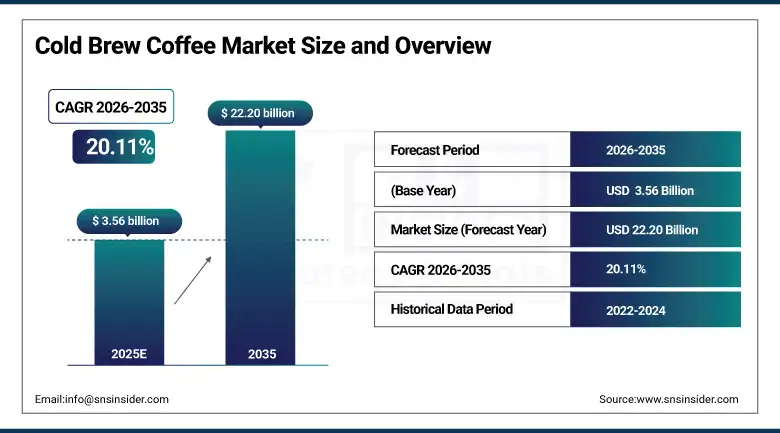
Cold Brew Coffee Market was valued at USD 3.56 billion in 2025 and is expected to reach USD 22.20 billion by 2035, growing at a CAGR 20.11% of from 2026-2035.
The cold brew coffee market is experiencing strong growth driven by changing consumer preferences toward smoother, less acidic coffee and convenient beverage formats. Increasing demand for ready-to-drink products, premiumization of coffee, and innovation in flavors and functional formulations are shaping market dynamics. Brands are focusing on quality sourcing, sustainable practices, and product differentiation to attract health-conscious and younger consumers. The market continues to evolve with advancements in brewing techniques, packaging innovation, and expanding availability across retail and online channels.
In 2025, around 45% of coffee consumers prefer cold brew over traditional iced coffee, reflecting a clear shift in consumption behavior toward smoother and less acidic coffee options.
Cold Brew Coffee Market Size and Forecast
-
Market Size in 2025: USD 3.56 Billion
-
Market Size by 2035: USD 22.20 Billion
-
CAGR: 20.11%
-
Base Year: 2025
-
Forecast Period: 2026-2035
-
Historical Data: 2022-2024
To Get more information On Cold Brew Coffee Market - Request Free Sample Report
Key Trends in the Cold Brew Coffee Market
-
Growing demand for ready-to-drink cold brew driven by convenience and on-the-go consumption
-
Rising popularity of premium, specialty, and artisanal coffee products
-
Increasing focus on functional cold brew with health-oriented ingredients
-
Expansion of online retail and direct-to-consumer distribution channels
-
Adoption of sustainable and eco-friendly packaging solutions
U.S. Cold Brew Coffee Market Insights:
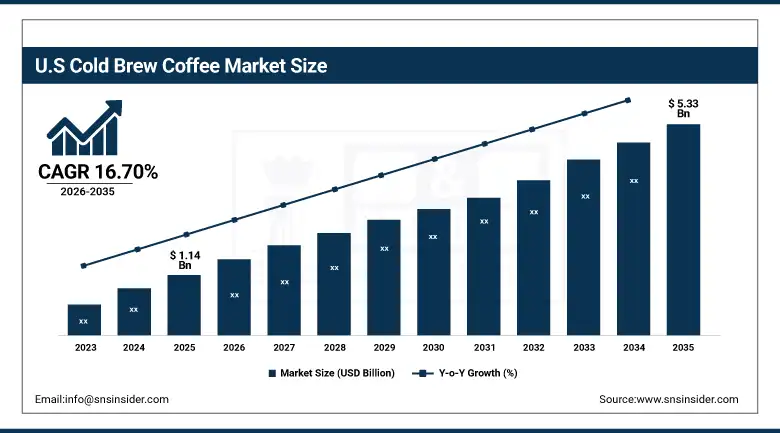
The U.S. Cold Brew Coffee Market is projected to grow from USD 1.14 Billion in 2025 to USD 5.33 Billion by 2035, at a CAGR of 16.70%. Growth is driven by rising demand for ready-to-drink beverages, expanding café culture, premiumization trends, increasing health-conscious consumption, flavor innovation, strong retail distribution, and the presence of established coffee brands across the United States.
Cold Brew Coffee Market Growth Drivers:
-
Rising Preference for Smoother and Low-Acidity Coffee
Growing consumer preference for smoother, less acidic coffee beverages is a key driver of the cold brew coffee market. Unlike traditional hot-brewed coffee, cold brew offers a naturally mellow flavor profile that is easier on the stomach, appealing to health-conscious and sensitive consumers. This shift is supported by changing taste preferences and lifestyle choices focused on comfort and wellness. In 2025, around 45% of coffee consumers preferred cold brew over traditional iced coffee, reinforcing the growing demand for smoother coffee experiences.
Cold Brew Coffee Market Restraints:
-
Shelf-Life and Storage Challenges for Fresh Cold Brew Products
Shelf-life and storage limitations present a key restraint in the cold brew coffee market, particularly for fresh and minimally processed products. Cold brew often requires refrigeration and careful handling to preserve flavor quality and prevent microbial growth. Unlike shelf-stable hot-brewed alternatives, fresh cold brew is more sensitive to temperature fluctuations during transportation and storage. In 2025, nearly 30% of cold brew producers cited shelf-life constraints as a major operational challenge, increasing logistics costs and limiting wider market penetration.
Cold Brew Coffee Market Opportunities:
-
Innovation in Sustainable Packaging and Brewing Technologies
Innovation in sustainable packaging and brewing technologies is a significant opportunity in the cold brew coffee market. Brands are increasingly adopting eco-friendly packaging solutions such as recyclable bottles, pouches, and Tetra Pak cartons to reduce environmental impact. Simultaneously, advancements in brewing techniques, including cold extraction methods and concentrate formulations, enhance flavor consistency and product quality. These innovations not only appeal to environmentally conscious consumers but also help companies differentiate their offerings and strengthen brand loyalty in a competitive market.
Cold Brew Coffee Market Segment:
-
By Product Type: In 2025, Ready to Drink dominated with 60% share; Concentrate fastest growing segment during 2026-2035
-
By Packaging: In 2025, Bottles and Cans dominated with 55% share; other Packaging such as Pouches and Tetra Pak fastest growing segment during 2026-2035
-
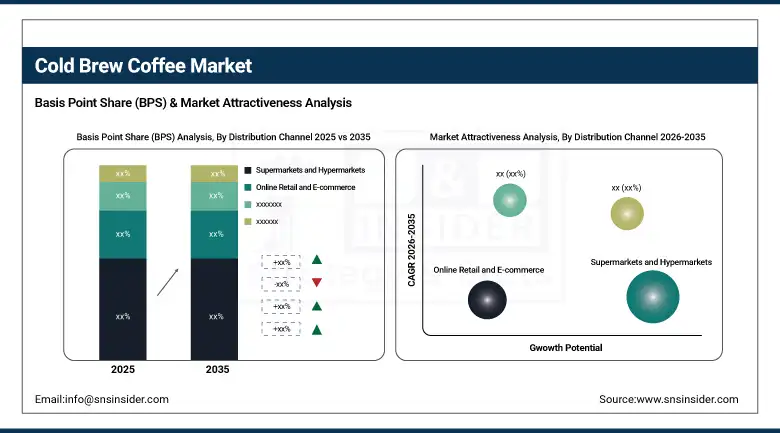
By Distribution Channel: In 2025, Supermarkets and Hypermarkets dominated with 50% share; Online Retail and E-commerce fastest growing segment during 2026-2035
-
By Flavor: In 2025, Classic dominated with 45% share; Functional and Specialty fastest growing segment during 2026-2035
Cold Brew Coffee Market Segment Analysis:
By Product Type: Ready to Drink Dominates, Concentrate Fastest-Growing
Ready to Drink dominates the product type segment due to its convenience, on-the-go consumption, and strong retail presence. Bottled and canned formats allow widespread distribution, and high consumer demand combined with brand recognition reinforces RTD cold brew as the leading product type.
Concentrate is the fastest-growing product type, driven by cafés, restaurants, and home brewing trends. Its versatility allows consumers to customize strength and flavor, and premium and specialty cold brew brands increasingly adopt concentrate formats to target niche markets. Growth is further accelerated by the rising popularity of sustainable and refillable packaging.
By Packaging: Bottles and Cans Dominates, Other Packaging Fastest-Growing
Bottles and Cans dominate the packaging segment due to convenience, portability, and strong retail adoption. This packaging is ideal for ready-to-drink cold brew, making it the preferred choice for major beverage companies.
Other Packaging such as pouches and Tetra Pak is the fastest-growing, driven by sustainability trends, lightweight materials, and environmental awareness among consumers. Emerging eco-friendly packaging solutions appeal to premium and health-conscious markets, boosting adoption globally.
By Distribution Channel: Supermarkets and Hypermarkets Dominates, Online Retail Fastest-Growing
Supermarkets and Hypermarkets dominate the distribution channel segment due to high foot traffic, convenience, and large-scale retail penetration. They serve as the primary avenue for mass-market cold brew products, supported by strong promotional activities and bundling strategies.
Online Retail and E-commerce is the fastest-growing channel, fueled by post-pandemic shifts to online shopping, home delivery, and subscription-based services. Consumers increasingly purchase premium and niche cold brew products online, allowing smaller brands to compete with established players.
By Flavor: Classic Dominates, Functional and Specialty Fastest-Growing
Classic flavor dominates the segment due to broad consumer preference for traditional coffee taste. Its consistent appeal across age groups and regions makes it the staple product offering for most cold brew brands.
Functional and Specialty flavors, which include added vitamins, adaptogens, or low-sugar options, are the fastest-growing segment. Increasing health-consciousness, demand for premium beverages, and interest in functional ingredients drive adoption, particularly among millennials and Gen Z.
Cold Brew Coffee Market - Regional Analysis
North America Cold Brew Coffee Market Insights:
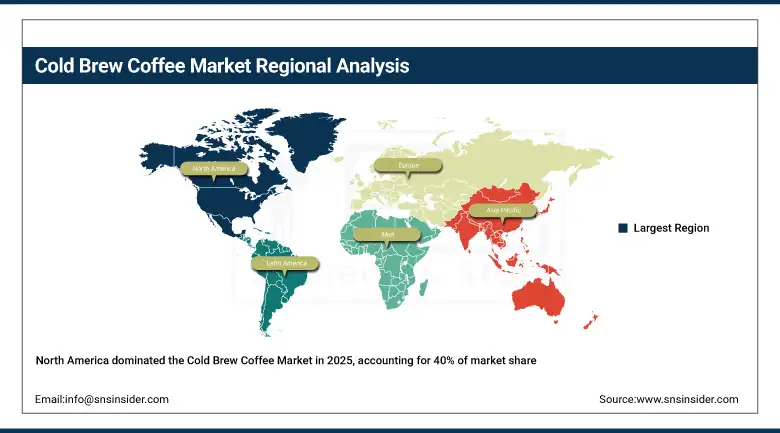
North America dominates the global cold brew coffee market, accounting for approximately 40% of total market share in 2025. The region’s leadership is driven by a strong café culture, high consumer preference for ready-to-drink beverages, and widespread adoption of premium cold brew products. Well-established retail infrastructure, increasing brand awareness, and the presence of major players such as Starbucks and Nestlé further reinforce North America’s dominant position in the global cold brew coffee market.
Get Customized Report as per Your Business Requirement - Enquiry Now
Europe Cold Brew Coffee Market Insights:
Europe represents a significant region in the global cold brew coffee market, supported by a strong specialty coffee culture and growing consumer interest in premium and artisanal beverages. The region’s market growth is driven by increasing experimentation with cold brew formats, rising demand for ready-to-drink coffee, and expanding café chains across countries such as the United Kingdom, Germany, and France. The presence of established coffee brands, focus on quality sourcing, and evolving consumer preferences continue to strengthen Europe’s position in the global cold brew coffee market.
Asia-Pacific Cold Brew Coffee Market Insights:
Asia-Pacific is the fastest-growing region in the global cold brew coffee market, registering a CAGR of 30.26% during the forecast period. The region’s rapid growth is driven by increasing urbanization, rising disposable incomes, and the expanding café and specialty coffee culture across countries such as China, Japan, and South Korea. Growing demand for ready-to-drink beverages, western lifestyle influence, and the entry of global coffee brands are further accelerating cold brew adoption across the Asia-Pacific market.
Latin America Cold Brew Coffee Market Insights:
Latin America plays an emerging role in the global cold brew coffee market, supported by its strong coffee-producing heritage and rising domestic consumption of specialty beverages. Growing urbanization, expanding café culture, and increasing exposure to premium and ready-to-drink coffee formats are encouraging cold brew adoption. Local coffee brands and international players are gradually introducing cold brew offerings, strengthening the region’s presence in the global market.
Middle East & Africa Cold Brew Coffee Market Insights:
The Middle East and Africa cold brew coffee market is gradually gaining traction, driven by increasing urbanization, a growing young population, and rising interest in specialty and premium coffee beverages. Expanding café culture, tourism-driven consumption, and the entry of international coffee chains are supporting market development. Consumers are increasingly exploring ready-to-drink and cold brew formats, contributing to steady adoption across key metropolitan areas in the region.
Cold Brew Coffee Market Competitive Landscape:
Starbucks Corporation, headquartered in Seattle, Washington, USA, is a leading global coffeehouse chain and a prominent player in the cold brew coffee market, specializing in ready-to-drink beverages, specialty coffee blends, and premium cold brew offerings. The company focuses on high-quality Arabica beans, innovative brewing techniques, and sustainable sourcing practices, emphasizing brand recognition, customer experience, and global retail presence.
-
In March 2025: Starbucks expanded its ready-to-drink cold brew portfolio with new flavored variants and functional beverages, targeting health-conscious and on-the-go consumers.
Nestle S.A., headquartered in Vevey, Switzerland, is a major multinational food and beverage company with a strong presence in the cold brew coffee market through its RTD and specialty coffee products. The company emphasizes product innovation, sustainable sourcing, and advanced coffee extraction technologies, delivering premium cold brew offerings under brands such as Nescafe and Blue Bottle Coffee.
-
In January 2025: Nestle launched a new line of organic and functional cold brew beverages to strengthen its global cold brew portfolio and cater to growing demand for health-focused and specialty coffee products.
Cold Brew Coffee Market Key Players
-
Starbucks Corporation
-
Nestle S.A.
-
Dunkin’ Brands Group, Inc.
-
The J.M. Smucker Company
-
Peet’s Coffee & Tea, Inc.
-
Stumptown Coffee Roasters
-
High Brew Coffee
-
La Colombe Coffee Roasters
-
Califia Farms
-
Blue Bottle Coffee
-
Chameleon Cold-Brew
-
Rise Brewing Co.
-
Grady’s Cold Brew
-
Slingshot Coffee Co.
-
Chango Coffee
-
Sleepy Dog Coffee Co.
-
Brew Dr. Kombucha (Cold Brew blends)
-
Tandem Coffee Roasters
-
Pret a Manger (Cold Brew line)
-
Coffee Bean & Tea Leaf
| Report Attributes | Details |
|---|---|
| Market Size in 2025 | USD 3.56 Billion |
| Market Size by 2035 | USD 22.20 Billion |
| CAGR | CAGR of 20.11% From 2026 to 2035 |
| Base Year | 2025 |
| Forecast Period | 2026-2035 |
| Historical Data | 2022-2024 |
| Report Scope & Coverage | Market Size, Segments Analysis, Competitive Landscape, Regional Analysis, DROC & SWOT Analysis, Forecast Outlook |
| Key Segments | • By Product Type: (Ready to Drink, Concentrate) • By Packaging: (Bottles and Cans, Cartons and Glass Bottles, Other Packaging such as Pouches and Tetra Pak) • By Distribution Channel: (Supermarkets and Hypermarkets, Online Retail and E-commerce, Cafes and Specialty Coffee Shops, Convenience Stores and Gas Stations) • By Flavor: (Classic, Flavored (Vanilla, Caramel & Mocha), Functional and Specialty (added Vitamins, Adaptogens, or Low Sugar)) |
| Regional Analysis/Coverage | North America (US, Canada), Europe (Germany, UK, France, Italy, Spain, Russia, Poland, Rest of Europe), Asia Pacific (China, India, Japan, South Korea, Australia, ASEAN Countries, Rest of Asia Pacific), Middle East & Africa (UAE, Saudi Arabia, Qatar, South Africa, Rest of Middle East & Africa), Latin America (Brazil, Argentina, Mexico, Colombia, Rest of Latin America). |
| Company Profiles | Starbucks Corporation, Nestlé S.A., Dunkin’ Brands Group, Inc., The J.M. Smucker Company, Peet’s Coffee & Tea, Inc., Stumptown Coffee Roasters, High Brew Coffee, La Colombe Coffee Roasters, Califia Farms, Blue Bottle Coffee, Chameleon Cold-Brew, Rise Brewing Co., Grady’s Cold Brew, Slingshot Coffee Co., Chango Coffee, Sleepy Dog Coffee Co., Brew Dr. Kombucha, Tandem Coffee Roasters, Pret a Manger, Coffee Bean & Tea Leaf |
Frequently Asked Questions
North America dominated the Cold Brew Coffee Market in 2025.
The “Ready to Drink (RTD)” segment dominated during the projected period.
The key drivers of the Low Sodium Refining Agents market include rising demand for smoother coffee, convenience, premiumization, flavor innovation, functional beverages, and expanding café culture and retail availability.
The market was valued at USD 3.56 Billion in 2025 and is projected to reach USD 22.20 Billion by 2035.
The Cold Brew Coffee Market is expected to grow at a CAGR of 20.11% during 2026–2035.
