
Component Cells Market Report Scope & Overview:
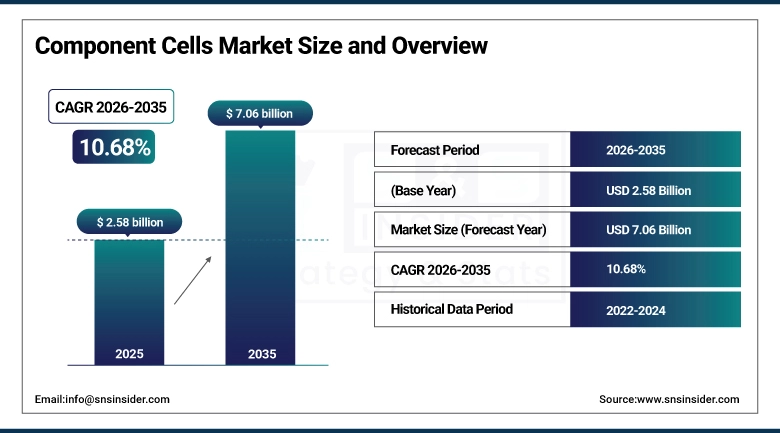
The Component Cells Market size is valued at USD 2.58 Billion in 2025 and is projected to reach USD 7.06 Billion by 2035, growing at a CAGR of 10.68% during the forecast period 2026–2035.
The Competent Cells Market analysis report provides a comprehensive overview of the dynamics of the market, technological advancements, and various applications of the technology. The increase in the demand for recombinant proteins, cloning and gene editing technology, the use of synthetic biology, and the increase in pharmaceutical and academic research are the major drivers for the Competent Cells Market to grow rapidly during 2026-2035.
Global competent cells revenue exceeded USD 2.1 billion in 2025, driven by rising demand for recombinant proteins, expanding adoption of cloning and CRISPR workflows, and rapid growth in synthetic biology applications.
Component Cells Market Size and Forecast:
-
Market Size in 2025: USD 2.58 Billion
-
Market Size by 2035: USD 7.06 Billion
-
CAGR: 10.68% from 2026 to 2035
-
Base Year: 2025
-
Forecast Period: 2026–2035
-
Historical Data: 2022–2024
To Get more information on Component Cells Market - Request Free Sample Report
Competent Cells Market Trends:
-
Competent cells are increasingly being engineered for synthetic biology applications, such as custom metabolic pathways and bio-based materials.
-
Labs are demanding cells optimized for CRISPR-Cas systems and gene circuit design, not just traditional cloning.
-
Growth in robotic liquid handling systems and automated cloning platforms is driving demand for competent cells that are pre-formatted for automation.
-
Sustainability certifications are becoming a differentiator, especially in Europe.
-
In India (Pune, Hyderabad, Bengaluru), demand is shifting toward CROs and startup biotech firms that need cost-effective but reliable competent cells.
-
Competent cells are increasingly sold as part of integrated kits that include plasmid design software powered by AI.
U.S. Competent Cells Market Insights:
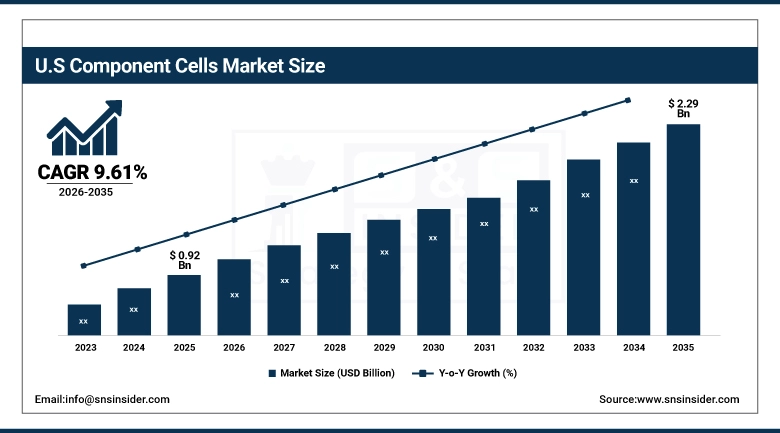
The U.S. competent cells market dominates North America, accounting for 82.19% of the regional share. Valued at approximately USD 0.92 billion in 2025, it is projected to reach around USD 2.29 billion by 2035, growing at a CAGR of 9.61%. Growth is driven by the country’s strong biotechnology and pharmaceutical presence, extensive academic research infrastructure, and high adoption of advanced cloning and protein expression technologies.
Competent Cells Market Growth Drivers:
-
Rising demand for recombinant proteins, biologics, and advanced molecular cloning techniques are key drivers of competent cells market growth.
Pharmaceutical companies, contract research organizations, and research institutions are increasingly utilizing highly efficient, ultracompetent, and kit-based cell formats to speed up cloning, mutagenesis, and gene editing. This is due to the advancements observed in transformation efficiency, inclusion of automated high-throughput systems, and strains for complex DNA uptake.
In 2025, over 60% of pharmaceutical and biotech companies utilized advanced competent cell products for protein expression and gene-editing applications, supporting sustained market expansion and positioning competent cells.
Competent Cells Market Restraints:
-
High costs of ultracompetent and specialized cell formats, along with limited affordability for smaller academic labs, remain key restraints on market growth.
In spite of the high demand, the difference in transformation efficiency and the need for skilled handling represent a technical barrier to entry for less experienced research environments. The high concentration of a few major industry players, including Thermo Fisher, Bio-Rad, and Agilent, creates a competitive constraint.
In 2025, nearly 40% of academic and mid-scale research institutes reported challenges in accessing premium competent cell products due to budget constraints, underscoring affordability and accessibility as persistent hurdles.
Competent Cells Market Opportunities:
-
Expanding applications in synthetic biology, gene editing, and biologics manufacturing present significant opportunities for market growth.
Pharma companies, CROs, and academic institutes are looking for highly efficient and ultracompetent cells to support advanced research and development processes for CRISPR-related research, vaccine development, and precision medicine. Integration with automation systems, AI-assisted plasmid design tools, and HTS solutions is providing new avenues for the adoption of competent cells.
In 2025, nearly 35% of CROs and biotech startups in Asia-Pacific reported shifting toward kit-based and automation-ready competent cell formats, highlighting strong demand in emerging biotech hubs.
Competent Cells Market Segmentation Analysis:
-
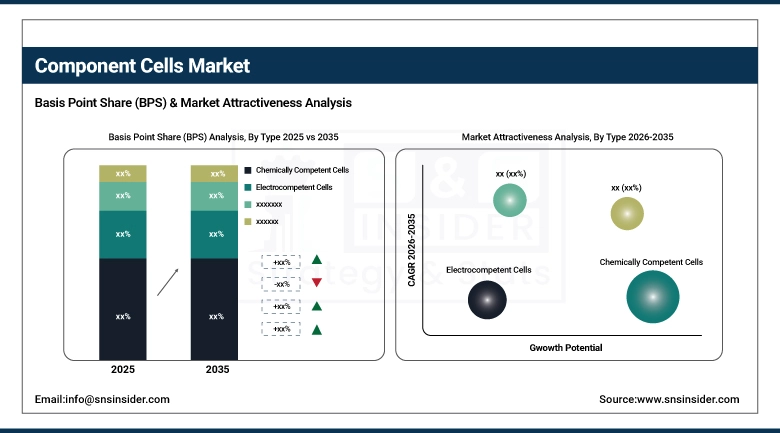
By Type, Chemically Competent Cells held the largest market share of 53.65% in 2025, while Electrocompetent Cells are expected to grow at the fastest CAGR of 10.93% during 2026–2035.
-
By Application, Cloning & Sub-Cloning dominated with 42.71% market share in 2025, whereas Protein Expression are projected to record the fastest CAGR of 12.91% through 2026–2035.
-
By Product Format, Single-Use Aliquots accounted for the highest market share of 46.45% in 2025, while Kits (Competent Cells + Reagents) are expected to grow at the fastest CAGR of 11.42 % during the forecast period.
-
By End User, Pharmaceutical & Biotechnology Companies dominated with a 53.11% share in 2025, while Contract Research Organizations (CROs) are anticipated to expand at the fastest CAGR of 12.84% through 2026–2035.
By Type, Chemically Competent Cells Dominate While Electrocompetent Cells Grow Rapidly:
The segment of Chemically Competent Cells holds the majority of the market share, owing to the fact that these cells are widely used for routine cloning and plasmid uptake. The reliability and cost-effectiveness, of these cells has made them the market leaders.
Electrocompetent Cells segment represent the fastest-growing segment, with growth fuelled by rising demand for high-efficiency transformation, advanced gene-editing applications, and integration into automated, high-throughput workflows. This segment is rapidly transforming molecular biology practices by enhancing DNA uptake efficiency and enabling more complex cloning and synthetic biology experiments.
By Application, Cloning & Sub-Cloning Dominate While Protein Expression Grows Rapidly:
The market share for the Cloning and Sub-Cloning segment is the highest due to this product is used in research for molecular biology, plasmid, and genetic engineering. The reliability and usage of this product by pharmaceutical companies, CRO, and academic institutions, and its importance in the biotechnology field, have made this product the market leader.
Protein Expression segment is found to be the fastest-growing segment due to this segment is witnessing significant growth in demand for recombinant proteins, biologics, and vaccines, and also in the application of gene editing and synthetic biology techniques. This segment is changing biotechnology workflows at a rapid rate by allowing large-scale production of therapeutic proteins and accelerating drug discovery.
By Product Format, Single-Use Aliquots Dominate While Kits Grow Rapidly:
The Single Use Aliquots segment has the highest market share due to the ease of use, reliability, and widespread usage in pharmaceutical companies, CROs, and research institutes. The ability of this segment to reduce the risk of contamination and transformation efficiency is also a contributing factor.
Kits (competent cells + reagents) segment represents the fastest-growing segment, with growth fuelled by rising demand for integrated, easy-to-use solutions, especially among smaller biotech firms and teaching laboratories. This segment is rapidly transforming laboratory workflows by simplifying cloning and protein expression processes, enhancing efficiency, and reducing technical barriers for less experienced users.
By End User, Pharmaceutical & Biotechnology Companies Dominate While Contract Research Organizations (CROs) Grow Rapidly:
The Pharmaceutical and Biotechnology Companies segment has the largest market share due to their high dependence on competent cells for drug discovery, biologics development, and sophisticated molecular cloning. Their well-developed R&D capabilities and high demand for recombinant proteins, along with their adoption of gene editing tools, have helped them remain at the top.
Contract Research Organizations (CRO's) segment is the fastest-growing segment, and this is driven by rising outsourcing trend, cost efficiency, and the adoption of high-efficiency competent cells for executing complex cloning and protein expression projects. The segment of Contract Research Organizations is revolutionizing the market, which is benefiting small and mid-tier biotech companies and pharma companies.
Competitive Cells Market Regional Analysis:
North America Competent Cells Market Insights:
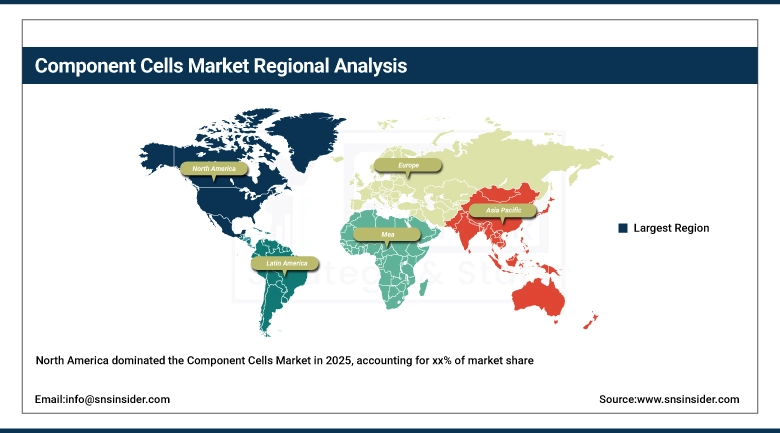
North America competent cells market is leading the way in the global competent cells market. The region is home to high R&D activities in the fields of biotechnology and pharmaceuticals. The region is also home to high-end research facilities. The pharmaceutical companies and research centers in this region have been adopting high-efficiency cloning and protein expression systems. The region is home to high R&D activities in the fields of biotechnology and pharmaceuticals. The region is also home to high-end research facilities.
Get Customized Report as per Your Business Requirement - Enquiry Now
U.S. Competent Cells Market Insights:
The United States holds the highest share of the competent cells market, driven by the presence of a well-established pharmaceutical industry, academic research, and the high demand for recombinant protein production. The United States has witnessed high acceptance of chemically competent cells, and the rapid adoption of electrocompetent cells, owing to the increasing need for gene editing. Additionally, the rising interest in biologics production, CRO partnerships, and the availability of automation-ready kits have made the United States the largest market.
Asia-Pacific Competent Cells Market Insights:
Asia-Pacific competent cells market: The Asia-Pacific competent cells market is considered to be the fastest-growing segment of the global competent cells market. The growth of the Asia-Pacific competent cells market is attributed to the increasing growth of the biotechnology industry and the increasing investments made by governments in genomics. Pharmaceutical companies, CRO services, and research institutes in Asia-Pacific countries such as China, India, and Japan are increasingly adopting chemically competent and electrocompetent cells. The strong demand for biologics and the increasing focus on synthetic biology and automation-ready kits have made Asia-Pacific the growth engine of the competent cells market.
China Competent Cells Market Insights:
China's competent cells market is considered to be one of the largest and fastest-growing markets in Asia Pacific. The growth of this market is mainly attributed to the high investment made by the government in the research of biotechnology, synthetic biology, and genomics. The pharmaceutical sector and CROs are increasingly adopting chemically competent cells for routine cloning applications. On the other hand, electrocompetent cells have also demonstrated promising growth in advanced gene editing and high-efficiency transformation applications.
Europe Competent Cells Market Insights:
The competent cells market in Europe has a large market share compared to other regions. The region is home to strong research activities and government-funded genomics research. The region is also home to strong pharmaceutical industries. The region is home to research and development activities of many research institutes and biotech companies that use chemically competent and electrocompetent cells. The focus on sustainability and green chemistry is also high in this region.
Germany Competent Cells Market Insights:
The competent cells market in Germany is leading the way in the entire European region due to its favorable academic environment, pharmaceutical R&D, and government support for biotechnology development. High penetration of chemical competent cells for cloning and the growing need for electro competent cells for gene editing and synthetic biology are boosting the competent cells market. Increased collaborations between academic and biotechnology institutions and international companies are pushing the German competent cells market to the top of the European region.
Latin America Competent Cells Market Insights:
Latin America's competent cells market is witnessing a steady growth trajectory, driven by increasing academic research, rising investments in biotechnology, and increasing partnerships with North American companies. Academic institutions and diagnostic research centers in Brazil and Mexico are increasingly using chemically competent cells for routine cloning, whereas the market for electrocompetent cells is witnessing growth potential from advanced molecular biology research. Limited infrastructure development, coupled with budget constraints, has, however, affected the growth of the market, but increasing partnerships are cementing Latin America's position as an emerging contributor.
Middle East & Africa Competent Cells Market Insights:
The Middle East & Africa competent cells market is in its early stage of development. It is driven by government-sponsored biotechnology initiatives and the expansion of academic research capabilities. Academic and research institutions in the Gulf region and South Africa are starting to adopt competent cells for molecular biology and cloning studies. Though the region faces a lack of infrastructure and high costs, the rise of partnerships with global players and the development of biotechnology innovation are boosting the region.
Competent Cells Market Competitive Landscape:
Thermo Fisher Scientific Inc. is a global leader in life sciences and biotechnology, with a strong focus on molecular biology reagents and transformation technologies. The company dominates the competent cells market through its extensive portfolio of chemically competent and electrocompetent cells, widely adopted in pharmaceutical companies, CROs, and academic research institutes. Thermo Fisher’s reputation for innovation, reliability, and scalability has positioned it as a trusted partner in cloning, protein expression, and gene-editing workflows.
-
In 2025, its competent cells portfolio accounted for a significant share of global molecular biology procedures, reinforcing its leadership in advanced biotechnology and research-driven applications.
Merck KGaA (Sigma-Aldrich) is a leading supplier of chemicals and life science tools, with a strong presence in molecular biology and genomics. The company dominates the competent cells market through its broad range of high-efficiency transformation products, including specialized strains tailored for cloning and mutagenesis. Merck’s emphasis on quality, consistency, and global distribution networks has positioned it as a key provider for both industrial and academic research.
-
In 2025, its competent cells portfolio was widely adopted across Europe and North America, reinforcing its leadership in reliable, cost-effective solutions for molecular biology research.
New England Biolabs (NEB) is a specialized biotechnology company recognized for its expertise in molecular biology reagents and cloning tools. NEB dominates the competent cells market through its high-performance chemically competent and electrocompetent cells, designed for advanced cloning, mutagenesis, and synthetic biology applications. Its reputation for scientific excellence, innovation, and strong support for academic research has positioned NEB as a trusted partner in molecular biology.
-
In 2025, NEB’s competent cells portfolio was extensively used in academic and research institutes, reinforcing its leadership in precision-driven cloning and gene-editing applications.
Competent Cells Market Key Players:
-
Thermo Fisher Scientific Inc.,
-
Merck KGaA (Sigma-Aldrich),
-
New England Biolabs (NEB)
-
Takara Bio Inc.
-
Agilent Technologies Inc.
-
Promega Corporation
-
Zymo Research Corp.
-
Avantor Inc.
-
Intact Genomics Inc.
-
Scarab Genomics LLC
-
Lucigen Corporation
-
GenScript Biotech Corporation
-
Tonbo Biosciences
-
Enzynomics Inc.
-
NZYTech
-
QIAGEN N.V.
-
Bio-Rad Laboratories Inc.
-
Addgene
-
OriGene Technologies Inc.
-
Yeastern Biotech Co., Ltd.
| Report Attributes | Details |
|---|---|
| Market Size in 2025 | USD 2.58 Billion |
| Market Size by 2035 | USD 7.06 Billion |
| CAGR | CAGR of 10.68% From 2026 to 2033 |
| Base Year | 2025 |
| Forecast Period | 2026-2035 |
| Historical Data | 2022-2024 |
| Report Scope & Coverage | Market Size, Segments Analysis, Competitive Landscape, Regional Analysis, DROC & SWOT Analysis, Forecast Outlook |
| Key Segments | • By Type (Chemically Competent Cells, Electrocompetent Cells, Ultracompetent Cells, Others) • By Application (Cloning & Sub-Cloning, Protein Expression, Mutagenesis, Phase Display & High-Throughput Cloning, Others) • By Product Format (Single-Use Aliquots, Bulk/Custom Packs, Kits (Competent Cells+Reagents), Others) • By End User (Pharmaceutical & Biotechnology Companies, Academic & Research Organizations (CROs), Others) |
| Regional Analysis/Coverage | North America (US, Canada), Europe (Germany, UK, France, Italy, Spain, Russia, Poland, Rest of Europe), Asia Pacific (China, India, Japan, South Korea, Australia, ASEAN Countries, Rest of Asia Pacific), Middle East & Africa (UAE, Saudi Arabia, Qatar, South Africa, Rest of Middle East & Africa), Latin America (Brazil, Argentina, Mexico, Colombia, Rest of Latin America). |
| Company Profiles | Thermo Fisher Scientific Inc., Merck KGaA (Sigma-Aldrich), New England Biolabs (NEB), Takara Bio Inc., Agilent Technologies Inc., Promega Corporation, Zymo Research Corp., Avantor Inc., Intact Genomics Inc., Scarab Genomics LLC, Lucigen Corporation, GenScript Biotech Corporation, Tonbo Biosciences, Enzynomics Inc., NZYTech, QIAGEN N.V., Bio-Rad Laboratories Inc., Addgene, OriGene Technologies Inc., Yeastern Biotech Co., Ltd. |
Frequently Asked Questions
The market was valued at USD 2.58 Billion in 2025 and is projected to reach USD 7.06 Billion by 2035 with a CAGR of 10.68% during 2026-2035.
North America leads the global market with share of 82.19%, supported by strong pharmaceutical R&D and advanced academic infrastructure.
Electrocompetent cells are the fastest-growing segment at CAGR of 10.93%, driven by their high transformation efficiency and increasing use in advanced applications.
Chemically competent cells dominate the market with 53.65% share, due to their cost-effectiveness, ease of use, and widespread adoption in routine cloning.
Competent cells are specially prepared bacterial cells with the ability to take up foreign DNA. They are essential tools in molecular biology, enabling cloning, protein expression, mutagenesis, and synthetic biology applications.
