
Cryogenic Electronics Market Report Scope & Overview:
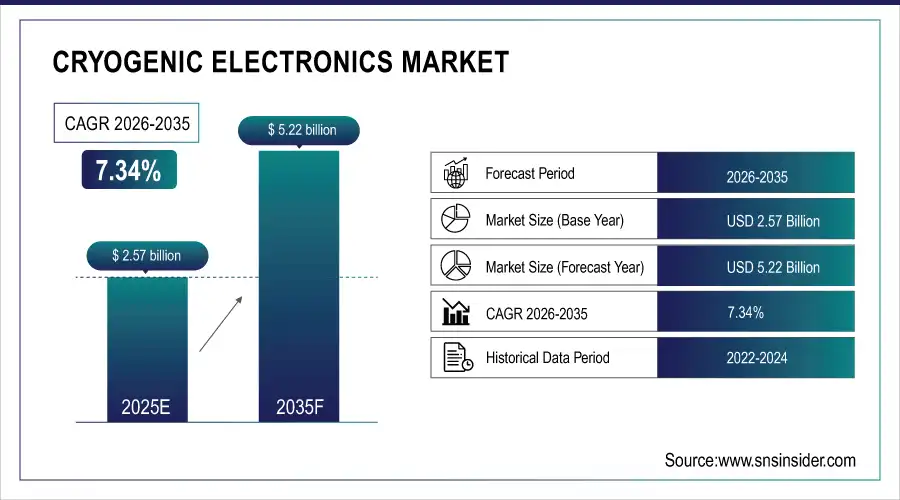
The Cryogenic Electronics Market size was valued at USD 2.57 Billion in 2025 and is projected to reach USD 5.22 Billion by 2035, growing at a CAGR of 7.34% during 2026–2035.
The Cryogenic Electronics market is witnessing significant growth due to rising demand for superconducting quantum processors, hybrid quantum computing systems, and high-performance cryogenic control hardware drives the Cryogenic Electronics market growth. The growth of the Cryoelectronic Market can be attributed to factors such as the surge of investments for quantum computing R&D activities, requirement for energy efficient high-speed electronics, and increasing integration of cryogenic components in national laboratories, academic research, and Advanced Computing Infrastructure. This growing adoption is being driven by advances with low temperature electronics, scaling of superconducting processors, and tech enhanced fabrication technology.
September 15, 2025 – QuantWare and India’s C-DAC have signed an LoI to co-develop indigenous superconducting quantum hardware and cryogenic electronics, supporting national quantum computing R&D. The partnership will leverage QuantWare’s VIO 3D processor expertise and C-DAC’s HPC capabilities to advance India’s Hybrid HPC-Quantum Mission under the ChipIN and National Quantum Mission programs.
To Get more information On Cryogenic Electronics Market - Request Free Sample Report
Cryogenic Electronics Market Highlights:
-
National quantum ecosystems are bolstered and advanced technology development accelerated in India through strategic partnership between QuantWare and C‑DAC for developing indigenous cryogenic electronics and superconducting quantum hardware set.
-
The QuantWare–C‑DAC partnership dovetails ChipIN and National Quantum Mission of India in establishing the foundation for hybrid quantum computing and next‑gen semiconductor first breed innovation.
-
Wireless terahertz cryogenic interconnects can alleviate heat and energy transfer restriction at low temperatures, thus answering the scalability issues for quantum processors.
-
The development of CMOS-based terahertz communication (also cryogenic compatible devices) could drastically reduce cryogenic systems cost and scalability due to reduction in heat loads and interconnect complexity.
-
These advancements reflect the growing industry interest in cryogenic electronics integration, driving the need for scalable energy‑efficient devices for quantum computing and other applications.
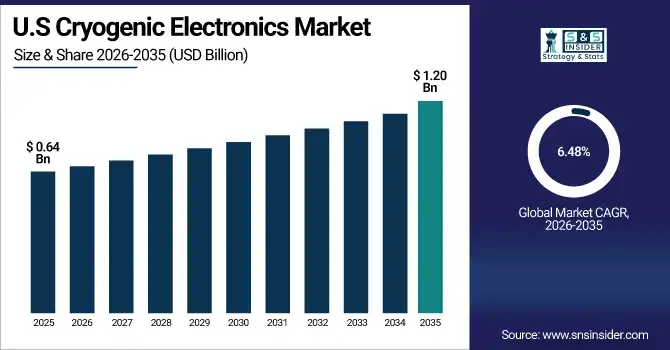
The U.S. Cryogenic Electronics Market size was valued at USD 0.64 Billion in 2025 and is projected to reach USD 1.20 Billion by 2035, growing at a CAGR of 6.48% during 2026–2035, Increasing adoption of quantum computing, development of cryogenic integrated circuits and amplifiers, and demand for low-temperature electronics solutions for aerospace, defense, and research applications to deliver improved system performance, reliability, and energy efficiency in critical applications are expected to accelerate the market for Cryogenic Electronics during the forecast period.
Cryogenic Electronics Market Drivers:
-
Scalable CMOS Quantum Dot Integration Drives Cryogenic Electronics Market Growth
The Cryogenic Electronics market is being driven by the need for scalable, low-temperature quantum processors that enhance qubit consistency, reduce noise, and improve signal management. Integration techniques and the ability to fabricate chips using standard CMOS provide a low-cost approach and an easy pathway for this technology to be integrated with the existing semiconductor infrastructure. Increasing demand in high-performance computing, quantum networks, aerospace and other advanced research applications is driving adoption. Cryogenic platforms for enhancing scalability enable new product development, higher quality and enhanced system reliability, and a broader commercialization path, leaving the market poised for sustainability as industries invest in novel quantum technologies and ultra-low–temperature electronic applications in the future.
In July 2025: Quantum Motion successfully integrates 384 silicon quantum dots with on-chip CMOS control, enabling scalable, low-temperature quantum processors with enhanced qubit consistency and reduced noise.
Cryogenic Electronics Market Restraints:
-
Technical Complexity and High Costs Constrain Cryogenic Electronics Market
While demand is on the upswing, the growth of the Cryogenic Electronics market is majorly hampered by a few restraints. The exorbitant price tag on the design and use of cryogenic systems (i.e. dilution refrigerators, superconducting circuits, and ultra-low temperature switches) means that only a handful of deep-pockets companies or the largest of labs can afford them. This technical complexity coupled with the high requirement of maintenance sharply translates into a lack of scalability and integration into quantum computing, aerospace and defense infrastructure, which is why it plays a role in IT. Moreover, any operational limits are derived from the reliance over exotic materials and techniques, the shortage of educated engineers, and the complex cooling processes. In addition, device commercialization and market entry can be delayed by product development cycle, along with regulatory and safety requirements.
Cryogenic Electronics Market Opportunities:
-
Rising Demand for Quantum Computing and Aerospace Applications Drives Cryogenic Electronics Expansion
The Cryogenic Electronics market presents significant opportunities as demand is driven by quantum computing, aerospace, defense, and advanced research applications. The trend of higher integration of superconducting qubits, high-performance cryogenic amplification and integrated circuits, increases the demand for scalability and low-power automated cooling, such as closed-cycle refrigerator. The growth is also aided by the rapid growth of IT and telecommunications for network-based quantum technologies as well as by the increasing investments in space observation, medical imaging, and materials research. Developments such as low-thermal-footprint switches, high-density wiring, and modular cryogenic platforms lead to rapid R&D cycles, and increased system reliability, paving the way for product lines, custom solutions, and market expansion around the world.
In Jan 2026, Menlo Micro launched the MM4250, a cryogenic SP6T RF switch for quantum computing, enabling high-performance, near-zero-thermal switching for superconducting qubits, processor calibration, and cryogenic measurements. The MM4250 reduces cooldown delays, doubles testing efficiency, and supports scalable, high-density quantum systems, accelerating research and commercial deployment in quantum technologies.
Cryogenic Electronics Market Segment Highlights:
-
By Product Type: Dominant – Cryogenic Amplifiers (38.50% → 26.50%); Fastest-Growing – Cryogenic Integrated Circuits (27.00% → 43.00%, CAGR 12.32%)
-
By Application: Dominant – Space and Astronomy (24.50% → 20.50%); Fastest-Growing – Quantum Computing (36.50% → 48.50%, CAGR 10.39%)
-
By End-User: Dominant – Aerospace & Defense (29.50% → 25.50%); Fastest-Growing – IT & Telecommunications (11.00% → 19.00%, CAGR 13.18%)
-
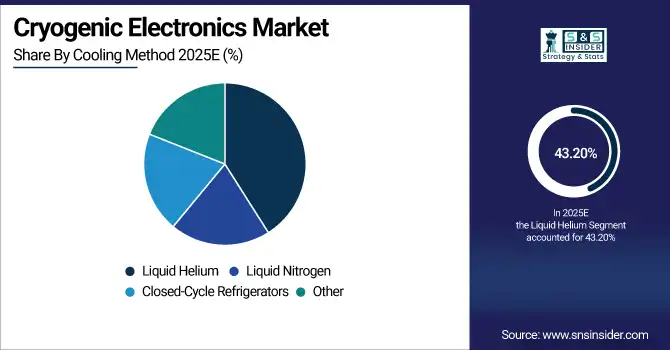
By Cooling Method: Dominant – Liquid Helium (43.20% → 36.80%); Fastest-Growing – Closed-Cycle Refrigerators (21.80% → 28.20%, CAGR 10.10%)
Cryogenic Electronics Market Segment Analysis:
Cryogenic Amplifiers Dominating and Cryogenic Integrated Circuits Fastest-Growing
Cryogenic Amplifiers remain the dominant product type in the Cryogenic Electronics market, This growth can be attributed to factors such as their age-old application in providing low-temperature signal amplification, superior reliability, and need in critical applications such as quantum computing, aerospace, and defense systems. Cryogenic Integrated Circuits dominated the market in terms of growth, owing to the increasing need for high-performance scalable and energy-efficient components for next-generation quantum processors, superconducting electronics, and advanced research applications.
Space and Astronomy Dominating and Quantum Computing Fastest-Growing
Space and Astronomy remains the dominant application in the Cryogenic Electronics market, supported by the long-standing use of cryogenic systems in telescopes, satellites, and deep-space observation instruments. The fastest-growing application is in Quantum Computing, resulting from the accelerated use of superconducting qubits, scalable cryogenic processors, and next-gen quantum science necessitating ultra-low temperature research environments.
Aerospace & Defense Dominating and IT & Telecommunications Fastest-Growing
Aerospace & Defense remains the dominant end-user segment, fueled by high demand for cryogenic systems in satellites, defense electronics, and advanced research programs. IT & Telecommunications is the fastest-growing segment, propelled by the adoption of cryogenic electronics in high-performance data centers, quantum networking infrastructure, and scalable communication systems requiring ultra-low temperature operation.
Liquid Helium Dominating and Closed-Cycle Refrigerators Fastest-Growing
Liquid Helium remains the dominant cooling method in the Cryogenic Electronics market, owing to its proven efficiency in achieving millikelvin temperatures for superconducting circuits and quantum applications. Closed-Cycle Refrigerators are the fastest-growing segment, driven by the need for sustainable, low-maintenance, and energy-efficient cooling solutions in research labs, quantum computing, and advanced semiconductor applications.
Cryogenic Electronics Market Regional Highlights:
-
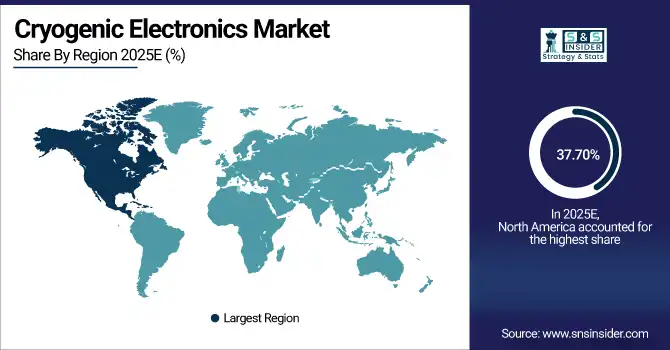
North America: 37.70% → 35.30% in 2035, Dominant Region with Gradual Decline (CAGR 6.64%)
-
Asia-Pacific: 23.70% → 29.30% in 2035, Fastest-Growing Region with Strong Growth (CAGR 9.62%)
-
Europe: 27.70% → 25.30% in 2035, Moderate Share with Slow Decline (CAGR 6.37%)
-
Latin America: 6.00% → 6.00% in 2035, Small Share with Steady Growth (CAGR 7.34%)
-
Middle East & Africa: 4.90% → 4.10% in 2035, Small Share with Gradual Decline (CAGR 5.43%)
Cryogenic Electronics Market Regional Analysis:
North America Cryogenic Electronics Market Insights:
The North America cryogenic electronics market leads globally owing to high investments in quantum groups and novel semiconductor researchers and domestic defense technologies. There are plenty of major technology firms, government-funded research programs, and early superconducting and cryogenic systems across quantum, aerospace, and scientific applications in the area.
Get Customized Report as per Your Business Requirement - Enquiry Now
U.S. Cryogenic Electronics Market Insights:
The U.S. drives the North America cryogenic electronics market that invests heavily in quantum computing and defense research and integrates advanced semiconductors for further utilization in the quantum computing field, which working closely with various technology companies, national labs, and universities.
Asia-Pacific Cryogenic Electronics Market Insights:
The Asia-Pacific cryogenic electronics market is experiencing robust growth, driven by rising investments in quantum computing, semiconductor fabrication, space research, and advanced physics laboratories across China, Japan, South Korea, and India, supported by strong government funding and expanding R&D ecosystems.
China Cryogenic Electronics Market Insights:
Growing adoption and government funding for national quantum technologies, space programs, superconductors, and advanced semiconductor manufacturing are driving steady growth of the China cryogenic electronics market, among other factors such as national lab and university adoption and demand from next-generation computing infrastructure.
Europe Cryogenic Electronics Market Insights:
The Europe cryogenic electronics market is growing moderately, due to the sustained investment in quantum research, particle physics and space exploration, and further strengthen by the academic–industry collaborations, government-funded programs, as well as the increasing adoption of cryogenic systems in research institutes and the upcoming quantum computing facilities
Germany Cryogenic Electronics Market Insights:
The Germany cryogenic electronics market is projected to grow steadily, backed by various government grants & funding, prominent research institutes, industrial automation, and increasing adoption of cryogenic systems in quantum computing, aerospace & scientific research segments.
Latin America Cryogenic Electronics Market Insights:
The Latin America cryogenic electronics market is witnessing steady growth, driven by increasing funding for R&D, rising demand for quantum and superconducting technologies, booming academic and industrial laboratories, and government and private interest in advanced scientific and space-related applications.
Brazil Cryogenic Electronics Market Insights:
Brazil is the leading country in the cryogenic electronics market due to the availability of government-funded research programs, investments in quantum technology, good scientific infrastructure and growing usage in aerospace, defense and academic applications.
Middle East & Africa (MEA) Cryogenic Electronics Market Insights:
The Middle East & Africa cryogenic electronics market is growing gradually, driven by increasing investments in advanced research, implementation of quantum and superconducting technologies, government-supported scientific initiatives and infrastructure growth in the aerospace, defense, and academic research sectors across major countries in the region become established..
Saudi Arabia Cryogenic Electronics Market Insights:
Saudi Arabia is often viewed as the dominant country in emerging semiconductor-related markets, supported by substantial government investment, strategic technology initiatives, advanced research programs, and growing industrial and academic adoption.
Cryogenic Electronics Market Competitive Landscape:
Oxford Instruments Founded in 1959 is a UK-based advanced technology company with a diverse portfolio ranging from cryogenic systems and superconducting magnets to scientific instrumentation that enables cutting-edge research for quantum computing to materials research, healthcare, and semiconductor industries in over 100 countries.XIOM The company is also globally-significant in a range of industries, supporting leading edge scientific, and industrial innovation
-
In November 2025, Oxford Instruments NanoScience installed its new ProteoxLX cryofree dilution refrigerator at OQC's New York Quantum-AI Data Centre, providing ultra-low-temperature capability to support scalable hybrid quantum-AI computing powered by next-generation superconducting qubits.
Bluefors is a Finland-based company Founded in 2008 specializing in cryogen-free dilution refrigerators and cryogenic measurement systems for quantum computing and low-temperature physics, providing high-performance, scalable cooling solutions with global installations supporting advanced research, quantum technologies, and superconducting applications.
-
In March 2025, Bluefors announces significant improvements to its cryogenic measurement systems, including improved cooling integration and high-density flex wiring, to enable scalable, high-qubit quantum computing systems.
Cryogenic Electronics Market Key Players:
-
IBM Corporation
-
Intel Corporation
-
Honeywell International Inc.
-
Lockheed Martin Corporation
-
Northrop Grumman Corporation
-
Teledyne Technologies Incorporated
-
Texas Instruments Incorporated
-
Analog Devices, Inc.
-
Keysight Technologies, Inc.
-
Raytheon Technologies Corporation
-
Oxford Instruments plc
-
NVIDIA Corporation
-
L3Harris Technologies, Inc.
-
Thales Group
-
STMicroelectronics N.V.
-
Fujitsu Limited
-
Toshiba Corporation
-
Mitsubishi Electric Corporation
-
Bosch Sensortec GmbH
-
Siemens AG
| Report Attributes | Details |
|---|---|
| Market Size in 2025 | USD 2.57 Billion |
| Market Size by 2035 | USD 5.22 Billion |
| CAGR | CAGR of 7.44% From 2026 to 2035 |
| Base Year | 2025 |
| Forecast Period | 2026-2035 |
| Historical Data | 2022-2024 |
| Report Scope & Coverage | Market Size, Segments Analysis, Competitive Landscape, Regional Analysis, DROC & SWOT Analysis, Forecast Outlook |
| Key Segments | • By Product Type(Cryogenic Amplifiers, Cryogenic Sensors, Cryogenic Integrated Circuits, Cryogenic Power Electronics and Others) • By Application(Quantum Computing, Space and Astronomy, Medical and Healthcare, Research and Development and Others) • By End-User(Aerospace & Defense, Healthcare, Research Institutes, IT & Telecommunications and Others) • By Cooling Method(Liquid Helium, Liquid Nitrogen, Closed-Cycle Refrigerators and Others) |
| Regional Analysis/Coverage | North America (US, Canada), Europe (Germany, UK, France, Italy, Spain, Russia, Poland, Rest of Europe), Asia Pacific (China, India, Japan, South Korea, Australia, ASEAN Countries, Rest of Asia Pacific), Middle East & Africa (UAE, Saudi Arabia, Qatar, South Africa, Rest of Middle East & Africa), Latin America (Brazil, Argentina, Mexico, Colombia, Rest of Latin America). |
| Company Profiles | Key players include IBM Corporation, Intel Corporation, Honeywell International, Lockheed Martin, Northrop Grumman, Teledyne Technologies, Texas Instruments, Analog Devices, Keysight Technologies, Raytheon Technologies, Oxford Instruments, NVIDIA, L3Harris Technologies, Thales Group, STMicroelectronics, Fujitsu, Toshiba, Mitsubishi Electric, Bosch Sensortec, and Siemens AG. |

Frequently Asked Questions
North America dominated the Cryogenic Electronics Market in 2025.
The Cryogenic Electronics Market size was USD 2.57 Billion in 2025 and is expected to reach USD 5.22 Billion by 2035.
The “Cryogenic Amplifiers” segment dominated during the projected period.
Rising adoption of industrial robots and automation in manufacturing is driving demand for high-performance robot joint harmonic drive greases.
The Cryogenic Electronics Market is expected to grow at a CAGR of 7.34% from 2026-2035.
