
Custom Antibody Market Report Scope & Overview:
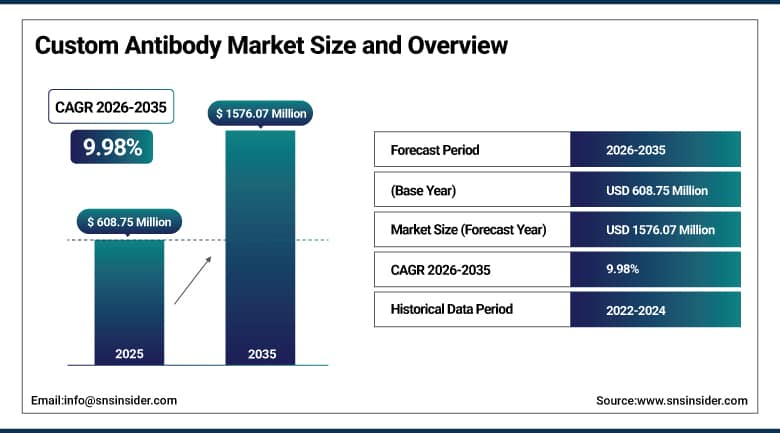
The Custom Antibody Market is valued at USD 608.75 Million in 2025 and is expected to reach USD 1576.07 Million by 2035, growing at a CAGR of 9.98% from 2026-2035.
The custom antibody market is growing due to increasing demand for personalized medicines, advanced therapeutics, and targeted diagnostics. Rising investments in biopharmaceutical research, expansion of antibody-based drug development, and growing prevalence of chronic and infectious diseases are driving the need for specialized and high-quality antibodies. Additionally, advancements in antibody engineering, rising adoption of custom antibodies in research and clinical applications, and the emphasis on precision medicine are fueling market growth globally.
85% of global biopharma and research institutions leveraged custom antibodies propelled by precision medicine, antibody-based therapeutics, and disease complexity to advance diagnostics, drug development, and clinical innovation.
Custom Antibody Market Size and Forecast:
-
Market Size in 2025: USD 608.75 Million
-
Market Size by 2035: USD 1576.07 Million
-
CAGR: 9.98% from 2026 to 2035
-
Base Year: 2025
-
Forecast Period: 2026–2035
-
Historical Data: 2022–2024
To Get More Information On Custom Antibody Market - Request Free Sample Report
Custom Antibody Market Trends:
-
Rising demand for highly specific antibodies supporting advanced research, diagnostics, and targeted therapeutic development
-
Growing adoption of custom antibodies in precision medicine, oncology research, and biomarker-based drug discovery
-
Increasing outsourcing to CROs for antibody production to reduce timelines and improve research cost efficiency
-
Advancements in recombinant and monoclonal technologies enhancing antibody specificity, reproducibility, and scalability
-
Expanding use of custom antibodies across academic institutes, biotech firms, and pharmaceutical research laboratories
US Market Size Outlook:
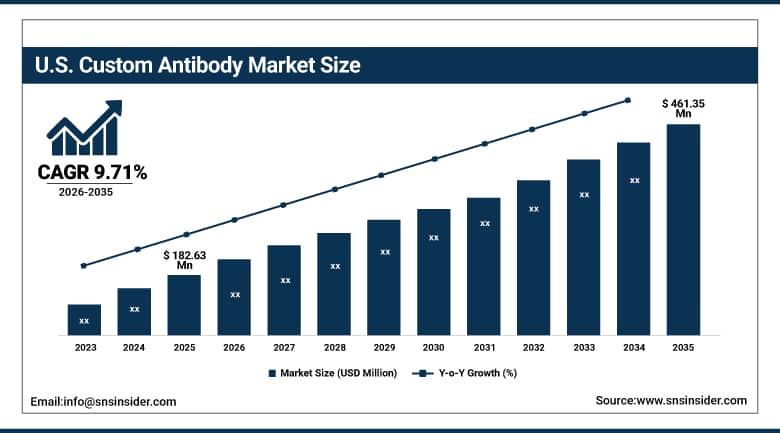
The U.S. Custom Antibody Market is valued at USD 182.63 Million in 2025 and is expected to reach USD 461.35 Million by 2035, growing at a CAGR of 9.71% from 2026-2035.
The U.S. custom antibody market is growing due to rising demand for targeted therapeutics and diagnostics, increasing biopharmaceutical research investments, and adoption of personalized medicine. Advances in antibody engineering and growing use in research and clinical applications are driving market expansion steadily.
Custom Antibody Market Growth Drivers:
-
Rising investment in biomedical research, drug discovery, and precision medicine is driving strong demand for custom antibodies across research, diagnostics, and therapeutic development
The increasing focus on advanced biomedical research and precision medicine has fueled demand for custom antibodies. Pharmaceutical companies, academic institutions, and research organizations are investing heavily in drug discovery, biomarker identification, and therapeutic development, which rely on highly specific antibodies for experiments and assays. Custom antibodies provide better specificity and sensitivity compared to standard antibodies, making them essential for complex research applications. Additionally, increasing funding from government agencies and private organizations supports the growth of research activities worldwide, driving widespread adoption of custom antibodies in diagnostics, proteomics, and therapeutic development.
82% of research and biopharma organizations boosted custom antibody adoption fueled by investments in precision medicine, drug discovery, and advanced diagnostics to accelerate therapeutic and diagnostic innovation.
-
Growing prevalence of chronic diseases and cancer is accelerating demand for highly specific custom antibodies in targeted diagnostics and biologic drug development
The global rise in chronic diseases, autoimmune disorders, and cancer has intensified the need for highly specific antibodies for targeted diagnostics and biologics. Custom antibodies play a crucial role in identifying disease biomarkers, developing therapeutic targets, and designing personalized medicine approaches. Pharmaceutical companies increasingly rely on these antibodies to improve drug efficacy and reduce side effects. Rising patient populations and increasing healthcare expenditures in developed and emerging markets are encouraging R&D investments, further boosting the demand for custom antibodies in both clinical diagnostics and innovative therapeutic research applications.
79% of biopharma and diagnostic developers increased custom antibody use driven by rising chronic and oncologic diseases to enable precise targeting in diagnostics and next-generation biologic therapies.
Custom Antibody Market Restraints:
-
High development costs, long production timelines, and complex validation processes limit accessibility of custom antibodies for small research laboratories and startups
The production of custom antibodies involves high costs, including antigen preparation, immunization, hybridoma generation, and purification processes. Additionally, development timelines can range from several weeks to months, delaying research progress. Rigorous validation is required to ensure specificity and reproducibility, further adding to costs and complexity. These factors make custom antibodies less accessible to small research labs, universities, and startups with limited budgets. As a result, smaller entities may rely on off-the-shelf antibodies or alternative technologies, slowing market adoption and limiting growth in certain segments, especially in cost-sensitive emerging markets.
70% of small research labs and startups faced limited access to custom antibodies due to high development costs, lengthy production cycles, and demanding validation protocols.
-
Variability in antibody quality, reproducibility challenges, and regulatory compliance requirements create barriers to adoption and slow commercial-scale deployment
Custom antibody production can sometimes result in batch-to-batch variability, affecting experiment reproducibility and reliability. Researchers require consistent, high-quality antibodies for critical applications, and any variability can compromise results. Additionally, stringent regulatory guidelines for clinical and therapeutic use increase the compliance burden for manufacturers. Ensuring adherence to quality standards, documentation, and validation processes adds complexity and cost. These challenges create adoption barriers, particularly for clinical or commercial applications. Consequently, the growth of the custom antibody market can be constrained by quality assurance concerns, reproducibility issues, and the need to meet regulatory requirements across multiple regions.
67% of biopharma firms delayed commercial-scale adoption of custom antibodies due to quality variability, reproducibility issues, and complex regulatory compliance requirements.
Custom Antibody Market Opportunities:
-
Advancements in recombinant antibody technologies and phage display platforms enable faster, more reliable, and scalable production of high-specificity custom antibodies
Technological innovations in recombinant DNA technology, phage display, and hybridoma engineering have significantly improved the efficiency, reliability, and scalability of custom antibody production. These platforms allow for faster development, higher specificity, and reproducibility, overcoming traditional limitations associated with animal immunization methods. The adoption of these advanced techniques opens opportunities for personalized medicine, therapeutic antibody development, and high-throughput screening. Pharmaceutical and biotech companies are increasingly leveraging these technologies to reduce timelines, lower production costs, and meet growing R&D demands, thereby driving growth and expanding the commercial potential of the custom antibody market globally.
In 2025, 78% of custom antibody developers adopted recombinant and phage display technologies cutting production timelines by 45% and enhancing specificity, scalability, and batch-to-batch consistency.
-
Expansion of biotechnology and pharmaceutical R&D in emerging markets creates significant growth opportunities for custom antibody providers globally
Emerging economies in Asia-Pacific, Latin America, and the Middle East are witnessing rapid growth in biotechnology and pharmaceutical research. Increased government funding, establishment of research institutes, and growing interest in drug discovery are creating substantial demand for custom antibodies. Companies expanding into these markets can tap into unmet research needs and collaborate with local biotech firms and academic institutions. Rising healthcare infrastructure and investment in precision medicine in these regions further enhance opportunities for custom antibody providers, allowing them to diversify their client base and drive revenue growth in untapped markets globally.
In 2025, 74% of custom antibody providers expanded into emerging markets capitalizing on surging biotech and pharma R&D investments to drive global growth and diversify client portfolios.
Custom Antibody Market Segment Highlights:
-
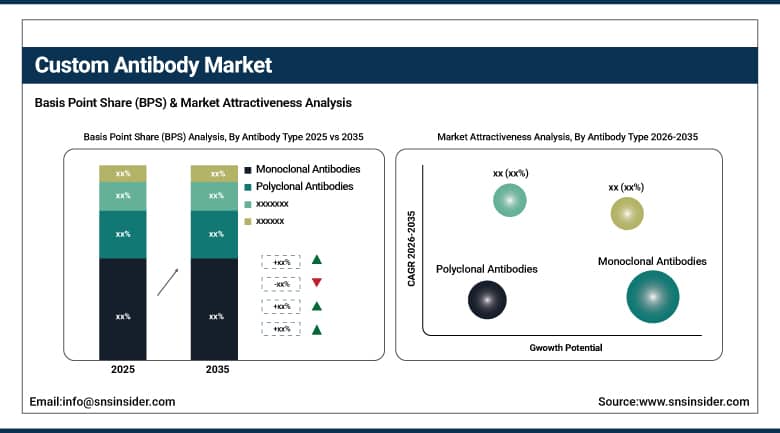
By Antibody Type: Monoclonal Antibodies led with 46.3% share, while Recombinant Antibodies is the fastest-growing segment with CAGR of 13.9%.
-
By Service Type: Antibody Development led with 38.7% share, while Antibody Humanization is the fastest-growing segment with CAGR of 14.6%.
-
By Application: Research led with 41.9% share, while Drug Discovery & Development is the fastest-growing segment with CAGR of 15.2%.
-
By End User: Pharmaceutical & Biotechnology Companies led with 44.8% share, while Contract Research Organizations (CROs) is the fastest-growing segment with CAGR of 13.7%.
Custom Antibody Market Segment Analysis:
By Antibody Type: Monoclonal Antibodies led, while Recombinant Antibodies is the fastest-growing segment.
Monoclonal Antibodies dominate the market due to their high specificity, reproducibility, and widespread use in research, diagnostics, and therapeutics. They are essential for targeted therapies, biomarker detection, and immunoassays, making them the preferred choice among pharmaceutical and academic laboratories. Their standardized production processes, consistent quality, and compatibility with advanced diagnostic platforms further reinforce their market leadership. Growing investments in monoclonal antibody research and increased adoption in personalized medicine applications maintain their dominance in both established and emerging markets globally.
Recombinant Antibodies are the fastest-growing segment because of their ability to provide fully human or engineered antibodies with high affinity and specificity. They reduce immunogenicity risks and allow scalable, reproducible production, making them ideal for drug discovery and therapeutic development. Increasing adoption in research, oncology, and immunotherapy, combined with technological advancements in recombinant expression systems and phage display libraries, is driving rapid market growth. Their flexibility and cost-efficiency compared to traditional monoclonal and polyclonal antibodies are accelerating adoption in both clinical and research applications.
By Service Type: Antibody Development led, while Antibody Humanization is the fastest-growing segment.
Antibody Development services dominate due to their critical role in creating custom antibodies for research, diagnostics, and therapeutic purposes. These services include antigen design, immunization, screening, and validation, providing end-to-end solutions that ensure high-quality antibodies. Demand from pharmaceutical companies, biotechnology firms, and academic institutions for tailored antibodies continues to expand the segment. The increasing complexity of target molecules and requirement for specialized expertise reinforce the importance of antibody development, maintaining its leading position in the market.
Antibody Humanization is the fastest-growing service segment as it allows murine or other non-human antibodies to be modified for use in humans, reducing immunogenicity in therapeutic applications. Growing focus on monoclonal antibody therapies, immuno-oncology drugs, and biopharmaceutical pipelines drives adoption. Technological advancements in gene engineering, CDR grafting, and bioinformatics accelerate humanization processes. Rising outsourcing of humanization services by pharmaceutical and biotechnology companies, combined with regulatory incentives for safer therapeutic antibodies, fuels strong growth in this segment globally.
By Application: Research led, while Drug Discovery & Development is the fastest-growing segment.
The Research application segment dominates the market because custom antibodies are widely used in basic and applied research to study proteins, cellular pathways, and biomarker identification. Academic institutions, CROs, and pharmaceutical companies rely on them for immunoassays, Western blotting, ELISA, and flow cytometry experiments. Consistent demand, high reproducibility, and critical importance in experimental design make this segment the largest. Investments in biomedical research, genomics, and proteomics reinforce the reliance on custom antibodies for accurate, reproducible, and validated results in laboratory studies worldwide.
Drug Discovery & Development is the fastest-growing application segment due to the increasing use of custom antibodies in preclinical studies, therapeutic development, and target validation. Antibodies are critical for high-throughput screening, biomarker detection, and pharmacodynamic studies, helping accelerate drug development pipelines. The growth of biopharmaceuticals, immunotherapies, and precision medicine fuels demand. Outsourcing of antibody-based assays and contract research partnerships further accelerates adoption. Technological advancements in antibody engineering and functional assays support rapid growth in this application segment.
By End User: Pharmaceutical & Biotechnology Companies led, while Contract Research Organizations (CROs) is the fastest-growing segment.
Pharmaceutical & Biotechnology Companies dominate the end-user segment as they extensively use custom antibodies for drug discovery, therapeutic development, and diagnostic product design. High demand for precision-targeted therapies, monoclonal antibodies, and recombinant antibodies drives adoption. These companies require validated, high-quality antibodies for research and clinical pipelines, creating consistent revenue for service providers. Integration with R&D workflows, regulatory compliance, and increasing investment in biologics further strengthens the dominance of pharmaceutical and biotechnology companies in the global custom antibody market.
Contract Research Organizations (CROs) are the fastest-growing end-user segment due to rising outsourcing of antibody development, screening, and validation services. Pharmaceutical and biotech companies increasingly rely on CROs for cost-effective, specialized, and scalable solutions. The growth of contract research partnerships, expansion of biopharmaceutical pipelines, and adoption of custom antibodies for preclinical studies and clinical trial support drive market expansion. CROs’ expertise, access to advanced technologies, and flexible service models make them a rapidly expanding segment globally.
Custom Antibody Market Regional Analysis:
North America Custom Antibody Market Insights
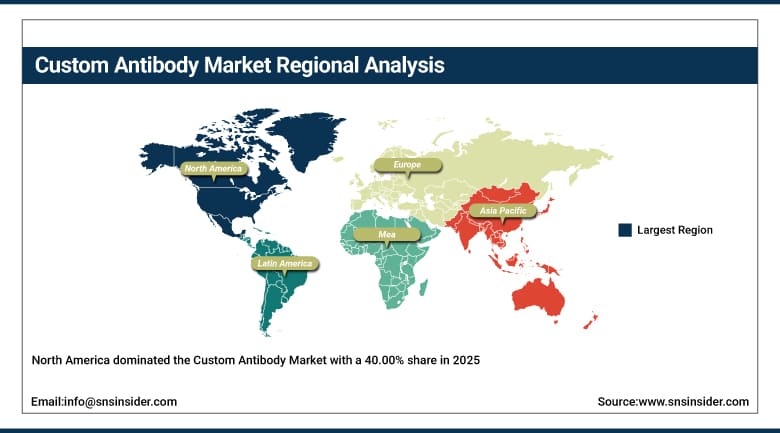
North America dominated the Custom Antibody Market with a 40.00% share in 2025 due to the strong presence of leading biotechnology and pharmaceutical companies, advanced research infrastructure, and high R&D spending. Extensive use of custom antibodies in drug discovery, diagnostics, and proteomics, supported by favorable funding and academic collaborations, reinforced regional market leadership.
Get Customized Report as Per Your Business Requirement - Enquiry Now
Asia Pacific Custom Antibody Market Insights
Asia Pacific is expected to grow at the fastest CAGR of about 12.48% from 2026–2035, driven by expanding biotechnology research, increasing pharmaceutical manufacturing, and rising investment in life sciences. Growth in academic research institutes, cost-effective antibody production, and government support for biomedical innovation are accelerating demand across the region.
Europe Custom Antibody Market Insights
Europe held a significant share in the Custom Antibody Market in 2025, supported by a strong life sciences research ecosystem, well-established pharmaceutical and biotechnology industries, and increasing use of custom antibodies in diagnostics and therapeutic development. Robust academic–industry collaborations, advanced laboratory infrastructure, and sustained funding for biomedical research further strengthened Europe’s market position.
Middle East & Africa and Latin America Custom Antibody Market Insights
The Middle East & Africa and Latin America together showed steady growth in the Custom Antibody Market in 2025, driven by expanding healthcare research capabilities, rising investment in biotechnology infrastructure, and growing adoption of advanced diagnostic technologies. Increasing academic research activities, improving laboratory facilities, and gradual government support for life sciences development contributed to the regions’ emerging market presence.
Custom Antibody Market Competitive Landscape:
Thermo Fisher Scientific Inc. is a global leader in life sciences and biotechnology solutions, offering a broad range of products and services, including custom antibodies. The company focuses on innovation, quality, and scientific expertise, serving research, diagnostics, and pharmaceutical sectors worldwide. Its custom antibody services include monoclonal and polyclonal antibody production, protein expression, and assay development. Thermo Fisher’s strong global presence, advanced technologies, and commitment to customer support make it a trusted partner for researchers and biopharmaceutical companies seeking reliable antibody solutions.
-
June 2024, Thermo Fisher launched the Antibody Design Studio, a digital platform that accelerates custom antibody development using AI-powered antigen analysis and epitope prediction.
Merck KGaA, headquartered in Germany, is a leading multinational company in healthcare, life sciences, and performance materials. Its life science division provides comprehensive custom antibody services, including antibody generation, conjugation, and validation for research and therapeutic applications. Merck emphasizes high-quality production, cutting-edge technology, and regulatory compliance. With a strong global footprint, the company supports academic institutions, biotech firms, and pharmaceutical companies. Its expertise in recombinant and monoclonal antibodies ensures precise, scalable, and reproducible solutions tailored to diverse scientific needs.
-
October 2023, Merck KGaA (operating its life science business as MilliporeSigma) enhanced its Custom Recombinant Antibody Service with high-throughput single B cell sorting and sequencing.
Abcam plc, based in the UK, specializes in research antibodies, proteins, and related reagents, offering custom antibody development services to the global scientific community. The company provides monoclonal, polyclonal, and recombinant antibody production, along with validation and conjugation services. Abcam is known for its focus on high-quality, reliable reagents, backed by rigorous validation standards and excellent customer support. Serving academic, diagnostic, and biopharmaceutical sectors worldwide, Abcam helps researchers accelerate discoveries by providing customized solutions tailored to specific experimental and therapeutic requirements.
-
January 2025, Abcam launched the Custom Antibody+ Platform, featuring a Rapid Rabbit Monoclonal Service that delivers high-affinity, highly specific rabbit monoclonal antibodies in 6–8 weeks.
Custom Antibody Market Key Players:
-
Thermo Fisher Scientific Inc.
-
Merck KGaA
-
Abcam plc
-
Bio-Rad Laboratories Inc.
-
GenScript Biotech Corporation
-
Creative Biolabs
-
Rockland Immunochemicals Inc.
-
Covance Inc. (Labcorp Drug Development)
-
Proteintech Group Inc.
-
ProMab Biotechnologies Inc.
-
Abnova Corporation
-
Sino Biological Inc.
-
RayBiotech Inc.
-
Novus Biologicals
-
Boster Biological Technology
-
Antibody Solutions
-
Moravian Biotechnology
-
Pacific Immunology
-
ImmunoPrecise Antibodies Ltd.
-
BioLegend Inc.
| Report Attributes | Details |
|---|---|
| Market Size in 2025 | USD 608.75 Million |
| Market Size by 2035 | USD 1576.07 Million |
| CAGR | CAGR of 9.98% From 2026 to 2035 |
| Base Year | 2025 |
| Forecast Period | 2026-2035 |
| Historical Data | 2022-2024 |
| Report Scope & Coverage | Market Size, Segments Analysis, Competitive Landscape, Regional Analysis, DROC & SWOT Analysis, Forecast Outlook |
| Key Segments | • By Antibody Type (Monoclonal Antibodies, Polyclonal Antibodies, Recombinant Antibodies, Antibody Fragments) • By Service Type (Antibody Development, Antibody Production, Antibody Humanization, Antibody Conjugation & Labeling, Antibody Characterization & Validation) • By Application (Research, Diagnostics, Therapeutics, Proteomics, Drug Discovery & Development) • By End User (Pharmaceutical & Biotechnology Companies, Academic & Research Institutes, Contract Research Organizations (CROs), Diagnostic Laboratories, Hospitals & Clinics) |
| Regional Analysis/Coverage | North America (US, Canada), Europe (Germany, UK, France, Italy, Spain, Russia, Poland, Rest of Europe), Asia Pacific (China, India, Japan, South Korea, Australia, ASEAN Countries, Rest of Asia Pacific), Middle East & Africa (UAE, Saudi Arabia, Qatar, South Africa, Rest of Middle East & Africa), Latin America (Brazil, Argentina, Mexico, Colombia, Rest of Latin America). |
| Company Profiles | Thermo Fisher Scientific Inc., Merck KGaA, Abcam plc, Bio-Rad Laboratories Inc., GenScript Biotech Corporation, Creative Biolabs, Rockland Immunochemicals Inc., Covance Inc. (Labcorp Drug Development), Proteintech Group Inc., ProMab Biotechnologies Inc., Abnova Corporation, Sino Biological Inc., RayBiotech Inc., Novus Biologicals, Boster Biological Technology, Antibody Solutions, Moravian Biotechnology, Pacific Immunology, ImmunoPrecise Antibodies Ltd., BioLegend Inc. |
Frequently Asked Questions
Custom antibodies are laboratory-produced antibodies specifically designed to bind with target antigens for research, diagnostic, and therapeutic applications.
The Custom Antibody Market is valued at USD 608.75 Million in 2025 and is expected to reach USD 1576.07 Million by 2035, growing at a CAGR of 9.98% from 2026-2035.
The market growth is driven by increasing investments in biotechnology research, rising demand for personalized medicine, expanding drug discovery activities, and advancements in antibody engineering technologies.
Pharmaceutical companies, biotechnology firms, academic research institutes, diagnostic laboratories, and contract research organizations are the primary end-users of custom antibodies.
Custom antibodies are widely used in drug discovery, immunoassays, western blotting, flow cytometry, immunohistochemistry, ELISA testing, and therapeutic research.
