
Digital Printing for Flexible Packaging Market Report Scope & Overview:
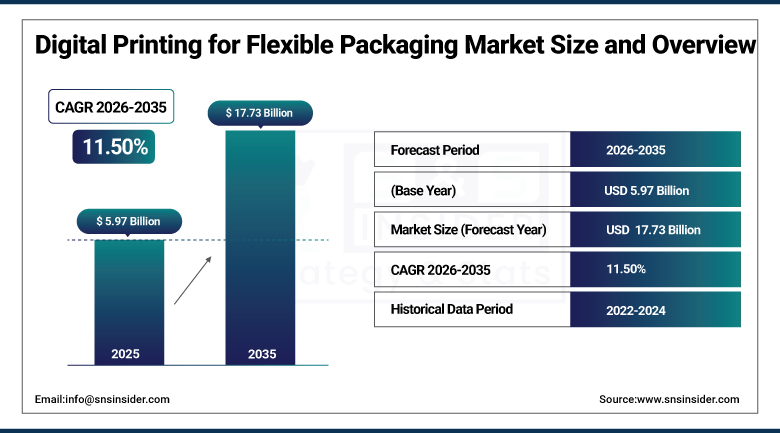
The Digital Printing for Flexible Packaging Market size was valued at USD 5.97 Billion in 2025 and is expected to reach USD 17.73 Billion by 2035, growing at a CAGR of 11.50% from 2026-2035.
Converters buy into the Digital Printing for Flexible Packaging Market to run shorter job lengths profitably, since a digital press avoids the plate-making step that makes short-run flexo work expensive per unit. Brand owners request regional variants, seasonal artwork and SKU-level personalization that a plate-based press cannot turn around fast enough to meet retail timelines. Press makers have responded with faster inkjet engines and expanded color stations that narrow the throughput gap with flexo on mid-length runs. Converters weigh press cost, ink chemistry and substrate compatibility, since a digital line that cannot run a brand's film stock adds no practical capacity. Asia Pacific leads adoption on volume and growth rate.
⮞In April 2025, China-based converter Honggan Packaging installed an HP Indigo 200K digital press, the 100th such system deployed across Asia Pacific for flexible packaging, as part of its shift from a conventional packaging manufacturer toward a digital-first model built around short-run orders.
To Get more information On Digital Printing for Flexible Packaging Market - Request Free Sample Report
Digital Printing for Flexible Packaging Market Trends
-
Press makers are launching hybrid platforms that combine inkjet printing with flexographic coating and finishing stations in a single pass.
-
Converters are adopting AI-enabled defect detection and color-matching software to cut waste on digitally printed short runs.
-
Brand owners are requesting SKU-level and regional artwork variants that only digital presses can turn around within retail timelines.
-
Subscription and pay-per-use press models are lowering the capital barrier for smaller converters entering digital flexible packaging.
-
Ink makers are expanding electron-beam and water-based formulations to meet tightening food-contact and recyclability requirements.
U.S. Digital Printing for Flexible Packaging Market Size Outlook
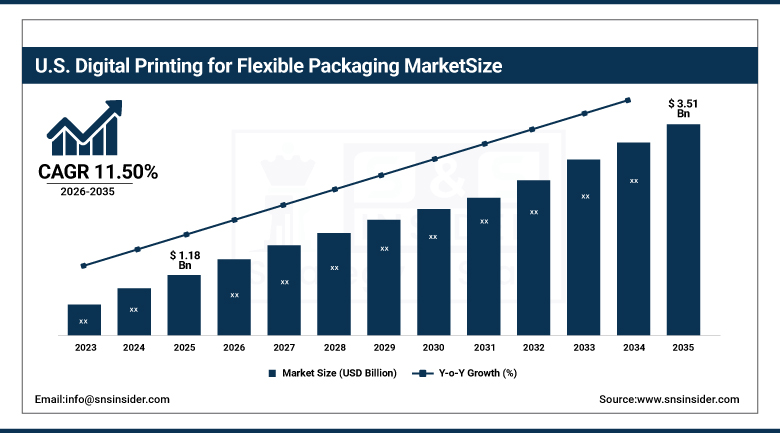
The U.S. Digital Printing for Flexible Packaging Market was valued at USD 1.18 Billion in 2025 and is expected to reach USD 3.51 Billion by 2035, growing at a CAGR of 11.50% from 2026-2035.
U.S. converters are concentrating digital investment in mid-web presses capable of running pouch and bag formats that mirror what their existing flexo lines already produce at volume. Contract packagers and co-packers account for a large share of installed digital capacity, since their business model depends on absorbing short-run brand orders that longer-run flexo customers cannot economically place. Vendor financing and subscription-style press agreements are helping mid-size converters add digital capacity without the balance-sheet strain of an outright equipment purchase. Food and beverage brand owners continue to drive the largest share of digital pouch and sachet orders, keeping the United States the largest single national market within North America.
⮞In October 2026, ePac Holdings entered a global partnership with Fujifilm to integrate the Jet Press FP790 water-based inkjet press into its flexible packaging production network. The first installation is planned for ePac's new Phoenix, Arizona facility, followed by additional installations across its international locations.
Digital Printing for Flexible Packaging Market Segment Analysis
-
By Printing Technology, the UV Inkjet segment dominated the Digital Printing for Flexible Packaging Market with approximately 30.90% share in 2025, while the Hybrid Presses segment is the fastest growing with a CAGR of approximately 14.40%.
-
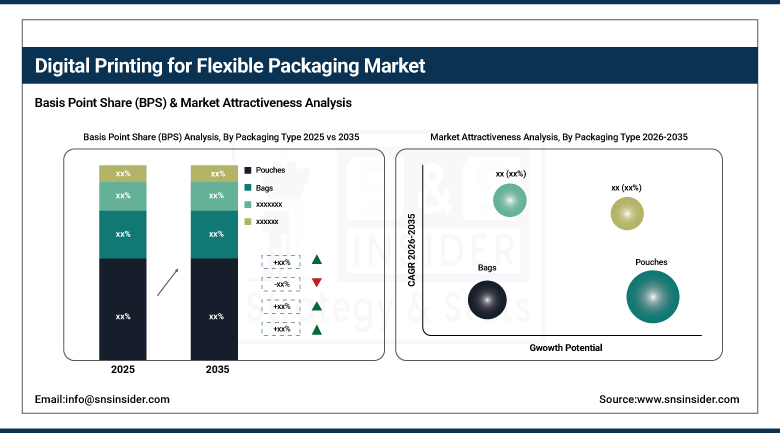
By Packaging Type, the Pouches segment dominated the Digital Printing for Flexible Packaging Market with approximately 37.00% share in 2025, while the Stick Packs & Sachets segment is the fastest growing with a CAGR of approximately 12.70%.
-
By Ink Type, the Water-Based segment dominated the Digital Printing for Flexible Packaging Market with approximately 39.00% share in 2025, while the Electron-Beam segment is the fastest growing with a CAGR of approximately 14.40%.
-
By End-Use Industry, the Food segment dominated the Digital Printing for Flexible Packaging Market with approximately 36.30% share in 2025, while the Pharmaceuticals segment is the fastest growing with a CAGR of approximately 13.60%.
By Packaging Type, Pouches Dominate the Digital Printing for Flexible Packaging Market and Stick Packs & Sachets Grow Fastest
Pouches hold the largest packaging-type share because they span the broadest range of food, beverage, pet care and household categories, giving converters the widest base of recurring digital print orders across client portfolios. Stand-up and spouted pouch formats in particular reward digital printing's fast turnaround, since brand owners refresh pouch artwork more frequently than they do for simpler flat-bag formats. Converters have built dedicated pouch-finishing lines around digital print stations specifically because pouch orders arrive in enough volume to justify the capital investment on its own. That combination of category breadth and finishing-line investment keeps pouches the dominant packaging type by digital print volume across most converting regions.
Stick packs and sachets are growing fastest as brand owners in nutraceuticals, personal care and single-serve food categories request smaller, more frequently refreshed packaging runs than traditional pouch or bag formats typically need. These formats favor digital printing because their small format size makes plate-based flexo setup costs disproportionately expensive relative to the printed area involved. Converters serving subscription and direct-to-consumer brands are adopting digital stick-pack lines specifically to accommodate the SKU proliferation these business models tend to generate. As subscription and single-serve categories keep expanding, stick packs and sachets are expected to keep growing faster than the broader packaging-type category through 2035.
⮞In May 2026, Flint Group Digital Xeikon, together with POLIFILM Performance Films and ACTEGA, presented a digitally printed high-barrier mono-polypropylene pouch developed with Gruber Folien. The packaging combines a recyclable polypropylene film structure with digital printing and specialized primers and overprint varnishes.
By Printing Technology, UV Inkjet Dominates the Digital Printing for Flexible Packaging Market and Hybrid Presses Grow Fastest
UV inkjet leads technology share because it cures instantly under UV light, letting converters run higher press speeds without the drying tunnels that water-based or solvent inkjet systems typically require. Converters value the broad substrate range UV-curable ink supports, since a single ink set can run across multiple film types without the formulation changes other chemistries sometimes demand. Press makers have built their fastest mid-web platforms specifically around UV inkjet engines, reinforcing the technology's position as the default choice for converters prioritizing throughput alongside color consistency. That combination of cure speed and substrate flexibility keeps UV inkjet the leading printing technology across most converting markets.
Hybrid presses are growing fastest as converters look to combine digital printing with flexographic coating, laminating or varnishing stations in a single pass rather than routing work across separate machines. Press makers are marketing hybrid platforms specifically at converters who want digital's short-run flexibility without giving up flexo's established finishing capability on the same job. Multilayer printing modules that place images on the front, back, liner or adhesive surface in one pass are extending what a single hybrid line can produce without secondary converting steps. As more converters seek that combined capability, hybrid presses are set to keep outpacing single-technology platform growth through 2035.
⮞In July 2026, Polish converter Aniflex invested in Mark Andy's Digital Series HD HighSpeed 1200 hybrid press, combining flexographic and UV inkjet printing technologies in an integrated production process. The investment supports the production of labels, shrink sleeves and flexible packaging while helping the converter manage increasing artwork variations, multiple languages and shorter production runs.
By Ink Type, Water-Based Dominates the Digital Printing for Flexible Packaging Market and Electron-Beam Grows Fastest
Water-based inks lead ink-type share because they meet food-contact and low-migration requirements more easily than solvent-based alternatives, a property that matters heavily given how much digital flexible packaging volume serves food and beverage brands. Converters also favor water-based systems for their lower volatile organic compound emissions, which simplifies compliance across plants operating in multiple regulatory jurisdictions at once. Ink makers have invested accordingly in expanding water-based formulation ranges to match the color gamut and substrate adhesion that UV-curable alternatives already offered converters. That combination of food-safety fit and emissions advantage keeps water-based inks the leading ink type by volume across most digital flexible packaging applications.
Electron-beam inks are growing fastest as converters serving brand owners with the strictest food-contact and migration standards adopt a curing method that leaves minimal uncured residue compared with UV-curable alternatives. Electron-beam curing also supports higher press speeds on certain substrates than UV lamps typically allow, giving converters a throughput incentive alongside the compliance benefit. Equipment costs for electron-beam curing units remain higher than UV lamp systems, which has so far concentrated adoption among larger converters serving demanding pharmaceutical and food accounts. As more converters qualify electron-beam systems for sensitive food-contact work, this ink type is expected to keep growing faster than the broader ink-type category through 2035.
⮞In February 2026, Italian flexible packaging converter Sacchital Group became the first company globally to install SCREEN's Truepress PAC 520P digital inkjet press for paper-based flexible packaging. The system uses water-based inks designed to meet European food-safety requirements and supports printing on recyclable, heat-sealable paper substrates.
By End-Use Industry, Food Dominates the Digital Printing for Flexible Packaging Market and Pharmaceuticals Grow Fastest
Food accounts for the largest end-use share because packaged food brands refresh promotional artwork, launch regional variants and run seasonal packaging more frequently than most other categories, generating steady recurring digital print demand. Converters serving food brands have standardized digital workflows around food-contact-compliant inks and substrates, reinforcing food's position as the anchor end-use category for most digital press investment decisions. Private-label food brands lean on digital printing to launch new flavors or formats without committing to the plate costs a longer production run would otherwise justify. That combination of refresh frequency and compliance-ready infrastructure keeps food the dominant end-use industry by digital print volume across nearly every converting region.
Pharmaceuticals are growing fastest as regulatory requirements for serialization, batch-specific text and anti-counterfeiting features push drug packaging toward formats that plate-based printing struggles to vary economically from batch to batch. Digital printing lets pharmaceutical packagers embed variable data such as lot numbers and expiration dates directly into the printed design rather than adding a separate overprinting step. Converters serving pharmaceutical accounts are investing in validated digital workflows that meet track-and-trace regulations now in force across several major markets. As serialization and anti-counterfeiting requirements keep tightening, pharmaceutical packaging is expected to keep growing faster than the broader end-use category through 2035.
⮞In June 2026, Sealed Air Corporation highlighted the growing role of digital printing in pharmaceutical packaging, particularly for on-demand customized printing, traceability and variable product information. The development follows the U.S. FDA's March 2026 final rule establishing a standardized 12-digit National Drug Code format, with full implementation scheduled for March 2033.
Regional Analysis
|
Region |
Major Country |
Share within Region, 2025 (%) |
|---|---|---|
|
Asia Pacific |
China |
37.80 |
|
North America |
United States |
81.40 |
|
Europe |
Germany |
23.60 |
|
Middle East and Africa |
United Arab Emirates |
30.20 |
|
Latin America |
Brazil |
43.50 |
Asia Pacific Digital Printing for Flexible Packaging Market Insights
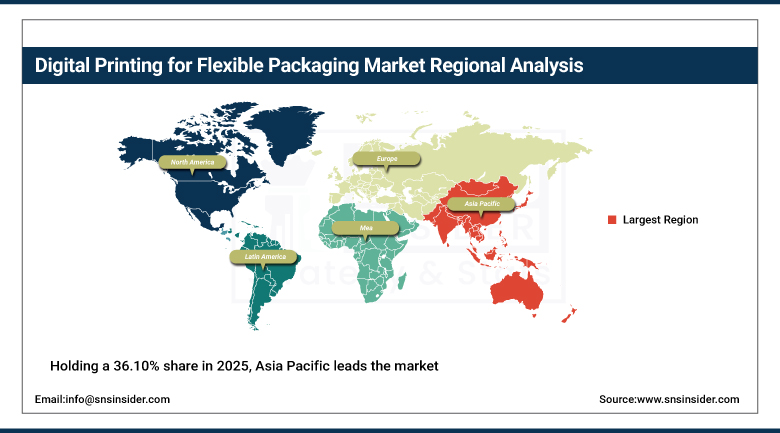
Holding a 36.10% share in 2025, Asia Pacific leads the market on the strength of a converting base that is adding digital capacity as new capacity rather than replacing an installed flexo fleet. China anchors regional volume, supported by a large packaged food and personal care manufacturing sector scaling digital print adoption alongside rapidly expanding e-commerce distribution. India and Southeast Asian markets are following a similar pattern, with converters investing in digital lines as part of new plant buildouts rather than as a retrofit to existing production. That combination of greenfield capacity additions and e-commerce-driven packaging demand keeps Asia Pacific the largest region despite still-developing converter infrastructure.
Regional converters are increasingly serving export accounts for multinational brand owners, requiring digital presses validated against the same food-contact and quality standards those brands enforce in their home markets. Local press and ink suppliers are expanding manufacturing and service footprints within the region to reduce the equipment lead times that importing presses from Europe or North America previously required. Government-backed manufacturing investment incentives in several Asia Pacific markets are also lowering the capital barrier for smaller converters adding their first digital press line. As regional converting capacity and export-account qualification continue to scale together, Asia Pacific's share of global digital flexible packaging volume is expected to keep rising through 2035.
⮞In July 2026, Chiyoda Gravure Corporation and SCREEN Graphic Solutions began full-scale commercial production of digitally printed flexible packaging using SCREEN's Truepress PAC 830F water-based inkjet press at Chiyoda's Itako facility in Japan. The press supports small- and medium-volume orders and reduces job changeover preparation time by approximately 70% compared with conventional printing processes.
Get Customized Report as per Your Business Requirement - Enquiry Now
North America Digital Printing for Flexible Packaging Market Insights
North America holds a 24.30% share of the global total in 2025, with the United States supplying 81.40% of regional output on the strength of an established converting base and large contract-packaging sector built around absorbing short-run orders. Canada contributes a smaller but steady share, supported by converters serving local retail brands and cross-border orders from U.S. customers seeking digital capacity. Contract packagers and co-packers account for a disproportionate share of regional digital press installations, since their business model depends on runs too short for flexo economics to serve profitably. That combination of established infrastructure and contract-packaging demand keeps North America a leading region even as faster growth concentrates elsewhere.
Vendor financing and subscription-style press agreements are helping mid-size North American converters add digital capacity without the upfront capital outlay full ownership would require. Food and beverage brand owners continue to generate the largest share of regional digital pouch and sachet orders, reflecting the broader weight those categories carry within the region's flexible packaging industry. Labor availability at converting plants remains an ongoing operational constraint, pushing some converters toward automated digital lines that reduce manual handling between print and finishing steps. Even with faster growth elsewhere, established contract-packaging infrastructure is expected to keep North America among the leading regions through 2035.
⮞In January 2025, American Packaging Corporation opened a digital printing unit built around two HP Indigo 200K presses at its Columbus, Wisconsin Center of Excellence, equipping the cell for laminating, coating and pouching as part of the company's shift from high-volume runs toward short-run and on-demand flexible packaging production.
Europe Digital Printing for Flexible Packaging Market Insights
Europe’s market is shaped by regulatory pressure, and Germany anchors regional demand through a large food and personal care converting sector that is adapting packaging design ahead of new rules. The EU’s Packaging and Packaging Waste Regulation came into effect in February 2025 and applies, in general, from August 2026. Its design requirements are changing how converters specify substrates and inks. France and Italy add further converting demand tied to their own food and luxury goods packaging sectors, both valuing digital printing's ability to produce premium, refreshed artwork in smaller runs. That combination of regulatory pressure and premium-packaging demand defines the near-term operating environment for European digital print converters.
Converters across the region are working with ink suppliers to qualify water-based and electron-beam formulations that meet both food-contact and recyclability requirements under the new regulatory framework. Recyclability performance grading becomes applicable in 2030 under the regulation, giving converters a multi-year runway to transition print and substrate specifications rather than facing an abrupt compliance deadline. Converters are also consolidating smaller regional printing operations in several national markets as compliance costs favor bigger, better-capitalized converting groups. European digital print investment will closely follow regulatory deadlines, rather than just demand growth, as recyclability requirements roll out through the early 2030s.
⮞In May 2026, Portuguese flexible packaging start-up Apolo Convert selected Fujifilm's Jet Press FP790 digital press for its new production facility. Scheduled for installation in September 2026, the press uses water-based inkjet technology and is intended to support sustainable flexible packaging production, shorter order runs and customized packaging designs.
MEA & Latin America Digital Printing for Flexible Packaging Market Insights
The Middle East and Africa region is building digital converting capacity around its expanding food and personal care manufacturing base, with the United Arab Emirates accounting for the largest regional share on the strength of a growing re-export and private-label sector. Gulf Cooperation Council markets are attracting press and ink suppliers seeking distribution partnerships rather than local manufacturing, given still-moderate converting volumes relative to mature regions. Elsewhere in the region, most markets rely on imported printed packaging rather than local converting capacity, leaving supply exposed to shipping-cost and currency volatility. Regulatory frameworks for food-contact packaging vary across the region, adding complexity for converters serving multiple markets from one base.
Latin America's digital print demand is closely tied to the region's large packaged food and personal care sector, with Brazil accounting for the largest regional share on the strength of converters serving local retail and regional export accounts. Mexico and Colombia contribute smaller but growing volumes as regional brand owners request more frequent artwork refreshes and private-label packaging variants than conventional flexo economics support. Currency volatility across several Latin American markets continues to complicate long-term equipment financing decisions, pushing some converters toward shorter-term press leasing arrangements. Even so, the region's packaged food and personal care manufacturing base is expected to keep supporting steady digital print demand growth through 2035.
⮞In January 2025, Brazilian packaging manufacturer Valgroup installed HP's Indigo 200K digital press, becoming the first company in South America to adopt the platform and marking the 400th HP Indigo digital press installed globally for flexible packaging. The investment enabled Valgroup to establish a dedicated digital printing operation, expand its flexible packaging portfolio and offer faster production with improved customization capabilities.
Market Dynamics
Growth Drivers: Shorter brand run lengths and regulatory serialization requirements are lifting digital adoption
Brand owners keep shortening the production runs they order as SKU counts multiply across regional variants, seasonal promotions and limited-edition packaging that a single standardized run cannot serve. Digital printing removes the plate-making step that makes short runs expensive on flexo presses, letting converters quote competitively on jobs that would otherwise require a volume commitment the brand owner cannot justify. Press makers are responding with faster inkjet engines and expanded color stations that narrow the cost gap with flexo on mid-length runs, widening the volume range digital can serve profitably. Together these forces are pulling converting work toward digital presses even on jobs that previously ran exclusively on flexo equipment.
A second driver is tightening regulatory requirements for serialization and variable data, particularly in pharmaceuticals, where track-and-trace rules demand batch-specific text that plate-based printing cannot vary economically from run to run. Digital presses embed lot numbers, expiration dates and anti-counterfeiting features directly into the printed design, letting packagers meet compliance requirements without a separate overprinting step. Converters serving regulated end-use categories are investing in validated digital workflows specifically to meet these requirements rather than treating variable-data printing as optional. As serialization and traceability rules continue expanding into new product categories, this regulatory driver is expected to keep broadening digital printing's addressable market through 2035.
⮞In October 2025, PPC Flexible Packaging installed an additional HP Indigo 200K digital press at its Wisconsin facility dedicated to nutraceutical and better-for-you stick-pack and flow-wrap orders, pairing the press with Digimarc digital watermarking to add anti-counterfeiting and supply-chain traceability to short-run production.
Restraints: High equipment costs and substrate compatibility limits slow broader adoption
Digital press acquisition costs remain substantially higher than conventional flexo equipment on a per-unit throughput basis, concentrating early adoption among larger converters and contract packagers with the capital to absorb a long payback period. Smaller converters often lack the balance-sheet capacity to commit to a digital press purchase outright, even where the business case for adding short-run capacity is otherwise clear. Press financing and subscription models are beginning to address this barrier, but adoption of these newer commercial structures remains uneven across regions and converter sizes. These cost pressures weigh most heavily on independent regional converters competing against larger groups with established digital capacity.
Substrate and ink compatibility limits also constrain how broadly digital printing can substitute for flexo across a converter's full product range, since not every film structure or ink chemistry performs identically across both printing methods. Converters running mixed substrate portfolios sometimes need to qualify separate digital and flexo workflows for different film types, adding operational complexity rather than simplifying production. High-speed, high-volume runs still favor conventional flexo on a pure per-unit cost basis in many cases, limiting digital printing's economic case to the shorter end of the run-length spectrum. Combined, equipment cost and substrate limitations represent the category's most persistent restraint on broader near-term adoption.
Opportunities: Sustainability compliance and contract packaging growth open new revenue paths
Tightening recyclability regulations, particularly the European Union's Packaging and Packaging Waste Regulation, are creating demand for digital presses validated against new mono-material and recyclable substrate specifications that older flexo lines were never designed to run. Converters that qualify digital workflows for these compliant substrates ahead of regulatory deadlines stand to capture brand-owner business from competitors still running legacy substrate combinations. Ink and press suppliers investing in electron-beam and water-based formulations specifically for compliant substrates are positioned to capture this transition-driven demand before deadlines force the market to move. That combination of regulatory timing and compliance-ready technology gives early movers a credible path to meaningful share over the next decade.
A second opportunity lies in the continued growth of contract packaging and co-packing, whose business model depends entirely on absorbing the short-run, SKU-diverse orders that digital printing is best suited to serve. Subscription and pay-per-use press models are lowering the capital barrier for smaller and regional converters to enter digital flexible packaging without committing to outright equipment ownership. Press makers partnering directly with large contract packagers on multi-unit fleet deals are securing recurring equipment and consumables revenue that a one-off sale to an individual converter cannot match. Suppliers that deepen these contract-packaging and flexible-financing relationships are positioned to capture volume growth that smaller, capital-constrained converters cannot generate alone.
⮞Press makers and converters are extending vendor-financed and subscription-style access to digital capacity beyond labels into flexible packaging, letting smaller and regional converters add short-run digital pouch and bag printing capacity without committing to outright press ownership.
Recent Developments:
-
In February 2026, HP Indigo and ePac Holdings announced an approximately USD 50 million, three-year agreement covering ten new HP Indigo 200K digital presses for ePac's North American and European operations, extending a decade-long partnership.
-
In May 2025, UK-based converter Eco Flexibles reported doubling its production capacity for flexible packaging after investing in two additional Fujifilm Jet Press FP790 digital inkjet presses at its Northampton facility.
-
In December 2024, BakPac, the flexible packaging division of UK converter Baker Labels, installed its second HP Indigo 200K digital press as part of a GBP 5 million, two-year investment plan extending digital pouch printing to smaller, shorter-run orders.
Digital Printing for Flexible Packaging Companies are:
-
Amcor plc
-
Mondi plc
-
Huhtamäki Oyj
-
CCL Industries Inc.
-
Sealed Air Corporation
-
HP Inc. (HP Indigo)
-
FUJIFILM Holdings Corporation
-
BOBST Group SA
-
Flint Group Digital Xeikon
-
ePac Holdings, LLC
-
SCREEN Holdings Co., Ltd.
Digital Printing for Flexible Packaging Market Report Scope:
| Report Attributes | Details |
|---|---|
| Market Size in 2025 | USD 5.97 Billion |
| Market Size by 2035 | USD 17.73 Billion |
| CAGR | CAGR of 11.50% From 2026 to 2035 |
| Base Year | 2025 |
| Forecast Period | 2026-2035 |
| Historical Data | 2022-2024 |
| Report Scope & Coverage | Market Size, Segments Analysis, Competitive Landscape, Regional Analysis, DROC & SWOT Analysis, Forecast Outlook |
| Key Segments | • By Printing Technology (UV Inkjet, Dry Toner, Liquid Toner, and Hybrid Presses) • By Packaging Type (Pouches, Bags, Wraps, and Stick Packs & Sachets) • By Ink Type (Water-Based, Solvent-Based, UV-Curable, and Electron-Beam) • By End-Use Industry (Food, Beverage, Pharmaceuticals, and Personal Care & Cosmetics) |
| Regional Analysis/Coverage | North America (US, Canada), Europe (Germany, UK, France, Italy, Spain, Russia, Poland, Rest of Europe), Asia Pacific (China, India, Japan, South Korea, Australia, ASEAN Countries, Rest of Asia Pacific), Middle East & Africa (UAE, Saudi Arabia, Qatar, South Africa, Rest of Middle East & Africa), Latin America (Brazil, Argentina, Mexico, Colombia, Rest of Latin America). |
| Company Profiles | Amcor plc, Mondi plc, Huhtamäki Oyj, CCL Industries Inc., Sealed Air Corporation, HP Inc. (HP Indigo), FUJIFILM Holdings Corporation, BOBST Group SA, Flint Group Digital Xeikon, ePac Holdings, LLC, SCREEN Holdings Co., Ltd. |

Frequently Asked Questions
The market includes Amcor, Mondi, Huhtamäki, CCL Industries, Sealed Air, HP Inc. (HP Indigo), FUJIFILM Holdings, BOBST Group, Flint Group Digital Xeikon, ePac Holdings and SCREEN Holdings, among others.
The main opportunities lie in qualifying digital presses for new recyclable and mono-material substrates ahead of tightening regulations, and in deepening contract-packaging and subscription-financing relationships that lower the capital barrier to digital adoption.
The key growth factor is the combination of shortening brand production runs and tightening serialization and traceability requirements, both of which favor digital printing's plate-free, variable-data capability over conventional flexo.
By printing technology, the UV Inkjet segment dominated the market with approximately 30.90% share in 2025, supported by its instant cure speed and broad substrate compatibility.
Asia Pacific dominated the market with approximately 36.10% share in 2025 and is also the fastest-growing region, with a projected CAGR of approximately 12.80% from 2026 to 2035.
