
Edge AI Semiconductor Market Report Scope & Overview:
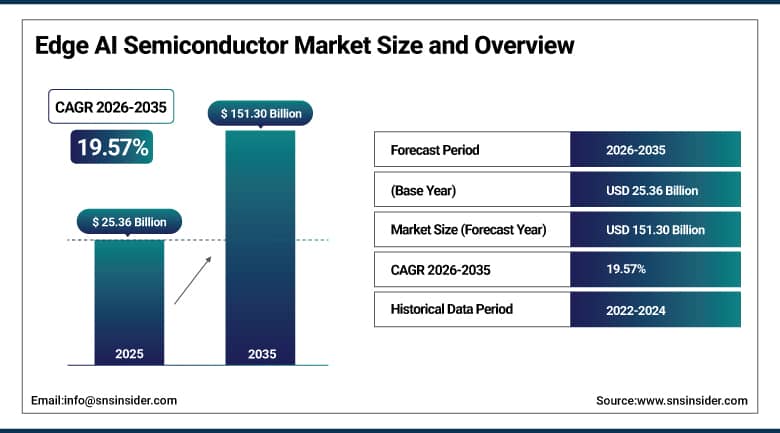
The Edge AI Semiconductor Market was valued at USD 25.36 Billion in 2025 and is projected to reach USD 151.30 Billion by 2035, expanding at a CAGR of 19.57% during the forecast period 2026–2035.
The Edge AI semiconductor industry is experiencing unprecedented growth due to an increase in the use of AI at the edge, a massive growth in connected devices, and rising needs for real-time data processing with very little latency. Edge AI semiconductors are semiconductor solutions that aim at executing AI workloads within the local devices without relying solely on cloud technology solutions. They provide fast decision-making, increased privacy, reduced bandwidth usage, and increased efficiency.
There has been a remarkable rise in the number of smart consumer electronics, autonomous cars, industrial automation devices, healthcare devices, robots, and intelligent surveillance platforms that need AI processors capable of providing good computing power while consuming very little energy. There have been many advances in NPU technology, AI specific Integrated Circuits (AI ASICs), heterogeneous computing architectures, FPGA accelerators, and AI CPUs which have transformed the semiconductor industry through efficient AI inference and edge analytics.
From 2025 to 2026, the major semiconductor firms launched new generations of AI accelerators with NPUs, AI engines, improved TOPS capability, enhanced security, and power efficiency for consumer electronics, automobiles, industrial automation and healthcare.
To Get More Information On Edge AI Semiconductor Market - Request Free Sample Report
Edge AI Semiconductor Market Trends
-
Growing deployment of Edge AI processors across consumer electronics, autonomous vehicles, industrial IoT, and smart healthcare devices.
-
Increasing adoption of dedicated AI accelerators including NPUs and AI ASICs to improve inference performance while reducing power consumption.
-
Rising investments in intelligent manufacturing, robotics, machine vision, and Industry 4.0 applications requiring real-time edge intelligence.
-
Expanding integration of computer vision, natural language processing, predictive analytics, and multimodal AI capabilities into edge devices.
-
Continuous innovation in semiconductor architectures, heterogeneous computing, advanced packaging technologies, and energy-efficient AI chips for next-generation intelligent systems.
The U.S. Edge AI Semiconductor Market Size Outlook
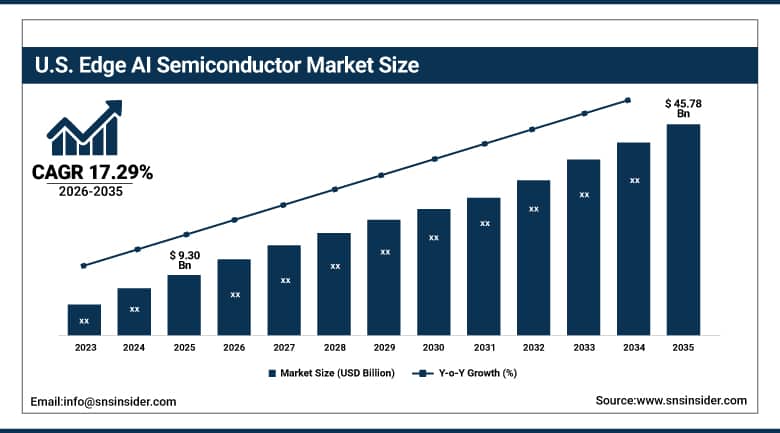
The U.S. Edge AI Semiconductor Market was valued at USD 9.30 billion in 2025 and is expected to reach approximately USD 45.78 billion by 2035, expanding at a CAGR of 17.29% during 2026–2035.
The dominance of the United States in the global market of Edge AI semiconductor chips is anticipated owing to the availability of major semiconductor chip suppliers, AI software developers, cloud computing services, and leading-edge research facilities. Increased spending in areas such as artificial intelligence, semiconductor chip fabrication, autonomous vehicles, industrial automation, aerospace and defense sector, and intelligent healthcare solutions is propelling the demand for Edge AI chips. The consumer electronics companies are installing AI semiconductor chips in smartphones, laptops, wearables, smart cameras, and home automation gadgets that provide real-time intelligence and enhance privacy and independence from cloud computing services.
During the period between 2025 and 2026, some U.S. semiconductor companies developed state-of-the-art Edge AI chips equipped with NPU, AI ASIC, improved security mechanisms, and energy-efficient architectures.
Edge AI Semiconductor Market Segment Analysis
-
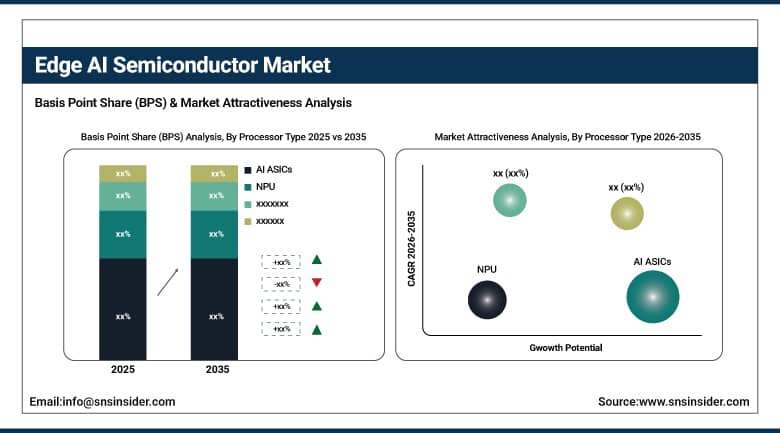
By Processor Type, AI ASICs dominated the market with 29.00% share in 2025, while NPUs are projected to witness the fastest growth with a CAGR of 22.15% during the forecast period.
-
By Device Type, consumer electronics dominated the market with 34.00% share in 2025, whereas automotive is expected to register the fastest CAGR of 23.06% during the forecast period.
-
By Function, AI inference accounted for the largest market share of 49.00% in 2025, while AI training is projected to witness the fastest growth with a CAGR of 20.38% during the forecast period.
-
By End User Industry, consumer electronics dominated the market with a 30.00% share in 2025, whereas automotive is anticipated to be the fastest-growing segment with a CAGR of 21.85% during the forecast period.
By Processor Type, AI ASICs dominated the market, while NPUs are projected to witness the fastest growth.
The AI ASICs held the highest market share of 29.00% in 2025 and is expected to retain its dominance through the entire forecast period. The key reason behind the leading position of AI ASICs lies in their outstanding performance in terms of processing efficiency, high latency and power efficiency as compared to the conventional processors. From 2025 to 2026, several semiconductor manufacturers launched their next-generation AI ASIC platforms featuring advanced neural processing engine, improved memory bandwidth, better security and heterogeneous computing functionalities in order to expedite edge AI applications in the automobile, industrial and consumer verticals.
The NPU (Neural Processing Unit) segment is expected to exhibit the fastest growth rate of 22.15% during the forecast period. NPUs have been specifically developed to optimize the neural network processing while using much lesser power than CPUs and GPUs. The rising utilization of generative AI, smart phones, AI PCs, robotics, wearables, IoT devices and autonomous solutions has created high demand for dedicated NPUs. The capability to perform AI inference tasks directly on-device is enabling NPUs to be an integral part of future-edge computing applications.
By Device Type, consumer electronics dominated the market, while automotive is projected to witness the fastest growth.
In 2025, the consumer electronics segment dominated the market with a significant market share of 34.00% due to the quick adoption of Edge AI semiconductors in smartphones, tablets, laptops, wearables, smart TVs, smart household appliances, AR/VR headsets, and intelligent cameras. Manufacturers are incorporating Edge AI processors that enable face recognition, voice assistants, computational imaging, predictive analysis, real-time language translations, and customized experiences without heavy reliance on cloud technology. Between 2025 and 2026, some major players in the consumer electronics industry have been launching AI-powered smartphones and personal computers embedded with high performance Edge AI processors that support NPUs, on-device generative AI, and efficient energy consumption for real-time AI.
The automotive segment would witness a CAGR of 23.06% during the forecast period. With an increasing demand for ADAS, autonomous driving, connected cars, intelligent cockpit systems, and V2X communications, there would be a significant demand for high-end Edge AI semiconductors. AI processors in the car would enable it to detect objects, process data from multiple sensors, monitor drivers, navigate, perform predictive maintenance, and analyze safety, and other tasks locally with extremely low latency.
By Function, AI inference dominated the market, while AI training is projected to witness the fastest growth.
AI inference held the largest market share of 49.00% in 2025 and continued to lead the Edge AI semiconductor market owing to the nature of inference workloads as the main activity executed by edge devices. AI inference helps make intelligent decisions locally by running the machine learning algorithms on hardware and does not require cloud computing to do that. The need for latency-free inference services in applications such as face recognition, object detection, industrial inspections, predictive maintenance, voice recognition, cyber security, and healthcare diagnostics becomes more relevant. From 2025 to 2026, semiconductor companies broadened their Edge AI offerings through the inclusion of specialized processors providing higher TOPS performance, reduced energy consumption, better security, and more complex AI models.
The AI training category will exhibit the fastest growth rate at a CAGR of 20.38%. As of now, training AI models is a task for the cloud due to the enormous amount of computational power required for the process; however, rising adoption of federated learning, personalized AI, adaptive edge intelligence, and localized training is expected to push the need for local model training in the future.
Regional Analysis
|
Region |
Major Country |
Share within Region, 2025 (%) |
|---|---|---|
|
North America |
United States |
94.00% |
|
Europe |
Germany |
20.00% |
|
Asia Pacific |
China |
34.00% |
|
Middle East & Africa |
UAE |
4.00% |
|
Latin America |
Brazil |
3.00% |
North America Edge AI Semiconductor Market Insights
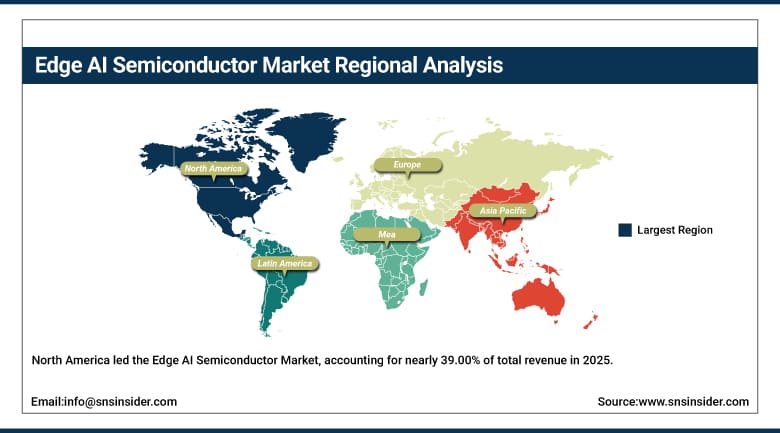
North America led the Edge AI Semiconductor Market, accounting for nearly 39.00% of total revenue in 2025 and is expected to retain its dominant position during the forecast period. This regional leadership is backed by the availability of prominent semiconductor players, artificial intelligence hardware firms, hyperscaler cloud vendors, and research organizations. Rising investments in artificial intelligence, edge computing systems, autonomous cars, industrial automation, military applications, robots, and smart healthcare have resulted in the growing demand for edge artificial intelligence processors. Companies operating in the consumer electronics sector are increasingly incorporating special-purpose AI chips in phones, computers, wearables, and smart home devices to enable better device intelligence. Domestic semiconductor production and AI innovations are constantly being invested in by the region.
Between 2025 and 2026, various semiconductor companies based in North America increased their Edge AI chip offerings by introducing innovative AI ASICs, NPUs, and heterogeneous computing platforms that can run generative AI and computer vision models along with inference in automotive, industrial, and consumer electronics domains.
Get Customized Report as Per Your Business Requirement - Enquiry Now
Europe Edge AI Semiconductor Market Insights
The Europe region witnesses’ consistent expansion in the Edge AI Semiconductor market due to growing investment in industrial automation, smart manufacturing, connected mobility, healthcare, and intelligent infrastructure sectors. The countries such as Germany, France, United Kingdom, Italy, and the Netherlands have initiated Industry 4.0 programs that necessitate the use of energy-efficient edge AI semiconductors for performing functions such as predictive maintenance, machine vision, robotics, and autonomous systems. In addition to the above-mentioned factors, the automobile industry is making use of Edge AI semiconductors for developing ADAS and connected cars. The emphasis of the European Union on semiconductor independence and innovation in the field of AI and semiconductors also contributes towards this development.
In 2025–2026, several European semiconductor and automobile technology companies launched AI enabled processors in Edge AI computing segment for applications of industrial automation, automotive electronics, and embedded AI.
Asia Pacific Edge AI Semiconductor Market Insights
The Asia Pacific region is expected to witness the fastest growth rate of CAGR 22.41% during the forecast period due to the rapid growth in the production of semiconductors, consumer electronics, adoption of AI, and digital transformation in countries like China, Japan, South Korea, Taiwan, India, and Southeast Asia. The region has emerged as one of the world’s leading producers of semiconductor fabrication, smartphone production, automotive electronics, industrial automation, and IoT devices, leading to increased demand for Edge AI processors. Growing government policies that help achieve semiconductors’ independence, innovation in AI, and smart manufacturing have driven the growth of the region.
During the year 2025 to 2026, many semiconductor companies of Asia-Pacific launched new-generation Edge AI processors with AI NPUs, AI ASICs, advanced packaging technology, and low-power technology aimed at use in smartphones, automotive, industrial IoT, and intelligent edge platforms.
Middle East & Africa and Latin America Edge AI Semiconductor Market Insights
Growth in the market in Middle East & Africa region is happening at a steady pace due to investments made towards digital infrastructure development, smart cities, automation, AI surveillance, and intelligent transportations systems in UAE, Saudi Arabia, South Africa, and nearby countries. Digital transformation programs initiated by governments and usage of AI technology in public sector, energy, logistics, and healthcare are expected to boost demand for Edge AI semiconductor. Although the ecosystem of semiconductor is relatively small in comparison to other developed regions, increased investment towards advanced computing infrastructure is anticipated to drive long-term growth.
Expanding steadily in the Latin America region are growth opportunities due to increasing digitization in the manufacturing, automotive, retail, health care, and telecommunication sectors. The countries like Brazil, Mexico, Argentina, and Chile are increasingly utilizing AI-based edge computing to improve operational efficiency, automation, prediction, and analysis. Increased investment made towards smart manufacturing, connectivity, and AI-based industrial applications are expected to drive the continuous adoption of Edge AI semiconductor solutions. The organizations in both the regions between 2025 and 2026 have been making accelerated investments in edge computing infrastructure powered by AI for industrial automation, smart cities, healthcare, and intelligent surveillance applications.
Market Dynamics
Growth Drivers: Increasing use of AI-enabled edge computing in consumer electronics, and others.
Increasing adoption of artificial intelligence at the edge has emerged as one of the key factors driving growth for the Edge AI Semiconductor Market. Enterprises are performing AI tasks using local compute instead of leveraging centralized cloud infrastructure to ensure fast response time, enhanced cyber security, lower latency, and reduced bandwidth consumption. The shift is creating a significant rise in demand for custom AI semiconductors comprising AI ASICs, NPUs, FPGAs, and AI-powered CPUs that can offer high-performance inference with low power consumption. Leading consumer electronics companies are equipping smartphones, laptops, wearables, smart cameras, TVs, and smart homes with Edge AI processors to facilitate on-device AI capabilities such as facial recognition, speech recognition, computational imaging, and other AI-driven functionalities.
Several global semiconductor companies have introduced innovative Edge AI processors in the form of advanced AI ASICs, AI NPUs, heterogeneous computing platforms, and AI accelerators capable of enabling generative AI, computer vision, and real-time analytics in edge applications during 2025–2026.
Restraints: Expensive semiconductor R&D process and escalating design complexities pose huge challenges.
The rapid pace of technology innovation does not eliminate some difficulties faced by Edge AI Semiconductor Market. These include high expenses connected with the design, manufacturing, and development of semiconductors. To develop effective AI processors, the company needs to use advanced manufacturing nodes, cutting-edge packaging techniques, specific intellectual property rights and software optimization. The increasing complexity of AI algorithms and ability to operate with different neural networks further raise chip development costs and make development cycle longer. Apart from that, semiconductor developers need to take into account such criteria as computing power, heat dissipation, memory throughput, silicon area and efficiency.
In 2026, there was an increasing trend in spending on advanced chipsets architecture, heterogeneous integration, and manufacturing process innovation to raise production efficiency and decrease development costs.
Opportunities: Growth in the areas of generative AI, and intelligent edge computing infrastructure.
The commercialization of generative AI, autonomous mobility, industrial robotics, and smart infrastructure is providing significant growth opportunities in the Edge AI Semiconductor Market. Businesses are leveraging Edge AI solutions that can run large language models, computer vision, speech recognition, predictive analytics, and automation at endpoints. Investments in AI-enabled factories, healthcare tools, autonomous drones, connected vehicles, analytics solutions, and smart city infrastructures have been providing opportunities in demand for specialized AI semiconductors tailored for use at the edge. In addition, the emergence of AI-powered personal computers, smartphones, wearables, and consumer electronics has been creating opportunities for semiconductor companies.
In 2025 and 2026, various semiconductor companies launched advanced Edge AI solutions that can support multimodal AI, generative AI inference, advanced NPU and optimized software tool chain solutions for automotive, industrial, healthcare and consumer electronics.
Recent Developments
-
2026: NVIDIA expanded its Edge AI computing portfolio by introducing advanced embedded AI platforms designed to deliver higher AI inference performance, improved energy efficiency, and enhanced support for autonomous machines, robotics, and industrial edge applications.
-
2026: Qualcomm Technologies introduced next-generation AI-enabled Snapdragon platforms featuring enhanced NPUs, on-device generative AI capabilities, and improved AI processing efficiency for smartphones, AI PCs, and intelligent edge devices.
-
2025: Intel Corporation expanded its Edge AI processor portfolio with AI-enabled Core Ultra and Xeon platforms integrating dedicated AI acceleration capabilities for industrial automation, enterprise edge computing, and intelligent IoT deployments.
-
2025: Advanced Micro Devices (AMD) strengthened its Edge AI semiconductor offerings by expanding adaptive computing and embedded AI solutions optimized for automotive systems, industrial robotics, machine vision, and intelligent manufacturing environments.
Edge AI Semiconductor Market Key Players are:
-
NVIDIA Corporation
-
Intel Corporation
-
Qualcomm Technologies, Inc.
-
Advanced Micro Devices, Inc. (AMD)
-
Apple Inc.
-
Samsung Electronics Co., Ltd.
-
MediaTek Inc.
-
Broadcom Inc.
-
Synaptics Incorporated
-
NXP Semiconductors N.V.
-
Texas Instruments Incorporated
-
STMicroelectronics N.V.
-
Renesas Electronics Corporation
-
Microchip Technology Inc.
-
Infineon Technologies AG
-
Arm Holdings plc
-
Hailo Technologies Ltd.
-
Ambarella, Inc.
-
Kinara Inc.
-
EdgeCortix Inc.
Edge AI Semiconductor Market Report Scope:
| Report Attributes | Details |
|---|---|
| Market Size in 2025 | USD 25.36 Billion |
| Market Size by 2035 | USD 151.30 Billion |
| CAGR | CAGR of 19.57% From 2026 to 2035 |
| Base Year | 2025 |
| Forecast Period | 2026-2035 |
| Historical Data | 2022-2024 |
| Report Scope & Coverage | Market Size, Segments Analysis, Competitive Landscape, Regional Analysis, DROC & SWOT Analysis, Forecast Outlook |
| Key Segments | • By Processor Type (AI ASICs, GPU, NPU, FPGA, CPU with AI Engine) • By Device Type (Consumer Electronics, Automotive, Industrial IoT, Healthcare Devices, Others) • By Function (AI Inference, AI Training, Computer Vision, Natural Language Processing (NLP), Others) • By End User Industry (Consumer Electronics, Automotive, Industrial Manufacturing, Healthcare, Others) |
| Regional Analysis/Coverage | North America (US, Canada), Europe (Germany, UK, France, Italy, Spain, Russia, Poland, Rest of Europe), Asia Pacific (China, India, Japan, South Korea, Australia, ASEAN Countries, Rest of Asia Pacific), Middle East & Africa (UAE, Saudi Arabia, Qatar, South Africa, Rest of Middle East & Africa), Latin America (Brazil, Argentina, Mexico, Colombia, Rest of Latin America). |
| Company Profiles | NVIDIA Corporation, Intel Corporation, Qualcomm Technologies, Inc., Advanced Micro Devices, Inc. (AMD), Apple Inc., Samsung Electronics Co., Ltd., MediaTek Inc., Broadcom Inc., Synaptics Incorporated, NXP Semiconductors N.V., Texas Instruments Incorporated, STMicroelectronics N.V., Renesas Electronics Corporation, Microchip Technology Inc., Infineon Technologies AG, Arm Holdings plc, Hailo Technologies Ltd., Ambarella, Inc., Kinara Inc., EdgeCortix Inc. |
Frequently Asked Questions
The Edge AI Semiconductor Market was valued at USD 25.36 Billion in 2025.
The market is projected to reach USD 151.30 Billion by 2035.
The market is expected to expand at a CAGR of 19.57% during the forecast period.
Asia Pacific is projected to register the fastest growth, expanding at a CAGR of 22.41% during 2026–203.
North America dominated the global market in 2025 with approximately 39.00% of total revenue.
