Dropshipping Market Report Scope & Overview:
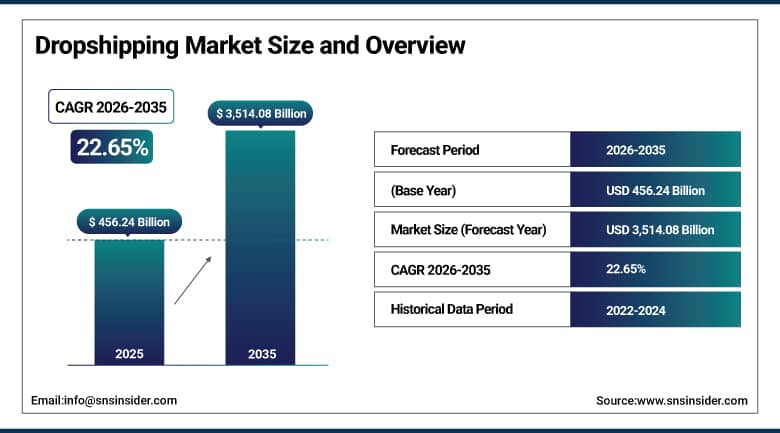
The Dropshipping Market was valued at USD 456.24 Billion in 2025 and is expected to reach USD 3,514.08 Billion by 2035, growing at a CAGR of 22.65% from 2026–2035.
The global dropshipping market is growing at an exceptional pace. Dropshipping is a retail fulfilment method where online stores sell products without maintaining inventory, relying on third-party suppliers who ship products directly to customers after purchase, eliminating inventory management costs and upfront stock investment. This model has gained prominence due to its low entry barriers, minimal investment requirements, and the ability to quickly respond to market trends and consumer demand shifts. The adoption rates of dropshipping business models have increased as more entrepreneurs seek low-cost entry into e-commerce, supported by digital tools, AI-driven automation, and social media marketing.
In 2023, Shopify enhanced its global fulfilment network with significantly more integration partners, enabling dropshippers to connect with suppliers across more countries and ship to customers worldwide with improved delivery speed and tracking visibility. The enhancement reflects Shopify’s commercial strategy of reducing the operational friction that supply chain management creates for dropshipping entrepreneurs whose core competence is marketing and customer acquisition rather than logistics optimisation.
Market Size and Forecast
-
Market Size in 2026E: USD 559.79 Billion
-
Market Size by 2035: USD 3,514.08 Billion
-
CAGR: 22.65% from 2026 to 2035
-
Fastest Growing Region: Asia Pacific
-
Largest Region: North America
To Get More Information On Dropshipping Market - Request Free Sample Report
Dropshipping Market Trends
-
AI-powered product research and trend analysis tools are helping dropshippers identify profitable niche products more efficiently.
-
Social commerce integration is transforming the dropshipping landscape by enabling purchases directly within social media platforms.
-
Print-on-demand dropshipping is expanding rapidly as brands, influencers, and creators launch customized merchandise without holding inventory.
-
Automated fulfillment platforms are streamlining order processing and reducing operational workloads.
-
Domestic dropshipping models are gaining popularity as businesses seek faster delivery times and improved customer satisfaction.
U.S. Dropshipping Market Outlook:
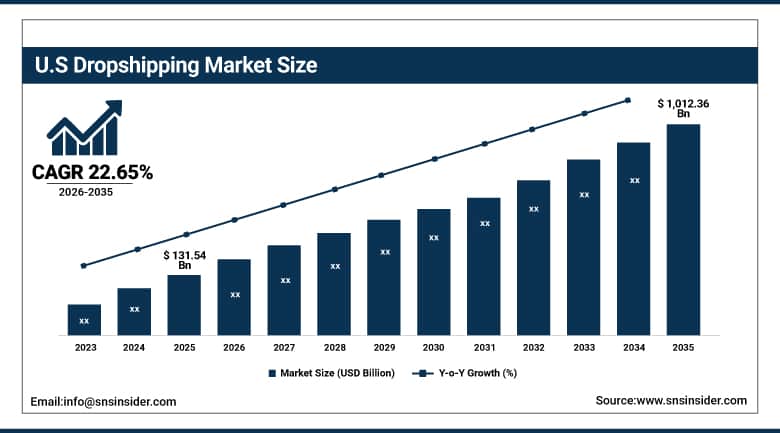
The U.S. Dropshipping Market was valued at approximately USD 131.54 Billion in 2025 and is expected to reach approximately USD 1,012.36 Billion by 2035, growing at a CAGR of approximately 22.65%.
The U.S. is the world’s most commercially sophisticated dropshipping market within North America’s dominant revenue position. Shopify’s Canadian-American operations, the U.S.’s entrepreneurial e-commerce culture, and the most advanced digital payments and logistics infrastructure of any market collectively create the commercial environment that sustains exceptional dropshipping adoption. The print-on-demand market’s concentration in U.S. fulfilment partners including Printful and Printify reinforces domestic dropshipping supply chain development.
In March 2023, ShipStation released ShipStation Dropship Manager, its first product specifically created for dropship managers to automate and streamline multi-supplier dropshipping order management. The platform enables retailers managing hundreds of dropship suppliers to automate purchase order routing, tracking update consolidation, and supplier performance monitoring from a centralised dashboard whose operational efficiency improvement creates commercial differentiation for established dropshipping operations managing complex multi-supplier fulfilment.
Dropshipping Market Segment Analysis:
-
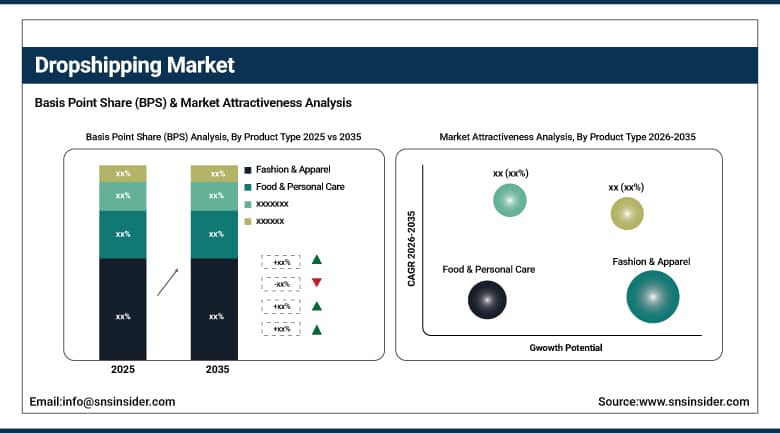
By Product Type, the Fashion & Apparel segment dominated the Dropshipping Market with approximately 36% share in 2025, while the Food & Personal Care segment is the fastest growing segment.
-
By Platform, the WooCommerce segment dominated the Dropshipping Market with approximately 28% share in 2025, while the Shopify segment is the fastest growing segment.
-
By Organisation Size, the Large Enterprise segment dominated the Dropshipping Market with approximately 55% share in 2025, while the Small & Medium Enterprises segment is the fastest growing segment.
By Product Type, fashion dominates, food & personal care grows fastest
Fashion and apparel retained the dominant product type position with approximately 36% of the dropshipping market in 2025. The fashion sector’s commercial primacy reflects its unique alignment with the dropshipping model’s fundamental strengths. Fast fashion’s trend-driven demand cycle creates a constantly refreshing product opportunity landscape whose adoption without inventory commitment represents the dropshipping model’s most commercially compelling value proposition. Social media platforms’ visual nature creates fashion product discovery environments where influencer marketing, viral trend content, and targeted advertising create high conversion commerce flows that translate directly into dropshipping order volume.
Food and personal care is the fastest-growing product category because the growing consumer preference for organic, natural, and sustainable food and personal care products creates niche product opportunities whose discovery online and purchase without physical retail access creates natural dropshipping demand. The beauty and wellness category’s extraordinary social media engagement, whose influencer marketing creates product discovery and purchase intent that converts at above-average e-commerce rates, sustains food and personal care’s commercial growth momentum. Each new wellness trend creates a dropshipping product opportunity whose time-to-market speed advantage over inventory-based alternatives creates first-mover commercial advantage.
By Platform, WooCommerce dominates, Shopify grows fastest
WooCommerce retained the dominant platform position with approximately 28% of the dropshipping market in 2025. WooCommerce’s commercial primacy reflects its WordPress ecosystem integration whose 43% of all websites deployed on WordPress creates an extraordinary existing merchant base with minimal technology switching cost to dropshipping capability. WooCommerce’s open-source nature and the extensive plugin ecosystem’s dropshipping automation tools, including AliDropship and Dropified’s WooCommerce integrations, create a functionally competitive dropshipping platform at lower subscription cost than proprietary alternatives. The merchant’s ability to customise WooCommerce’s dropshipping functionality through plugins sustains its dominance among technically capable entrepreneurs.
Shopify is the fastest-growing platform because its purpose-built e-commerce infrastructure, seamless app marketplace integration with DSers, AutoDS, and Spocket’s dropshipping automation, and the industry’s most comprehensive fulfilment network partnership create the most commercially polished dropshipping launch experience for new entrepreneurs. Shopify’s monthly subscription model’s lower upfront commitment relative to self-hosted alternatives creates accessibility that sustains new merchant adoption whose compounding subscription base drives above-average platform revenue growth.
By Organisation Size, large enterprise dominates, SMEs grow fastest
Large enterprises retained the dominant organisation size position with approximately 55% of the dropshipping market in 2025. Large enterprise dropshipping encompasses established multi-channel retailers, branded consumer goods manufacturers, and platform marketplace operators whose dropshipping operations complement existing owned inventory businesses. Amazon’s third-party seller fulfilment, established retail brands’ extended range dropshipping programmes, and direct-to-consumer brand operations collectively represent the large enterprise dropshipping commercial scale whose revenue substantially exceeds individual entrepreneur operations in aggregate commercial value despite smaller participant count.
SMEs are the fastest-growing organisation size because the dropshipping model’s fundamental commercial proposition—zero inventory risk, minimal capital requirement, and platform-accessible customer acquisition infrastructure—most compellingly addresses the operational constraints that small business cash flow limitations create. Each new entrepreneurial dropshipping business launched on Shopify, WooCommerce, or social commerce platforms creates SME commercial activity whose aggregate with millions of concurrent operations creates the market’s largest participant count and fastest growth rate.
Regional Analysis:
|
Region |
Major Country |
Share within Region, 2025 (%) |
|---|---|---|
|
North America |
United States |
87.4% |
|
Europe |
Germany |
22.3% |
|
Asia Pacific |
China |
44.8% |
|
Middle East & Africa |
UAE |
38.4% |
|
Latin America |
Brazil |
44.2% |
North America Dropshipping Market Insights
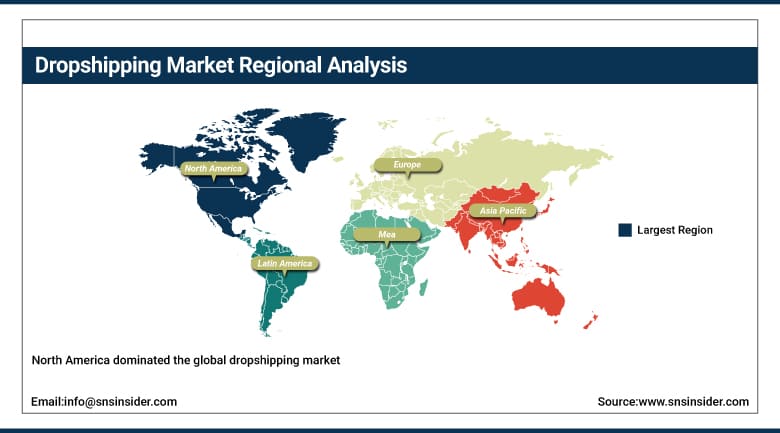
North America dominated the global dropshipping market in 2023 as the most commercially advanced e-commerce region. The United States accounts for approximately 87.4% of North American revenues through its extraordinary e-commerce infrastructure, Shopify’s extensive merchant network, and the consumer’s above-average online purchase frequency whose combined commercial environment creates the most favourable dropshipping market of any national economy.
Canada contributes approximately 12.6% of North American revenues through its above-average e-commerce adoption, the Shopify-affiliated dropshipping ecosystem, and the growing social commerce adoption among Canadian consumers whose digital purchasing behaviour closely mirrors U.S. market patterns.
Get Customized Report as Per Your Business Requirement - Enquiry Now
Europe Dropshipping Market Insights
Europe is a significant dropshipping market where the EU single market’s cross-border e-commerce rules, the growing online retail penetration in Western European markets, and the emerging Eastern European e-commerce adoption create a commercially diverse dropshipping environment. Germany accounts for approximately 22.3% of European revenues through its largest e-commerce market scale, the online retail sector’s above-average consumer spending, and the established payment infrastructure’s dropshipping transaction capability.
The United Kingdom, France, and the Netherlands are significant secondary European markets whose established e-commerce infrastructure, high internet penetration, and growing dropshipping entrepreneur community create consistent market development.
Asia Pacific Dropshipping Market Insights
Asia Pacific is the fastest-growing regional dropshipping market, driven by extraordinary e-commerce growth in China, India, Southeast Asia, and Australia whose combined online shopping population creates above-average dropshipping opportunity. China accounts for approximately 44.8% of Asia Pacific revenues through its extraordinary manufacturing base that creates the world’s most comprehensive dropshipping supplier ecosystem whose AliExpress, 1688, and Alibaba platforms provide the product sourcing infrastructure that global dropshippers access.
India and Southeast Asia are the most commercially dynamic emerging markets within Asia Pacific where rapidly growing smartphone penetration, improving digital payment infrastructure, and growing entrepreneurial e-commerce culture are creating above-average new dropshipping business formation rates.
MEA & Latin America Dropshipping Market Insights
UAE leads MEA revenues at approximately 38.4% through its above-average consumer digital sophistication, growing e-commerce adoption, and the entrepreneurial culture’s receptivity to dropshipping’s low-capital business model. Brazil leads Latin American revenues at approximately 44.2% through its large and growing e-commerce market, Mercado Libre’s marketplace infrastructure, and the growing dropshipping entrepreneur community whose adoption is creating structured market development.
Saudi Arabia and South Africa represent significant secondary MEA markets whose e-commerce infrastructure development and growing online retail adoption are creating expanding dropshipping opportunity across product categories aligned with regional consumer preferences.
Market Dynamics:
Growth Drivers: E-commerce expansion creating low-barrier market entry and AI-driven automation enabling scale without capital investment
E-commerce’s global expansion is the dropshipping market’s most commercially certain structural growth driver. The global e-commerce market’s compound annual growth creates a continuously expanding consumer base whose online purchase comfort and digital payment accessibility create the commercial environment that dropshipping’s inventory-free model requires. Each percentage point increase in global e-commerce penetration creates proportional dropshipping opportunity whose commercial scale grows with the overall market’s expansion. Social commerce’s emergence as a high-conversion shopping channel whose in-app purchase completion creates dropshipping order flow without website visit requirements creates a new structural demand channel that sustains exceptional market growth.
AI-driven automation is simultaneously creating the technical capability that enables dropshipping businesses to scale order volume without proportional operational cost increase. Automated product research, supplier sourcing, order routing, tracking update communication, and customer service response tools collectively reduce the manual effort per order that historically created a practical ceiling on individual dropshipping business scale. Each operational automation that reduces cost per order creates commercial motivation for dropshipping volume growth whose aggregate across millions of global operations sustains market expansion at exceptional rates.
Restraints: Supply chain quality control limitations and international shipping delivery time creating customer satisfaction risk
Dropshipping’s fundamental commercial model—where the retailer never physically handles the product—creates quality control limitations whose commercial consequence is customer satisfaction risk from product quality variation, inaccurate product representation, and packaging quality inconsistency. Each quality complaint creates return processing cost, negative review creation, and customer acquisition cost waste whose combined impact on repeat purchase rate directly affects dropshipping business sustainability. The inability to inspect inventory before customer delivery creates a structural product quality risk that conventional retail’s inventory ownership model does not face.
International shipping delivery times of 15-30 days from Asian suppliers create customer satisfaction risk in markets where Amazon Prime’s 1-2 day delivery has established consumer expectations that international dropshipping cannot meet at equivalent cost. Each customer whose order delivery expectation substantially exceeds reality creates a cancellation, return, or chargeback whose commercial cost reduces the net margin that international dropshipping’s low product cost creates.
Opportunities: Print-on-demand personalisation and domestic dropshipping model capturing premium delivery expectation market
Print-on-demand dropshipping represents the most commercially differentiated opportunity in the dropshipping market whose custom product creation eliminates the commodity competition that standard product dropshipping faces from multiple retailers selling identical sourced items. Each creator, influencer, or brand that launches print-on-demand merchandise creates a unique product whose market is exclusively the creator’s audience, eliminating the price competition that generic product dropshipping cannot escape.
Domestic dropshipping from warehouses in the retailer’s home country represents the most commercially promising model evolution that addresses the delivery time limitation constraining international dropshipping’s market expansion. Each domestic warehouse partnership that enables 2-5 day delivery at economics superior to international alternatives creates a structural commercial advantage that sustains customer satisfaction at levels compatible with repeat purchase and positive review generation.
Recent Developments:
-
2023: Shopify enhanced its global fulfilment network in 2023 with significantly more integration partners, enabling dropshippers to connect with suppliers across more countries and improve delivery speed and tracking visibility for international customer orders.
-
2023: ShipStation released ShipStation Dropship Manager in March 2023, its first product specifically for dropship managers enabling automated multi-supplier order routing, tracking update consolidation, and supplier performance monitoring from a centralised platform.
-
2024: DSers, the official AliExpress dropshipping partner, launched enhanced AI-powered product sourcing and order automation features in 2024, enabling dropshippers to automatically identify top-performing products, manage bulk orders, and track supplier performance across thousands of simultaneous product listings.
Dropshipping Market Key Players:
-
Shopify Inc.
-
AliDropship
-
SaleHoo Group Limited
-
Printful Inc.
-
Spocket
-
Zendrop
-
DSers
-
Syncee
-
Inventory Source
-
CJDropshipping
-
Doba Inc.
-
Megagoods Inc.
-
Modalyst Inc.
-
Wholesale2b
-
Dropshipzone
-
Printify
-
AutoDS
-
Sunrise Wholesale Merchandise
-
Importify
-
AppScenic
Dropshipping Market Report Scope:
| Report Attributes | Details |
|---|---|
| Market Size in 2025 | USD 456.24 Billion |
| Market Size by 2035 | USD 3,514.08 Billion |
| CAGR | CAGR of 22.64% From 2026 to 2035 |
| Base Year | 2025 |
| Forecast Period | 2026-2035 |
| Historical Data | 2022-2024 |
| Report Scope & Coverage | Market Size, Segments Analysis, Competitive Landscape, Regional Analysis, DROC & SWOT Analysis, Forecast Outlook |
| Key Segments | • by Product Type (Fashion & Apparel, Electronics & Media, Furniture & Appliances, Food & Personal Care, Toys & Hobby, Others) • by Platform (Shopify, WooCommerce, BigCommerce, Magento, Others) • by Organisation Size (Small & Medium Enterprises, Large Enterprise) |
| Regional Analysis/Coverage | North America (US, Canada, Mexico), Europe (Eastern Europe [Poland, Romania, Hungary, Turkey, Rest of Eastern Europe] Western Europe] Germany, France, UK, Italy, Spain, Netherlands, Switzerland, Austria, Rest of Western Europe]), Asia Pacific (China, India, Japan, South Korea, Vietnam, Singapore, Australia, Rest of Asia Pacific), Middle East & Africa (Middle East [UAE, Egypt, Saudi Arabia, Qatar, Rest of Middle East], Africa [Nigeria, South Africa, Rest of Africa], Latin America (Brazil, Argentina, Colombia, Rest of Latin America) |
| Company Profiles | Shopify Inc., AliDropship, SaleHoo Group Limited, Printful Inc., Spocket, Zendrop, DSers, Syncee, Inventory Source, CJDropshipping, Doba Inc., Megagoods Inc., Modalyst Inc., Wholesale2b, Dropshipzone, Printify, AutoDS, Sunrise Wholesale Merchandise, Importify, AppScenic |
Frequently Asked Questions
Ans- Asia-Pacific is expected to register the fastest CAGR during the forecast period.
Ans-Growth of e-commerce and digital payments is fueling dropshipping adoption by enabling easy store setup and seamless transactions.
Ans- Rising competition and market saturation make differentiation difficult, leading to price wars and reduced profit margins.
Ans- The CAGR of the Dropshipping Market during the forecast period is 22.65% from 2024-2032.
Ans The Dropshipping Market was valued at USD 303.20 Billion in 2023 and is expected to reach USD 1900.8 Billion by 2032
Get in Touch

Rohan Jadhav
Principal Consultant