
EtherCAT Market Report Scope & Overview:
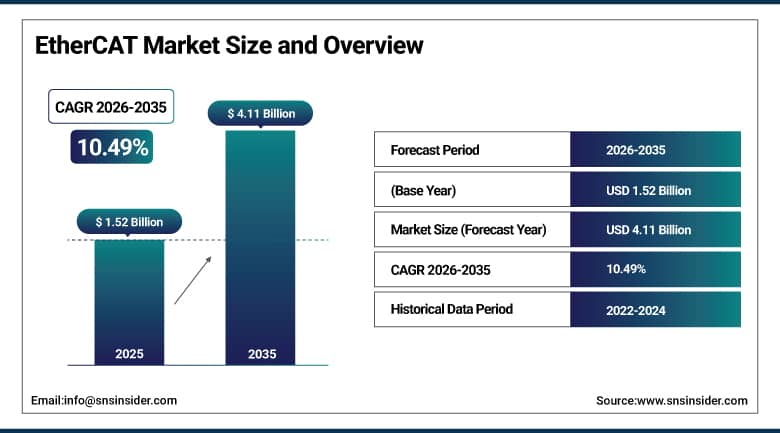
The EtherCAT Market was valued at USD 1.52 Billion in 2025 and is projected to reach USD 4.11 Billion by 2035, expanding at a CAGR of 10.49% during the forecast period 2026–2035.
The industry continues to grow consistently owing to the rise in dependence on smartphones, tablets, laptops, wearable devices, and many other portable electronic gadgets that need convenient charging solutions in commercial settings. Charging stations are being set up by transportation terminals, shopping complexes, airports, hotels, schools, hospitals, corporate organizations, and many other places for increasing user convenience and engaging the customers. Innovations in fast-charging capabilities, wireless charging, advanced payment methods, and charging management systems supported by the Internet of Things (IoT) technology are fueling the growth of the charging solutions market worldwide.
Charging solutions vendors launched a number of intelligent charging stations with wireless charging capabilities, USB-C Power Delivery, digital advertising displays, and efficient charging management systems during 2025-2026.
To Get More Information On EtherCAT Market - Request Free Sample Report
EtherCAT Market Trends
-
Increasing deployment of Industry 4.0 and smart factory technologies utilizing high-speed real-time industrial Ethernet communication.
-
Growing adoption of EtherCAT-enabled industrial robots, servo drives, motion controllers, and machine automation systems.
-
Rising investments in semiconductor manufacturing, automotive production, electronics assembly, and warehouse automation requiring deterministic communication protocols.
-
Expanding integration of EtherCAT with Industrial IoT (IoT), AI-enabled predictive maintenance, edge computing, and digital twin technologies.
-
Continuous advancements in industrial networking, synchronized motion control, machine vision integration, and cyber security supporting highly automated manufacturing environments.
U.S. EtherCAT Market Size Outlook:
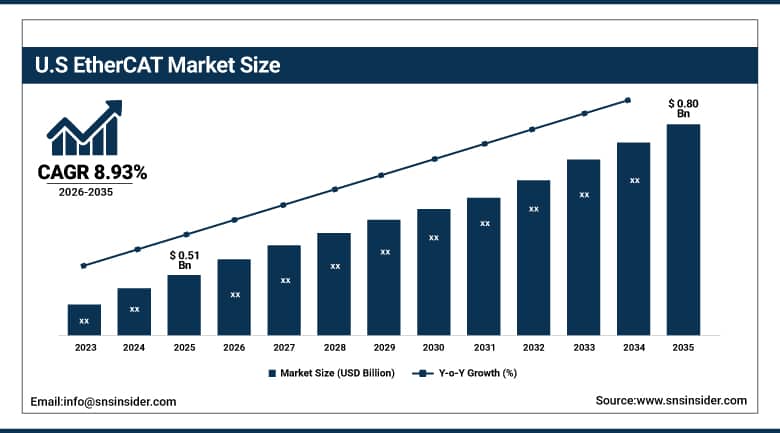
The U.S. EtherCAT Market was valued at USD 0.51 billion in 2025 and is expected to reach approximately USD 0.80 billion by 2035, expanding at a CAGR of 8.93% during 2026–2035.
The United States will remain one of the prime markets for EtherCAT technology because of increased investments in industrial automation, advanced manufacturing, semiconductor manufacturing, robotics, warehouse automation, and smart factories. Factories belonging to the automotive industry, aerospace industry, electronic manufacturing industry, food processing industry, pharmaceutical industry, and logistics sector are increasingly employing EtherCAT enabled communication networks. The increasing implementation of Industry 4.0, artificial intelligence based manufacturing systems, collaborative robots, and industrial edge computing solutions will help to increase the growth rate. Federal government's initiatives for manufacturing of semiconductors and advanced industrial infrastructure are providing a boost to the market.
In the period between 2025 and 2026, many industrial automation companies operating in the United States augmented their EtherCAT based automation product lines with the latest generation of servo drives, industrial controllers, robotic automation solutions, and intelligent motion control systems with AI assisted diagnostic, cyber security, and real-time industrial networking functionalities.
EtherCAT Market Segment Analysis:
-
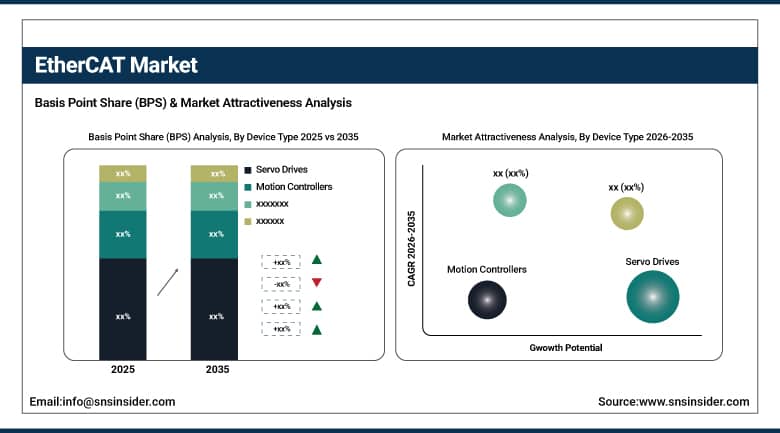
By Device Type, servo drives dominated the market with 27.00% share in 2025 and are projected to witness the fastest growth with a CAGR of 12.06% during the forecast period.
-
By Component, hardware dominated the market with 49.00% share in 2025, while communication controllers & ASICs are projected to witness the fastest growth with a CAGR of 12.44% during the forecast period.
-
By Industry Vertical, automotive manufacturing dominated the market with 24.00% share in 2025, whereas electronics manufacturing is expected to register the fastest CAGR of 12.10% during the forecast period.
-
By Deployment, discrete manufacturing dominated the market with 58.00% share in 2025, while industrial IoT & smart factory is projected to witness the fastest growth with a CAGR of 11.77% during the forecast period.
By Device Type, servo drives dominated the market and are also the fastest-growing segment.
Servo drives held the major market share of 27.00% in 2025 and will experience the maximum CAGR of 12.06% over the projected period. This is mainly due to the growing need for fast and accurate motion control in industries such as automotive manufacturing, semiconductor fabrication, electronics assembly, packaging machines, and robotics. EtherCAT-supported servo drives provide deterministic communication, minimal latency, multiaxis synchronization, and improved machine performance.
The growth in the installation of intelligent servo systems combined with EtherCAT communication systems has seen an increased adoption of these devices due to modernization in production plants as part of Industry 4.0 strategies among manufacturers. This is boosted by their ability to be used together with advanced PLCs, industrial robots, machine vision systems, and predictive maintenance solutions. During the years 2025-2026, the major industrial automation firms launched new-age EtherCAT-capable servo drive solutions with AI-based tuning features, real-time diagnostics, energy-efficient design, and high-speed synchronization functions.
By Component, hardware dominated the market, while communication controllers & ASICs are projected to witness the fastest growth.
Hardware segment accounted for the largest market share of 49.00% in 2025 due to increased use of EtherCAT-controlled controllers, industrial PCs, servo drives, industrial I/O modules, network interfaces, communication gateways, and motion control systems. Automation technology companies are spending significantly on automation hardware in order to increase production efficiency, machine reliability, and flexibility of operations. Increased modernization of manufacturing plants, growing installation of robots and intelligent manufacturing infrastructure, and rising adoption of robotics are some of the key factors that have been driving the demand for hardware solutions enabled with EtherCAT. As production lines get more and more connected, hardware investments will be crucial for deterministic communication within manufacturing lines.
Communication controllers & ASICs segment is anticipated to record the highest CAGR of 12.44% during the forecast period. Rising demand for communication ASICs that support fast processing speed, low latency, high synchronization, and ease of system integration has been boosting the demand in the global market. Companies continue introducing highly-integrated communication controllers to support advanced industrial automation systems. From 2025 to 2026, various automation technology firms have launched several EtherCAT communication ASICs for robotics, industrial networking, edge computing, and high-performance machine control systems.
By Industry Vertical, automotive manufacturing dominated the market, while electronics manufacturing is projected to witness the fastest growth.
Automotive Manufacturing emerged as the most dominant segment in terms of market share holding around 24.00% in 2025 because of the extensive use of industrial robots, automated assembly lines, welding, painting machinery, material handling, and quality inspection systems. In the process of manufacturing automobiles, there is increased use of EtherCAT for the purpose of achieving synchronization among multiple machines and enabling flexible manufacturing along with real-time control of automated manufacturing processes. Investments in manufacturing of electric vehicles, digital manufacturing, collaborative robots, and smart factory. During 2025 to 2026, there have been several upgrades made in the automation infrastructure of several automotive manufacturing facilities through EtherCAT based robotics, intelligent assembly lines, automated inspection machinery, and AI enabled production monitoring solutions.
Electronics manufacturing segment will exhibit the highest CAGR of 12.10%. Rising manufacture of semiconductors, consumer electronics, communication equipment, and precision electronic components is driving the demand for faster communication technologies in industries. EtherCAT helps in controlling the complicated manufacturing machinery in a synchronized manner while allowing high speed throughput, positioning accuracy, and real-time communication capabilities.
Regional Insights:
|
Region |
Major Country |
Share within Region, 2025 (%) |
|---|---|---|
|
North America |
United States |
94.00% |
|
Europe |
Germany |
34.00% |
|
Asia Pacific |
China |
24.00% |
|
Middle East & Africa |
UAE |
3.00% |
|
Latin America |
Brazil |
3.00% |
North America EtherCAT Market Insights
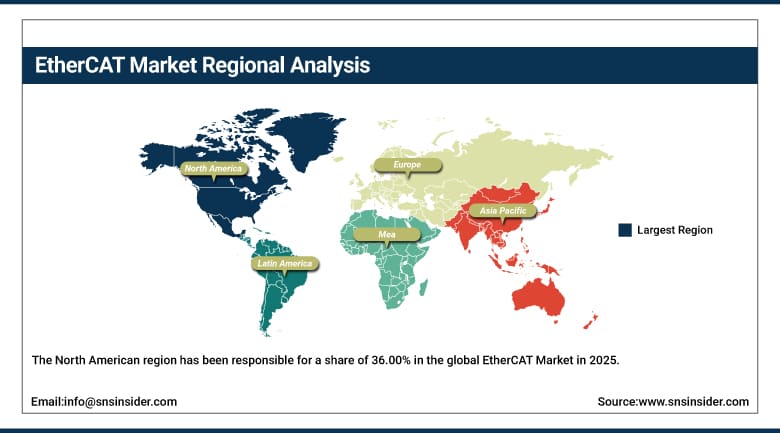
The North American region has been responsible for a share of 36.00% in the global EtherCAT Market in 2025 and remains among the most technologically advanced industrial automation regions globally. Growth drivers include growing investments in smart manufacturing, semiconductor manufacturing, industrial robotics, warehouse automation, and digital transformation programs within the US and Canada. Industrial manufacturers have adopted EtherCAT-based communication networks for enhancing machine synchronization, real-time control, production efficiency, and predictive maintenance capabilities. Adoption of Industry 4.0 technologies, AI-driven manufacturing systems, edge computing, and collaborative robots has fueled the need for high-speed industrial Ethernet solutions. Initiatives from governments for promoting the development of domestic semiconductor and industrial manufacturing facilities have further helped market expansion.
During the period between 2025 and 2026, several North American automation firms diversified their EtherCAT-based industrial networking offerings through the introduction of the next-generation servo drives, industrial controllers, robotic automation systems, and intelligent motion control systems that incorporate advanced features such as cyber security, edge connectivity, and AI diagnostics.
Get Customized Report as Per Your Business Requirement - Enquiry Now
Europe EtherCAT Market Insights
Europe held the lead among all other geographical regions in the global EtherCAT Market in 2025, capturing around 34.00% of total revenue, and would retain its leading position during the forecast period. Europe is well-supported by the presence of world-class industrial automation players, highly developed manufacturing units, automobile original equipment manufacturers, machinery builders, and industrial robotics firms. Germany acts as the world center of adoption of EtherCAT technology due to the widespread adoption of Industry 4.0 programs and the presence of highly automated manufacturing units. Increasing investments in precision manufacturing, digital factories, industrial Internet-of-things (IoT), smart logistics, further enhance the regional demand. Industrial automation firms are incorporating EtherCAT technology in factory automation systems to ensure deterministic communication.
In 2025-2026, a number of industrial automation firms from Europe launched state-of-the-art EtherCAT enabled controllers, industrial robots, machine vision systems, and smart manufacturing solutions for next generation connected factories and artificial intelligence-based production lines.
Asia Pacific EtherCAT Market Insights
Asia Pacific is expected to hold the highest CAGR of 12.47% in the coming years because of industrialization, electronics manufacturing, semiconductor manufacturing, automobile production, and governmental initiatives towards smart manufacturing. Continuous investments are being made in industrial automation infrastructure, robotics, and intelligent manufacturing technology in countries such as China, Japan, South Korea, Taiwan, and India. The growing use of industrial robots, automation assembly lines, artificial intelligence-driven manufacturing platforms, and industrial Internet of Things ecosystem increases the need for EtherCAT communications. The growth of semiconductor manufacturing and electronics manufacturing also plays a crucial role in driving the market.
During the period from 2025 to 2026, top Asian automation companies introduced new products in the EtherCAT communication industry which include next-generation products like high-speed motion control systems, intelligent robots, edge computing technology, and AI factory automation platforms.
Middle East & Africa and Latin America EtherCAT Market Insights
Expansive investments in industries related to the modernization of industrial production, smart manufacturing, oil & gas automation, food processing, and logistics infrastructure in the UAE, Saudi Arabia, and South Africa have led to a constant expansion of the Middle East & Africa region. Industrial communication systems based on EtherCAT are gaining popularity among manufacturers to achieve higher productivity, greater machinery reliability, and process monitoring. Industrial diversification policies of the government remain one of the key drivers of investments in innovative factory automation technologies.
Stable growth of the Latin America market is due to the increasing implementation of automation technologies in the manufacturing processes in the automotive, food & beverages, mining, packaging, and consumer goods industries in Brazil, Mexico, Argentina, and Chile. Increased investments in industrial digitalization, robotics, and intelligent manufacturing have led to the greater adoption of the EtherCAT technology. During 2025 and 2026, many industrial manufacturers of Latin America and the Middle East adopted the EtherCAT technology in automation systems along with the industrial IoT platform, advanced robotics, and smart manufacturing.
Market Dynamics:
Growth Drivers: Increasing prevalence of Industry 4.0, industrial automation and fast-speed Ethernet-based real-time communication.
Among the major drivers that influence EtherCAT Market are growing transformations of manufacturing industries through Industry 4.0 programs and automation of factories. Manufacturers are increasingly using EtherCAT technology-based industrial communication systems for deterministic real-time data exchange, synchronized motion control and extremely fast machine control. The performance of servo drives, motion controllers, industrial robots, PLCs, machine vision systems and automated production lines increases with EtherCAT technology due to synchronization of communication among various devices without excessive network burden.
Growing investments in automotive manufacturing, semiconductor manufacturing, electronics manufacturing, and automation of warehouses, packaging equipment and industrial robotics continue to boost the growth of the market. Moreover, growing deployment of Industrial Internet of Things (IoT), edge computing, AI-based predictive maintenance and digital twins requires high-performance industrial Ethernet networks for advanced smart factories. In 2025-2026 period some of the major players in industrial automation industry launched new EtherCAT technology-based products such as next-generation industrial controllers, servo systems, robotic automation platforms and AI-based motion control solutions.
Restraints: High cost of adoption and complex integration with existing industrial infrastructure.
Even with advanced technology, the EtherCAT Market still faces certain difficulties in terms of the upgrading of existing industrial sites. Most manufacturing sites utilize existing communication technologies and industrial automation technologies, which would need to go through some infrastructure upgrade before the adoption of EtherCAT is possible. This entails that the adoption process of EtherCAT may include replacement of controllers, network hardware, field devices, software, and machine interfaces, which translates into high expenses. Also, integration requires special engineering skills, system setup, and cyber security setup, testing, and training of employees to achieve smooth interoperability throughout the entire industrial facility.
Small and mid-sized manufacturers may decide not to implement modernization programs because of budget constraints and possible business disruption from implementation process. Maintenance of EtherCAT compatibility with other industrial Ethernet standards is also an issue faced by many industrial facilities. In 2026, industrial automation companies concentrated on development of modular EtherCAT gateways, protocol converters, and plug-and-play communication modules.
Opportunities: Growth in adoption of smart factories, industrial robotics, and IoT ecosystems.
Increasingly widespread use of technologies of smart manufacturing offers a number of growth opportunities for the EtherCAT Market. Modern industries around the world employ more collaborative robots, AMRs, AGVs, AI-based quality control systems, edge computing systems, and predictive maintenance technologies that use high-speed deterministic communication networks. The use of EtherCAT allows achieving real-time synchronization in complex industrial operations as well as machine-to-machine communication in interconnected manufacturing facilities.
Investments in such industries as semiconductor fabrication, electric vehicle production, electronics assembly, automation in pharmaceutical industry, renewable energy equipment manufacturing, and logistics automation contribute to growing addressable market. Adoption of technologies such as digital twins, cloud-based manufacturing systems, AI-based manufacturing analytics, and cyber security solutions for industrial environments will also be important for increasing demand for EtherCAT solutions over the coming years. In 2025–2026, several major global automation providers launched integrated EtherCAT platforms for IoT connectivity, machine diagnostics with AI, autonomous robotics, predictive maintenance, and edge computing for next-generation smart manufacturing facilities.
Recent Developments:
-
2026: Beckhoff Automation expanded its EtherCAT automation portfolio by introducing next-generation EtherCAT terminals, industrial controllers, and AI-enabled motion control solutions supporting higher synchronization accuracy and enhanced industrial networking performance.
-
2026: Omron Corporation enhanced its EtherCAT-compatible factory automation solutions by launching advanced servo systems, machine controllers, and robotics platforms designed for high-speed manufacturing and smart factory applications.
-
2025: Bosch Rexroth introduced upgraded EtherCAT-enabled motion control and automation solutions featuring enhanced cybersecurity, real-time diagnostics, edge connectivity, and seamless integration with Industry 4.0 production environments.
-
2025: Yaskawa Electric Corporation expanded its EtherCAT-based industrial robotics and servo drive portfolio by integrating AI-assisted motion optimization, predictive maintenance capabilities, and high-speed industrial Ethernet communication for precision manufacturing applications.
EtherCAT Companies are:
-
Beckhoff Automation GmbH & Co. KG
-
Omron Corporation
-
Yaskawa Electric Corporation
-
Siemens AG
-
ABB Ltd.
-
Schneider Electric SE
-
Rockwell Automation, Inc.
-
Mitsubishi Electric Corporation
-
Advantech Co., Ltd.
-
Pepperl+Fuchs SE
-
SICK AG
-
Phoenix Contact GmbH & Co. KG
-
Festo SE & Co. KG
-
Hilscher Gesellschaft für Systemautomation mbH
-
HMS Networks AB
-
B&R Industrial Automation GmbH (ABB Group)
-
Panasonic Industry Co., Ltd.
-
Kollmorgen Corporation
EtherCAT Market Report Scope:
| Report Attributes | Details |
|---|---|
| Market Size in 2025 | USD 1.52 Billion |
| Market Size by 2035 | USD 4.11 Billion |
| CAGR | CAGR of 10.49% From 2026 to 2035 |
| Base Year | 2025 |
| Forecast Period | 2026-2035 |
| Historical Data | 2022-2024 |
| Report Scope & Coverage | Market Size, Segments Analysis, Competitive Landscape, Regional Analysis, DROC & SWOT Analysis, Forecast Outlook |
| Key Segments | • By Device Type (Servo Drives, Industrial I/O Modules, Motion Controllers, Industrial Robots, Others) • By Component (Hardware, Software, Services, Communication Controllers & ASICs) • By Industry Vertical (Automotive Manufacturing, Semiconductor Manufacturing, Food & Beverage, Electronics Manufacturing, Others) • By Deployment (Discrete Manufacturing, Process Automation, Industrial IoT & Smart Factory) |
| Regional Analysis/Coverage | North America (US, Canada), Europe (Germany, UK, France, Italy, Spain, Russia, Poland, Rest of Europe), Asia Pacific (China, India, Japan, South Korea, Australia, ASEAN Countries, Rest of Asia Pacific), Middle East & Africa (UAE, Saudi Arabia, Qatar, South Africa, Rest of Middle East & Africa), Latin America (Brazil, Argentina, Mexico, Colombia, Rest of Latin America). |
| Company Profiles | Beckhoff Automation GmbH & Co. KG, Omron Corporation, Bosch Rexroth AG, Yaskawa Electric Corporation, Siemens AG, ABB Ltd., Schneider Electric SE, Rockwell Automation, Inc., Mitsubishi Electric Corporation, Delta Electronics, Inc., Advantech Co., Ltd., Pepperl+Fuchs SE, SICK AG, Phoenix Contact GmbH & Co. KG, Festo SE & Co. KG, Hilscher Gesellschaft für Systemautomation mbH, HMS Networks AB, B&R Industrial Automation GmbH (ABB Group), Panasonic Industry Co., Ltd., Kollmorgen Corporation |

Frequently Asked Questions
The Ether CAT Market was valued at USD 1.52 Billion in 2025.
The market is expected to expand at a CAGR of 10.49% during the forecast period.
North America dominated the global market in 2025 with approximately 36.00% revenue share.
Asia Pacific is projected to register the fastest CAGR of 12.47% during 2026–2035.
The market is projected to reach USD 4.11 Billion by 2035.
