
Fab Automation Market Report Scope & Overview:
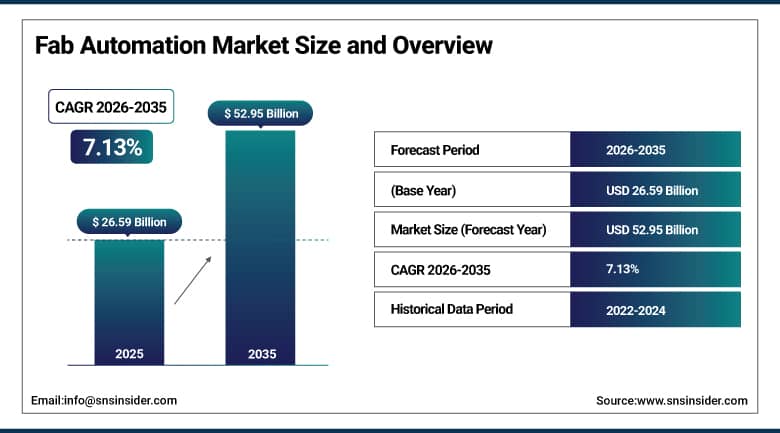
The Fab Automation Market was valued at USD 26.59 Billion in 2025 and is expected to reach USD 52.95 Billion by 2035, growing at a CAGR of 7.13% from 2026 to 2035.
The Fab Automation Market analysis report provides a comprehensive overview of automation technologies, fab operations and semiconductor manufacturing adoption trends. Rising investments in advanced fabs, demand for process efficiency, yield optimization and increasing semiconductor complexity are expected to drive market growth during the forecast period.
Fab automation is expected to be deployed across over 1,100 semiconductor fabs by 2025, driven by rising chip demand and increasing manufacturing automation.
Market Size and Forecast
-
Market Size in 2026E: USD 28.49 Billion
-
Market Size by 2035: USD 52.95 Billion
-
CAGR: 7.13% from 2026 to 2035
-
Fastest Growing Region: North America
-
Largest Region: Asia Pacific
To Get More Information On Fab Automation Market - Request Free Sample Report
Fab Automation Market Trends:
-
Increasing investment in advanced semiconductor fabs is accelerating adoption of automated material handling, robotics and process control systems.
-
Growing complexity of semiconductor nodes is driving demand for precision automation, real-time monitoring and yield optimization solutions.
-
Rising focus on cost efficiency and productivity is encouraging fabs to replace manual operations with fully integrated automation platforms.
-
Expansion of 300 mm fabs and advanced packaging facilities is boosting demand for high-throughput, scalable automation technologies.
-
Integration of AI, machine learning and data analytics is enhancing predictive maintenance and process optimization across fab operations.
-
Strong emphasis on reducing human error and contamination risks is reinforcing the shift toward lights-out and highly automated fabs.
U.S. Fab Automation Market Insights:
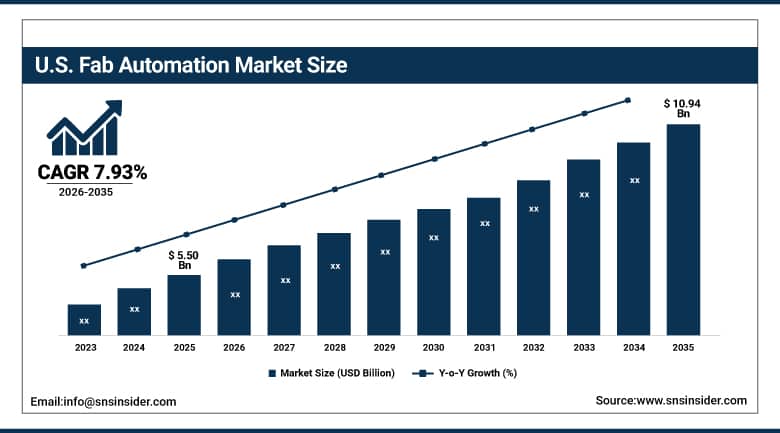
The U.S. Fab Automation Market was valued at approximately USD 5.50 Billion in 2026 and is expected to reach approximately USD 10.94 Billion by 2035, growing at a CAGR of approximately 7.93%.
The growth in the U.S. market is supported by advanced semiconductor research and development, wafer fabrication capacity expansions, use of robots and automated material handling equipment, and the rising need for high-performance and AI semiconductors. The growing need for semiconductors is increasing the use of automation technologies to increase yield, throughput, and efficiency of manufacturing in American fabs, while increasing uses of semiconductors in automotive, consumer electronics, industrial automation, and data centers continues to raise the need for semiconductors in the country.
In April 2025, Daifuku opened a new manufacturing facility in Hyderabad, India for the production of automated storage systems, conveyors, and pallet sorters, improving the global fab automation supply chain that U.S. semiconductor companies have been increasingly reliant on.
Fab Automation Market Segmentation Analysis:
-
By Automation Type, Automated Material Handling Systems (AMHS) held the largest market share of 32.45% in 2025, while Robotics is expected to grow at the fastest CAGR of 9.21% during 2026–2033.
-
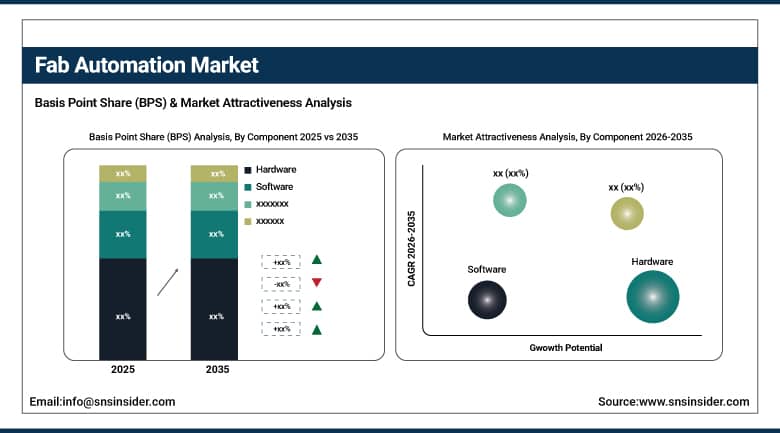
By Component, Hardware accounted for the highest market share of 54.32% in 2025, while Software is projected to expand at the fastest CAGR of 8.57% during the forecast period.
-
By Fab Type, Wafer Fabrication (Front-End) dominated with a 48.96% share in 2025, while Assembly & Packaging (Back-End) is expected to grow at the fastest CAGR of 8.34% through 2026–2033.
-
By Wafer Size, 300 mm held the largest share of 62.11% in 2025, while 200 mm is forecasted to register the fastest CAGR of 7.88% during 2026–2033.
-
By Technology Node, 29–65 nm accounted for the largest share of 36.85% in 2025, while ≤10 nm is expected to grow at the fastest CAGR of 9.12% through the forecast period.
-
By End-User, Foundries held the largest share of 42.98% in 2025, while OSATs are projected to expand at the fastest CAGR of 8.89% during 2026–2033.
By Component, Hardware Dominates While Software Expands Rapidly:
Hardware segment dominated the market as it forms the backbone of fab automation, including conveyors, robotic arms, sensors and controllers. Over 1,400 fabs utilized hardware-intensive automation in 2025 for reliable operations and consistent throughput.
Software is the fastest-growing segment, driven by demand for advanced process control, predictive maintenance and real-time monitoring solutions. In 2025, software adoption expanded across 750 fabs, enabling AI-driven optimization, better yield management and data analytics integration for complex fab operations.
By Automation Type, AMHS Dominates While Robotics Expands Rapidly:
Automated Material Handling Systems (AMHS) segment dominated the market due to their essential role in material transportation, wafer handling and efficient integration with fab operations. Over 1,200 fabs relied on AMHS in 2025 to streamline production, reduce human error and enhance yield.
Robotics is the fastest-growing segment, driven by increasing adoption of precision handling, wafer transfer automation and process flexibility. In 2025, over 420 fabs deployed robotics systems, reflecting growing demand for high-accuracy, scalable and adaptable automation solutions in semiconductor manufacturing.
By Fab Type, Wafer Fabrication Dominates While Assembly & Packaging Expands Rapidly:
Wafer Fabrication (Front-End) segment dominated the market due to the high automation requirements in lithography, etching, deposition and inspection processes. Over 900 front-end fabs integrated advanced automation in 2025 to meet increasing chip demand.
Assembly & Packaging (Back-End) is the fastest-growing segment, fueled by expansion in OSAT facilities and advanced packaging technologies. Around 480 back-end fabs adopted automated handling and inspection systems in 2025, reflecting the rising need for scalable, high-throughput assembly and testing processes.
By Wafer Size, 300 mm Dominates While 200 mm Expands Rapidly:
300 mm segment dominated the market as larger wafers enable higher production volumes, improved yield and reduced per-chip costs. Over 1,000 fabs were operating 300 mm lines in 2025, making them central to semiconductor production.
200 mm are the fastest-growing segment, driven by demand for specialized analog, MEMS and power devices. In 2025, 450 fabs continued adopting 200 mm automation solutions, reflecting steady demand in mature technologies and niche semiconductor applications.
By Technology Node, 29–65 nm Dominates While ≤10 nm Expands Rapidly:
29–65 nm segment dominated the market due to their widespread use in automotive, consumer electronics and industrial applications. Over 850 fabs focused on mature nodes in 2025, ensuring stable production and cost-efficient operations.
≤10 nm is the fastest-growing segment, driven by advanced logic, memory and AI chip demand. In 2025, more than 320 fabs adopted ≤10 nm automation systems, emphasizing precision handling, robotics and sophisticated process control to meet complex semiconductor manufacturing requirements.
By End-User, Foundries Dominate While OSATs Expand Rapidly:
Foundries segment dominated the market as they serve multiple chip designers and require large-scale, automated production to meet semiconductor demand. Over 950 foundries relied on automation in 2025 for wafer handling, process monitoring and throughput optimization.
OSATs (Outsourced Semiconductor Assembly and Test) are the fastest-growing segment, driven by the expansion of packaging, testing and assembly operations. In 2025, over 400 OSAT facilities deployed automation solutions, reflecting the increasing complexity of semiconductor packaging and need for high-speed, precise operations.
Fab Automation Market Regional Analysis:
Asia-Pacific Fab Automation Market Insights:
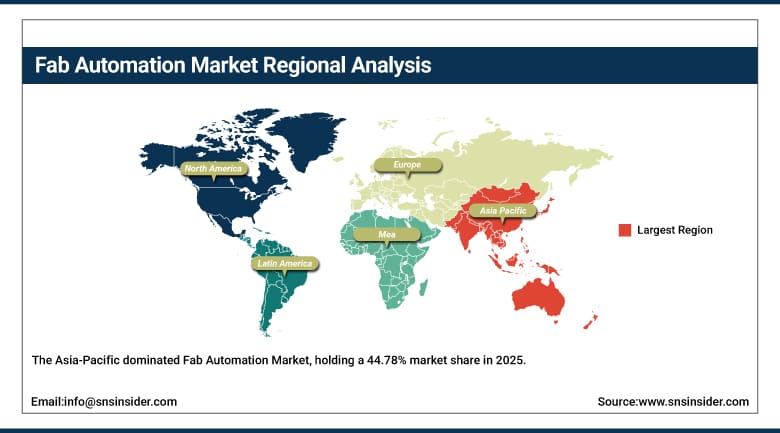
The Asia-Pacific dominated Fab Automation Market, holding a 44.78% market share in 2025. Growth is driven by the presence of major semiconductor manufacturers, leading foundries and high-volume fabs across China, Taiwan, South Korea and Japan. Rising investments in advanced wafer fabrication, robotics, AMHS and process control systems, coupled with strong government support and expanding electronics demand, position Asia-Pacific as the key hub for fab automation adoption and technological innovation in the semiconductor industry.
Get Customized Report as Per Your Business Requirement - Enquiry Now
China Fab Automation Market Insights:
China’s Fab Automation Market is driven by rapid semiconductor manufacturing expansion, increasing adoption of robotics, AMHS and process control systems and strong government support for advanced fabs. Rising demand for high-volume chip production, technology upgrades and investment in 300 mm wafer facilities positions China as a key contributor to the Asia-Pacific fab automation market.
North America Fab Automation Market Insights:
The North America Fab Automation Market is the fastest-growing region, projected to expand at a CAGR of 8.26% during the forecast period. Growth is driven by advanced semiconductor R&D, new fab construction and adoption of robotics, AMHS and process control systems across the U.S. and Canada. Increasing demand for AI, automotive and high-performance computing chips, coupled with government incentives for domestic manufacturing and technology upgrades, positions North America as a key hub for fab automation adoption and innovation.
U.S. Fab Automation Market Insights:
The U.S. Fab Automation Market is driven by the presence of leading semiconductor manufacturers, extensive wafer fabrication facilities and advanced technology adoption. Strong government incentives, investments in AI, automotive and high-performance computing chips, coupled with integration of robotics and AMHS, support operational efficiency and position the U.S. as a dominant hub in North American fab automation.
Europe Fab Automation Market Insights:
The Europe Fab Automation Market is driven by increasing investments in semiconductor manufacturing, advanced wafer fabrication and robotics integration. Countries such as Germany, France, the UK and the Netherlands are major contributors, supported by strong industrial infrastructure, skilled workforce and government incentives. Rising demand for automotive, industrial and consumer electronics chips, coupled with adoption of process control systems and AMHS, strengthens Europe’s position as a key regional hub for fab automation and technological innovation.
Germany Fab Automation Market Insights:
Germany is a key Fab Automation market, supported by advanced semiconductor manufacturing infrastructure, skilled workforce and strong industrial policies. High adoption of robotics, AMHS and process control systems in wafer fabrication and packaging, along with government incentives and technology-driven initiatives, strengthen Germany’s position as a major contributor within the European fab automation landscape.
Latin America Fab Automation Market Insights:
The Latin America Fab Automation Market is witnessing steady growth driven by increasing semiconductor manufacturing investments and rising demand for automated fabrication solutions. Countries such as Brazil, Mexico and Argentina are key contributors, supported by expanding wafer fabrication facilities, adoption of robotics and AMHS and government initiatives promoting technological development and industrial automation.
Middle East and Africa Fab Automation Market Insights:
The Middle East & Africa Fab Automation Market is expanding due to increasing semiconductor manufacturing investments and adoption of automation technologies. Countries such as Saudi Arabia, the UAE and South Africa are key contributors, supported by developing wafer fabrication facilities, growing robotics and AMHS integration and government initiatives promoting industrial automation and technology innovation.
Market Dynamics
Growth Drivers: Surging semiconductor demand is accelerating fab automation adoption to enhance yield, throughput and manufacturing efficiency.
Surging semiconductor demand is a key driver of Fab Automation Market growth. Expanding applications across automotive, consumer electronics, industrial automation and data centers are increasing chip production requirements. To meet high-volume output, strict quality standards and shorter production cycles, semiconductor manufacturers are accelerating investments in automated material handling, robotics and process control systems. Fab automation improves yield, minimizes human error, reduces contamination risks and enhances operational efficiency. Additionally, ongoing fab expansions and technology node advancements are reinforcing sustained demand for advanced automation solutions.
Fab automation investments are projected to grow by over 12% in 2025, driven by rising semiconductor production volumes and increasing adoption of fully automated fabrication processes.
Restraints: High capital investment requirements and complex integration challenges are restraining widespread adoption of fab automation solutions.
High capital investment requirements and complex system integration pose significant restraints for the Fab Automation Market. Advanced automation solutions, including robotics, AMHS and process control systems, require substantial upfront costs, making adoption challenging for smaller fabs. Integration with existing manufacturing lines can be technically complex, requiring specialized expertise and downtime, which may disrupt production. Additionally, high maintenance and training costs further limit widespread deployment. These financial and operational challenges restrict market accessibility, slowing overall growth despite increasing demand for efficient, high-yield semiconductor manufacturing.
Opportunities: Growing adoption of advanced semiconductor nodes and 300 mm fabs presents significant opportunities for fab automation expansion.
Growing adoption of advanced semiconductor nodes and 300 mm fabs represents a significant opportunity for the Fab Automation Market. As manufacturers invest in cutting-edge technologies to meet rising chip demand, automation solutions such as robotics, AMHS and process control systems become essential for efficient, high-yield production. Fab operators can leverage these technologies to optimize throughput, reduce errors and support complex manufacturing processes. This trend creates opportunities for automation providers to expand offerings, enhance scalability and capture long-term market growth.
Advanced nodes and 300 mm fabs are expected to represent over 28% of fab automation deployments in 2025.
Recent Developments:
-
In April 2025, Daifuku launched a new manufacturing plant in Hyderabad, India, expanding production of automated storage systems, conveyors and pallet sorters. This strengthens fab automation solutions and enhances operational efficiency across regional semiconductor supply chains.
-
In November 2025, Murata Machinery showcased advanced robotics and smart logistics solutions, including ALPHABOT and MoCS AMRs, at iREX 2025, highlighting its leadership in intelligent material handling, factory automation and semiconductor manufacturing.
-
In September 2025, Atlas Copco inaugurated its first Smart Factory Innovation Centre in Pune, India, demonstrating advanced automation, Industry 4.0 technologies and precision manufacturing solutions to support high‑efficiency semiconductor and electronics production with improved productivity and zero‑defect output.
Fab Automation Market Key Players:
-
Daifuku Co., Ltd.
-
Murata Machinery, Ltd.
-
Atlas Copco
-
Rorze Corporation
-
Ebara Corporation
-
FANUC Corporation
-
Kawasaki Heavy Industries
-
Hirata Corporation
-
Yaskawa Electric Corporation
-
KUKA AG
-
Siemens AG
-
Brooks Automation, Inc.
-
JASCO Automation
-
System Logistics S.p.A.
-
Toyota Industries Corporation
-
Mitsubishi Electric Corporation
-
SSI Schaefer Group
-
SINFONIA TECHNOLOGY Co., Ltd.
-
Yamaha Motor Co., Ltd.
-
ABB Ltd.
| Report Attributes | Details |
|---|---|
| Market Size in 2025 | USD 26.59 Billion |
| Market Size by 2035 | USD 52.95 Billion |
| CAGR | CAGR of 7.13% From 2026 to 2035 |
| Base Year | 2025E |
| Forecast Period | 2026-2035 |
| Historical Data | 2022-2024 |
| Report Scope & Coverage | Market Size, Segments Analysis, Competitive Landscape, Regional Analysis, DROC & SWOT Analysis, Forecast Outlook |
| Key Segments | • By Automation Type (Automated Material Handling Systems (AMHS), Material Handling Systems, Robotics, Process Control Systems, Inspection & Metrology Systems) • By Component (Hardware, Software, Services) • By Fab Type (Wafer Fabrication (Front-End), Assembly & Packaging (Back-End), Testing) • By Wafer Size (200 mm, 300 mm, Others) • By Technology Node (≤10 nm, 11–28 nm, 29–65 nm, >65 nm) • By End-User (Foundries, Integrated Device Manufacturers (IDMs), Outsourced Semiconductor Assembly and Test (OSATs)) |
| Regional Analysis/Coverage | North America (US, Canada), Europe (Germany, UK, France, Italy, Spain, Russia, Poland, Rest of Europe), Asia Pacific (China, India, Japan, South Korea, Australia, ASEAN Countries, Rest of Asia Pacific), Middle East & Africa (UAE, Saudi Arabia, Qatar, South Africa, Rest of Middle East & Africa), Latin America (Brazil, Argentina, Mexico, Colombia, Rest of Latin America). |
| Company Profiles | Daifuku Co., Ltd., Murata Machinery, Ltd., Atlas Copco, Rorze Corporation, Ebara Corporation, FANUC Corporation, Kawasaki Heavy Industries, Hirata Corporation, Yaskawa Electric Corporation, KUKA AG, Siemens AG, Brooks Automation, Inc., JASCO Automation, System Logistics S.p.A., Toyota Industries Corporation, Mitsubishi Electric Corporation, SSI Schaefer Group, SINFONIA TECHNOLOGY Co., Ltd., Yamaha Motor Co., Ltd., ABB Ltd. |

Frequently Asked Questions
Asia-Pacific dominated the market with a 44.78% share in 2025, while North America is the fastest-growing region with a CAGR of 8.26% during 2026–2033.
Automated Material Handling Systems (AMHS) dominated with a 32.45% share in 2025, while Robotics is projected to grow at the fastest CAGR of 9.21% during 2026–2033.
Growth is driven by rising semiconductor demand, greater adoption of robotics, AMHS and process control systems and expansion of advanced fabs for higher yield and efficiency.
The market is valued at USD 26.59 Billion in 2025E and is projected to reach USD 52.95 Billion by 2035.
The Fab Automation Market is expected to grow at a CAGR of 7.13% during the forecast period 2026–2033.
