
Glycerin Market Report Scope & Overview:
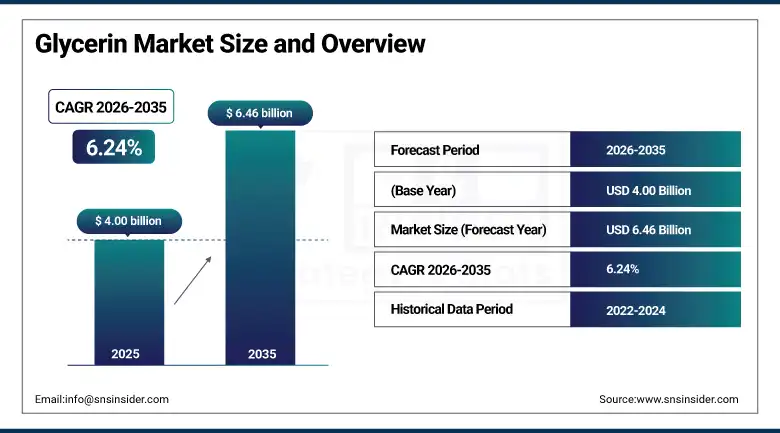
The Glycerin Market was valued at USD 4.00 Billion in 2025 and is expected to reach USD 6.46 Billion by 2035, growing at a CAGR of 6.24% from 2026 to 2035.
Glycerin or glycerol is a basic polyol material that occupies a distinctive place within the scope of commerce due to its role as a significant by-product from industrial fatty acid and oil processing as well as an important active component utilized in numerous industrial applications and consumer goods. Chemically speaking, glycerol is a trihydroxy alcohol possessing humectant and hygroscopic characteristics that become crucial in such fields as cosmetics, medicine, food manufacturing, and specialty chemicals production.
The entire glycerol supply chain is integrated into the biodiesel market in connection with the production process through which 10 kg of crude glycerol emerge for every 100 kg of biodiesel manufactured; therefore, an increase in biodiesel production results in additional volumes of crude glycerol on the market, with subsequent transformation into pharmaceutical, food industry, and cosmetic forms providing higher value within the commercial context.
KLK OLEO expanded its pharmaceutical-grade glycerol production capacity at its Emmerich, Germany facility in 2025, adding dedicated high-purity refining lines certified under EU GMP standards to serve the growing European pharmaceutical manufacturing market whose parenteral drug formulation requirements demand glycerol of consistent pharmaceutical compendial quality.
Market Size and Forecast
-
Market Size in 2026E: USD 4.25 Billion
-
Market Size by 2035: USD 6.46 Billion
-
CAGR: 6.24% from 2026 to 2035
-
Fastest Growing Region: North America
-
Largest Region: Asia Pacific
To Get more information On Glycerin Market - Request Free Sample Report
Glycerin Market Trends
-
Growing demand for natural and bio-based glycerin is driving sustainable vegetable oil-derived glycerin production.
-
Rising pharmaceutical manufacturing is increasing consumption of USP-grade glycerin in medicines and healthcare products.
-
Expansion of bio-based polymers, coatings, and polyols is creating new industrial applications for glycerin.
-
Biodiesel production growth is ensuring a steady glycerin supply and supporting competitive pricing.
-
Increasing use of glycerin in vaping and aerosol formulations is contributing to market demand growth.
The U.S. Glycerin Market Outlook
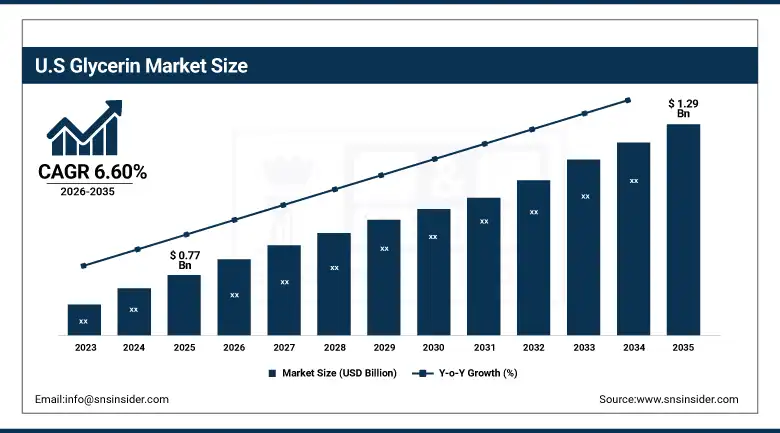
The U.S. Glycerin Market was valued at USD 0.77 Billion in 2025 and is expected to reach USD 1.29 Billion by 2035, growing at a CAGR of 6.60% from 2026 to 2035.
One of the largest glycerin consumers worldwide is the United States, where glycerin usage is dispersed between its mature personal care and pharmaceutical market, food processing market, and its growing biodiesel production capacity, which yields substantial domestically available crude glycerin output. More than 62% of the glycerin used in the U.S. originates from natural resources, as a result of consumer and regulator preferences regarding the source of ingredients utilized in personal care and food products. Use of glycerol in U.S. pharmaceutical manufacturing of injectables, oral medicines, and topicals represents a sizable demand for a premium quality product that can be met by domestic pharmaceutical grade glycerin production along with pharmaceutical grade imports from Europe and Asia.
Cargill, Incorporated expanded its glycerin refining capacity at its Iowa City operations in 2025, adding high-purity pharmaceutical and food-grade glycerol production capability to serve the growing domestic demand from pharmaceutical manufacturers and food processors whose supply chain resilience priorities following pandemic-related raw material disruptions had motivated investment in domestic high-grade glycerol procurement.
Glycerin Market Segment Analysis
-
By Source, the vegetable oils segment dominated the glycerin market in 2025, while the biodiesel by-product segment provides growing supply with increasing biofuel production mandates globally.
-
By Grade, the pharmaceutical grade/USP segment is growing fastest, while technical grade serves the largest volume applications.
-
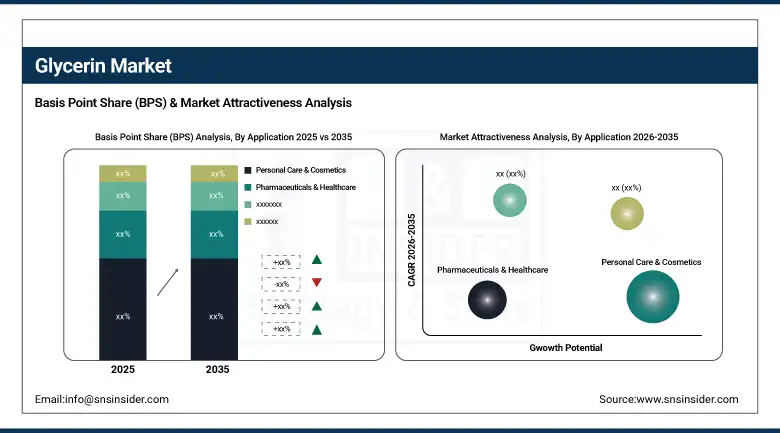
By Application, the personal care & cosmetics segment dominated the glycerin market in 2025, while the pharmaceuticals & healthcare segment is the fastest growing application during 2026 to 2035.
-
By End Use Industry, the personal care industry dominated the glycerin market with the largest share in 2025, while the pharmaceutical industry is the fastest growing end use sector during 2026 to 2035.
By Application, personal care & cosmetics dominate, pharmaceuticals grow fastest
Personal care and cosmetics accounted for the dominant application revenue share in 2025, a position reflecting glycerine’s adoption as the world's most widely used humectant ingredient across the full spectrum of skin care, hair care, and personal hygiene product formulations. Glycerin was present in approximately 75% of global moisturisers and cleansers sold in 2024, a penetration rate that confirms its near-universal status as the default moisture-binding ingredient across both mass and prestige personal care product categories globally.
Pharmaceuticals and healthcare are growing fastest, driven by the global expansion of pharmaceutical manufacturing capacity across generic drug production in India and China and biopharmaceutical production in developed markets, each of which generates growing glycerol consumption in parenteral formulations, oral liquid medications, suppository bases, cough and cold preparations, and topical pharmaceutical products whose pharmacopoeial grade specifications create a premium demand segment.
By Grade, pharmaceutical grade is growing fastest
The pharmaceutical grade USP glycerin segment is the highest-value and fastest-growing grade category, reflecting the premium pricing commanded by glycerol purified to United States Pharmacopoeia, European Pharmacopoeia, or Japanese Pharmacopoeia specifications that certify its suitability for direct patient contact in injectable, oral, and topical pharmaceutical applications. Each pharmaceutical manufacturing facility that enters GMP production globally creates sustained long-term pharmaceutical-grade glycerol procurement demand whose growth is structurally linked to global pharmaceutical industry capacity expansion.
The technical grade segment serves the largest volume application base across alkyd resin synthesis, explosives manufacturing, polyurethane production, antifreeze formulation, and other industrial process applications where pharmaceutical purity standards are not required. Industrial and technical grade glycerin demand benefits from its role as a bio-based chemical intermediate whose adoption in industrial chemistry applications supports the broader trend toward renewable feedstock substitution of petroleum-derived raw materials.
Regional Analysis
|
Region |
Major Country |
Share within Region, 2025 (%) |
|---|---|---|
|
North America |
United States |
82.47% |
|
Europe |
Germany |
28.47% |
|
Asia Pacific |
China |
38.47% |
|
Middle East & Africa |
Malaysia |
24.73% |
|
Latin America |
Brazil |
43.84% |
North America Glycerin Market Insights
The North American region holds the position of the fastest-growing glycerin market region-wise, growing at a CAGR of around 6.94% until 2035 due to an increasing demand for glycerin as per the standards for USP and food grade from the rising pharmaceutical manufacturing sector, the personal care sector's choice for renewable and native sources of glycerin, and the biodiesel blending requirement by virtue of the Renewable Fuel Standard that ensures domestic supply of crude glycerin from soybean biodiesel production. The United States constitutes around 82.47% of the total regional revenue due to the presence of several industries such as pharmaceutical, personal care, and food processing that utilize glycerol.
Europe Glycerin Market Insights
Europe accounted for around 21.00% of the world market revenues of glycerin market in 2025. Germany, France, the Netherlands, and Belgium are the prominent countries, which have prominent pharma, cosmetic, and specialty chemicals manufacturing industries, and their glycerol requirement extends from pharmaceutical grade to industrial grade usage. The Renewable Energy Directive of the European Union, which compels the blending of biodiesel with the fuel, ensures the continuous supply of crude glycerin from the biodiesel manufacturing processes utilizing rapeseed and palm oils in Europe.
Asia Pacific Glycerin Market Insights
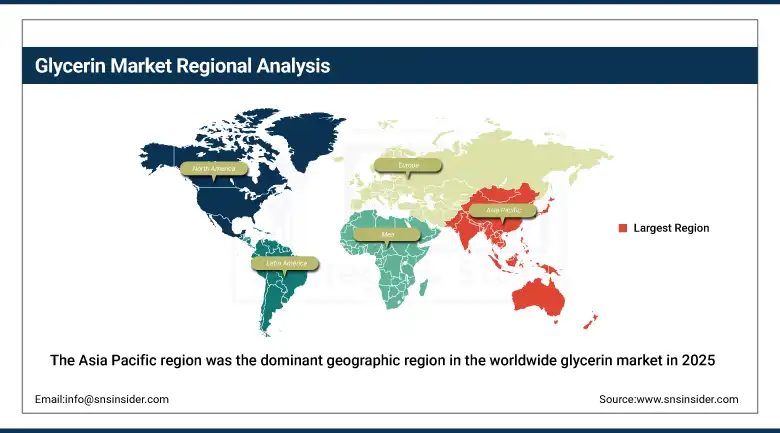
The Asia Pacific region was the dominant geographic region in the worldwide glycerin market in 2025, accounting for around 42.00% of the global revenue share due to the dominance of the Asia Pacific region in vegetable oil processing and biodiesel production, which leads to the production of crude glycerin required for refined glycerin manufacturing. China is responsible for nearly 38.47% of the Asia Pacific region's revenues, as it is the largest user of glycerin globally in all major applications including pharmaceuticals, personal care products, food processing, and chemicals industry along with a huge domestic production of glycerin from palm and soybean biodiesel production.
Get Customized Report as per Your Business Requirement - Enquiry Now
MEA & Latin America Glycerin Market Insights
MEA and Latin America are emerging markets for Glycerin as increased production of palm oil, pharmaceutical and personal care products, and biodiesel manufacture in both regions are causing growth in both supply and demand. Malaysia is the leading market within the MEA region accounting for roughly 24.73% of the total revenue generated in this region as it is the second largest producer of palm oil in the world with an oleochemical refining industry that processes crude glycerin for local usage and export to international markets as a raw material in food, personal care, and pharmaceutical industries. Brazil is the leading market in Latin America accounting for around 43.84% of the total revenue earned by the Latin American market due to its extensive biodiesel, personal care, and pharmaceutical industries consuming a lot of glycerol.
Market Dynamics
Growth Drivers: Expanding biodiesel production and increasing demand for pharmaceutical- and cosmetic-grade glycerin market are driving growth.
Glycerine’s linkage within the structure of biodiesel production creates increasing supply of glycerin from biodiesel production through the progressive imposition of biofuels mandates around the world, including Europe, the US, and Asia Pacific. This increased glycerin is refined into higher purity levels for use in pharmaceuticals, food additives, and cosmetics segments where glycerol achieves its highest value. Glycerol’s symbiotic relationship with biodiesel economics means that increased margins for glycerol refinery and higher-value glycerol grade development help improve the economic viability of biodiesel production, which is partially dependent on feedstock price parity with Petro-diesel fuel.
Restraints: Oversupply of crude glycerin and feedstock price fluctuations create pricing pressure and impact refining profitability.
This structural dependence between glycerin supply and biodiesel production makes crude glycerin oversupply inevitable during periods of rapid adoption of mandatory biodiesel targets, wherein new biodiesel production leads to increased output of crude glycerin which may exceed the rate at which refining facilities for crude glycerin are developed. The oversupply situation causes crude glycerin prices to fall to levels that are unprofitable for independent glycerin refiners who are not part of an integrated oleochemical facility. The prices of glycerin are affected by vegetable oil price changes, with commodity cycles in vegetable oil making it difficult for refining margins to remain attractive amid high crude costs relative to pure glycerin prices.
Opportunities: Growth in bio-based polyol applications and expansion of pharmaceutical-grade glycerin production in emerging markets offer significant opportunities.
The process of looking for bio-derived substitutes to petroleum-based chemical intermediates in the chemical industry has led to identifying glycerine as a platform chemical capable of being converted into several high value-added intermediates such as epichlorohydrin used in producing epoxy resin, propylene glycol used as an industrial and pharmaceutical diol, 1,3-propanediol useful for making polymers and cosmetics, and acrolein which can be used to make acrylic acid and acrylates. Every time glycerine is successfully used in chemical industries as a feedstock, demand will increase hence increasing its market prices. Pharmaceuticals' market in developing countries in pharmaceutical production such as India, China, Brazil, and South Korea offers a highly valued market due to the growth of the pharmaceuticals industry itself.
Recent Developments:
-
2025: KLK OLEO expanded pharmaceutical-grade glycerol production at its Emmerich, Germany facility with EU GMP-certified high-purity refining lines, addressing growing European pharmaceutical manufacturing demand for consistent pharmacopoeial quality glycerol in injectable and oral liquid drug formulations.
-
2025: Cargill expanded glycerin refining capacity at its Iowa City operations with new pharmaceutical and food-grade production lines, supporting domestic U.S. supply chain resilience for pharmaceutical manufacturers and food processors whose pandemic-driven sourcing diversification programmes prioritise domestic high-grade glycerol procurement.
Glycerin Market Key Players are:
-
Wilmar International Ltd.
-
KLK OLEO (Kuala Lumpur Kepong Berhad)
-
Cargill Incorporated
-
BASF SE
-
Procter & Gamble Chemicals
-
Archer Daniels Midland Company
-
Emery Oleochemicals Group
-
IOI Corporation Berhad
-
Godrej Industries Ltd.
-
Kao Corporation
-
Vantage Specialty Chemicals Inc.
-
Croda International PLC
-
Oleon NV (Avril Group)
-
Global Green Chemicals PCL
-
Glycotech Inc.
-
Granol Industria Comercio e Exportacao SA
-
Musim Mas Holdings Pte. Ltd.
-
PT Ecogreen Oleochemicals
-
INEOS Oxide Ltd.
-
Twin Rivers Technologies Inc.
Glycerin Market Report Scope:
| Report Attributes | Details |
|---|---|
| Market Size in 2025 | USD 4.00 Billion |
| Market Size by 2035 | USD 6.46 Billion |
| CAGR | CAGR of 6.24% From 2026 to 2035 |
| Base Year | 2025 |
| Forecast Period | 2026-2035 |
| Historical Data | 2022-2024 |
| Report Scope & Coverage | Market Size, Segments Analysis, Competitive Landscape, Regional Analysis, DROC & SWOT Analysis, Forecast Outlook |
| Key Segments | • By Source (Vegetable Oils, Biodiesel By-Product, Animal Fats, Synthetic) • By Grade (Pharmaceutical Grade/USP, Food Grade, Technical Grade, Industrial Grade) • By Application (Personal Care & Cosmetics, Pharmaceuticals & Healthcare, Food & Beverages, Alkyd Resins & Paints, Tobacco, Polyether Polyols, Automotive, Others) • By End Use Industry (Personal Care, Pharmaceutical, Food Processing, Chemical, Others) |
| Regional Analysis/Coverage | North America (US, Canada), Europe (Germany, UK, France, Italy, Spain, Russia, Poland, Rest of Europe), Asia Pacific (China, India, Japan, South Korea, Australia, ASEAN Countries, Rest of Asia Pacific), Middle East & Africa (UAE, Saudi Arabia, Qatar, South Africa, Rest of Middle East & Africa), Latin America (Brazil, Argentina, Mexico, Colombia, Rest of Latin America). |
| Company Profiles | Wilmar International Ltd., KLK OLEO (Kuala Lumpur Kepong Berhad), Cargill Incorporated, BASF SE, Procter & Gamble Chemicals, Archer Daniels Midland Company, Emery Oleochemicals Group, IOI Corporation Berhad, Godrej Industries Ltd., Kao Corporation, Vantage Specialty Chemicals Inc., Croda International PLC, Oleon NV (Avril Group), Global Green Chemicals PCL, Glycotech Inc., Granol Industria Comercio e Exportacao SA, Musim Mas Holdings Pte. Ltd., PT Ecogreen Oleochemicals, INEOS Oxide Ltd., and Twin Rivers Technologies Inc. |

Frequently Asked Questions
The Glycerin Market was valued at USD 4.00 Billion in 2025.
The primary growth factors are global biodiesel production mandate expansion ensuring structural crude glycerin supply growth, rising pharmaceutical-grade glycerol demand from expanding global generic and biopharmaceutical manufacturing capacity, natural and bio-based humectant preference in personal care formulation, and food and beverage application expansion including low-calorie and sugar-free product development driving glycerol demand.
The Glycerin Market is expected to grow at a CAGR of 6.24% from 2026 to 2035.
The personal care & cosmetics segment dominated the Glycerin Market with the largest share in 2025.
Asia Pacific dominated the Glycerin Market in 2025, holding approximately 42.00% of global revenues, with China accounting for approximately 38.47% of Asia Pacific revenues as both the world's largest glycerin consumer and a major glycerin producing economy.
