
Goat Milk Products Market Report Scope & Overview:
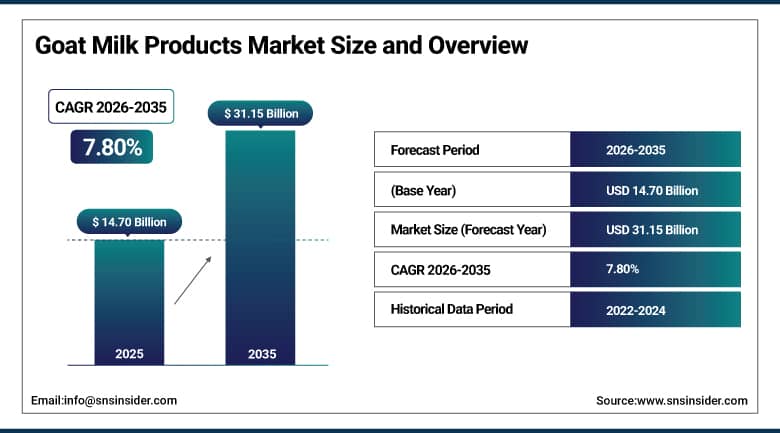
The global Goat Milk Products Market was valued at USD 14.70 Billion in 2025 and is expected to reach USD 31.15 Billion by 2035, growing at a CAGR of 7.80% from 2026 to 2035.
The growth of the Goat Milk Products Market is driven by rising consumer awareness of the nutritional benefits of goat milk, including its digestibility and protein, calcium, and vitamin content. Increasing lactose sensitivity and demand for dairy alternatives are encouraging consumers to explore goat milk products. Growing interest in clean-label, natural, and minimally processed foods is further supporting demand. Product diversification across liquid milk, cheese, yogurt, milk powder, butter, ghee, and infant nutrition is expanding consumption opportunities. Rising disposable incomes and premiumization are encouraging purchases of specialty dairy products. In addition, expanding supermarkets, specialty stores, foodservice outlets, and e-commerce platforms is improving product accessibility. Growing applications in infant nutrition and functional foods are further strengthening market expansion worldwide.
The U.S. Food and Drug Administration issued "no questions" letters in February 2025 for three goat milk GRAS notices, removing the final regulatory hurdle for commercialization and enabling Ausnutria's Kabrita to become the first goat milk infant formula to complete the FDA's pre-market review, reflecting a pivotal regulatory milestone opening the American market to specialized goat milk infant nutrition products that were previously unable to secure formal U.S. market clearance.
To Get More Information On Goat Milk Products Market - Request Free Sample Report
Goat Milk Products Market Trends
-
Growing advances in processing and packaging technology continue increasing shelf life and convenience, making goat milk products more widely available.
-
Rising use of goat milk in cosmetics and pharmaceutical applications continues propelling market expansion beyond traditional dairy consumption.
-
Expanding e-commerce distribution, with a 40% digital growth rate in goat milk product sales between 2020 and 2025, is reshaping purchasing patterns.
-
Increasing regulatory progress and clean-label trends continue driving growth more than demographic changes across major North American and European markets.
-
Growing strategic investment in premium bioactive goat milk ingredients, including lactoferrin and colostrum powder, is diversifying beyond conventional milk powder.
U.S. Goat Milk Products Market Outlook
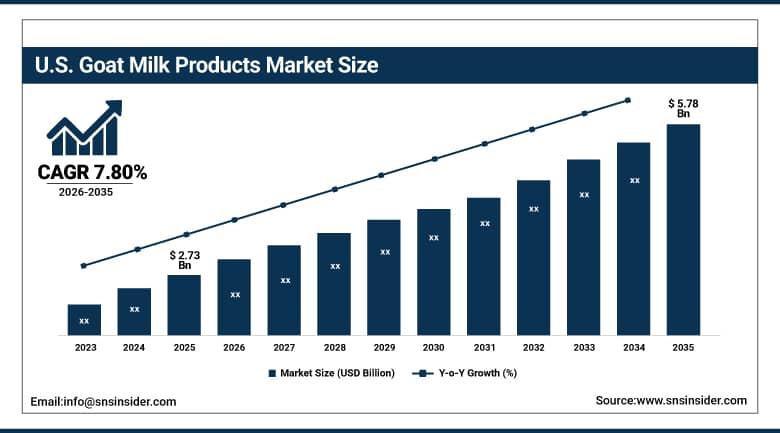
The U.S. Goat Milk Products Market was valued at USD 2.73 Billion in 2025 and is projected to reach USD 5.78 Billion by 2035, growing at a CAGR of 7.80% during 2026-2035.
Health consciousness continues driving demand for goat milk products, particularly across North America, with culinary innovation and artisanal appeal enhancing the popularity of fermented goat milk products remaining the largest segment. Leading brands continue to expand goat milk infant formula and specialty dairy portfolios addressing rising consumer allergen-friendly and organic dairy alternative demand. Growing regulatory clearance for goat milk infant formula continues to reinforce sustained domestic market development nationwide.
Ausnutria's Kabrita demonstrated its first-mover advantage and effective e-commerce execution in the first half of 2025 by capturing a significant share of China's goat milk formula market, including the imported segment, reflecting the strategic importance of robust online sales channels in driving market penetration for goat milk infant formula brands across increasingly competitive global markets.
Goat Milk Products Market Segment Analysis
-
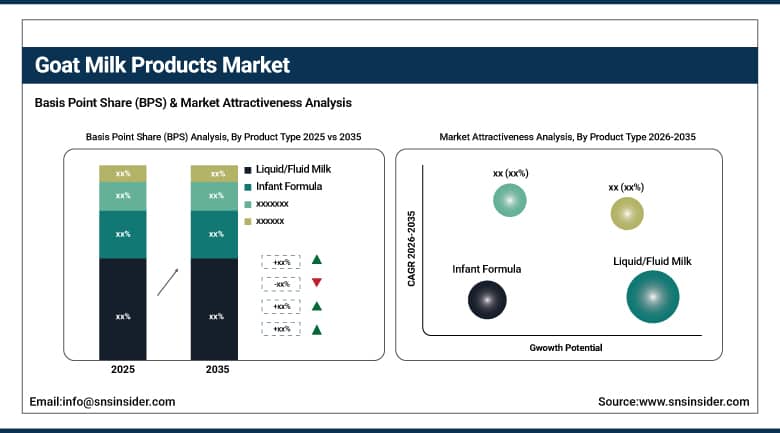
By Product Type, Liquid/Fluid Milk segment dominated the Goat Milk Products Market in 2025 with approximately 38% share; Infant Formula segment is the fastest growing segment.
-
By Distribution Channel, Off-Trade segment dominated the Goat Milk Products Market in 2025 with approximately 72% share; On-Trade segment is the fastest growing segment.
-
By End User, Adults segment dominated the Goat Milk Products Market in 2025 with approximately 48% share; Infants segment is the fastest growing segment.
-
By Packaging, Glass Bottles segment dominated the Goat Milk Products Market in 2025 with approximately 35% share; Tetra Paks/Cartons segment is the fastest growing segment.
By Product Type, Liquid/Fluid Milk Dominates the Goat Milk Products Market While Infant Formula Emerges as the Fastest-Growing Segment
Liquid/Fluid Milk dominated the Goat Milk Products Market with approximately 38% share in 2025, primarily because it is the most established and widely consumed goat milk product. Consumers commonly use it as a direct beverage and as an ingredient in household food preparation. Its nutritional profile, digestibility, and growing preference for minimally processed dairy alternatives support demand. Broad availability through grocery stores, supermarkets, specialty dairy outlets, and local producers further improves accessibility, reinforcing liquid goat milk's leading market position.
Infant Formula is expected to be the fastest-growing product type segment in the Goat Milk Products Market, supported by increasing parental interest in specialized and alternative infant nutrition products. Goat milk-based formulas are often perceived as easier to digest and nutritionally suitable for certain infants, encouraging consideration among parents and caregivers. Expanding availability of premium infant nutrition products, greater awareness of goat milk-based formulations, and product innovation are supporting adoption. Increasing distribution through pharmacies, specialty retailers, and e-commerce is further contributing to segment growth.
By Distribution Channel, Off-Trade Dominates the Goat Milk Products Market While On-Trade Registers the Fastest Growth
Off-Trade dominated the Goat Milk Products Market with approximately 72% share in 2025, reflecting the strong prevalence of household purchases through supermarkets, grocery stores, specialty retailers, pharmacies, and online platforms. Consumers generally purchase goat milk products for home consumption, including beverages, cooking, and nutritional purposes. Wider shelf availability, convenient packaged formats, promotional pricing, and the growing presence of goat milk products in mainstream retail outlets further support off-trade sales. Increasing e-commerce penetration is also expanding consumer access to packaged goat milk products.
On-Trade is projected to be the fastest-growing distribution channel segment in the Goat Milk Products Market, driven by increasing incorporation of goat milk products into cafés, restaurants, hotels, bakeries, and specialty foodservice establishments. Growing consumer interest in premium, alternative, and specialty dairy products is encouraging foodservice operators to introduce goat milk beverages, desserts, cheeses, and other menu items. Expansion of specialty cafés and health-focused foodservice concepts, together with rising experimentation with goat milk-based recipes, is expected to increase commercial demand through on-trade channels.
By End User, Adults Dominate the Goat Milk Products Market While Infants Witness the Fastest Growth
Adults dominated the Goat Milk Products Market with approximately 48% share in 2025, supported by broad consumption of goat milk and related products as part of everyday diets. Adults increasingly seek nutrient-rich foods and alternative dairy options, while goat milk is valued for its protein, calcium, and other essential nutrients. Its use in beverages, yogurt, cheese, and other food products further expands consumption opportunities. Growing interest in digestive comfort and naturally sourced foods also contributes to sustained demand among adult consumers.
Infants are expected to be the fastest-growing end-user segment in the Goat Milk Products Market, primarily due to increasing interest in goat milk-based infant nutrition and specialized formula products. Parents and caregivers are increasingly exploring alternative formula options that are perceived as gentle and nutritionally appropriate for infants. Rising awareness of premium infant nutrition, expanding product availability, and continued formulation improvements are supporting demand. Growth in specialized retail and e-commerce channels is also making goat milk-based infant products more accessible to consumers across various markets.
By Packaging, Glass Bottles Dominate the Goat Milk Products Market While Tetra Paks/Cartons Experience the Fastest Growth
Glass Bottles dominated the Goat Milk Products Market with approximately 35% share in 2025, supported by their established use for fresh and premium dairy products. Glass provides a strong barrier against external contaminants and does not readily absorb odors or flavors, helping preserve product quality. Its transparent appearance can also reinforce perceptions of freshness and premium positioning. Additionally, reusable and recyclable characteristics appeal to environmentally conscious consumers. Local dairies, specialty producers, and premium goat milk brands continue to favor glass bottles for packaged products.
Tetra Paks/Cartons are projected to be the fastest-growing packaging segment in the Goat Milk Products Market, driven by their lightweight, convenient, and storage-efficient characteristics. Carton packaging can provide extended shelf stability for appropriately processed milk while reducing transportation weight and improving handling efficiency. Its stackable design and suitability for modern retail distribution further support adoption. Growing consumer demand for convenient packaged dairy products, combined with increased availability of shelf-stable and premium goat milk offerings, is encouraging manufacturers to expand carton-based packaging formats.
Regional Insights
|
Region |
Country |
Share (2025) |
|---|---|---|
|
Asia Pacific |
China |
34.60% |
|
North America |
United States |
84.60% |
|
Europe |
Netherlands |
24.80% |
|
Middle East & Africa |
Saudi Arabia |
22.60% |
|
Latin America |
Brazil |
24.60% |
Asia Pacific Goat Milk Products Market Insights
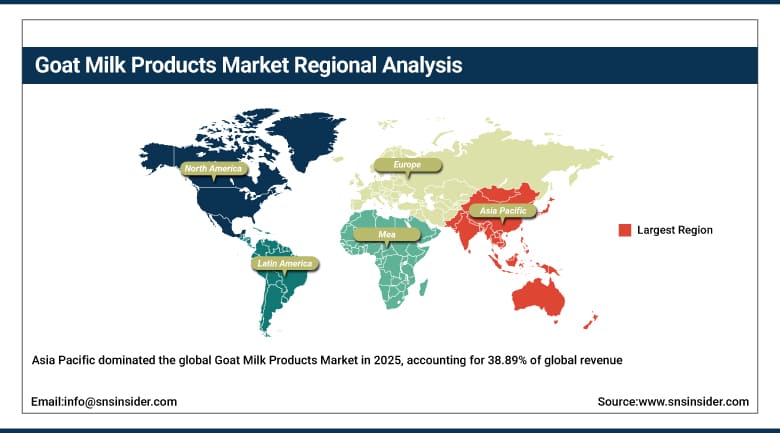
Asia Pacific dominated the global Goat Milk Products Market in 2025, accounting for 38.89% of global revenue, driven by rising demand for infant nutrition and increasing awareness of goat milk’s digestive and nutritional benefits. Growing consumer interest in easily digestible and nutrient-rich dairy products is supporting regional consumption. Expanding domestic production of goat milk-based infant formula is strengthening supply capabilities, while investments in processing infrastructure are improving product availability. Rapid growth in e-commerce and modern retail channels is further increasing consumer access to goat milk products. These factors continue to reinforce Asia Pacific’s leadership across the broader goat milk products landscape.
China accounted for approximately 34.60% of the Asia Pacific market in 2025, supported by its rapidly expanding goat milk infant formula market and growing consumer awareness of digestive health benefits. Japan, India, and South Korea are also contributing meaningfully to regional growth, with rising demand for premium, allergen-friendly dairy alternatives across the region's expanding health-conscious consumer base.
Get Customized Report as Per Your Business Requirement - Enquiry Now
North America Goat Milk Products Market Insights
North America held a significant share of the global Goat Milk Products Market in 2025, driven by rising health consciousness and increasing consumer interest in nutrient-rich dairy alternatives, particularly in the United States. Growing awareness of goat milk’s digestibility and nutritional benefits is supporting broader adoption. Culinary innovation and the growing appeal of artisanal foods are further strengthening demand for goat cheese, yogurt, and other specialty products. Fermented goat milk products are gaining popularity among health-focused consumers seeking functional and premium dairy options. Expanding specialty retailers, supermarkets, and e-commerce platforms are also improving product accessibility, reinforcing sustained regional demand across the specialty dairy and gourmet food segments.
The United States accounted for approximately 84.60% of the North American market in 2025, reflecting its large health-conscious consumer base and recent goat milk infant formula regulatory clearances. Canada is contributing to regional growth through steady specialty dairy adoption and growing consumer interest in allergen-friendly, easily digestible dairy alternatives.
Europe Goat Milk Products Market Insights
Europe held a meaningful share of the global Goat Milk Products Market in 2025, supported by well-established goat dairy industries across Germany, France, and the Netherlands. These countries have developed strong production and processing capabilities, supplying quality raw goat milk to regional dairy manufacturers. Growing consumer preference for organic, natural, and sustainably produced foods is further supporting demand. The increasing adoption of organic and Demeter-certified biodynamic farming practices is strengthening the availability of premium, traceable goat milk products. Expanding specialty dairy markets, rising interest in artisanal products, and growing consumer awareness of goat milk’s nutritional benefits are expected to sustain regional demand throughout the forecast period.
The Netherlands led the European market with a 24.80% regional share in 2025, supported by its position as a major global hub for goat milk infant formula production and dairy ingredient manufacturing. Germany, France, and the United Kingdom are also contributing meaningfully to regional growth, supported by well-established goat dairy industries and growing specialty cheese consumption.
Middle East & Africa and Latin America Goat Milk Products Market Insights
The Middle East & Africa region is set to post the fastest CAGR between 2026 and 2035, driven by growing dietary awareness and expanding modern retail infrastructure investment across the Gulf states. Latin America is similarly benefiting from expanding specialty dairy consumption and growing consumer interest in easily digestible dairy alternatives across major regional economies.
Saudi Arabia led the Middle East & Africa market with a 22.60% regional share in 2025, supported by growing dietary awareness and expanding modern retail penetration. Brazil represented 24.60% of the Latin American market in 2025, driven by expanding specialty dairy consumption, with Mexico also contributing to regional growth through rising interest in allergen-friendly dairy alternatives.
Growth Drivers: Digestive Health Benefits and Infant Formula Regulatory Progress Driving Market Growth
The Goat Milk Products Market is being driven primarily by the incidence of lactose intolerance, digestion problems, and allergies associated with conventional dairy products rising rapidly, alongside the increased popularity of goat milk-based infant formula and nutritional supplements. Advances in processing and packaging technology continue increasing the shelf life and convenience of goat milk products, making them more widely available to customers, while rising use of goat milk in cosmetics and pharmaceuticals continues propelling market expansion.
Growing advances in processing and packaging technology continue increasing shelf life and convenience. Rising use of goat milk in cosmetics and pharmaceutical applications continues propelling market expansion beyond traditional dairy consumption. Expanding e-commerce distribution, with a 40% digital growth rate in goat milk product sales, is further reshaping purchasing patterns and reinforcing sustained category momentum.
Restraints: Higher Production Costs and Limited Supply Chain Scale Limiting Market Expansion
Despite favorable underlying demand, the market faces meaningful restraints related to higher production costs relative to conventional cow milk, given goats' comparatively lower milk yield per animal requiring larger herds and more intensive management to achieve equivalent production volumes. Limited supply chain scale, particularly for specialty and organic goat milk products, continues to constrain broader mainstream retail accessibility relative to established cow milk supply chains.
Complex regulatory pathways for goat milk infant formula, requiring extensive safety and nutritional testing before market clearance, continue to extend product development timelines for manufacturers seeking to enter this high-growth segment. Growing competitive intensity among an expanding roster of specialty dairy manufacturers also continues to compress margins across mainstream goat milk product categories, particularly amid rising feed cost pressures affecting production units.
Opportunities: Bioactive Ingredient Innovation and Infant Nutrition Expansion Creating New Growth Avenues
Substantial opportunity exists in continued development of premium bioactive goat milk ingredients, including lactoferrin, casein hydrolysate, and colostrum powder, capable of commanding premium positioning in clinical and infant nutrition markets. Companies that successfully commercialize differentiated, high-value bioactive ingredients stand to capture significant share of category growth as manufacturers diversify beyond conventional milk powder and whey protein concentrate.
Growing infant formula regulatory clearance across major markets presents a further significant growth avenue, as recent FDA approvals and similar international regulatory progress continue opening previously inaccessible markets to goat milk-based infant nutrition. Expanding sports nutrition and pet food channel applications across emerging markets in Asia Pacific also represent meaningful untapped opportunity for goat milk ingredient manufacturers.
Recent Developments:
-
2025: Ausnutria Dairy Corporation expanded its premium goat milk ingredients portfolio, launching goat milk casein hydrolysate, whey protein hydrolysate, lactoferrin, and colostrum powder.
-
2025: Dairy Goat Co-operative launched a NZD 40 million capital raise to fund expanded infant formula production capacity and grow ingredient sales to Korea and China.
-
2024: Ausnutria Dairy Ingredients BV partnered with NXT Group to establish its presence in the Indian market through a Multi-Market Distribution platform.
-
2024: Ausnutria Dairy completed a major expansion of its goat milk powder plant in the Netherlands, increasing processing capacity by 38%.
Goat Milk Products Companies are:
-
Ausnutria Dairy Corporation Ltd.
-
Emmi Group
-
Saputo Inc.
-
Dairy Goat Co-operative NZ Ltd.
-
Holle Baby Food AG
-
St Helen’s Farm Ltd.
-
Woolwich Dairy Inc.
-
Xi'an Baiyue Goat Dairy Group Co., Ltd.
-
Meyenberg Goat Milk Products
-
Redwood Hill Farm & Creamery
-
Hay Dairies Pte Ltd.
-
Good Goat Milk Company
-
Delamere Dairy Ltd.
-
Hewitt’s Dairy Ltd.
-
HiPP GmbH & Co. Vertrieb KG
-
AVH Dairy Trade B.V.
-
Granarolo S.p.A.
-
Amalthea Group
Goat Milk Products Market Report Scope:
| Report Attributes | Details |
|---|---|
| Market Size in 2025 | USD 14.70 Billion |
| Market Size by 2035 | USD 31.15 Billion |
| CAGR | CAGR of 7.80% From 2026 to 2035 |
| Base Year | 2025 |
| Forecast Period | 2026-2035 |
| Historical Data | 2022-2024 |
| Report Scope & Coverage | Market Size, Segments Analysis, Competitive Landscape, Regional Analysis, DROC & SWOT Analysis, Forecast Outlook |
| Key Segments | • By Product Type (Liquid/Fluid Milk, Cheese, Milk Powder, Yogurt, Butter & Ghee, Infant Formula, Others) • By Distribution Channel (Off-Trade, On-Trade) • By End User (Adults, Teenagers, Elderly, Infants) • By Packaging (Glass Bottles, Tetra Paks/Cartons, Stand-Up Pouches, Tins/Cans, Others) |
| Regional Analysis/Coverage | North America (US, Canada), Europe (Germany, UK, France, Italy, Spain, Russia, Poland, Rest of Europe), Asia Pacific (China, India, Japan, South Korea, Australia, ASEAN Countries, Rest of Asia Pacific), Middle East & Africa (UAE, Saudi Arabia, Qatar, South Africa, Rest of Middle East & Africa), Latin America (Brazil, Argentina, Mexico, Colombia, Rest of Latin America). |
| Company Profiles | Ausnutria Dairy Corporation Ltd., Emmi Group, Saputo Inc., Dairy Goat Co-operative NZ Ltd., Goat Partners International Inc., Holle Baby Food AG, St Helen’s Farm Ltd., Woolwich Dairy Inc., Xi'an Baiyue Goat Dairy Group Co., Ltd., Meyenberg Goat Milk Products, Redwood Hill Farm & Creamery, Hay Dairies Pte Ltd., Good Goat Milk Company, Stickney Hill Dairy Inc., Delamere Dairy Ltd., Hewitt’s Dairy Ltd., HiPP GmbH & Co. Vertrieb KG, AVH Dairy Trade B.V., Granarolo S.p.A., Amalthea Group. |

Frequently Asked Questions
The Goat Milk Products Market is expected to grow at a CAGR of 7.80% from 2026 to 2035.
The Goat Milk Products Market was valued at USD 14.70 Billion in 2025.
The market is driven by rising incidence of lactose intolerance and cow-milk allergies, alongside the increased popularity of goat milk-based infant formula and nutritional supplements.
The Liquid/Fluid Milk segment dominated the Goat Milk Products Market in 2025, accounting for approximately 54.20% market share.
The Asia Pacific region dominated the Goat Milk Products Market in 2025, accounting for approximately 38.89% market share.
