
Heart Rate Monitor Market Report Scope & Overview:
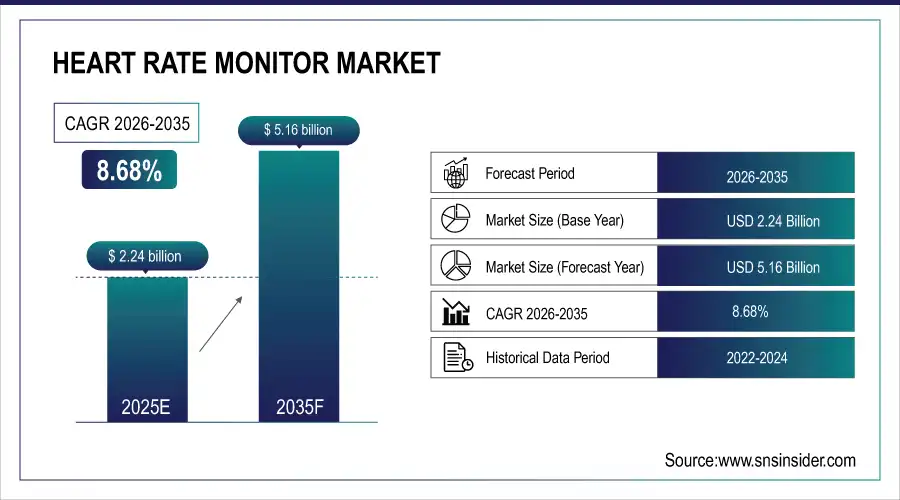
Heart rate monitor market was valued at USD 2.24 billion in 2025 and is expected to reach USD 5.16 billion by 2035, growing at a CAGR 8.68% of from 2026-2035.
The heart rate monitor market is experiencing steady growth driven by rising health awareness, increasing fitness participation, and a growing prevalence of cardiovascular diseases. Expanding adoption of telehealth and remote patient monitoring has further increased demand. Technological advancements such as improved sensors, artificial intelligence, and data analytics are enhancing accuracy and user experience.
Heart rate monitor adoption expanded globally in 2025, driven by over 1.1 billion wearables, rising remote patient monitoring, and growing clinical usage.
Heart rate monitor Market Size and Forecast
-
Market Size in 2025: USD 2.24 Billion
-
Market Size by 2035: USD 5.16 Billion
-
CAGR: 8.68%
-
Base Year: 2025
-
Forecast Period: 2026-2035
-
Historical Data: 2022-2024
To Get more information On Heart Rate Monitor Market - Request Free Sample Report
Trends in the Heart Rate Monitor Market
-
Rapid adoption of smart wearables with continuous, real-time heart rate tracking
-
Growing integration of AI and advanced analytics for early detection of cardiac abnormalities
-
Rising demand for remote patient monitoring and home-based cardiac care solutions
-
Increasing use of optical (PPG) and hybrid sensing technologies for improved accuracy
-
Expansion of wireless connectivity and smartphone-integrated health ecosystems
-
Shift toward compact, patch-based, and non-invasive monitoring devices
U.S. Heart Rate Monitor Market Insights:
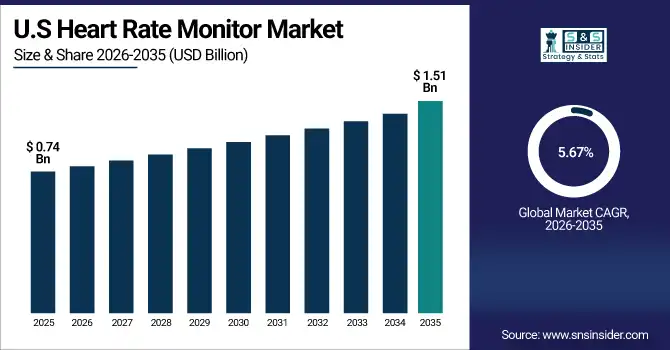
The U.S. Heart Rate Monitor Market is projected to grow from USD 0.74 Billion in 2025E to USD 1.51 Billion by 2035, at a CAGR of 5.67%. Growth will be driven by rising cardiovascular disease prevalence, increasing fitness awareness, expanding telehealth and remote monitoring adoption, aging population, and advances in AI-enabled, connected heart rate monitoring technologies.
Heart rate monitor Market Growth Drivers:
-
Rising Cardiovascular Burden and Aging Population
The growing prevalence of cardiovascular and lifestyle-related diseases, coupled with a rapidly aging global population, is a key driver of the heart rate monitor market. Cardiovascular diseases account for over 30% of global deaths, while adults aged 60 and above represent nearly 70% of cardiac-related hospitalizations. This demographic shift is increasing demand for continuous heart rate monitoring in hospitals, remote patient monitoring programs, and home healthcare environments.
Heart rate monitor Market Restraints:
-
Accuracy, Cost, and Reimbursement Challenges
Despite strong market growth, accuracy limitations in optical heart rate sensors remain a key restraint, with studies indicating 9% error rates during high intensity activities, compared to up to 99% accuracy achieved by ECG based chest strap monitors, highlighting the performance gap between optical and electrical sensing technologies.
Heart rate monitor Market Opportunities:
-
Growth of Remote Monitoring and Emerging Markets
The heart rate monitor market is witnessing strong growth due to rising adoption of remote patient monitoring and home-based healthcare solutions. Advances in AI and data analytics support early cardiac risk detection and personalized insights, while integration with digital health platforms enhances care continuity. Moreover, increasing health awareness, higher fitness participation, and expanding healthcare investments in emerging economies are creating substantial opportunities across both consumer and clinical segments.
Heart rate monitor Market Segment:
-
By Product Type: In 2025, Wrist-based heart rate monitors led the market with 35% share, while remote cardiac telemetry monitors are fastest-growing segment during 2026–2035.
-
By Technology: In 2025, ECG-based heart rate monitoring dominated the market with 55% share, while hybrid sensing technology is fastest growing segment during 2026–2035.
-
By Application: In 2025, Medical and clinical monitoring accounted for 42% share, while remote patient monitoring is the fastest-growing segment during 2026–2035.
-
By End User: In 2025, hospitals and clinics led the market with 48% share, while home healthcare settings are the fastest growth during 2026–2035.
-
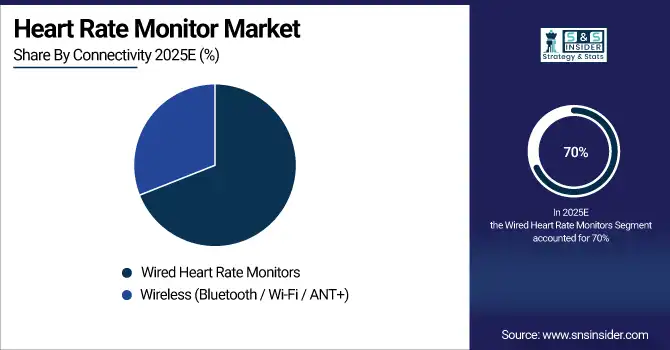
By Connectivity: In 2025, wireless heart rate monitors dominated the market with 70% share, while this segment is also projected to grow at the highest CAGR during 2026–2035.
Heart rate monitor Market Segment Analysis:
By Product Type: Wrist-Based Devices Lead as Remote Cardiac Telemetry Emerges as Fastest-Growing Segment.
Wrist-based heart rate monitors dominate the product type segment due to their ease of use, comfort, and widespread adoption for daily fitness and health tracking. Their seamless integration with smartphones and digital health platforms supports continuous monitoring across consumer applications.
Remote cardiac telemetry monitors are the fastest-growing product type, driven by rising adoption of remote patient monitoring and telehealth services. These devices enable continuous, real-time cardiac data transmission, supporting early diagnosis, long-term disease management, and improved clinical outcomes in home-care settings.
By Technology: ECG-Based Monitoring Leads as Hybrid Sensing Technology Emerges as Fastest-Growing Segment.
ECG-based heart rate monitoring technology dominates the market due to its high accuracy and reliability, making it widely used in hospitals and clinical settings for continuous cardiac monitoring and diagnostics.
Hybrid sensing technology is the fastest-growing segment, as it combines ECG and optical sensors to enhance accuracy and enable broader adoption across both medical and consumer health monitoring applications.
By Application: Medical and clinical monitoring leads as remote patient monitoring is fastest-growing segment.
Medical and clinical monitoring leads the application segment due to the high prevalence of cardiovascular diseases and the need for continuous heart rate monitoring in both critical and non-critical care settings.
Remote patient monitoring is the fastest-growing application, driven by expanding telehealth adoption and increasing use of home-based cardiac monitoring to improve care delivery and reduce hospital readmissions.
By End User: Hospitals and clinics lead, the market while home healthcare is the fastest growing segment.
Hospitals and clinics dominate the end-user segment due to high patient volumes, advanced monitoring infrastructure, and widespread use of heart rate monitors in intensive care and emergency settings.
Home healthcare is the fastest-growing end-user segment, driven by an aging population, rising chronic disease prevalence, and growing preference for remote and home-based health monitoring solutions.
By Connectivity: Wireless heart rate monitors dominated the market, while this segment is also projected to grow.
Wireless heart rate monitors dominate the connectivity segment due to widespread adoption of Bluetooth and Wi-Fi enabled devices that support real-time data sharing and integration with digital health platforms.
Wireless connectivity is also the fastest-growing segment, driven by rising demand for mobile health solutions, cloud-based monitoring, and remote patient monitoring programs.
Heart Rate Monitor Market – Regional Analysis
North America Heart Rate Monitor Market Insights:
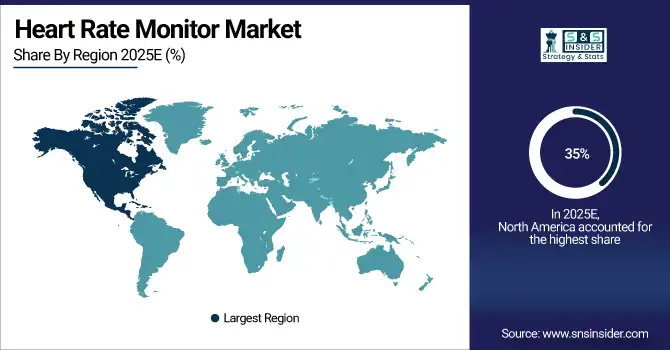
North America accounts for over 35% of the global heart rate monitor market, remaining the largest regional segment due to advanced healthcare infrastructure, early adoption of digital health technologies, and supportive reimbursement frameworks. The region benefits from widespread telehealth usage and a strong preventive care focus. Additionally, the high prevalence of cardiovascular conditions—affecting nearly 48% of U.S. adults—continues to drive demand for continuous monitoring solutions across both clinical and home-care settings.
Get Customized Report as per Your Business Requirement - Enquiry Now
Europe Heart Rate Monitor Market Insights:
Europe represents a significant portion of the global heart rate monitor market, driven by an aging population and a strong emphasis on preventive healthcare. The region benefits from well-established healthcare systems, supportive regulatory frameworks, and growing integration of heart rate monitors into national digital health programs across Germany, the UK, and France, with over 85 million people in Europe living with cardiovascular diseases, sustaining long-term demand.
Asia-Pacific Heart Rate Monitor Market Insights:
Asia-Pacific is the fastest-growing region, expected to grow at a CAGR 11.48%, fuelled by rising healthcare investments and expanding middle-class populations. Countries such as China, India, and Japan are experiencing rapid growth due to increasing cardiovascular disease prevalence and growing adoption of fitness and remote monitoring devices. Government initiatives to improve digital healthcare access and expanding telemedicine services further support market expansion.
Latin America Heart Rate Monitor Market Insights:
In 2025, Latin America is an emerging region in the heart rate monitor market, supported by improving healthcare infrastructure and growing awareness of chronic disease management. Brazil and Mexico lead regional adoption due to rising urbanization and expanding private healthcare services. However, limited reimbursement coverage and uneven access to advanced medical technologies continue to restrain faster market growth across the region.
Middle East & Africa Heart Rate Monitor Market Insights:
The Middle East and Africa region is supported by growing healthcare investments and rising adoption of digital health solutions, particularly across GCC countries such as the UAE and Saudi Arabia. Increasing prevalence of lifestyle-related diseases and expanding hospital infrastructure are driving demand, while limited affordability and restricted healthcare access in parts of Africa continue to limit broader market penetration.
Heart Rate Monitor Market Competitive Landscape:
Apple Inc., headquartered in Cupertino, California, leads the heart rate monitor market through its Apple Watch ecosystem. The company integrates optical heart rate sensors, ECG capabilities, and AI-driven health analytics into user-friendly wearable devices. Its strong focus on design, data accuracy, and ecosystem integration supports widespread adoption across fitness tracking and preventive healthcare applications.
-
In June 2025: Apple announced improved heart rate trend analysis, irregular rhythm notifications, and expanded health data capabilities at WWDC 2025 as part of upcoming watch OS updates.
-
In September 2025: These features were officially released to users alongside the annual Apple Watch refresh and public rollout of the latest watch OS version.
Garmin Ltd., headquartered in Olathe, Kansas, is a key player in the heart rate monitor market, particularly within sports, fitness, and outdoor performance segments. The company is known for high-accuracy heart rate monitoring solutions used by athletes, professionals, and endurance enthusiasts. Garmin offers a wide portfolio of wrist-based devices and chest strap monitors under brands such as Forerunner, Fenix, and Venu, emphasizing performance optimization, durability, and advanced analytics.
-
In January 2025: Garmin enhanced heart rate tracking, HRV insights, and training analytics through new smartwatch launches and firmware updates, improving sensor accuracy and performance metrics for athletes.
-
In mid-2025: Garmin released software and firmware updates for select Forerunner, Fenix, and Venu models, improving optical heart rate accuracy during high-intensity activities and expanding health and recovery analytics.
Heart Rate Monitor Market Key Players
-
Apple Inc.
-
Garmin Ltd.
-
Fitbit (Google LLC)
-
Samsung Electronics
-
Polar Electro
-
Philips Healthcare
-
GE HealthCare
-
Medtronic
-
Omron Healthcare
-
Masimo
-
Nihon Kohden
-
Baxter International (Hillrom)
-
Biotronik
-
AliveCor
-
Suunto
-
Xiaomi
-
Withings
-
Abbott Laboratories
-
Drägerwerk
-
Zephyr Technology
| Report Attributes | Details |
|---|---|
| Market Size in 2025 | USD 2.24 Billion |
| Market Size by 2035 | USD 5.16 Billion |
| CAGR | CAGR of 8.68% From 2026 to 2035 |
| Base Year | 2025 |
| Forecast Period | 2026-2035 |
| Historical Data | 2022-2024 |
| Report Scope & Coverage | Market Size, Segments Analysis, Competitive Landscape, Regional Analysis, DROC & SWOT Analysis, Forecast Outlook |
| Key Segments | • By Product Type:(Wrist-Based Heart Rate Monitors, Chest Strap Heart Rate Monitors, Finger-Based Heart Rate Monitors, Remote Cardiac Telemetry Monitors) •By Technology:(Optical (PPG) Heart Rate Monitoring, ECG-Based Monitoring, Hybrid Sensing Technology) •By Application:(Medical & Clinical Monitoring, Remote Patient Monitoring, Fitness & Sports Tracking, Wellness & Preventive Healthcare) •By End User:(Hospitals & Clinics, Home Healthcare Settings, Fitness Centers & Sports Institutes, Ambulatory Care Centers) •By Connectivity:(Wired Heart Rate Monitors, Wireless Heart Rate Monitors (Bluetooth, Wi-Fi, ANT+)) |
| Regional Analysis/Coverage | North America (US, Canada), Europe (Germany, UK, France, Italy, Spain, Russia, Poland, Rest of Europe), Asia Pacific (China, India, Japan, South Korea, Australia, ASEAN Countries, Rest of Asia Pacific), Middle East & Africa (UAE, Saudi Arabia, Qatar, South Africa, Rest of Middle East & Africa), Latin America (Brazil, Argentina, Mexico, Colombia, Rest of Latin America). |
| Company Profiles | Apple Inc., Garmin Ltd., Fitbit (Google LLC), Samsung Electronics, Polar Electro, Philips Healthcare, GE HealthCare, Medtronic, Omron Healthcare, Masimo, Nihon Kohden, Baxter International (Hillrom), Biotronik, AliveCor, Suunto, Xiaomi, Withings, Abbott Laboratories, Drägerwerk, Zephyr Technology |
Frequently Asked Questions
North America dominated the Heart Rate Monitor Market in 2025.
The “Wrist-based heart rate monitor” segment dominated during the projected period.
The heart rate monitor market is driven by rising health awareness, growing cardiovascular diseases, increasing fitness and sports adoption, expanding wearable device usage, technological advancements, and rising demand for remote patient monitoring and digital healthcare solutions.
The market was valued at USD 2.24 Billion in 2025 and is projected to reach USD 5.16 Billion by 2035.
The Heart Rate Monitor Market is expected to grow at a CAGR of 8.68% during 2026–2035.
