
Human Liver Model Market Report Scope & Overview:
The Human Liver Model market is witnessing continuous growth owing to the increase in the number of cases associated with liver diseases such as hepatitis, Non-alcoholic fatty liver disease, liver cancer, and metabolic disorders around the globe. Moreover, the growth can be attributed to the rising adoption of 3D cell culture practices coupled with the advancements made in 3D bioprinting and liver-on-chip microfluidic models with improved in vivo liver performance and clarity. The human liver models are predictive platforms used in pharmaceutical research to obtain accurate drug toxicity and metabolism data. The data obtained supports drug testing without the use of animal studies that can hinder the process.
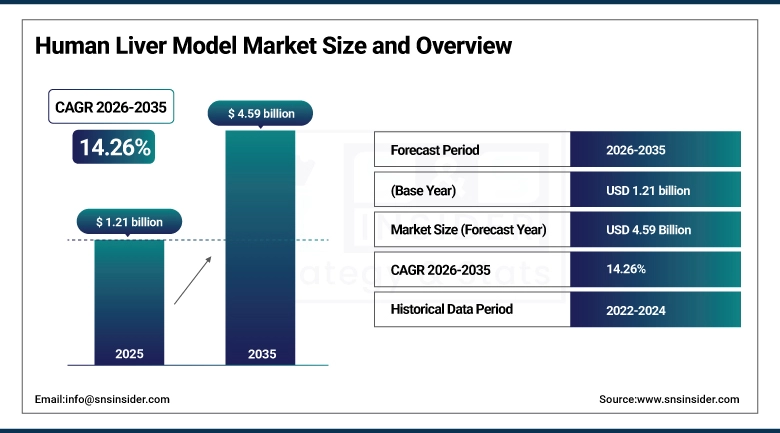
The Human Liver Model Market was valued at USD 1.21 Billion in 2025 and is expected to reach USD 4.59 Billion by 2035, growing at a CAGR of 14.26% from 2026 to 2035.
For instance, in April 2025, the EU Horizon program awarded USD 25 million to support liver organoid and microfluidic liver research, boosting personalized medicine and advanced Human Liver Model Market applications.
To Get more information on Human Liver Model Market - Request Free Sample Report
Key Human Liver Model Market Trends:
-
Advanced modelling technologies: Rising adoption of 3D bioprinting, organ-on-chip platforms, and AI-assisted simulations for highly accurate liver structure and function replication.
-
Integration with smart systems: Use of cloud-based data management, AI algorithms, and computational modelling to enhance predictive toxicity testing and drug metabolism studies.
-
Personalized medicine applications: Development of patient-specific liver models for tailored drug testing, disease modelling, and regenerative therapy planning.
-
Collaborative research solutions: Partnerships between pharmaceutical companies, biotech firms, and academic institutions to co-develop liver models for drug discovery and toxicity assessment.
-
Portable & scalable platforms: Emergence of miniaturized liver-on-chip devices and modular systems enabling high-throughput screening and on-site lab evaluations.
-
Regulatory support & awareness: Strengthened guidelines from FDA, EMA, and other regulatory bodies encouraging adoption of human-relevant liver models for preclinical testing and reducing reliance on animal studies.
Key Market Highlights
|
Market Parameter |
Market Highlight / Data |
Key Growth Driver |
|---|---|---|
|
Largest Product |
2D Models – 73.99% share in 2025 |
Low-cost, abundant, and simple to manipulate for basic hepatocyte studies. |
|
Fastest-Growing Product |
3D Models – 14.78% CAGR |
Better mimic of in vivo liver structure and function for toxicity testing. |
|
Largest Application |
ADME Studies – 40.83% share in 2025 |
Predictive hepatotoxicity testing and accurate metabolism data requirements. |
|
Fastest-Growing Application |
Toxicology Testing – 14.93% CAGR |
Growing requirement to detect drug-induced liver damage early. |
|
Largest Technology |
3D Cell Culture – 35.80% share in 2025 |
Provides a closer milieu to human liver physiology than 2D models. |
|
Fastest-Growing Technology |
Microfluidics – 14.95% CAGR |
Mimics liver-on-chip systems with dynamic fluid flow and in-line detection. |
|
Largest End User |
Pharmaceutical & Biotechnology Companies – 48.52% share in 2025 |
Frequent application in drug discovery, ADME profiling, and toxicity testing. |
|
Fastest-Growing End User |
Academic & Research Institutes – 14.71% CAGR |
Higher government and private funding toward personalized medicine research. |
|
Largest Region |
North America – 40.76% share in 2025 |
Robust healthcare system and high investment in drug development. |
|
Fastest-Growing Region |
Asia Pacific – 15.12% CAGR |
Expansion of pharmaceutical industry and growing R&D expenditure. |
U.S. human liver model market size outlook
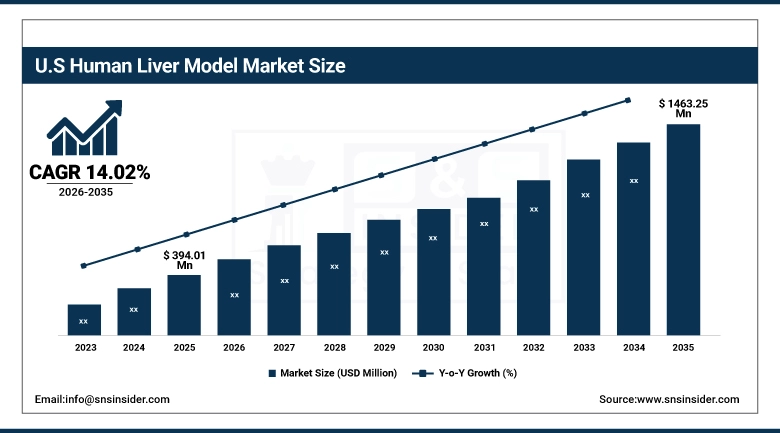
The U.S. human liver model market was valued at USD 394.01 million in 2025 and is expected to reach USD 1463.25 million by 2035, growing at a CAGR of 14.02% over 2026-2035. The human liver model market in the US is the largest due to the advanced pharmaceutical R&D, high acceptance of 3D liver models and liver-on-chip platforms, and high investment toward biotech innovation. The U.S. market dominance can be attributed to the early adopters in the U.S., which cover a complete range of applications and technology types, including top market players, regulatory environment, drug toxicity demand, and drug metabolism testing.
Human Liver Model Market Growth Drivers:
-
Increasing Prevalence of Liver Diseases is Driving the High-Intensity Focused Ultrasound Market Growth
Growing incidences of liver diseases are the leading cause of the human liver model market. Increasing prevalence of hepatitis, Non-alcoholic fatty liver disease (NAFLD), liver cancer, and metabolic disorders, and growing need for advanced liver models for disease and therapeutic research. This trend has a major influence on the human liver model market share as healthcare and pharma find investing in liver systems that are predictive and physiologically relevant.
For instance, in March 2024, the American Liver Foundation reported over 100 million Americans affected by NAFLD, a 15% rise over 2023, boosting demand for Human Liver Model Market research solutions.
Human Liver Model Market Restraints:
-
Technical Complexity and Standardization Issues are Hampering the Human Liver Model Market Growth
One important limitation is the lack of technical standardization and the complexity of human liver model development. These platforms are not widely available and vary in the expertise required and across-lab consistency. This hinders the usage of scaling and widespread use. Recent human liver model market analysis revealed a lack of consensus standards for validation, which slows advances in regulatory adoption to meet the needs of global pharma companies relying on robust liver model platforms.
For instance, in May 2024, a Nature Biotechnology survey revealed 42% of research groups faced reproducibility issues in 3D liver models, highlighting the need for standardized protocols in the Human Liver Model Market.
Human Liver Model Market Opportunities:
-
Regulatory Compliance & Alternatives to Animal Testing Drive Future Growth Opportunities for the Human Liver Model Market
The emerging trend of human-relevant liver models is on account to tightened restrictions and ethical issues. Regulatory agencies, including the FDA and EMA recommend the use of in vitro methods to assess the safety of drugs to minimize animal experiments. This represents a large market opportunity for providers of advanced human liver models and organ-on-chip platforms.
For instance, in April 2025, AI-driven whole-body imaging enables faster reconstruction, automated anomaly detection, and predictive diagnostics, improving workflow efficiency and clinical decision-making in advanced imaging centers.
Key Human Liver Model Market Segment Analysis:
-
By product, 2d models held the largest share of around 73.99%in 2025, and the 3d models’ segment is expected to register the highest growth with a CAGR of 14.78%.
-
By application, the ADME studies segment dominated the market with approximately 40.83%share in 2025, while toxicology testing is expected to register the highest growth with a CAGR of 14.93%.
-
By technology, 3d cell culture accounted for the leading share of nearly 35.80% in 2025, and microfluidics is expected to register the highest growth with a CAGR of 14.95%.
-
By end user, the pharmaceutical & biotechnology companies led the market with about 48.52% share in 2025, while the academic & research institutes segment is forecasted to grow the fastest at a CAGR of 14.71%.
By Product, 2D Models Lead the Market, while 3D Models Register Fastest Growth
The 2D models segment accounted for the highest revenue share of approximately 73.99% in 2025, as they are low-cost, abundant, and simple to manipulate, the basic hepatocyte studies and high-throughput drug screening are commonly utilized. Drivers are their established workflows, wide use in academic and pharma research facilities, and regulatory acceptance. In comparison, the 3D model segment is anticipated to achieve the highest CAGR of nearly 14.78% during the 2026–2035 period, driven by its better mimic of in vivo liver structure and function. Rising pharmaceutical adoption for precise drug toxicity testing, growing need for disease-specific liver organoids.
By Application, the ADME Studies Segment dominates, while the Toxicology Testing Segment Shows Rapid Growth
The ADME Studies segment held the largest revenue share of approximately 40.83%in 2025, driven by the pharmaceutical industry’s continued embrace of predictive hepatotoxicity testing, increasing regulatory focus on accurate metabolism data, and growing need to avoid costly late-stage drug failures. On the other hand, the Toxicology Testing segment is predicted to grow at the strongest CAGR of approximately 14.93% during 2026–2035, as there is a growing requirement to detect drug-induced liver damage early. The driving factors are perhaps tightening regulatory demands, the increasing quest for safer drug pipelines.

By Technology, 3D Cell Culture Lead, and Microfluidics Registers Fastest Growth
The 3D cell culture accounted for the largest share of the human liver model market with about 35.80%, as it provides a closer milieu to human liver physiology than 2D models. Factors including the superior predictive results for drug toxicity testing, increasing use of the technology for disease modelling, and personalized medicine are driving its uptake. In addition, microfluidics is slated to grow at the fastest rate with a CAGR of around 14.95% throughout the forecast period of 2026–2035, as it can mimic the liver-on-chip systems, providing dynamic fluid flow and in-line detection. Factors, including increasing demand for accurate drug metabolism studies, decline in animal testing, and acceptance in the pharmaceutical industry for HTPS, are driving the market.
By End User, Pharmaceutical & Biotechnology Companies Lead, While the Academic & Research Institutes Segment Grows the Fastest
The pharmaceutical & biotechnology companies held the largest revenue share of around 48.52% in the human liver model market in 2025, as they frequently apply liver models in drug discovery, ADME profiling, and toxicity testing. Market drivers include the increase in R&D spending, the need for safer drugs, and rising regulatory pressure to replace animal testing. On the flip side, the academic & research institutes segment, however, is projected to register the highest CAGR of around 14.71% during the forecast period of 2026 - 2035, owing to the higher government and private funding, attention towards personalized medicine, and developments in stem cell research. These centers promote innovation by generating advanced 3D liver tissues and microfluidic devices for preclinical investigations.
Human Liver Model Market Regional Analysis:
North America Human Liver Model Market Insights
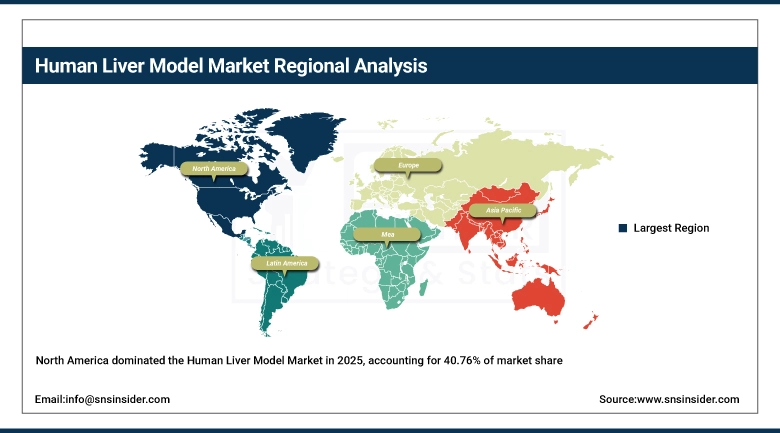
North America accounted for the highest revenue share of approximately 40.76% in 2025 of the Human Liver Model Market, driven by its robust healthcare system, leading research institutions, and high level of investment in drug development and discovery. The high concentration of major pharmaceutical and biotechnology firms, combined with substantial funding over the NIH and other government organizations, is expected to further boost the acceptance of novel liver models. Also, the region is leading in the adoption rate due to the strict FDA norms related to drug testing and increasing need for alternatives to animal testing, which makes it a key for the growth of the market in the region.
Get Customized Report as per Your Business Requirement - Enquiry Now
Asia Pacific Human Liver Model Market Insights
Asia Pacific is the fastest-growing segment in the human liver model market with a CAGR of 15.12%, fueled by the expansion of the pharmaceutical and biotechnology industry, especially in China, India, Japan, and South Korea. Growing R&D expenditure, prevalence of liver-related diseases, and government programs for promoting regenerative medicine and drug development are driving the adoption. The increasing focus on minimizing reliance on animal testing and the rising demand for economical preclinical models continue to foster growth. A growing partnership between multinational corporations and local research institutes is contributing to innovation. Moreover, favorable regulatory policies and a rise in investment in healthcare research drive the advanced technologies, including 3D liver models and microfluidics. These forces combine to make Asia Pacific the most dynamic and high-growth region in the market.
Europe Human Liver Model Market Insights
Europe is the second leading region for the human liver model market, with high regulatory support over the EMA and strong pharmaceutical and biologics sectors adopting advanced in vitro models. Demand is driven by major government and EU-funded research projects, and a strong emphasis on the reduction of animal testing. The partnership between the academic institutions and the industry further strengthens Europe in that market.
Latin America (LATAM) and Middle East & Africa (MEA) Human Liver Model Market Insights
In Latin America, rising pharmaceutical R&D, government-backed innovation programs, and growing adoption of organ-on-chip technologies are driving demand for human liver models. In the Middle East & Africa, expanding biotech hubs, increased research funding, and regulatory encouragement for alternative testing methods are fueling market growth, although adoption is slower due to infrastructure and awareness challenges compared to developed regions.
Competitive Landscape for the Human Liver Model Market:
Emulate, Inc.: Develops advanced organ-on-chip platforms, including liver models, enabling drug toxicity testing and disease modelling. Its FDA collaborations and predictive platforms support regulatory compliance and reduce reliance on animal testing globally.
-
In June 2024, partnered with FDA to validate liver-on-chip models, enhancing drug toxicity prediction and regulatory compliance.
Organovo Holdings, Inc.: Pioneers 3D bioprinting of human liver tissues for preclinical research, drug metabolism studies, and disease modelling. Focuses on scalable, high-fidelity tissue constructs to accelerate drug development and personalized medicine applications.
-
In March 2024, we introduced scalable 3D bioprinter liver tissues for preclinical drug testing, supporting personalized medicine and increasing predictive accuracy.
CN Bio Innovations Ltd.: Specializes in micro physiological liver systems and organ-on-chip platforms for pharmaceutical testing. Offers high-accuracy, human-relevant models to improve drug safety prediction, reduce animal testing, and support regulatory requirements.
-
In February 2024, launched an advanced liver micro physiological system, improving predictive toxicology by ~35% versus traditional in vitro models.
Human Liver Model Market Key Players:
-
Emulate, Inc.
-
Organovo Holdings, Inc.
-
CN Bio Innovations Ltd.
-
InSphero AG
-
Hμrel Biotech
-
Axol Bioscience Ltd.
-
Mimic Technologies
-
TissUse GmbH
-
Harvard Wyss Institute
-
Biotek, Inc.
-
Sartorius AG
-
Lonza Group AG
-
Thermo Fisher Scientific
-
Sigma-Aldrich
-
PromoCell GmbH
-
Cell Systems, Inc.
-
Reprocell Inc.
-
Charles River Laboratories
-
HepaTox Solutions
-
Alveole Biotechnologies
| Report Attributes | Details |
|---|---|
| Market Size in 2025 | USD 1.21 Billion |
| Market Size by 2035 | USD 4.59 Billion |
| CAGR | CAGR of 14.26% From 2026 to 2035 |
| Base Year | 2025 |
| Forecast Period | 2026-2035 |
| Historical Data | 2022-2024 |
| Report Scope & Coverage | Market Size, Segments Analysis, Competitive Landscape, Regional Analysis, DROC & SWOT Analysis, Forecast Outlook |
| Key Segments | • By Product (2D Models, 3D Models) • By Application (ADME Studies, Toxicology Testing, Disease Modelling, Others) • By Technology (2D Cell Culture, 3D Cell Culture, Microfluidics, Tissue Engineering) • By End User (Academic & Research Institutes, Pharmaceutical & Biotechnology Companies, Contract Research Organizations) |
| Regional Analysis/Coverage | North America (US, Canada), Europe (Germany, France, UK, Italy, Spain, Poland, Russsia, Rest of Europe), Asia Pacific (China, India, Japan, South Korea, Australia,ASEAN Countries, Rest of Asia Pacific), Middle East & Africa (UAE, Saudi Arabia, Qatar, Egypt, South Africa, Rest of Middle East & Africa), Latin America (Brazil, Argentina, Mexico, Colombia Rest of Latin America) |
| Company Profiles | Emulate, Inc., Organovo Holdings, Inc., CN Bio Innovations Ltd., InSphero AG, Hμrel Biotech, Axol Bioscience Ltd., Mimic Technologies, TissUse GmbH, Harvard Wyss Institute, 3D Biotek, Inc., Sartorius AG, Lonza Group AG, Thermo Fisher Scientific, Sigma-Aldrich, PromoCell GmbH, Cell Systems, Inc., Reprocell Inc, Charles River Laboratories, HepaTox Solutions, Alveole Biotechnologies and other players. |
Frequently Asked Questions
The Human Liver Model Market refers to the industry focused on developing and commercializing in vitro and in vivo liver models used for drug testing, disease research, and toxicity screening.
The market was valued at USD 1.21 billion in 2025 and is projected to grow significantly over the forecast period.
The market is expected to grow at a CAGR of 14.26% from 2026 to 2035, indicating strong expansion driven by research and pharmaceutical demand.
The Human Liver Model Market is anticipated to reach approximately USD 4.59 billion by 2035.
Key drivers include increasing drug development activities, rising demand for alternatives to animal testing, advancements in 3D cell culture technologies, and growing prevalence of liver diseases.
