
Human Vaccines Market Report Scope & Overview:
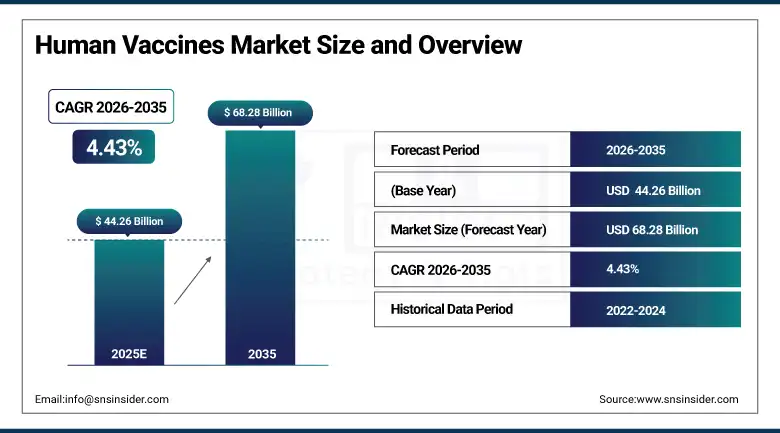
The Human Vaccines Market Size is valued at USD 44.26 Billion in 2025 and is projected to reach USD 68.28 Billion by 2035, growing at a CAGR of 4.43% during the forecast period 2026–2035.
The Human Vaccines Market analysis report provides a comprehensive overview of market dynamics, emphasizing technological advancements, vaccine development, and immunization strategies. Growing incidence of communicable and preventable diseases along with government that is also unfolds, awareness amongst the population are expected to boost demand for the market during the forecast period.
Human vaccine doses reached 12.5 billion in 2025, driven by rising infectious diseases and expanded immunization programs.
Human Vaccines Market Size and Forecast:
-
Market Size in 2025: USD 44.26 Billion
-
Market Size by 2035: USD 68.28 Billion
-
CAGR: 4.43% from 2026 to 2035
-
Base Year: 2025
-
Forecast Period: 2026–2035
-
Historical Data: 2022–2024
To Get more information on Human Vaccines Market - Request Free Sample Report
Human Vaccines Market Trends:
-
Increasing attention to mRNA and viral vector platforms is advancing the creation of second-generation vaccines for infectious diseases and emerging pathogens.
-
Vaccination coverage has been extended globally through improved government programmes and increasing awareness in the community.
-
Emergence of digital health and cold-chain technologies are enhancing vaccine distribution, monitoring and access.
-
Increasing demand for age-specific vaccines such as pediatrics and geriatrics are influencing product development approaches.
-
Growing public-private partnerships are accelerating research, funding and quick deployment of vaccines at times of outbreaks.
-
Focus on safety and clinical verifications and regulatory compliance is driving market confidence and acceptance.
U.S. Human Vaccines Market Insights:
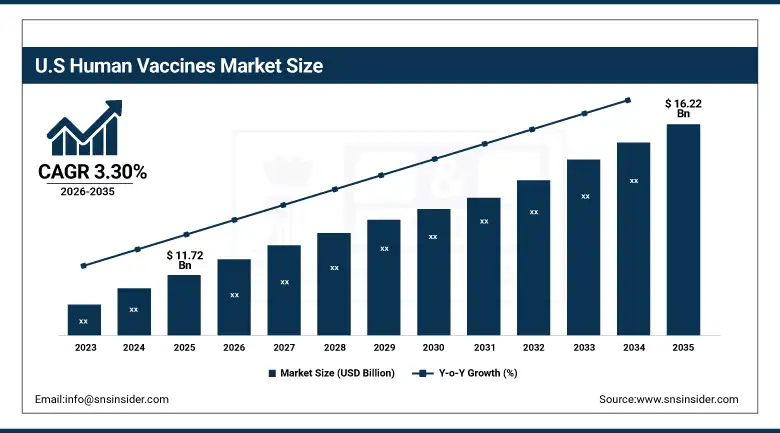
The U.S. Human Vaccines Market is projected to grow from USD 11.72 Billion in 2025 to USD 16.22 Billion by 2035, at a CAGR of 3.30%. Growth is attributed to strong immunization programs, high vaccine awareness level, strong healthcare support and early adoption of the innovative class vaccines such as mRNA and viral vector platform.
Human Vaccines Market Growth Drivers:
-
Rising infectious disease outbreaks and preventive healthcare initiatives driving demand for innovative vaccine solutions.
Rising infectious disease outbreaks and preventive healthcare initiatives are key drivers of the Human Vaccines Market growth. The rise in the incidence of diseases, along with diseases such as COVID-19, influenza, hepatitis and HPV leading to social issues is driving demand for new and effective vaccines. Vaccines exert selective immunologic pressure, minimize the burden of disease and fortify public health. Increasing awareness; government centers and preventive healthcare driving vaccine coverage: influencing market expansion.
Human vaccine market revenue grew 5.1% in 2025, driven by rising infectious disease cases and expanded immunization programs globally.
Human Vaccines Market Restraints:
-
High development costs, stringent regulatory requirements and complex cold-chain logistics are limiting large-scale vaccine market growth.
High development costs, stringent regulatory requirements, and complex cold-chain logistics are major restraints for the Human Vaccines Market. Vaccine producers must navigate very long approval times and intensive clinical trials that add time to product launches and costs to development. The continued utility of storage and distribution systems which are temperature sensitive adds more logistical issues and expense. Combined, these are barriers to mass production, delayed uptake for new entrants to the market and restricted access, particularly in emerging and resource-constrained regions.
Human Vaccines Market Opportunities:
-
Expansion of mRNA and personalized vaccine technologies presents opportunities for innovative, disease-specific immunization solutions.
Expansion of mRNA and personalized vaccine technologies presents a significant opportunity for the Human Vaccines Market. Progress in the field of biotechnology allow creation of vaccines unique to individual pathogens, age bands or patient immune profiles. Manufacturers are prioritizing new delivery techniques, increased efficacy and accelerated development pipelines. It is this move toward tailor-made, targeted vaccination that benefits public health and promotes confidence in vaccination programs, fueling continued market growth.
mRNA and personalized vaccines represented 22% of new vaccine approvals in 2025, driven by advances in biotechnology and targeted immunization.
Human Vaccines Market Segmentation Analysis:
-
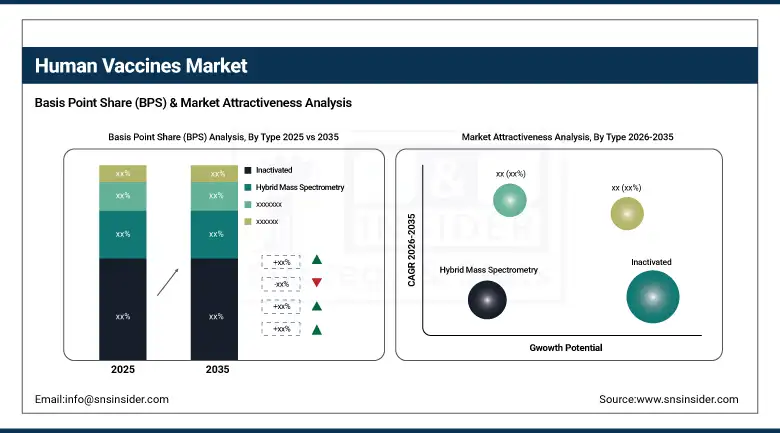
By Type, Inactivated vaccines held the largest market share of 28.74% in 2025, while mRNA vaccines are expected to grow at the fastest CAGR of 7.12% during 2026–2035.
-
By Administration Route, Intramuscular vaccines accounted for the highest market share of 46.32% in 2025, while Intradermal delivery is projected to expand at the fastest CAGR of 6.45% during the forecast period.
-
By Disease Target, COVID-19 vaccines dominated with a 31.25% share in 2025, while HPV vaccines are anticipated to record the fastest CAGR of 7.34% through 2026–2035.
-
By Age Group, Adult vaccines held the largest share of 39.61% in 2025, while Geriatric vaccines are expected to grow at the fastest CAGR of 6.98% during 2026–2035.
-
By End User, Hospitals accounted for the largest share of 53.12% in 2025, while Research & Academic Institutes are forecasted to register the fastest CAGR of 7.21% during 2026–2035.
-
By Distribution Channel, Hospital Pharmacy held the largest share of 45.87% in 2025, while Online Pharmacy is expected to grow at the fastest CAGR of 6.78% during 2026–2035.
By Age Group, Adult Vaccines Dominate While Geriatrics Expands Rapidly:
Adult segment dominated the market since there is large demand for influenza, hepatitis, and booster shots among the working-age population. Adoption is fueled by efforts for occupational health and routine immunization programs. Adult vaccine doses administered surpassed 5.0 billion in 2025.
Geriatric is the fastest-growing segment, due to increase in aging populations and trends, exposure of elderly to various infectious diseases due weakening immune system and increasing pedagogic vaccination drives. In 2025, geriatric vaccine doses reached 1.3 billion, supported by seasonal influenza, shingles, and pneumonia vaccination programs.
By Type, Inactivated Vaccines Dominate While mRNA Expands Rapidly:
Inactivated segment dominated the market as they have been effective for longer durations, widely used among different age group, and is well known to healthcare providers. They are in widespread use for influenza, hepatitis and polio and underpin most world vaccination programs. In 2025, inactivated vaccine doses administered surpassed 5.2 billion.
mRNA is the fastest-growing segment, fueled by breakthrough tech, fast development times and applicability to emerging pathogens such as COVID-19. In 2025, mRNA vaccine doses reached 1.9 billion, reflecting strong adoption and pipeline expansion.
By Administration Route, Intramuscular Dominates While Intradermal Expands Rapidly:
Intramuscular segment dominated the market as it easier to administer, has established efficacy and also has a greater mainstream acceptance with major vaccines such as influenza, hepatitis and COVID-19. In 2025, intramuscular vaccines exceeded 6.3 billion doses.
Intradermal is the fastest-growing segment, due to such benefits as dose sparing, better immune response and new compatibility. In 2025, intradermal vaccine deliveries reached 1.1 billion doses, boosted by technological advancements in micro-needle and patch-based delivery systems.
By Disease Target, COVID-19 Vaccines Dominate While HPV Expands Rapidly:
COVID-19 segment dominated the market, share, as there was pandemic response with mass campaigns of vaccination and high level of population awareness. The adoption was accelerated by emergency programs and high infection rates. Total COVID-19 vaccine doses administered in 2025 exceeded 4.8 billion.
HPV are the fastest-growing segment, due to increased focus on cervical cancer prevention and adolescent vaccination programs. In 2025, HPV vaccine doses reached 1.2 billion, reflecting expanding coverage in both developed and emerging markets.
By End User, Hospitals Dominate While Research & Academic Institutes Expand Rapidly:
Hospitals segment dominated the market as main outlets for vaccines, by utilizing infrastructure capacities, human resources and other facilities gave lead to mass immunization. In 2025, hospital-administered vaccine doses exceeded 6.0 billion.
Research & Academic Institutes are the fastest-growing segment, which are involved with clinical trials, vaccine development programs and experimental immunization studies. In 2025, vaccines administered through research facilities reached 1.0 billion doses, highlighting rapid growth in innovation-focused environments.
By Distribution Channel, Hospital Pharmacy Dominates While Online Pharmacy Expands Rapidly:
Hospital Pharmacy segment dominated the market in 2025, based on reliable supply and control over quality and easy availability for mass vaccination campaigns. Total hospital pharmacy vaccine deliveries surpassed 5.5 billion doses.
Online Pharmacy are the fastest-growing segment, driven by digital health adoption, convenience and expanding home vaccination services. In 2025, online vaccine shipments reached 1.4 billion doses, reflecting increased consumer preference and pandemic-driven e-health trends.
Human Vaccines Market Regional Analysis:
North America Human Vaccines Market Insights:
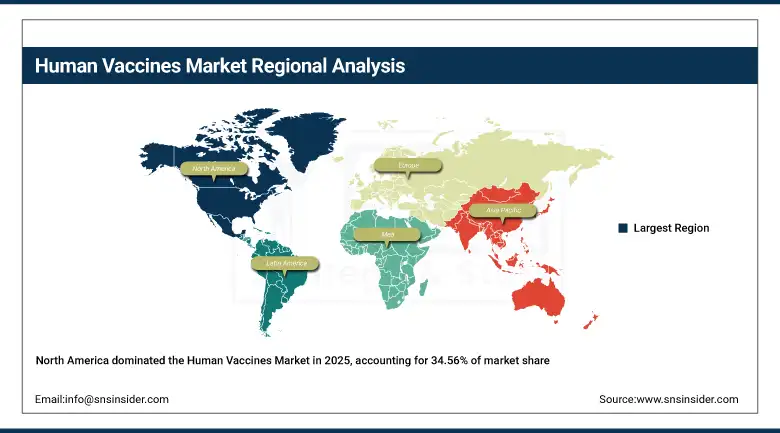
North America dominated the Human Vaccines Market, accounting for a 34.56% market share in 2025. There is strong health infrastructure, high vaccination cover and many government vaccination programmes in place in a region where leadership is good. Widespread public visibility, large spend on research and development, early interest in pioneering technologies such as mRNA and viral vector platforms is additional evidence of its status. Activity in terms of vaccine R&D, trials and commercialization has historically been centred on North America.
Get Customized Report as per Your Business Requirement - Enquiry Now
U.S. Human Vaccines Market Insights:
The U.S. Human Vaccines Market is primarily driven by the high incidence of infectious diseases, strong governmental and other support for vaccination, and increasing take-up of vaccines in public health programs. The fast development of mRNA and viral vector technology, high R&D investment for vaccine discovery, and government immunization programs help solidify the country position as a leader in commercializing vaccines.
Asia-Pacific Human Vaccines Market Insights:
The Asia-Pacific Human Vaccines Market is the fastest-growing globally, projected to register a CAGR of 5.89% during 2026–2035. Growth is led by extended immunization coverage, increasing incidence of infectious diseases and strong pediatric populations in China, India, Japan and Southeast Asia. Robust government vaccination systems, growing biotech manufacturing capacity and the widespread take up of cutting-edge technologies including mRNA all provide further evidence that Asia-Pacific is set to be the most dynamic and investable place for vaccines.
China Human Vaccines Market Insights:
China’s Human Vaccines Market is propelled by expanding national immunization programs, rising infectious disease burden and strong public health investments. Fast expansion in domestic capacity of vaccine production, acceptance of novel platforms including mRNA and encouragement from the government on biotechnology development contribute to China's becoming a growth driver in Asia-Pacific vaccines market.
Europe Human Vaccines Market Insights:
The Europe Human Vaccines Market as it is supported by the strong immunization programs, increasing prevalence of infectious diseases and focus on preventive health care. The regional demand is supported by high vaccination coverage, rapid uptake of novel vaccine platforms and growing government investments. Germany, the UK, France and Italy are still significant stakeholders due to well-developed healthcare infrastructure, strict regulatory environment and continued spending on public health initiatives focusing on universal vaccinations in different demographics.
Germany Human Vaccines Market Insights:
Germany is one of the largest humans vaccine markets due to its superior healthcare system, vaccination infrastructure and public health expenditure. Growth in the infectious disease prevention sector, adoption of next-generation vaccine technologies and strict regulatory guidelines further solidify Germany’s leading position in the field of vaccines, outbreak control and general immunization preparedness within Europe.
Latin America Human Vaccines Market Insights:
The Latin America Human Vaccines Market is driven by increasing awareness about immunization, high prevalence of infectious diseases and expanding government funding for healthcare in Brazil, Argentina and Mexico. Growing need for both routine and advanced vaccines, increased infiltration of national immunization programs, enhanced regional vaccination coverage and participation due to improved access to cold-chain infrastructure.
Middle East and Africa Human Vaccines Market Insights:
The Middle East & Africa Human Vaccines Market is growing due to increasing awareness on vaccination, disease burden and improved health care infrastructure in the BMR. Vaccine programmes and cold-chain logistics Modern vaccines also require significant investment in vaccination, and both the Saudi Arabia and UAE governments have implemented national health plans to drive vaccine uptake.
Human Vaccines Market Competitive Landscape:
Pfizer Inc., headquartered in the U.S., dominates the human vaccines market due to its extensive biopharmaceutical expertise, advanced mRNA capabilities and one of the most sophisticated manufacturing networks. Its cutting-edge work on pneumococcal, meningococcal and COVID-19 vaccines further cemented its leadership. A strong R&D engine, massive clinical trials and strategic partnerships underwrite the speed of its innovations and the scale of their distribution. Its focus on safety, quality and availability makes Pfizer one of the more formidable vaccine manufacturers.
-
In August 2025, Pfizer and BioNTech gained FDA approval for their updated COMIRNATY LP.8.1 mRNA COVID-19 vaccine, designed for 2025–2026 strain protection, reinforcing Pfizer’s continued leadership in advanced, seasonally updated respiratory vaccine platforms.
GlaxoSmithKline plc, based in the UK, is a leader in human vaccines supported by decades of immunology research, a comprehensive vaccine portfolio and advanced adjuvant technologies. Its leadership is based on the strength of its performance in influenza, shingles and pediatric vaccines and modern supply methodology. R&D Collaboration GSK places a strong emphasis on research and development, making it possible to develop surprises in preventive health. It’s a testament to its strong regulatory track record and historical public-health partnerships, which makes is leader in the vaccines space.
-
In February 2025, GSK received FDA approval for Penmenvy, its 5-in-1 meningococcal vaccine offering broad MenABCWY protection, simplifying adolescent immunization schedules and strengthening GSK’s position in next-generation bacterial vaccine innovation and public health preparedness.
Merck & Co., Inc., headquartered in the U.S., is a powerhouse in the vaccines market due to its strong scientific foundation and breakthrough products across HPV, measles, mumps, hepatitis and pneumococcal vaccines. Merck’s success is built on a special strength in clinical science, broad real-world evidence and obscure government and global-health ties. The company’s high-quality manufacturing cultures, virus-based drive to innovation and quality-of-life health-care solutions for the prevention and treatment of human illnesses have resulted in a market leading position in human vaccines.
-
In March 2025, Merck expanded distribution of its HPV vaccines to strengthen cervical cancer prevention programs as demand surged, reinforcing the company’s dominance in HPV immunization despite no major new product launches that year.
Human Vaccines Market Key Players:
-
Pfizer Inc.
-
GlaxoSmithKline plc (GSK)
-
Merck & Co., Inc.
-
Sanofi (Sanofi Pasteur)
-
Moderna, Inc.
-
AstraZeneca
-
Johnson & Johnson
-
Serum Institute of India Pvt. Ltd. (SII)
-
Bharat Biotech
-
CSL Limited (including Seqirus)
-
Novavax, Inc.
-
Sinovac Biotech Ltd.
-
CanSino Biologics
-
BioNTech SE
-
CSL Behring
-
Bavarian Nordic
-
Inovio Pharmaceuticals, Inc.
-
CureVac N.V.
-
Vaxart, Inc.
-
Walvax Biotechnology Co., Ltd.
| Report Attributes | Details |
|---|---|
| Market Size in 2025 | USD 44.26 Billion |
| Market Size by 2035 | USD 68.28 Billion |
| CAGR | CAGR of 4.43% From 2026 to 2035 |
| Base Year | 2025 |
| Forecast Period | 2026-2035 |
| Historical Data | 2022-2024 |
| Report Scope & Coverage | Market Size, Segments Analysis, Competitive Landscape, Regional Analysis, DROC & SWOT Analysis, Forecast Outlook |
| Key Segments | • By Type (Live-Attenuated, Inactivated, Subunit, mRNA, Viral Vector, Conjugate, Others) • By Administration Route (Intramuscular, Subcutaneous, Oral, Intradermal) • By Disease Target (COVID-19, Influenza, Hepatitis, Measles, Polio, HPV, Others) • By Age Group (Pediatrics, Adolescent, Adult, Geriatrics) • By End User (Hospitals, Clinics, Research & Academic Institutes, Others) • By Distribution Channel (Hospital Pharmacy, Retail Pharmacy, Online Pharmacy, Government Programs, Others) |
| Regional Analysis/Coverage | North America (US, Canada), Europe (Germany, UK, France, Italy, Spain, Russia, Poland, Rest of Europe), Asia Pacific (China, India, Japan, South Korea, Australia, ASEAN Countries, Rest of Asia Pacific), Middle East & Africa (UAE, Saudi Arabia, Qatar, South Africa, Rest of Middle East & Africa), Latin America (Brazil, Argentina, Mexico, Colombia, Rest of Latin America). |
| Company Profiles | Pfizer Inc., GlaxoSmithKline plc (GSK), Merck & Co., Inc., Sanofi (Sanofi Pasteur), Moderna, Inc., AstraZeneca, Johnson & Johnson, Serum Institute of India Pvt. Ltd. (SII), Bharat Biotech, CSL Limited (including Seqirus), Novavax, Inc., Sinovac Biotech Ltd., CanSino Biologics, BioNTech SE, CSL Behring, Bavarian Nordic, Inovio Pharmaceuticals, Inc., CureVac N.V., Vaxart, Inc., Walvax Biotechnology Co., Ltd. |

Frequently Asked Questions
Ans: North America dominated the market with a 34.56% share in 2025, while Asia-Pacific is the fastest-growing region with a CAGR of 5.89% during 2026–2035.
Inactivated vaccines dominated with a 28.74% share in 2025, while mRNA vaccines are projected to record the fastest growth with a 7.12% CAGR during 2026–2035.
Growth is driven by rising infectious diseases, expanding immunization programs, increasing vaccine awareness and rapid advancements in mRNA and viral vector technologies.
The market is valued at USD 44.26 Billion in 2025 and is projected to reach USD 68.28 Billion by 2035.
The Human Vaccines Market is expected to grow at a CAGR of 4.43% during the forecast period 2026–2035.
