
Industrial Wax Market Report Scope & Overview:
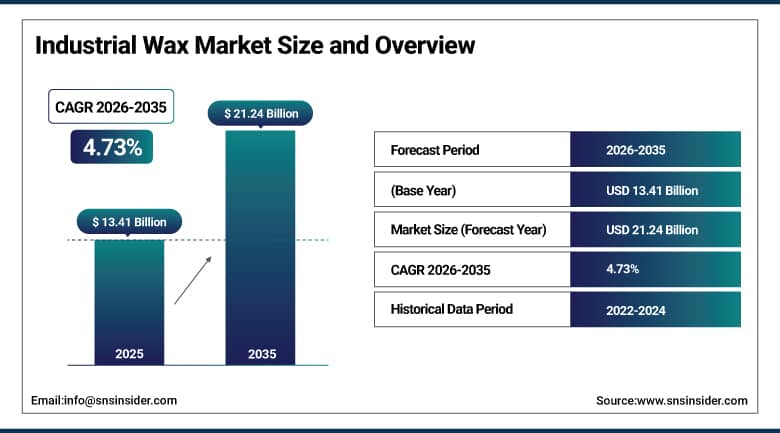
The Global Industrial Wax Market was valued at USD 13.41 billion in 2025 and is expected to reach USD 21.24 billion by 2035, growing at a CAGR of 4.73 % from 2026–2035.
The industrial wax market is witnessing steady global growth due to rising demand for surface protection, polishing, lubrication, and coating applications across packaging, plastics, rubber, cosmetics and personal care, paper and board, adhesives, candles, and industrial manufacturing sectors, along with the increasing adoption of advanced wax processing technologies such as hydro processed paraffin wax, synthetic Fischer–Tropsch wax, bio-based wax alternatives, wax emulsions, microcrystalline wax formulations, and high-performance specialty wax blends for improved durability, moisture resistance, gloss enhancement, and thermal stability. The expansion of packaging and e-commerce industries, rising use of sustainable and bio-based materials, and increasing demand for high-performance coatings and additives in industrial production processes are also contributing to market growth.
The governmental regulations related to environmental sustainability, petrochemical refining standards, product safety compliance, and industrial chemical usage guidelines such as REACH (Registration, Evaluation, Authorisation and Restriction of Chemicals), EPA (Environmental Protection Agency) chemical safety frameworks, ISO material quality standards, and global sustainability initiatives are significantly influencing industrial wax production, formulation, and application development. In addition, the U.S. environmental protection and refining policies, India’s petrochemical and manufacturing growth initiatives, China’s industrial upgrading and green materials policies, and the European Union’s sustainability and circular economy frameworks are further accelerating market adoption.
To Get More Information On Industrial Wax Market - Request Free Sample Report
Industrial Wax Market Trends
-
Growing demand for bio-based and sustainable wax materials is driving the shift from petroleum-based waxes toward renewable sources such as plant-based and natural waxes in industrial applications.
-
Increasing usage of industrial wax in packaging and e-commerce sectors is enhancing moisture resistance, coating performance, and product durability in paper and board packaging solutions.
-
Rising adoption of wax-based additives in plastics and rubber processing is improving lubrication, anti-blocking properties, and surface finishing quality across manufacturing industries.
-
Expanding application of industrial wax in cosmetics and personal care products is supporting formulation stability, texture enhancement, and improved product performance.
-
Technological advancements in wax refining and processing methods are enabling production of high-performance synthetic and microcrystalline wax with improved thermal and chemical stability.
-
Strengthening environmental regulations and sustainability initiatives are encouraging manufacturers to adopt eco-friendly wax production processes and low-emission industrial practices.
U.S. Industrial Wax Market Size Outlook
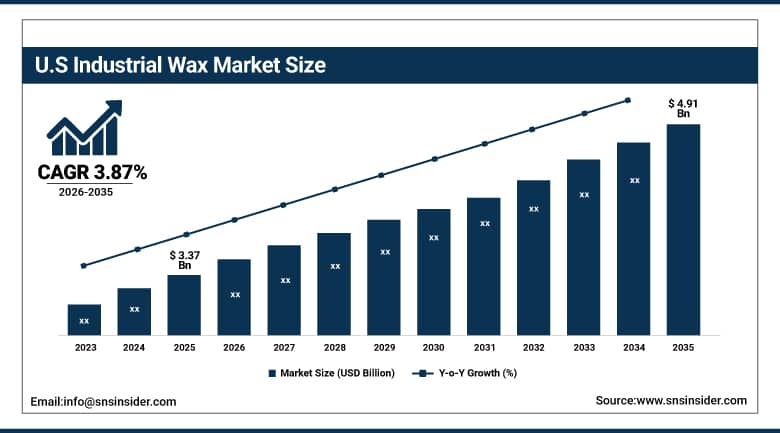
The U.S. Industrial Wax Market was valued at USD 3.37 billion in 2025 and is expected to reach around USD 4.91 billion by 2035, growing at a CAGR of 3.87% from 2026–2035.
The U.S. industrial wax market is a highly developed specialty chemical market driven by strong demand from packaging, plastics, rubber, cosmetics and personal care, adhesives, paper and board, and industrial manufacturing sectors. Growth is supported by advanced wax technologies such as hydro processed paraffin wax, microcrystalline wax, Fischer–Tropsch synthetic wax, and bio-based formulations, along with emulsification and blending systems that improve protection, lubrication, moisture resistance, and coating performance. Rising demand for high-purity, sustainable wax solutions further strengthens the market. Key players including ExxonMobil, Shell, Sasol, TotalEnergies, Calumet Specialty Products Partners, and HF Sinclair are expanding capacity and focusing on innovation and sustainability.
Government efforts in the United States to enhance chemical safety, environmental sustainability, and industrial compliance through EPA chemical regulations, REACH-aligned safety standards, energy efficiency initiatives, and sustainable petrochemical production policies are driving increased demand for industrial wax solutions. These initiatives, along with growing focus on circular economy adoption, sustainable packaging development, and modernization of petrochemical refining infrastructure, are further supporting market growth.
Industrial Wax Market Segment Analysis
-
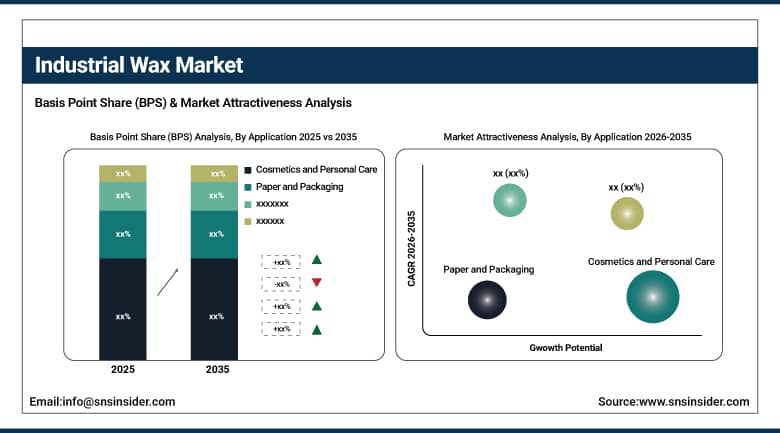
By Application, cosmetics and personal care dominated the industrial wax market with 39.10% share in 2025; while paper and packaging is the fastest growing segment.
-
By Raw Material, paraffin wax dominated the industrial wax market with 34.80% share in 2025; while candelilla wax is the fastest growing segment.
-
By Functionality, functionality dominated the industrial wax market with 33.70% share in 2025; while gloss enhancing is the fastest growing segment.
-
By Type, fossil-based wax dominated the industrial wax market with 48.60% share in 2025; while bio-based wax is the fastest growing segment.
By Application, cosmetics and personal care dominated the industrial wax market, while paper and packaging are the fastest growing segment.
Cosmetics & Personal Care sector was dominant in the industrial wax market in 2025 due to the extensive use of wax in lipsticks, creams, lotions, and skincare products to improve texture, stability, gloss, and overall formulation quality. Industrial wax is widely used to enhance product performance, shelf life, and sensory appeal in premium cosmetic formulations. Rising consumer preference for high-quality beauty and personal care products, along with growing demand for skincare and grooming solutions, further drives strong industrial wax consumption in this segment.
Paper & Packaging sector is expected to record the fastest CAGR during 2026–2035, driven by rising demand for sustainable, moisture-resistant, and eco-friendly packaging solutions across e-commerce, food, pharmaceuticals, and consumer goods industries. Growth is supported by increasing online retail activity, stricter regulations on plastic usage, and growing adoption of recyclable and biodegradable packaging materials. These factors are encouraging wider use of wax-coated packaging solutions globally.
By Raw Material, paraffin wax dominated the industrial wax market, while candelilla wax are the fastest growing segment.
Paraffin Wax segment held the dominant market share in terms of revenue in the industrial wax market in 2025 due to its easy availability, cost-effectiveness, and strong demand across packaging, cosmetics, candles, and various industrial applications. Its excellent properties such as moisture resistance, lubrication, and efficient coating make it highly suitable for large-scale manufacturing and industrial production processes, further strengthening its widespread adoption globally.
Candelilla Wax segment is expected to record the fastest CAGR during 2026–2035, driven by rising demand for natural, plant-based, and sustainable wax alternatives. Its increasing use in cosmetics, personal care, and pharmaceutical formulations is supported by the growing clean-label trend and consumer preference for eco-friendly ingredients, making it a highly preferred option in premium product formulations.
By Functionality, antiblocking dominated the industrial wax market, while gloss enhancing are the fastest growing segment.
Antiblocking segment held the dominant market share in terms of revenue for the industrial wax market in 2025 due to its widespread usage in plastic, rubber, and packaging industries as an effective anti-sticking agent. Demand is driven by large-scale production activities, cost-effectiveness, and its crucial role in improving processing efficiency by reducing friction, preventing adhesion, and enhancing overall product handling and performance in industrial applications.
Gloss Enhancing segment is expected to record the fastest growth rate during 2026–2035 due to rising demand for high-quality finishing and premium appearance products across packaging, cosmetics, and coatings industries. Increasing consumer preference for glossy, visually appealing products is boosting adoption of wax-based gloss enhancers, which improve surface shine, aesthetic value, and product differentiation in competitive markets.
By Type, fossil-based wax dominated the industrial wax market, while bio-based wax are the fastest growing segment.
Fossil-Based Wax Segment generated the dominated revenue share during the period of analysis owing to its abundant availability, affordability, and effective supply chain due to the extraction process from oil refining industries. Fossil-based waxes are commonly used in the packaging industry, coatings, adhesive, and industrial applications owing to their stable performance and consistency in production processes in various end-use industries.
Bio-based Wax Segment will witness the fastest CAGR between 2026-2035 owing to stringent environmental norms, sustainability trends, and consumer preference towards sustainable products. The demand for bio-based wax is rapidly increasing across cosmetics, packaging, and food segments as companies adopt sustainable production processes by using natural and renewable sources such as plant wax.
Regional Analysis:
|
Region |
Major Country |
Share within Region, 2025(%) |
|---|---|---|
|
North America |
United States |
72.84% |
|
Europe |
Germany |
25.10% |
|
Asia Pacific |
China |
28.60% |
|
Middle East & Africa |
UAE |
5.00% |
|
Latin America |
Brazil |
7.40% |
North America Industrial Wax Market Insights
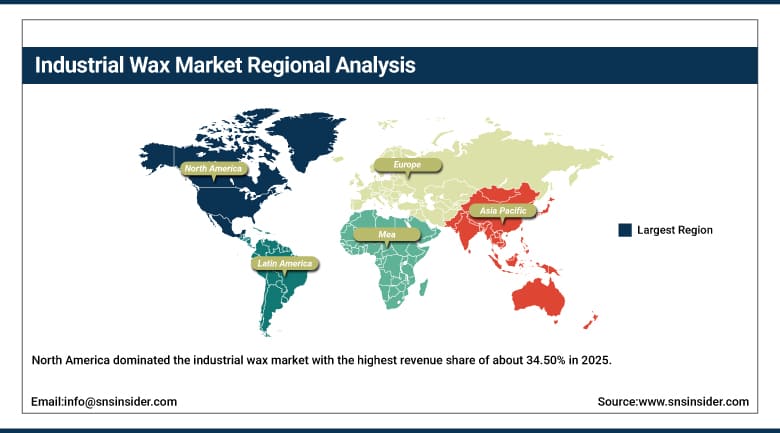
North America dominated the industrial wax market with the highest revenue share of about 34.50% in 2025 due to strong demand from packaging, adhesives, coatings, cosmetics, pharmaceuticals, rubber, and paper industries, along with high adoption of advanced wax processing technologies such as refined paraffin wax, microcrystalline wax solutions, synthetic wax blends, and high-performance specialty wax formulations. The region benefits from strong presence of key players such as ExxonMobil, Baker Hughes, The International Group, Inc., IGI Wax, and Sonneborn LLC, along with widespread industrial usage across the United States and Canada in packaging, personal care, and manufacturing applications.
Get Customized Report as Per Your Business Requirement - Enquiry Now
Europe Industrial Wax Market Insights
Europe is an extremely significant region in the industrial wax market, which can be attributed to its strong focus on sustainability, high-quality manufacturing standards, and strict regulatory compliance regarding chemical safety, food-grade applications, and environmental protection. The main European nations, including Germany, France, United Kingdom, Italy, and Netherlands, have been making significant contributions by adopting advanced wax-based coatings, bio-based wax materials, and specialty wax solutions across packaging, cosmetics, automotive, and pharmaceutical industries. There are several European regulations such as EU REACH regulations, EU Packaging and Packaging Waste Directive, food-contact material safety standards, and Green Deal sustainability initiatives that are helping Europe adopt more eco-friendly and high-performance industrial wax technologies.
Asia Pacific Industrial Wax Market Insights
Asia Pacific segment is expected to grow at the fastest CAGR of about 5.64% from 2026–2035 due to rapid industrialization, expanding manufacturing base, and increasing adoption of applications such as packaging, adhesives, and cosmetics across emerging economies in the region. Rising demand for food packaging, personal care products, rubber processing, and industrial coatings is driving strong adoption of industrial wax solutions. Government initiatives focused on manufacturing expansion, smart industry development, and export-oriented production are further accelerating growth. Increasing infrastructure development and rising consumption of consumer goods also support rapid market expansion in the region.
Middle East & Africa and Latin America Industrial Wax Market Insights
The Middle East & Africa and Latin American regions are set to see continued growth within the industrial wax market due to increasing industrialization, infrastructure development, and rising demand for packaging, construction materials, cosmetics, and adhesives applications. Nations like the United Arab Emirates, Saudi Arabia, and South Africa in the Middle East & Africa region are adopting industrial wax solutions in construction coatings, packaging, and automotive applications. In the Latin American region, countries like Brazil and Mexico are creating demand owing to expanding food packaging industries, cosmetics manufacturing, rubber processing, and growing adoption of industrial manufacturing and export-driven production activities.
Market Dynamics:
Growth Drivers: Rising Demand from Packaging, Adhesives, and Coatings Industry Boosting Industrial Wax Consumption Globally
The rapid growth in the packaging industry, adhesive industry, and coating industry is leading to an increased demand for industrial wax throughout the world. Industrial wax finds application in paper, cardboard, food packaging, and flexible packaging materials where waxing is done to provide protection against moisture. The increasing use of e-commerce and retail marketing, as well as an increase in the consumption of processed foods, is further increasing the demand for wax-coated packaging. Moreover, adhesives and hot melt also use wax for better results.
Restraints: Environmental Regulations and Shift toward Sustainable Alternatives Restricting Traditional Fossil-Based Wax Usage
Due to the tightening of regulations owing to environmental laws and the focus on sustainability, traditional petrochemical waxes cannot be used freely in many places. Regulations such as REACH and safety laws have made it essential for companies to reduce their use of petroleum-derived wax. Companies are increasingly using biodegradable and recycled waxes, which cost more money and require sophisticated technology. This is proving difficult for the producers of traditional waxes. In addition to this, the problem of carbon footprints has forced companies to change their product formulations.
Opportunities: Technological Advancements in Wax Processing and Functional Wax Development Enhancing Industrial Application Scope
Innovations in technology in relation to the production of wax are giving rise to several possibilities for wax products that not only have a high performance level but also can be used for multiple purposes. Wax refinement and blending techniques have helped to ensure desirable features such as the stable melting point, lubricity, non-blocking property, and good quality in terms of glossing capability. Moreover, this technological innovation has also led to an increased usage of these wax products in applications such as electric cars, coatings, and intelligent packaging materials.
Recent Developments
-
2026: ExxonMobil expanded its industrial wax and specialty hydrocarbon portfolio through refinery optimization and higher-value paraffin wax production, focusing on packaging, adhesives, and industrial coating applications with improved performance efficiency.
-
2025: Sasol strengthened its Fischer–Tropsch wax product line with enhanced low-carbon and high-purity wax grades, targeting sustainable packaging, cosmetics, and industrial applications across global supply chains.
-
2025: BASF enhanced its specialty chemicals and wax additive solutions portfolio, focusing on advanced coating performance, plastics processing efficiency, and sustainable material innovation for industrial applications.
-
2024: Shell optimized its downstream chemicals and hydrocarbon derivatives operations, improving industrial wax feedstock integration and supporting cleaner refining processes for packaging and coating industries.
Industrial Wax Market Key Players are:
-
Sasol
-
ExxonMobil
-
Shell
-
TotalEnergies
-
Sinopec
-
PetroChina
-
Nippon Seiro
-
BASF
-
Clariant
-
Evonik Industries
-
Calumet Specialty Products Partners
-
H&R ChemPharm Group
-
HF Sinclair
-
International Group Inc. (IGI Wax)
-
Kerax Limited
-
Repsol
-
Indian Oil Corporation
-
Numaligarh Refinery Limited
-
Petroliam Nasional Berhad (PETRONAS)
-
PT Pertamina
Industrial Wax Market Report Scope:
| Report Attributes | Details |
|---|---|
| Market Size in 2025 | USD 13.41 Billion |
| Market Size by 2035 | USD 21.24 Billion |
| CAGR | CAGR of 4.73% From 2026 to 2035 |
| Base Year | 2025 |
| Forecast Period | 2026-2035 |
| Historical Data | 2022-2024 |
| Report Scope & Coverage | Market Size, Segments Analysis, Competitive Landscape, Regional Analysis, DROC & SWOT Analysis, Forecast Outlook |
| Key Segments | • By Application (Polishes and Emulsions, Plastics and Rubber, Paper and Packaging, Cosmetics and Personal Care) • By Raw Material (Paraffin Wax, Synthetic Wax, Carnauba Wax, Candelilla Wax, Beeswax) • By Functionality (Antiblocking, Water Repellent, Gloss Enhancing, Lubricating) • By Type (Fossil-Based Wax, Synthetic Wax, Bio-based Wax, Microcrystalline Wax, Petroleum Wax) |
| Regional Analysis/Coverage | North America (US, Canada), Europe (Germany, UK, France, Italy, Spain, Russia, Poland, Rest of Europe), Asia Pacific (China, India, Japan, South Korea, Australia, ASEAN Countries, Rest of Asia Pacific), Middle East & Africa (UAE, Saudi Arabia, Qatar, South Africa, Rest of Middle East & Africa), Latin America (Brazil, Argentina, Mexico, Colombia, Rest of Latin America). |
| Company Profiles | Sasol, ExxonMobil, Shell, TotalEnergies, Sinopec, PetroChina, Nippon Seiro, BASF, Clariant, Evonik Industries, Calumet Specialty Products Partners, H&R ChemPharm Group, HF Sinclair, International Group Inc. (IGI Wax), Kerax Limited, Repsol, Indian Oil Corporation, Numaligarh Refinery Limited, Petroliam Nasional Berhad (PETRONAS), PT Pertamina |

Frequently Asked Questions
The industrial wax market is expected to grow at a CAGR of 4.73% from 2026 to 2035.
The industrial wax market was valued at USD 13.41 billion in 2025.
Rising demand from packaging, adhesives, coatings, cosmetics, and manufacturing is driving the industrial wax market. Growing use in surface protection, lubrication, moisture resistance, and sustainable packaging is further supporting market growth.
The cosmetics and personal care segment dominated the industrial wax market in 2025.
North America dominated the industrial wax market in 2025.
