
Interplanetary Dust Sensor Market Report Scope & Overview:
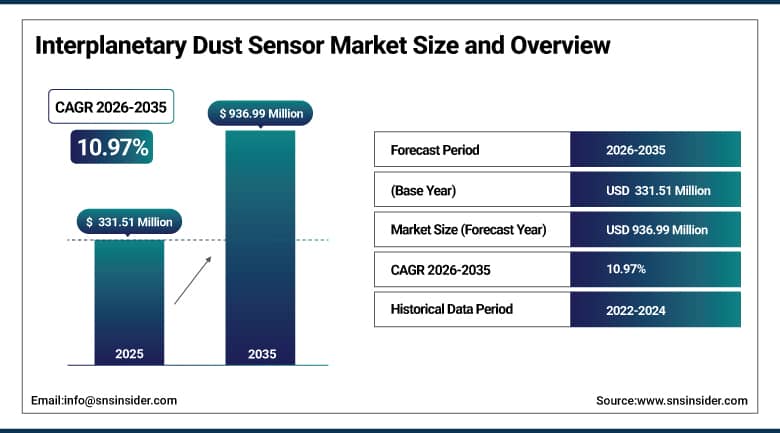
The Interplanetary Dust Sensor Market was valued at USD 331.51 million in 2025 and is expected to reach USD 936.99 million by 2035, growing at a CAGR of 10.97% from 2026–2035.
The interplanetary dust sensor market is witnessing steady growth in the global market owing to rising deep space exploration missions. Increasing satellite deployment and interplanetary research programs are boosting sensor adoption. Growing focus on space debris detection is supporting market expansion. Manufacturers are developing highly sensitive detection technologies. Rising investments in space science and astronomy missions are driving innovation. Increasing collaboration between space agencies and private players is accelerating market adoption.
The big space organizations control more than 100 science missions that focus on small payloads and on-board processing. Although more than 80 countries today launch satellites for practical use on Earth, space exploration is a narrow field. For space missions, on-board hardware processing is critical to compress large amounts of data from mass spectrometers.
To Get More Information On Interplanetary Dust Sensor Market - Request Free Sample Report
Interplanetary Dust Sensor Market Trends
-
-
Miniaturized sensors of interplanetary dust can be used in conjunction with small satellites and deep space exploration CubeSats efficiently.
-
The use of artificial intelligence will result in increased precision and speed of analyzing dust particles in real time.
-
Increasing number of satellite constellations leads to an increase in the need for constant monitoring of the space environment and detection of interplanetary particles around the Earth.
-
Increase in concerns about micro-meteoroids and space debris results in increased adoption of advanced dust detection techniques to protect the spacecraft.
-
Onboard space mission’s advancements in processing will allow for faster decision-making in space without depending much on earth-based processing systems.
-
Integration of smart sensors into satellites is resulting in increased performance in space missions and long-duration deep space explorations.
-
U.S. Interplanetary Dust Sensor Market Outlook
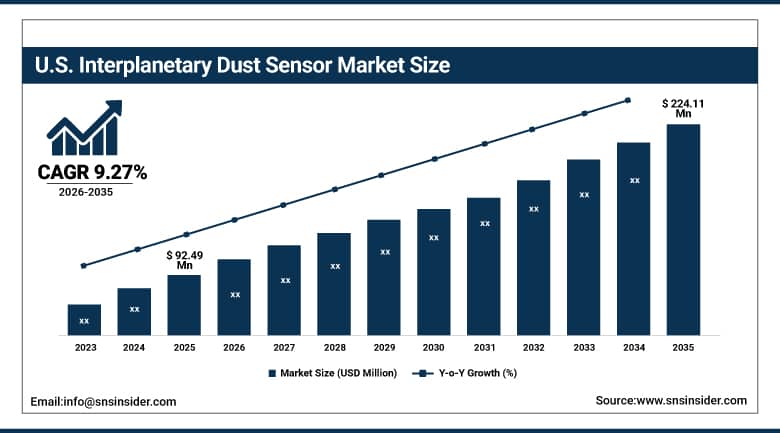
The U.S. Interplanetary Dust Sensor Market was valued at USD 92.49 million in 2025 and is expected to reach around USD 224.11 million by 2035, growing at a CAGR of 9.27% from 2026–2035.
The U.S. interplanetary dust sensor market is expanding steadily owing to strong space exploration programs. NASA-led deep space missions are driving consistent demand for advanced dust sensing systems. Increasing focus on planetary protection and spacecraft safety is supporting market growth. Rising investments in interplanetary research and satellite shielding technologies are further accelerating adoption. Growth in commercial space missions is strengthening sensor deployment. Manufacturers are focusing on high-precision impact ionization and optical sensor technologies. Increasing collaboration between government and private space companies is boosting innovation and market penetration.
According to the NASA’s Science Mission Directorate presently runs more than thirty planetary and heliophysics missions, many of which have customized in-situ particle sensors to measure dust and particles. This custom instrumentation is currently analyzing the dust environment of the universe. In addition, the National Academy decadal survey gives prominence to dust analysis and sample return missions as key elements of the U.S. future space explorations.
Interplanetary Dust Sensor Market Segment Analysis
-
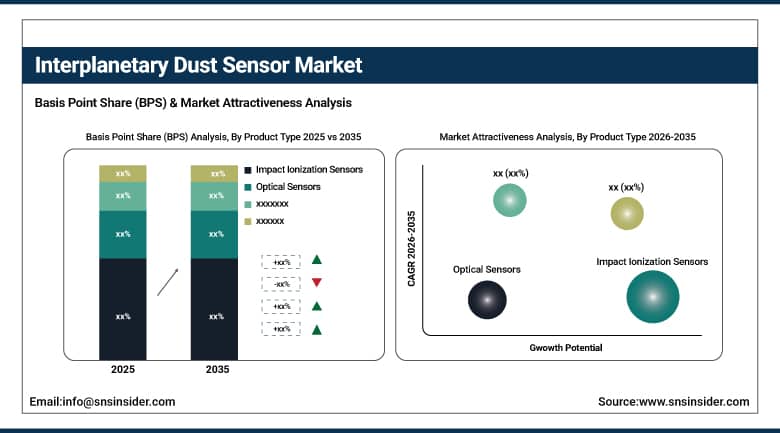
By Product Type, impact ionization sensors dominated the market with 54.32% share in 2025; while optical sensors are the fastest growing segment with CAGR of 15.18% during 2026 to 2035.
-
By Application, space missions dominated the market with 56.74% share in 2025; while satellite protection is the fastest growing segment with CAGR of 15.75% during 2026 to 2035.
-
By Platform, space probes dominated the market with 48.91% share in 2025; while satellites are the fastest growing segment with CAGR of 14.92% during 2026 to 2035.
-
By End-User, space agencies dominated the market with 57.83% share in 2025; while commercial space companies are the fastest growing segment with CAGR of 19.60% during 2026 to 2035.
By Product Type, impact ionization sensors dominated the interplanetary dust sensor market, while optical sensors are the fastest growing segment.
The Impact Ionization Sensors segment captured the leading share in terms of revenue in the interplanetary dust sensor market in 2025 owing to their high sensitivity to microscopic dust particles in space conditions. Impact ionization sensors give real-time impact detection and are used in deep space missions. Due to their reliability and longevity, these sensors remain the most favorable among all types of sensors used in space exploration.
The Optical Sensors segment is projected to grow with the highest CAGR between 2026 and 2035 owing to growing demands for non-contact type detection technology in space exploration applications. Optical sensors have higher resolution particle analysis and accurate data detection compared to other technologies available in the industry. Increasing demand for optical sensors in satellite safety and miniature space instrumentations is driving the segment growth.
By Application, space missions dominated the interplanetary dust sensor market, while satellite protection is the fastest growing segment.
Space Missions segment held the dominated revenue share in the interplanetary dust sensor market in 2025 owing to the presence of various deep space exploration missions and interplanetary research missions. Growing number of planetary science and asteroid missions are increasing the use of sensors. Increasing investments of space agencies in scientific payloads is adding to the growing demand. Increasing requirement for monitoring of dust environment in space missions is aiding market leadership.
The Satellite Protection segment is anticipated to register the fastest CAGR during the forecast period from 2026 to 2035 because of increasing numbers of satellite launches along with increasing threat of orbit congestion. Increasing threats related to micrometeoroids and dust particles are increasing the adoption. Increasing emphasis on extending satellite lifetime and safety in space missions is propelling the demand. Growth of commercial satellite constellations is further aiding the growth.
By Platform, space probes dominated the interplanetary dust sensor market, while satellites is the fastest growing segment.
Space Probes segment emerged as the leading segment in the global interplanetary dust sensor market, accounting for the dominated revenue share in 2025. The dominance of the segment is due to the presence of multiple deep space exploration and planetary science research projects. Advanced dust sensors are installed on space probes to measure particles in space directly. High project cost and duration of scientific objectives fuel their installation. There is increasing emphasis on analyzing cosmic dust compositions and solar system origin.
The Satellites segment is projected to register the fastest CAGR during the forecast period of 2026 to 2035. This is attributed to the rapid rise in satellite constellation and space observation networks. Demand for space situational awareness and space debris tracking encourages their installation on satellites. Miniaturization of sensor technology enables their easy installation on small satellites. The increasing number of commercial satellite projects and orbital observation programs fuels their adoption.
By End-User, space agencies dominated the interplanetary dust sensor market, while commercial space companies are the fastest growing segment.
The Space Agencies segment held the dominated revenue share of the interplanetary dust sensor market in 2025 owing to heavy government investments in exploring deep space. Rising planetary science missions by NASA, ESA, and ISRO fuel the demand. High funding in scientific instruments and space missions encourages adoption. Presence of well-established infrastructure and consistent research initiatives aid in dominating the advanced space instrument development market.
The Commercial Space Companies segment is projected to witness the fastest CAGR from 2026 to 2035 owing to the growing privatization of space exploratory missions. Rising number of satellite constellation and commercial deep space missions encourage the demand. Increasing funding from the private aerospace companies is propelling the adoption of sensors. The technological advancement in the launch systems and lowering the cost of launch systems fuel the expansion of the market.
Regional Analysis
|
Region |
Major Country |
Share within Region, 2025(%) |
|---|---|---|
|
North America |
United States |
72.35% |
|
Europe |
Germany |
24.50% |
|
Asia Pacific |
China |
36.80% |
|
Middle East & Africa |
UAE |
11.20% |
|
Latin America |
Brazil |
41.30% |
North America Interplanetary Dust Sensor Market Insights.
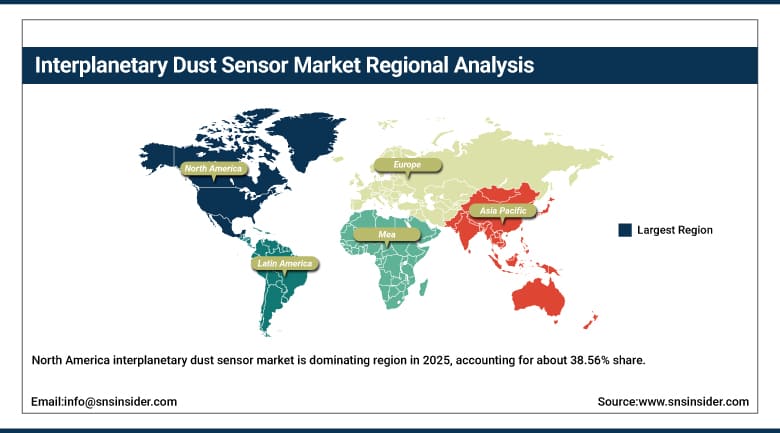
North America interplanetary dust sensor market is dominating region in 2025, accounting for about 38.56% share, driven by strong space exploration programs. The region benefits from advanced aerospace infrastructure and high government funding. Increasing NASA deep space missions and satellite research initiatives are strengthening adoption. Growing participation of private space companies is accelerating innovation. Strong R&D capabilities and technology leadership further reinforce regional dominance in sensor development.
According to the Science Mission Directorate of NASA and the Decadal Survey 2023-2032, the U.S. maintains more than 30 planetary and Helio physics missions, among them there are also specific missions equipped with in-situ dust and particulates detectors. Dust and particulate sensors in interplanetary space have been launched on more than 15 spacecraft missions since the time of Voyager era, and the current sensors possess micron/sub-micron capabilities. In addition, according to NASA and the U.S. Geological Survey, there is an increasing trend towards expanding space environment monitoring systems.
Get Customized Report as Per Your Business Requirement - Enquiry Now
Europe Interplanetary Dust Sensor Market Insights.
Europe interplanetary dust sensor market is characterized by stable growth in 2025 owing to strong ESA-led space exploration initiatives. Key countries include Germany, France, United Kingdom, and Italy. Rising focus on planetary science missions is driving adoption. Increasing collaboration among European aerospace firms is supporting sensor innovation. Growth in space research funding and scientific payload development is further strengthening market expansion across the region.
According to the Space Environment Report 2025 and Space Safety Programme documents published by ESA, Europe's foremost space environment monitoring program is aimed at reducing space debris from humans, which are estimated to be around 1.2 million pieces larger than 1 centimeter. Even though there are a few numbers of missions in deep space, such as BepiColombo, that are equipped with in-situ particle impact detectors, ESA's space environment monitoring program depends largely on radars and telescopic observations from the ground and space weather missions.
Asia Pacific Interplanetary Dust Sensor Market Insights.
Asia Pacific is the fastest growing region in the interplanetary dust sensor market, registering a CAGR of about 13.38% during 2026–2035. Rapid expansion of space programs in China, India, Japan, and South Korea is driving strong demand. Increasing satellite launches and interplanetary missions are accelerating adoption. Growing investment in space technology infrastructure is further boosting market growth. Rising scientific research capabilities are supporting regional expansion.
According to the Indian Space Research Organisation, ‘Indian Space Situation Awareness Report 2025’, by the end of 2025, India had 53 operational government satellites and 2 deep space missions along with five successful launch missions. Responding to the increasing amount of manmade space debris in earth orbits, the Indian Space Research Organisation evaluated 150,000 close approach alerts and undertook 18 collision avoidance missions. The increase in such orbital traffic has led to investment in SSA facilities in the region including radars and optical sensors on the ground.
Middle East & Africa and Latin America Interplanetary Dust Sensor Market Insights.
The Middle East & Africa along with Latin America regions are witnessing steady growth due to emerging space programs. Key countries include UAE, Saudi Arabia, Brazil, and Mexico. Increasing investment in satellite development is driving demand. Rising participation in space research collaborations is supporting market expansion. Growth in academic space research and government initiatives is further strengthening regional adoption of advanced sensor technologies.
As stated by the United Nations Office for Outer Space Affairs, the Middle East and Latin America are continuing their development of national space programs with countries such as the UAE, Saudi Arabia, Brazil, and Argentina having strong satellite programs. On the other hand, the Africa Space Policy of the African Union focuses on the development of satellites throughout the African continent for Earth observation, satellite communications, and navigation with the aim of solving socio-economic and environmental problems. In all these emerging space economies, the emphasis is clearly on terrestrial use of space data.
Market Dynamics
Growth Drivers: Growing satellite deployment and space debris monitoring needs boosting precision interplanetary dust detection technologies
Fast growth of satellite constellations raises demands for space environment monitoring systems. Growing anxiety about the dangers of micro-meteoroids and orbit debris stimulates interest in dust detectors. The safety improvement of spacecrafts becomes a priority for space agencies and commercial companies. Permanent monitoring of interplanetary dust particles becomes necessary to secure the mission. Advanced sensors become increasingly integrated into satellites to ensure reliable space operations.
As per the ESA Space Environment Report 2025, around 40,000 space objects are being tracked by agencies regularly in Earth’s orbits, while about 1.2 million pieces of debris, each greater than one centimeter in size, have been reported. Furthermore, as per historic data, more than 20,000 objects have been sent into orbit up to early 2025, out of which around 15,000 objects were in the orbit, and approximately 11,000 of them were functioning payloads. These growing trends of congestion in orbit are causing a worldwide need for Space Situational Awareness systems that are largely dependent on ground radar systems
Restraints: Harsh space environment conditions and limited mission frequency restricting continuous data collection and sensor utilization
High extremes in temperatures and exposure to radiation in deep space missions can negatively influence the sensor stability. Small number of interplanetary missions leads to lack of constant information flow. High mission risk and long development period limit the number of launches. High communication lag and limitations in data transfer prevent real time analysis. Rare launch of planetary missions limits the operation possibilities. Unpredictable conditions in outer space add up to the difficulties of instrument functioning.
Opportunities: Advancements in miniaturized sensor technologies and AI based data analysis enhancing interplanetary dust research capabilities
The development of miniaturized and lightweight sensor systems makes it easy to install them on small satellites. The integration of artificial intelligence is making the dust particles analysis more accurate. Increased capability of onboard processing is helping in real-time data interpretation. The trends in miniaturization are allowing for reduced payload considerations while launching. Increased usage of smart sensor systems is increasing the efficiency of the mission.
According to the European Space Agency and NASA, more than 50 active deep-space and planetary science missions are currently operating or in development globally. To maximize scientific yield over limited communication bandwidths, modern payloads are increasingly reliant on advanced onboard autonomous data processing. In the field of interplanetary dust sensing, these processing capabilities allow instruments to autonomously filter out noise and compress complex mass-spectrometry data in real-time, resulting in vastly improved detection accuracy and high-resolution chemical analysis of sub-micron particles without requiring heavier spacecraft payloads.
Recent Developments
-
2026: Rocket Lab USA, Inc. announced an $8 billion acquisition of Iridium Communications to expand satellite manufacturing capabilities.
-
2025: MDA Space Ltd. signed a definitive $1.1 billion contract with Globalstar to manufacture next-generation LEO constellation satellites.
-
2025: Leonardo S.p.A. signed a strategic Memorandum of Understanding with Airbus and Thales to create a European space alliance.
-
2024: Honeywell International Inc. signed a strategic $17 billion agreement with Bombardier covering advanced avionics and satellite communications technologies.
Interplanetary Dust Sensor Market Key Players are:
-
Lockheed Martin Corporation
-
Northrop Grumman Corporation
-
Thales Group
-
Teledyne Technologies Incorporated
-
Airbus SE
-
RTX Corporation
-
L3Harris Technologies, Inc.
-
Honeywell International Inc.
-
BAE Systems plc
-
Leonardo S.p.A.
-
OHB SE
-
Mitsubishi Electric Corporation
-
NEC Corporation
-
Redwire Corporation
-
MDA Space Ltd.
-
Safran S.A.
-
Kongsberg Gruppen ASA
-
Rocket Lab USA, Inc.
-
AAC Clyde Space AB
-
von Hoerner & Sulger GmbH
Interplanetary Dust Sensor Market Report Scope:
| Report Attributes | Details |
|---|---|
| Market Size in 2025 | USD 331.51 Million |
| Market Size by 2035 | USD 936.99 Million |
| CAGR | CAGR of 10.97% From 2026 to 2035 |
| Base Year | 2025 |
| Forecast Period | 2026-2035 |
| Historical Data | 2022-2024 |
| Report Scope & Coverage | Market Size, Segments Analysis, Competitive Landscape, Regional Analysis, DROC & SWOT Analysis, Forecast Outlook |
| Key Segments | • By Product Type (Impact Ionization Sensors, Optical Sensors, Acoustic Sensors, Others) • By Application (Space Missions, Satellite Protection, Research & Development, Others) • By Platform (Space Probes, Satellites, Spacecraft, Others) • By End-User (Space Agencies, Research Institutes, Commercial Space Companies, Others) |
| Regional Analysis/Coverage | North America (US, Canada), Europe (Germany, UK, France, Italy, Spain, Russia, Poland, Rest of Europe), Asia Pacific (China, India, Japan, South Korea, Australia, ASEAN Countries, Rest of Asia Pacific), Middle East & Africa (UAE, Saudi Arabia, Qatar, South Africa, Rest of Middle East & Africa), Latin America (Brazil, Argentina, Mexico, Colombia, Rest of Latin America). |
| Company Profiles | Lockheed Martin Corporation, Northrop Grumman Corporation, Thales Group, Teledyne Technologies Incorporated, Airbus SE, RTX Corporation, L3Harris Technologies, Inc., Honeywell International Inc., BAE Systems plc, Leonardo S.p.A., OHB SE, Mitsubishi Electric Corporation, NEC Corporation, Redwire Corporation, MDA Space Ltd., Safran S.A., Kongsberg Gruppen ASA, Rocket Lab USA, Inc., AAC Clyde Space AB, von Hoerner & Sulger GmbH |

Frequently Asked Questions
The major growth factors include rising deep space exploration missions, increasing satellite deployments, expanding space science investments, advancements in miniaturized AI-enabled sensors, growing debris monitoring requirements, and stronger collaboration between government agencies and commercial space companies.
The interplanetary dust sensor market was valued at USD 331.51 million in 2025.
