
LiDAR Perimeter Detection Market Report Scope & Overview:
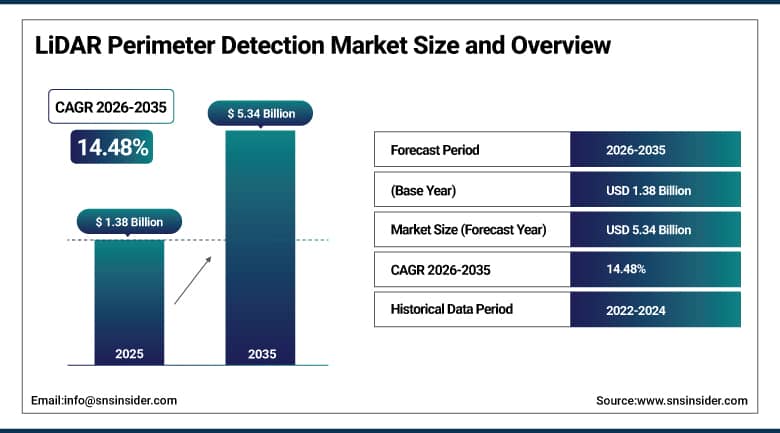
The LiDAR Perimeter Detection Market was valued at USD 1.38 Billion in 2025 and is expected to reach USD 5.34 Billion by 2035, growing at a CAGR of 14.48% from 2026 to 2035.
Perimeter security has traditionally relied on cameras and motion sensors that struggle with poor lighting, bad weather, or simply telling a genuine intruder apart from a stray animal, and LiDAR has emerged as a genuinely compelling answer to all three problems at once. By mapping a secured boundary in precise 3D and tracking movement through laser light rather than visible light, LiDAR systems deliver accurate, real-time monitoring in virtually any lighting or weather condition, distinguishing real intrusions from harmless environmental activity by analyzing object size, movement speed, and direction. That combination of accuracy and reliability has made LiDAR increasingly central to security programs at nuclear sites, power plants, airports, data centers, and other facilities where a false alarm is costly and a missed intrusion is potentially catastrophic. Continuous innovation in hardware and software, alongside steadily improving detection accuracy and reduced false alarm rates, keeps positioning LiDAR as a critical component of modern perimeter security infrastructure.
In January 2025, Ouster, Inc. was awarded a USD 2 million contract to deploy its BlueCity LiDAR traffic management system across more than 120 intersections in Chattanooga, Tennessee, creating what the company describes as the largest LiDAR-enabled smart traffic network currently operating anywhere in the United States, a genuine milestone for city-scale LiDAR deployment.
To Get More Information On LiDAR Perimeter Detection Market - Request Free Sample Report
LiDAR Perimeter Detection Market Trends
-
Rising adoption of 4D LiDAR is helping critical infrastructure facilities improve security and real-time threat monitoring, even in poor visibility and complicated environmental conditions.
-
Multi-sensor integration, combining LiDAR with cameras, radar, and thermal imaging, is becoming increasingly common to strengthen overall detection reliability.
-
Automated intrusion detection and intelligent analytics for predictive monitoring are moving from premium features to standard expectations across the industry.
-
Organizations are steadily switching from conventional sensors to intelligent LiDAR-based perimeter systems that lower false alarms and automate detection workflows.
-
Rising demand for scalable, cost-effective security solutions continues fueling market expansion across government, industrial, and commercial applications alike.
The U.S. LiDAR Perimeter Detection Market Outlook
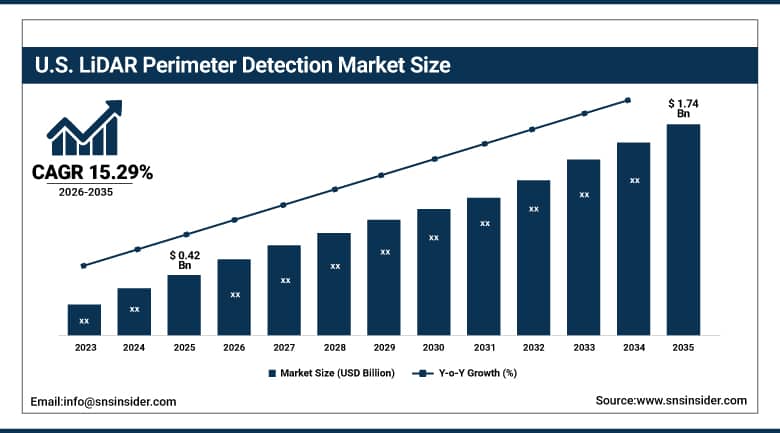
The U.S. LiDAR Perimeter Detection Market is estimated to be USD 0.42 Billion in 2025 and is projected to reach USD 1.74 Billion by 2035, growing at a CAGR of 15.29% during 2026–2035.
Growth in the U.S. market is being driven by increasing security requirements across industrial, commercial, and governmental sectors, alongside rising demand for advanced surveillance technologies capable of real-time threat detection and perimeter monitoring. Adoption of AI-driven analytics, 3D mapping, and multi-sensor integration is enhancing operational efficiency and reducing false alarms across American security deployments, and continuous innovation in LiDAR hardware and software, combined with sustained investment in critical infrastructure and smart facilities, keeps positioning the U.S. as a leading hub for next-generation perimeter security solutions. The country's defense sector in particular has been an early and consistent adopter, reinforcing American leadership in both LiDAR technology development and deployment scale.
Hesai launched its AT512 ultra long-range ADAS LiDAR and ET25 ultra-thin windshield-mounted LiDAR in January 2024, alongside opening a 740,000 square foot Maxwell R&D and manufacturing center, a significant investment advancing high-resolution, long-range LiDAR technology for both automotive and industrial security applications.
LiDAR Perimeter Detection Market Segment Analysis
-
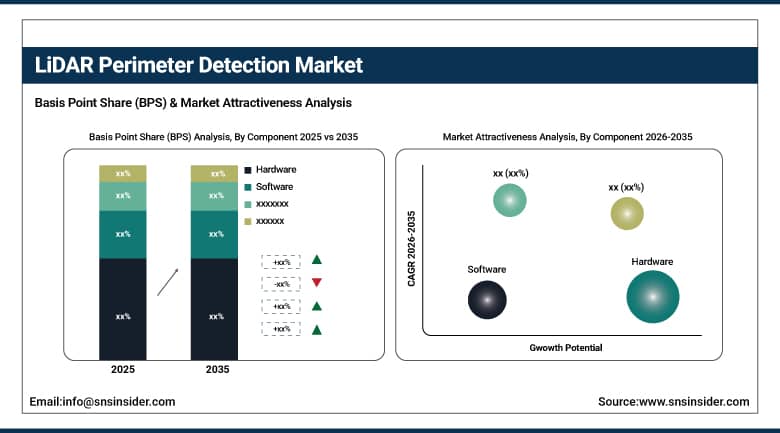
By Component, Hardware led the market with a 58.88% share in 2025, while Software is the fastest-growing component segment at a CAGR of 17.79%.
-
By Application, Commercial applications led with a 25.25% share in 2025, while Industrial applications is the fastest-growing application segment at a CAGR of 15.61%.
-
By Range, Long-Range systems dominated with a 48.75% share in 2025, reflecting their capability to cover extensive areas and support critical operations reliably.
By Component, Hardware leads, Software grows fastest
Hardware dominated in terms of the component category as the largest segment capturing 58.88% of the market value in 2025 owing to the indispensable nature of this component that provides the necessary reliability and robustness needed for perimeter security applications. Lasers, sensors and detectors are essential elements that make up the LiDAR system physically, which has been enough to ensure the dominant position of hardware revenues over the software one.
Software has emerged as the fastest growing component segment driven by the increasing use of AI, automation platforms and analytics capabilities that ensure efficient and flexible operation of the system. In view of the fact that LiDAR hardware has already reached its maturity stage, the true point of difference offered by vendors lies in the software segment that determines the ability of the system to discriminate threats from the environmental background and, thus, drives the rapid software growth rate.
By Application, Commercial leads, Industrial grows fastest
Commercial applications continued to lead the application segment, holding a 25.25% share in 2025, due to their widespread adoption across various sectors and consistent demand for efficiency and automation. Office parks, retail complexes, and other commercial facilities have proven a steady, reliable source of demand, since commercial property owners increasingly view LiDAR-based perimeter security as a meaningful upgrade over traditional camera-only systems.
Industrial applications are the fastest-growing segment, at a CAGR of 15.61%, driven by increasing automation, smart manufacturing, and AI-enabled processes that enhance productivity and operational safety simultaneously. As factories and industrial facilities keep automating their broader operations, perimeter security is increasingly getting folded into that same digital transformation push, and that convergence is what's driving industrial applications' growth rate ahead of the already-dominant commercial segment.
By Range, Long-Range dominates
Long-range systems remained the dominant range segment, holding a 48.75% share, due to their capability to cover extensive areas and support critical operations reliably across large, often geographically dispersed facilities. Airports, power plants, and border security applications in particular demand the kind of extended detection coverage that only long-range LiDAR can deliver without requiring dozens of overlapping shorter-range units.
Short and medium-range systems continue serving more localized, cost-sensitive applications, such as smaller commercial properties or facility perimeters where extensive coverage simply isn't necessary. As critical infrastructure protection remains the market's most demanding and highest-value use case, though, long-range systems look set to retain their leading position, since the facilities most willing to invest heavily in perimeter security tend to be exactly the large-footprint sites long-range LiDAR is built for.
Regional Analysis
|
Region |
Major Country |
Share within Region, 2025 (%) |
|---|---|---|
|
North America |
United States |
83.60% |
|
Europe |
Germany |
24.85% |
|
Asia Pacific |
China |
31.75% |
|
Middle East & Africa |
UAE |
27.90% |
|
Latin America |
Brazil |
36.40% |
North America LiDAR Perimeter Detection Market Insights
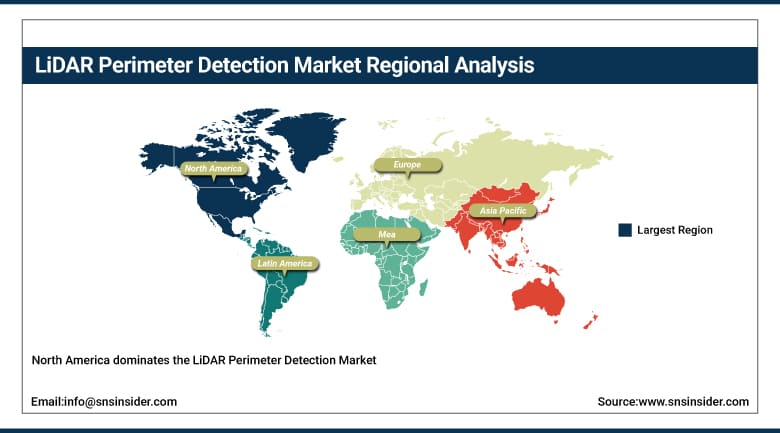
North America dominates the LiDAR Perimeter Detection Market, driven by advanced security infrastructure, rapid adoption in critical sectors, and strong technological innovation across the region's defense, government, and commercial security programs. Growing investments in smart surveillance, defense applications, and industrial automation continue bolstering market growth, positioning the region as the key hub for LiDAR-based perimeter security solutions worldwide.
The United States leads the market, fueled by advanced security infrastructure, high adoption across defense and industrial sectors, and continuous technological innovation driving robust market growth nationwide. The country accounts for roughly 83.60% of regional revenue, and Canada adds further regional demand through its own critical infrastructure protection programs, keeping North America the largest addressable market for LiDAR perimeter detection vendors well through the forecast period.
Get Customized Report as Per Your Business Requirement - Enquiry Now
Europe LiDAR Perimeter Detection Market Insights
Europe holds a meaningful share of the global LiDAR perimeter detection market, supported by strong regulatory frameworks around critical infrastructure protection and steady investment in advanced surveillance technology across the region's government and industrial sectors. Countries with significant energy, transportation, and defense infrastructure have proven particularly consistent adopters of LiDAR-based perimeter security.
Germany leads regional demand at roughly 24.85% of European revenue, supported by its extensive industrial base and consistent investment in critical infrastructure protection. The UK and France contribute substantial additional demand, and continued European investment in smart surveillance and defense modernization should keep regional demand for LiDAR perimeter detection climbing steadily through the forecast period.
Asia Pacific LiDAR Perimeter Detection Market Insights
Asia Pacific is the fastest-growing region in the LiDAR Perimeter Detection market, at a CAGR of approximately 16.13%, driven by increasing infrastructure development, rising security concerns, and rapid adoption of advanced surveillance technologies across the region's largest economies. Government-led infrastructure investment and rapidly expanding urban development are both feeding directly into rising demand for sophisticated perimeter security.
China leads the region, accounting for roughly 31.75% of regional revenue, supported by extensive infrastructure development and substantial government investment in smart surveillance technology. Japan, South Korea, and India contribute meaningful additional demand, with rapid urbanization and expanding critical infrastructure across the region continuing to drive Asia Pacific's growth rate well ahead of every other region tracked in this report.
MEA & Latin America LiDAR Perimeter Detection Market Insights
In Middle East & Africa and Latin America, there is still an ongoing process of building up the markets for LiDAR perimeter detection solutions as a result of increasing security concerns, investments in critical infrastructure projects, and government focus on safeguarding energy, transportation, and government facilities in both regions. Middle East & Africa holds a fairly stable share of worldwide revenue with a CAGR of about 12.53%, with the security infrastructure market development in this region proceeding.
UAE drives Middle East & Africa market share by accounting for around 27.90% of total regional revenue thanks to high investments in the development of critical infrastructure and a desire to develop a sophisticated security infrastructure system. Saudi Arabia and South Africa generate additional demand in this region due to their own initiatives related to infrastructure protection. In Latin America, Brazil drives regional demand generating more than 36.40% of total regional revenue.
Market Dynamics
Growth Drivers: Rising adoption of 4D LiDAR for critical infrastructure security
With the growing deployment of highly advanced 4D LiDAR systems to protect against intrusion and provide real-time monitoring capabilities of potential threats, the LiDAR perimeter detection market continues to grow. With their highly accurate object detection, efficient speed tracking, and capability of functioning without GPS, they are capable of conducting effective surveillance even in poor visibility and adverse weather conditions where cameras fail to function efficiently.
The increasing need for perimeter security of highly sensitive facilities like nuclear power plants, airports, and data centers due to the increasing security threats and inability to tolerate both false alarms and any potential intrusion are some of the factors that are prompting companies to use intelligent LiDAR-based perimeter protection systems.
Restraints: High implementation costs and technical complexity
The cost of implementing perimeter security using a LiDAR perimeter detection system is significantly higher than other conventional methods such as cameras and motion sensors and presents a real limitation for the mass adoption of these solutions, especially by smaller commercial or industrial facilities that do not have large security budgets. The advanced LiDAR perimeter security technology requires an expensive hardware and software solution, which means a much bigger investment compared to old security systems.
In terms of technical difficulties of implementation and integration with the existing security infrastructure, LiDAR technology is another factor that poses a problem for adoption by organizations without experienced technical staff. This is one of the reasons why LiDAR adoption is increasing rapidly in case of critical infrastructures but proceeds slowly when it comes to smaller commercial and industrial facilities.
Opportunities: Multi-sensor integration and smart city expansion
The growing trend toward multi-sensor integration, combining LiDAR with cameras, radar, and thermal imaging into a single unified security platform, represents a genuinely significant opportunity for vendors able to deliver seamless, interoperable systems. Facilities increasingly want a comprehensive security picture rather than managing separate, disconnected sensor systems, and vendors that can offer that integrated capability stand to capture meaningful share as security programs consolidate around fewer, more capable platforms.
Expanding smart city and traffic management applications offer a second substantial opportunity, as demonstrated by deployments like Ouster's BlueCity system in Chattanooga, which is applying LiDAR perimeter detection technology to urban traffic management at genuine city scale. As municipalities increasingly invest in smart infrastructure, LiDAR vendors with technology that can serve both traditional perimeter security and broader smart city applications are well positioned to capture a meaningfully larger addressable market than perimeter security alone would offer.
Recent Developments:
-
2026: On January 10, Nvidia announced its $20 billion acquisition of Groq, a move aimed at strengthening low-latency inference and agentic AI capabilities, which are critical for robotics execution
-
2025: December 14, iRobot filed for Chapter 11 bankruptcy due to mounting debt and margin pressures, and was subsequently acquired by Shenzhen PICEA Robotics in a $100 million debt-cancellation deal, signaling China’s growing dominance in household robotics.
LiDAR Perimeter Detection Market key players are:
-
Hesai Group
-
Ouster, Inc.
-
Velodyne Lidar (Ouster)
-
Leishen Intelligent System Co., Ltd.
-
SICK AG
-
Quanergy Systems, Inc.
-
RoboSense (Suteng Innovation Technology Co., Ltd.)
-
Innoviz Technologies Ltd.
-
Cepton, Inc.
-
Luminar Technologies, Inc.
-
Teledyne FLIR LLC
-
AEye, Inc.
-
Beijing Surestar Technology Co., Ltd.
-
Blickfeld GmbH
-
Livox Technology Company Limited
-
Panasonic Corporation
-
Trimble Inc.
-
YellowScan
-
Aeva Technologies, Inc.
-
Optex Co., Ltd.
LiDAR Perimeter Detection Market Report Scope:
| Report Attributes | Details |
|---|---|
| Market Size in 2025 | USD 1.38 Billion |
| Market Size by 2035 | USD 5.34 Billion |
| CAGR | CAGR of 14.48% From 2026 to 2035 |
| Base Year | 2025 |
| Forecast Period | 2026-2035 |
| Historical Data | 2022-2024 |
| Report Scope & Coverage | Market Size, Segments Analysis, Competitive Landscape, Regional Analysis, DROC & SWOT Analysis, Forecast Outlook |
| Key Segments | • by Component (Hardware, Software) • by Range (Short Range, Medium Range, Long Range) • by Application (Commercial, Industrial, Government & Defense, Others) |
| Regional Analysis/Coverage | North America (US, Canada, Mexico), Europe (Eastern Europe [Poland, Romania, Hungary, Turkey, Rest of Eastern Europe] Western Europe] Germany, France, UK, Italy, Spain, Netherlands, Switzerland, Austria, Rest of Western Europe]), Asia Pacific (China, India, Japan, South Korea, Vietnam, Singapore, Australia, Rest of Asia Pacific), Middle East & Africa (Middle East [UAE, Egypt, Saudi Arabia, Qatar, Rest of Middle East], Africa [Nigeria, South Africa, Rest of Africa], Latin America (Brazil, Argentina, Colombia, Rest of Latin America) |
| Company Profiles | Hesai Group, Ouster, Inc., Velodyne Lidar, Leishen Intelligent System Co., Ltd., SICK AG, Quanergy Systems, Inc., RoboSense (Suteng Innovation Technology Co., Ltd.), Innoviz Technologies Ltd., Cepton, Inc., Luminar Technologies, Inc., Teledyne FLIR LLC, AEye, Inc., Beijing Surestar Technology Co., Ltd., Blickfeld GmbH, Livox Technology Company Limited, Panasonic Corporation, Trimble Inc., YellowScan, Aeva Technologies, Inc., Optex Co., Ltd. |
Frequently Asked Questions
The LiDAR Perimeter Detection Market is expected to grow at a CAGR of 14.48% from 2026 to 2035.
The LiDAR Perimeter Detection Market was valued at USD 1.38 Billion in 2025.
The major growth factor is rising adoption of 4D LiDAR for critical infrastructure security, along with increasing security concerns across industrial, commercial, and governmental sectors.
The Hardware segment dominated the LiDAR Perimeter Detection Market with a 58.88% share by component in 2025.
North America dominated the LiDAR Perimeter Detection Market in 2025, supported by advanced security infrastructure and strong technological innovation.
