
Medical Writing Market Report Scope & Overview:
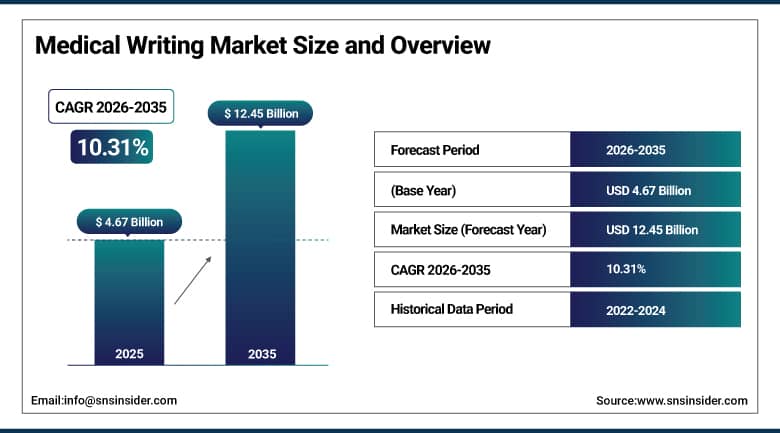
The Medical Writing Market was valued at USD 4.67 Billion in 2025 and is expected to reach USD 12.45 Billion by 2035, growing at a CAGR of 10.31% from 2026-2035.
The Medical Writing Market covers the creation of scientific and regulatory documents used in drug, device and healthcare development, including clinical study reports, protocols, regulatory submissions, safety reports, manuscripts and educational material. Pharmaceutical, biotechnology and device companies rely on specialist writers to meet strict agency requirements and to speed approvals. Growing clinical trial activity and stricter transparency rules are increasing document volumes. Generative AI tools now draft sections and check consistency, but human review remains essential. Shortages of qualified writers and data security concerns are challenges. Outsourcing to contract research and specialist firms continues to grow. Companies increasingly buy integrated packages that combine writing, regulatory strategy and safety services.
⮞In January 2026, the U.S. Food and Drug Administration's drug center reported that it approved 46 novel drugs in 2025. Each approval rests on large sets of regulatory documents that medical writers prepare.
To Get More Information On Medical Writing Market - Request Free Sample Report
Medical Writing Market Trends:
-
Generative AI drafting of clinical study reports and regulatory responses
-
Rising outsourcing of writing to contract research and specialist firms
-
Implementation of EU clinical trial regulation and updated good clinical practice guidance
-
Plain-language summaries and transparency requirements for trial results
-
Consolidation among writing and medical communications providers
U.S. Medical Writing Market Outlook:
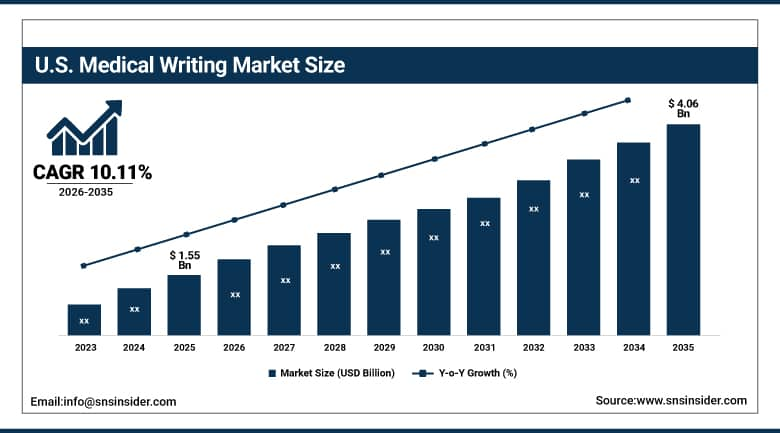
The U.S. Medical Writing Market was valued at USD 1.55 Billion in 2025 and is expected to reach USD 4.06 Billion by 2035, growing at a CAGR of 10.11% from 2026-2035.
The U.S. Medical Writing Market is the largest national market, supported by the world's biggest concentration of drug and device developers and a rigorous regulatory system. Companies prepare investigational new drug applications, new drug applications, safety updates and labeling documents for the Food and Drug Administration. Contract research organizations and specialist agencies handle much of this work for small and mid-sized biotechs. Venture-backed biotech activity drives steady demand. Data privacy and confidentiality requirements shape outsourcing choices. Writers with deep therapeutic knowledge remain in short supply, which supports pricing. Large biotech clusters in Boston, San Francisco and New Jersey sustain a deep vendor base.
⮞In September, 2025, The U.S. Food and Drug Administration (FDA) issued its final E6(R3) Good Clinical Practice guidance, introducing updated, risk-based approaches to clinical trial design, conduct, and oversight. Implementing these principles requires clear and consistent clinical documentation, supporting demand for medical writing services in clinical study protocols, clinical study reports, and trial-related regulatory documents.
Medical Writing Market Segment Analysis:
-
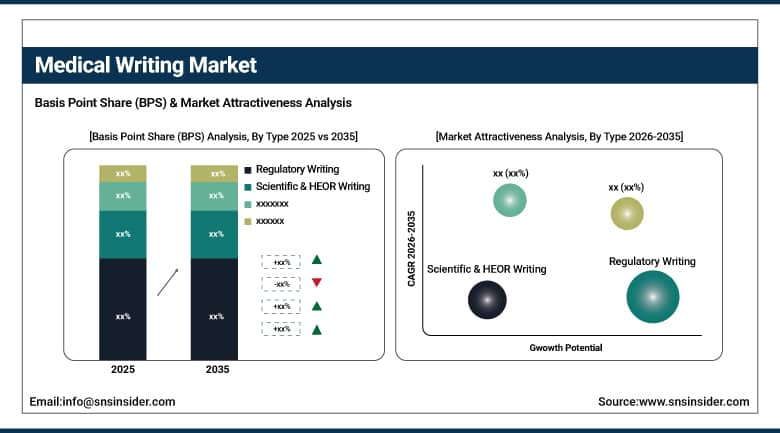
By Type, the Regulatory Writing segment dominated the Medical Writing Market with approximately 41.69% share in 2025, while the Scientific & HEOR Writing segment is the fastest growing with a CAGR of approximately 11.08%.
-
By Therapeutic Area, the Oncology segment dominated the Medical Writing Market with approximately 37.34% share in 2025, while the Immunology segment is the fastest growing with a CAGR of approximately 11.15%.
-
By End User, the Pharmaceutical Companies segment dominated the Medical Writing Market with approximately 49.17% share in 2025, while the Biotechnology Companies segment is the fastest growing with a CAGR of approximately 10.96%.
-
By Application, the Medical Journalism segment dominated the Medical Writing Market with approximately 36.45% share in 2025, while the Medico Marketing segment is the fastest growing with a CAGR of approximately 11.51%.
By Type, Regulatory Writing Dominates the Medical Writing Market and Scientific & HEOR Writing Grows Fastest
Regulatory writing leads because every drug and device approval requires detailed submissions that follow agency formats and deadlines. Writers prepare common technical document modules, investigator brochures, risk management plans, labeling and responses to agency questions. Errors cause delays that cost sponsors millions in lost sales, so companies pay for experienced specialists. Global filings multiply the work, since each region has its own rules. Frequent changes in guidance, such as new clinical practice standards and transparency rules, also create steady demand for updates and new documents. Experienced reviewers also check cross-document consistency before each submission goes out.
Scientific and health economics and outcomes research writing is the fastest growing type as payers and health technology bodies ask for stronger evidence of value. Manuscripts, posters, systematic reviews and value dossiers support market access and physician education. Real-world evidence studies are expanding, and each requires protocols and reports. Companies also publish more trial results to meet transparency expectations. Clinical writing remains a core service tied to trial volumes, and it is gaining efficiency from automation tools that draft routine sections. Medical societies and journals also set stricter reporting standards, which adds review work.
⮞In October 2026, TransPerfect Life Sciences acquired Synterex, adding its AgileWriter.ai platform for regulated documents to expand its medical writing offer. The deal shows demand for technology-enabled regulatory writing.
By Therapeutic Area, Oncology Dominates the Medical Writing Market and Immunology Grows Fastest
Oncology leads because cancer drugs make up the largest group of clinical trials and new approvals. Trials in cancer are complex, with biomarkers, adaptive designs and long follow-up, which produce heavy documentation. Sponsors need writers who understand tumor biology, endpoints and regulatory expectations for accelerated approval. Combination therapies and new modalities, such as cell and gene therapy, add further complexity. The sheer number of oncology programs ensures the segment remains the largest source of writing work. Companion diagnostics and biomarker strategies add extra sections to many submissions.
Immunology is the fastest growing area as drug makers pursue treatments for autoimmune and inflammatory diseases, and as biologics and biosimilars expand. Programs in rheumatology, dermatology and gastroenterology run large trials with long safety follow-up. Neurology, cardiology and rare diseases also grow as new therapies reach late-stage development. Rare disease submissions often need special documents for orphan designation and expedited pathways, which draw on specialist writers. Long-term extension studies in these diseases generate large safety reports over many years.
⮞In March 2026, the Association of Clinical Research Organizations reported that oncology accounted for 27% of studies, or 2,092 trials, among 7,634 studies run by its member companies in 2025. The share confirms the central position of oncology in clinical research.
By End User, Pharmaceutical Companies Dominates the Medical Writing Market and Biotechnology Companies Grows Fastest
Pharmaceutical companies lead because they run the largest portfolios of clinical programs and marketed products. They need writing across the product life cycle, from early protocols to periodic safety reports and label updates. Many keep in-house teams for core work and use outside providers for peaks and specialist tasks. Large firms also fund medical education and publications. Global operations require consistent documents in many languages, which favors established providers with international reach. Mergers and portfolio changes also create work in harmonizing documents across products.
Biotechnology companies are the fastest growing end users because venture funding and licensing deals have increased the number of small sponsors moving drugs into the clinic. Most have no in-house writing staff, so they outsource to contract research organizations and specialist firms. They also adopt AI tools to stretch lean teams. Contract research organizations and academic institutions form further groups of users, and they rely on writing partners to meet sponsor and funder requirements. Investors often require quick regulatory milestones, which raises demand for experienced external teams.
⮞In November 2025, Weave Bio launched HAQ Manager, built with Takeda, to draft responses to health authority questions using artificial intelligence. The launch shows pharmaceutical demand for faster regulatory documents.
By Application, Medical Journalism Dominates the Medical Writing Market and Medico Marketing Grows Fastest
Medical journalism stands out since the publication of clinical trials results, reviews, and scientific news forms the basis of evidence dissemination in this area. Medical journalists write manuscripts, abstracts, and content for medical conferences in adherence to the guidelines of the journals and ethical standards. There is a need for timely publication due to sponsors' requirements to create product positioning and transparency policies to disclose results. Therefore, the job requires scientific accuracy and compliance checking, and hence, it requires a specialized team of professionals. Medical education requires the same skills and develops physician education programs.
Medico marketing is the fastest-growing application due to manufacturers' investment in launch activities, medical affairs, and scientific communication. They are developing monographs, slideshows, training presentations and digital content, which should be accurate and comply with regulations. Agency consolidation leads to emergence of larger organizations combining science and commercial knowledge and skills. Digital media channels, such as virtual conferences, webinars, and e-learning platforms require more content, which should be checked for every statement in terms of evidence. Committees spend extra time reviewing content, and thus efficiency of compliance workflow provides an advantage.
⮞In June 2026, Klick Health announced the acquisition of Oxford PharmaGenesis, a health science communications firm with about 500 staff, to join scientific and commercial capabilities. The deal highlights consolidation in medical communications.
Regional Analysis:
|
Region |
Major Country |
Share within Region, 2025 (%) |
|---|---|---|
|
North America |
U.S. |
84.62 |
|
Europe |
Germany |
29.84 |
|
Asia Pacific |
China |
36.57 |
|
Latin America |
Brazil |
47.93 |
|
Middle East & Africa |
Saudi Arabia |
27.18 |
North America Medical Writing Market Insights
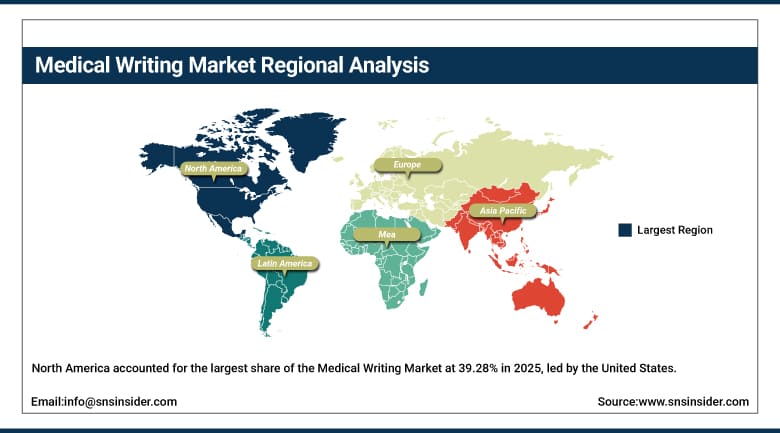
North America accounted for the largest share of the Medical Writing Market at 39.28% in 2025, led by the United States. The region hosts the biggest drug developers, a deep biotech sector, major contract research organizations and specialist agencies. Canada adds demand through its clinical research sector and regulatory reviews. Close ties between sponsors and writing vendors support long-term contracts. Specialist hubs in Boston, San Diego, New Jersey and the Research Triangle add depth.
Regulation and technology shape the market. Agency requirements for submissions, labeling and postmarket reporting create continuous workloads, and draft guidance on the use of artificial intelligence in regulatory decisions is raising interest in automated tools. Sponsors worry about confidentiality and accuracy when using generative AI, so vendors build secure platforms with human review. The shortage of senior writers pushes wages up and draws work to offshore delivery centers. Sponsors also look for vendors that can scale quickly during late-stage submissions.
⮞In April 2026, Canada's Patented Medicine Prices Review Board reported 10,501 new medicines in the pipeline, with about 40% of them for cancer. The pipeline points to heavy regulatory documentation ahead.
Get Customized Report as Per Your Business Requirement - Enquiry Now
Europe Medical Writing Market Insights
Europe is led by Germany, the United Kingdom, France, Switzerland and the Netherlands. The region has major pharmaceutical headquarters, a broad network of contract research organizations and a large pool of experienced writers. Specialist agencies in the United Kingdom and Switzerland serve global sponsors, and many writers work as freelancers who join project teams on demand. Cross-border teams are common, with writers in several time zones supporting each project.
Rules drive activity. The EU Clinical Trials Regulation, the Clinical Trials Information System and updated good clinical practice guidance have changed document requirements and timelines. Transparency rules require plain-language summaries and public release of trial results, which adds work. The European Medicines Agency's centralized review means that many companies prepare a single, extensive dossier. Brexit and national differences add complexity for firms operating across borders. Sponsors often keep European and global versions of documents aligned to avoid errors.
⮞In July 2025, Ireland's Health Products Regulatory Authority reported that the ICH E6(R3) good clinical practice guideline took effect in the EU on 23 July 2025, replacing E6(R2). The change requires sponsors to update protocols and related documents.
Asia Pacific Medical Writing Market Insights
Asia Pacific is projected to be the fastest growing region, with a CAGR of 11.17% during 2026-2035. China, India, Japan, South Korea and Australia lead. China's rise as a source of innovative drugs is creating demand for English-language global submissions, and India offers a large pool of trained scientific staff for offshore writing. Japan and Korea require local-language documents for their own agencies. Time zone differences also let teams work around the clock on urgent filings.
A number of factors are contributing towards growth. There is an increase in approvals for clinical trials and alignment with international standards by the governments, while there is also collaboration between local biotech companies and Western companies. Outsourcing companies from India and Philippines have constructed huge delivery centers for regulatory and safety writing. Language proficiency, data privacy and security, and quality controls are some of the critical issues for sponsors. Cost savings is still a factor despite increases in salary and development of more training programs to develop writers.
⮞In March 2026, India's Ministry of Health and Family Welfare reported that 284 clinical trial permissions were granted in 2025, up from 213 in 2024. The increase signals growing trial activity that needs documentation.
MEA & Latin America Medical Writing Market Insights
In Latin America, Brazil, Mexico, Argentina and Colombia lead, driven by growing clinical trial activity and regulators who are shortening review times. Brazil's agency publishes annual reports on clinical research, and Mexico's regulator aims to speed trial authorization. Local language documents and ethics committee submissions create demand for regional writing support. Contract research organizations active in the region often bring their own writing teams.
In the Middle East and Africa, Saudi Arabia, the United Arab Emirates, Israel and South Africa lead. Gulf regulators are adopting reliance pathways that use decisions from trusted agencies, and they are investing in biotechnology and clinical research. Sponsors need documents in line with international standards plus local requirements. Elsewhere in Africa, limited capacity and funding keep the market small, but vaccine and infectious disease research create specialized needs. Regional hubs may emerge as agencies in the Gulf align with international standards.
⮞In January 2026, the Saudi Food and Drug Authority reported that advanced-therapy and biotech clinical trial applications rose 83% in 2025 and that its reliance pathway cut approval times by 74%. The change shows regulators speeding up in the region.
Market Dynamics:
Growth Drivers: Rising Trial Volumes and Regulatory Complexity Drive Growth in the Medical Writing Market
The demand will increase because of an increase in trial volume and regulations. The volume of programs for drug and device approvals is increasing. There is documentation needed for each program, which consists of protocols, reports, submissions, and safety data. Regulatory bodies are requiring more details and transparency, and regulation differs depending on the regions. Sponsors require writers who specialize in each system. Outsourcing enables companies to deal with spikes in their load without hiring extra personnel. It also gives small companies access to specialists they cannot employ. In the case of international trials, there is also a need for translation and localization in addition to documentation.
New technology and high investments add to the growth. Generative AI technology reduces the amount of time for writing standardized sections and quality control. This increases the capacity and decreases the cost of service. High investments in research provide a continuous supply of drugs in the pipeline. Companies conduct drugs development all around the world. New standards of good clinical practice and trial regulations create demand for documents. There is an increased demand for summaries and reports in plain language and real-world evidence. Secure platforms give the company an advantage.
⮞In 2026, the European Federation of Pharmaceutical Industries and Associations reported EUR 56.344 billion in R&D investment in Europe in 2024. The spending base keeps the volume of trials and regulatory documents rising.
Restraints: Writer Shortages and Review Delays Restrain Growth in the Medical Writing Market
Lack of experienced personnel is a limitation to growth. The senior regulatory and clinical writers have to be knowledgeable in science and gain several years of experience, but demand exceeds supply. Higher wages put pressure on vendors, and they find it difficult to equip projects with enough therapeutic expertise. Turnover rate is high in some companies, which negatively impacts the quality and continuity of work. It takes time to train new writers, and hence, the growth in capacity does not follow demand, causing delays during peak hours. Work from home has expanded the pool of available talent, but competition among employers has increased.
Review delays and data security become additional limitations. The long process of approvals and recruitment leads to trial delays, which, in turn, lead to delays in the writing process. Sponsor organizations have data security concerns when sharing confidential information with third-party providers or AI solutions and conduct thorough data security checks. Large customers and offshore vendors create price pressure, while differences in regulations cause higher costs due to customized documentations. Smaller vendors cannot afford audits that larger sponsors require.
⮞In May 2026, the European Commission, the European Medicines Agency and the heads of national agencies reported that only about 40% of EU trials recruited their first patient within 200 days, against a target of 66% by 2030. Slow start-up delays the documents that depend on trial progress.
Opportunities: AI-Enabled Authoring and Emerging Regulatory Markets Create Opportunities in the Medical Writing Market
AI-enabled authoring offers the largest opportunity. Platforms that draft clinical study reports, answer agency questions and keep documents consistent can cut timelines from weeks to days. Providers that combine technology with expert review can offer faster delivery and new pricing models. Structured data approaches allow content to be reused across submissions. Companies that prove accuracy and security will win trust from cautious sponsors. Early adopters can differentiate by sharing validated accuracy data with clients.
Emerging regulatory markets and new document types add potential. Regulators in Asia, the Middle East and Latin America are modernizing, and sponsors need support to file in these regions. Pharmacovigilance and safety reporting are expanding as post-market monitoring grows. Cell and gene therapy, digital health and real-world evidence are creating documents with new formats. Specialist providers in these areas can capture premium work. Partnerships with local experts help global vendors meet language and procedural needs.
⮞In December 2025, the Council for International Organizations of Medical Sciences published its working group report on artificial intelligence in pharmacovigilance. The guidance supports wider and more consistent use of AI in safety documentation.
Recent Developments:
-
In April 2026, Certara agreed to sell its regulatory and medical writing business, including Synchrogenix, to Veristat for up to USD 135 million. The unit had about USD 50 million in 2025 revenue and about 220 staff.
-
In May 2026, Parexel launched ParexelAI, an artificial intelligence suite for clinical development. The company reported a 30% cut in clinical study report preparation time and a partnership that shortens regulatory authoring timelines.
-
In July 2025, Indegene launched NEXT Medical Writing Automation, a generative AI tool that works inside Microsoft Word and integrates with regulatory information systems. The launch builds on its earlier acquisition of Trilogy Writing and Consulting.
-
In November 2025, QInscribe launched a generative AI-driven medical writing service focused on regulatory and scientific documents. The company said it can produce a draft clinical study report in about 5 hours against the usual 50 to 100 hours.
Medical Writing Market Key Players are:
-
Certara, Inc. (Synchrogenix)
-
Veristat, LLC
-
Parexel International
-
Indegene Limited (Trilogy Writing)
-
QInscribe
-
Thermo Fisher Scientific (PPD)
-
IQVIA Holdings Inc.
-
TFS HealthScience
-
Freyr Solutions
-
Weave Bio
-
TransPerfect Life Sciences
-
Oxford PharmaGenesis (Klick Health)
Medical Writing Market Report Scope:
| Report Attributes | Details |
|---|---|
| Market Size in 2025 | USD 4.67 Billion |
| Market Size by 2035 | USD 12.45 Billion |
| CAGR | CAGR of 10.31% From 2026 to 2035 |
| Base Year | 2025 |
| Forecast Period | 2026-2035 |
| Historical Data | 2022-2024 |
| Report Scope & Coverage | Market Size, Segments Analysis, Competitive Landscape, Regional Analysis, DROC & SWOT Analysis, Forecast Outlook |
| Key Segments | • By Type (Regulatory Writing, Clinical Writing, Scientific & HEOR Writing, and Others) • By Therapeutic Area (Oncology, Immunology, Neurology, Cardiology, and Others) • By End User (Pharmaceutical Companies, Biotechnology Companies, Contract Research Organizations, and Others) • By Application (Medical Journalism, Medico Marketing, Medical Education, and Others) |
| Regional Analysis/Coverage | North America (US, Canada), Europe (Germany, UK, France, Italy, Spain, Russia, Poland, Rest of Europe), Asia Pacific (China, India, Japan, South Korea, Australia, ASEAN Countries, Rest of Asia Pacific), Middle East & Africa (UAE, Saudi Arabia, Qatar, South Africa, Rest of Middle East & Africa), Latin America (Brazil, Argentina, Mexico, Colombia, Rest of Latin America). |
| Company Profiles | Certara, Inc. (Synchrogenix), Veristat, LLC, Parexel International, Indegene Limited (Trilogy Writing), QInscribe, Thermo Fisher Scientific (PPD), IQVIA Holdings Inc., TFS HealthScience, Freyr Solutions, Weave Bio, TransPerfect Life Sciences, Oxford PharmaGenesis (Klick Health) |

Frequently Asked Questions
Key players include Certara, Veristat, Parexel, Indegene, QInscribe, PPD (Thermo Fisher Scientific), IQVIA, TFS HealthScience, Freyr Solutions, Weave Bio, TransPerfect Life Sciences and Oxford PharmaGenesis.
Key opportunities include AI-enabled authoring, pharmacovigilance writing, services for emerging regulatory markets and specialist work in cell and gene therapy and real-world evidence.
Rising clinical trial volumes and growing regulatory complexity are the main growth factors, supported by outsourcing and AI tools.
By Type, the Regulatory Writing segment dominated the market in 2025 with an estimated 41.69% share, supported by the need for detailed submissions that follow agency formats.
North America dominated the market with a share of 39.28% in 2025, driven by the concentration of drug developers, contract research organizations and specialist agencies.
