Men’s Intimate Hygiene Products Market Report Scope & Overview:
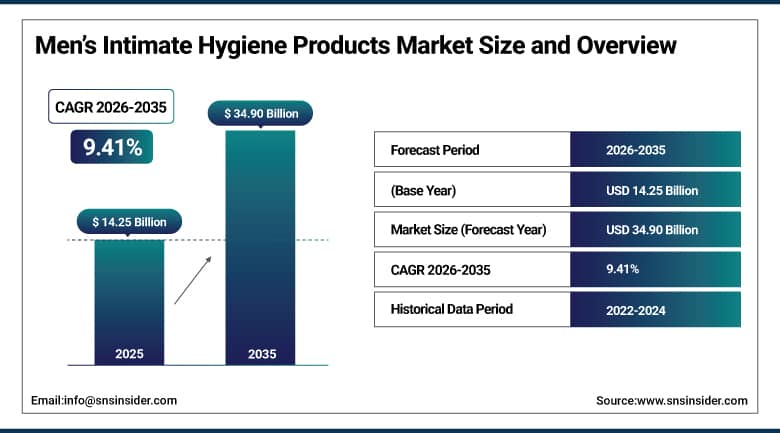
The Men’s Intimate Hygiene Products Market was valued at USD 14.25 billion in 2025 and is expected to reach USD 34.90 billion by 2035, growing at a CAGR of 9.41% from 2026-2035.
The Men’s Intimate Hygiene Products Market is witnessing strong growth due to increasing knowledge about personal hygiene, grooming, and health care among males. Increased consumer preference for personal care products specific to intimate areas such as washes, wipes, deodorants, moisturizing, and shaving products are fueling the growth of the market. Increased disposable incomes, shifting grooming trends, urbanization, and growing acceptance of male personal care products are contributing to the demand. Moreover, easy availability through e-commerce and retail channels, innovations in the product, premiumization, and marketing initiatives are helping in promoting the use of such products. Increasing importance of personal hygiene and development of gender-specific personal care products are also contributing to the market growth.
In 2025, Unilever’s Personal Care business achieved 4.7% underlying sales growth, supported by premium product innovation and market-share gains across key personal care markets.
To Get More Information On Men’s Intimate Hygiene Products Market - Request Free Sample Report
Men’s Intimate Hygiene Products Market Trends:
-
Rising awareness of men’s personal hygiene and intimate care is driving demand for specialized products designed to support daily cleanliness and freshness.
-
Increasing focus on grooming and self-care is encouraging men to adopt intimate washes, wipes, deodorants, moisturizers, and shaving care products.
-
Growing disposable incomes and premiumization trends are supporting demand for high-quality, specialized, and dermatologically tested men’s intimate hygiene products.
-
Rising e-commerce penetration is improving product accessibility, expanding consumer choices, and enabling brands to reach previously underserved male consumer segments.
-
Increasing product innovation is driving demand for organic, natural, fragrance-free, and skin-friendly formulations tailored to specific intimate hygiene requirements.
-
Growing influence of social media, digital marketing, and male grooming influencers is increasing awareness and reducing hesitation surrounding men’s intimate hygiene products.
-
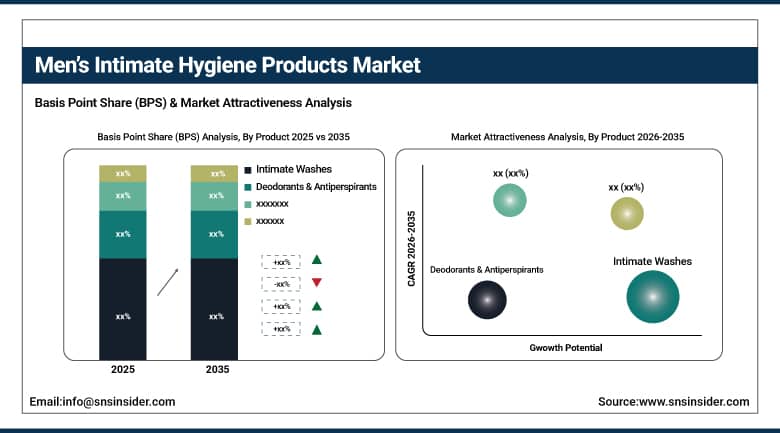
By Product, Intimate Washes dominate the Men’s Intimate Hygiene Products Market with 28% share in 2025, while Deodorants & Antiperspirants are expected to grow fastest at a CAGR of 11.24% from 2026–2035.
-
U.S. Men’s Intimate Hygiene Products Market Outlook:
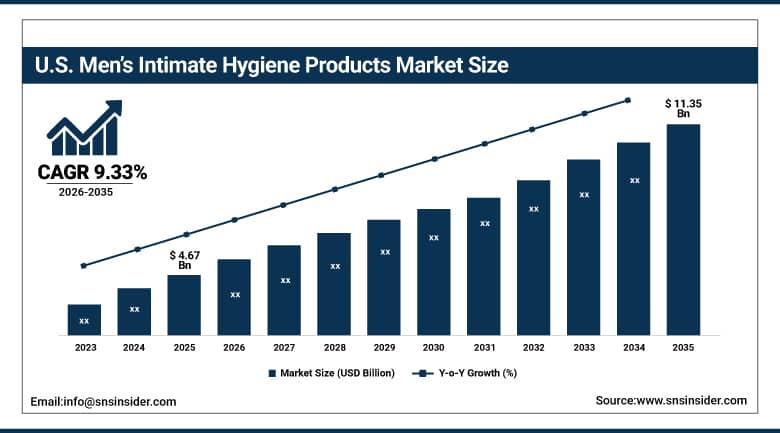
The U.S. Men’s Intimate Hygiene Products Market was valued at USD 4.67 billion in 2025 and is expected to reach USD 11.35 billion by 2035, growing at a CAGR of 9.33% from 2026-2035.
The U.S. Men’s Intimate Hygiene Products Market is witnessing strong growth Due to increasing awareness about personal hygiene, grooming, and personalized skin care among men. Increasing demand for intimate washes, wipes, deodorants, moisturizers, and shaving care products is contributing to market growth. Increasing disposable income, changing grooming habits, premiumization, and increased acceptance of men hygiene products are other factors fueling the consumer demand. Other factors contributing to market growth include increasing e-commerce and retail penetration, innovation in product formulas, marketing efforts, and availability of personalized skin care solutions. Increasing focus on daily hygiene, well-being, and preventive skin care is also fueling the growth of the market in the United States.
In 2025, Dove and Dove Men+Care achieved double-digit growth in deodorants, supported by the continued success and growing consumer adoption of whole-body deodorants.
Men’s Intimate Hygiene Products Market Segment Analysis:
-
By Type, Conventional dominates the Men’s Intimate Hygiene Products Market with 72% share in 2025, while Organic is expected to grow fastest at a CAGR of 10.11% from 2026–2035.
-
By Form, Liquid dominates the Men’s Intimate Hygiene Products Market with 46% share in 2025, while Gel is expected to grow fastest at a CAGR of 11.20% from 2026–2035.
-
By Price, Medium dominates the Men’s Intimate Hygiene Products Market with 48% share in 2025, while High is expected to grow fastest at a CAGR of 10.52% from 2026–2035.
-
By Packaging, Bottles dominate the Men’s Intimate Hygiene Products Market with 34% share in 2025, while Roll-Ons are expected to grow fastest at a CAGR of 11.13% from 2026–2035.
By Product, Intimate Washes dominate the men’s intimate hygiene products market, Deodorants & Antiperspirants grow fastest.
Intimate Washes segment dominated the Men’s Intimate Hygiene Products Market with the highest market share of about 28% in 2025 owing to the rising level of awareness of intimacy hygiene and fresh grooming among men. The easy accessibility and special formulation of these products makes them popular among consumers. Increasing awareness about personal grooming is also one of the factors behind their popularity.
Deodorants & Antiperspirants segment is expected to grow at the fastest CAGR of 11.24% from 2026-2035 due to rising importance placed on freshness, smell management, grooming, and hygiene. The increased popularity of full-body antiperspirants, high-end antiperspirants, new scents, and easier means of application is making consumers more receptive to adopting them. Further, increased distribution through e-commerce channels and marketing campaigns will drive segment growth.
By Type, Conventional dominates the men’s intimate hygiene products market, Organic grows fastest.
Conventional segment dominated the Men’s Intimate Hygiene Products Market with the highest market share of about 72% in 2025 because of wide availability, known by consumers, affordable prices, and wide distribution through retailers. Standard formulas still can be found in supermarkets, drugstores, corner stores, and via online stores. The well-known efficiency and wide consumer approval ensure high demand for these products worldwide.
Organic segment is expected to grow at the fastest CAGR of 10.11% from 2026-2035 due to the rising preference of consumers towards natural, plant-derived, and eco-friendly personal care products. Consumer awareness about the use of safe ingredients, clean label formulation, and sustainable packaging is driving acceptance. The premiumization, innovation, and increasing availability of organic men’s hygiene products online is set to drive quick growth of the segment.
By Form, Liquid dominates the men’s intimate hygiene products market, Gel grows fastest.
Liquid segment dominated the Men’s Intimate Hygiene Products Market with the highest market share of about 46% in 2025 owing to the benefits that liquid formulations bring in terms of ease of use, efficient cleaning, and compatibility with hygiene products. This established trend for intimacy washes, cleansers, and personal care products is sustained owing to their wide availability in retail outlets and familiarity with consumers.
Gel segment is expected to grow at the fastest CAGR of 11.20% from 2026-2035 due to the growing consumer preference for lighter, refreshing, and more convenient formulations for personal care. Gels provide ease of application, rapid absorption, and better sensory benefits, aiding premium positioning. Innovative developments in the intimate care category, increased grooming consciousness, and increasing internet sales are likely to drive segment growth.
By Price, Medium dominates the men’s intimate hygiene products market, High grows fastest.
Medium segment dominated the Men’s Intimate Hygiene Products Market with the highest market share of about 48% in 2025 As a result of offering good value for money and high-quality products. The middle-priced products tend to attract a wide range of consumers due to their effectiveness and convenience at affordable prices. The accessibility of the products in various stores is another reason for segment dominance.
High segment is expected to grow at the fastest CAGR of 10.52% from 2026-2035 driven by the growing trend of premiumization as well as the consumers’ readiness to shell out money for high-quality personal care items for men. Expensive products are usually formulated with advanced technology, premium ingredients, high-end perfumes, and improved packaging. Higher disposable incomes and heightened brand recognition will push the trend further.
By Packaging, Bottles dominate the men’s intimate hygiene products market, Roll-Ons grow fastest.
Bottles segment dominated the Men’s Intimate Hygiene Products Market with the highest market share of about 34% in 2025 as a result of their convenience, durability, ease of administration, and suitability for use in liquid products. They offer great product protection and controlled usage and also allow for good brand presentation. They are readily available through various retail and online platforms, thus contributing greatly to consumer acceptance.
Roll-Ons segment is expected to grow at the fastest CAGR of 11.13% from 2026-2035 due to increased consumer demand for convenience, portability, and accurate means of application. Roll-ons offer controlled delivery, help reduce waste of product, and are ideal for hygienic and deodorizing applications. Increased consumer interest in convenient grooming products, travel-sized packages, and novel products is predicted to drive fast growth of the segment.
Regional Analysis:
|
Region |
Major Country |
Share within Region, 2025 (%) |
|---|---|---|
|
North America |
United States |
89.0% |
|
Europe |
Germany |
26.0% |
|
Asia Pacific |
China |
36.5% |
|
Middle East & Africa |
UAE |
23.0% |
|
Latin America |
Brazil |
41.0% |
North America Men’s Intimate Hygiene Products Market Insights
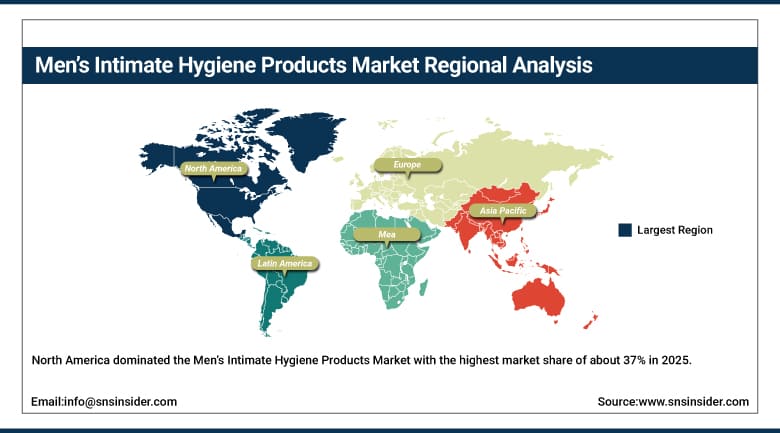
North America dominated the Men’s Intimate Hygiene Products Market with the highest market share of about 37% in 2025, driven by high consumer awareness of personal hygiene, established male grooming habits, premium product adoption, and strong retail and e-commerce networks. The region’s higher disposable incomes, product innovation, and growing preference for specialized, convenient, and skin-friendly intimate-care solutions are further supporting market demand.
The U.S. Men’s Intimate Hygiene Products Market accounted for a market share of 89.0%, Facilitated by greater recognition of the importance of men’s hygiene, grooming, and intimate care products. Higher disposable incomes, use of premium products, good distribution channels both offline and online, product innovation, and growing consumer acceptance of men’s hygiene products are some other factors driving the market in the US.
Get Customized Report as Per Your Business Requirement - Enquiry Now
Europe Men’s Intimate Hygiene Products Market Insights
The Europe Men’s Intimate Hygiene Products Market is growing consistently owing to hygiene consciousness, changing grooming patterns among males, and growing preference for specialized products. Premium, dermatologist-tested, and skin-friendly personal care products have started attracting more consumers’ attention. Effective retailing and e-commerce routes, innovations in products, increased expenditure on personal care products, and increasing availability of organic and sustainable products have been aiding this growth trend.
The Germany Men’s Intimate Hygiene Products Market accounted for a market share of 26.0%, fueled by an increase in knowledge regarding personal hygiene, rising awareness of specialized products for grooming, and increasing demand for high-quality products. Effective distribution and sales strategies, higher consumer spending on personal care products, innovative products, and acceptance of intimate hygiene products for men are other factors that are helping market growth in Germany.
Asia Pacific Men’s Intimate Hygiene Products Market Insights
Asia Pacific is expected to grow at the fastest CAGR of about 10.49% from 2026–2035, supported by rising hygiene awareness, urbanization, increasing disposable incomes, and evolving male grooming preferences. Expanding e-commerce platforms, wider product availability, premiumization, growing consumer acceptance of specialized intimate-care products, and increasing investments by manufacturers in innovative formulations are further accelerating market adoption across the region.
The China Men’s Intimate Hygiene Products Market accounted for a market share of 36.5%, Backed by heightened awareness on hygiene, changing trends in male grooming, urbanization, and rising disposable incomes. Increased usage of innovative personal care products, growth in e-commerce, premiumization, innovation in products, and greater availability via modern retailing channels is also encouraging men to include intimate hygiene products in their personal care regime.
Middle East & Africa and Latin America Men’s Intimate Hygiene Products Market Insights
The Middle East & Africa and Latin America Men’s Intimate Hygiene Products Market is growth that has been facilitated by increased awareness on hygiene, urbanization, male grooming practices, and rising disposable income levels. Penetration of retail and e-commerce platforms is making products easily accessible to consumers. Increased demand for customized, premium, and convenient hygiene products, coupled with innovations and expansion of brands internationally, is presenting opportunities in these regions.
The UAE Men’s Intimate Hygiene Products Market accounted for a market share of 23.0%, Backed up by an increased focus on personal hygiene, grooming and luxury mens care products. Increased disposable income, penetration of modern retailing and e-commerce services, increased number of expatriates and urban consumers, demand for specialized hygiene solutions and presence of premium international brands is also driving the growth of the market in the UAE.
Market Dynamics:
Growth Drivers: Growing awareness of personal hygiene and male grooming is accelerating demand for specialized intimate care products globally
Increasing awareness of personal hygiene and male grooming is one of the key drivers fueling the demand for intimate hygiene products among men. There has been an increase in awareness about intimate hygiene, smell, skin health, and personal hygiene amongst men, which has prompted them to use specially formulated intimate hygiene products like intimate washes, intimate wipes, intimate deodorant sprays, moisturizing creams, and intimate cleansers. Changing consumer attitudes towards personal grooming products are making men less reluctant about using intimate care products. Higher disposable incomes and wider access to high-end personal hygiene products is also helping in boosting consumption. Brands are coming up with specially formulated intimate hygiene products catering to the skin of men that are pH balanced, dermatologically tested, and fragrant-based.
Restraints: Limited consumer awareness and cultural sensitivity surrounding intimate hygiene can restrict product adoption across several markets
Limited awareness and cultural sensitivity surrounding men’s intimate hygiene can restrain market growth, particularly in developing and conservative markets. Intimate hygiene products are a fairly personal sub-category of products, and consumers might experience unease while talking or buying such products. Ignorance about the advantages of using separate intimate hygiene and grooming products is another factor that restricts regular usage. Moreover, consumers might use regular soaps or other personal hygiene products in place of specific intimate hygiene products, limiting the market for category-specific products. The company might be restricted to discreet marketing and consumer awareness due to cultural beliefs, embarrassment, and ignorance regarding products. Even though the digital space is slowly bringing about changes, regional variations in social attitude and hygiene habits might continue to act as barriers.
Opportunities: Rising demand for natural and skin-friendly formulations creates significant opportunities for men’s intimate hygiene product manufacturers globally
Growing consumer preference for natural, gentle, and skin-friendly personal care products is creating significant opportunities in men’s intimate hygiene. In-timate hygiene products can be considered a rather intimate category of products, and thus there may be feelings of discomfort both in communicating and purchasing them. Lack of knowledge regarding the benefits of using different types of products for intimate hygiene and grooming can be considered yet another barrier preventing frequent usage. In addition, customers may choose to replace intimate hygiene products with regular soaps and other personal hygiene products. The company may find itself restricted to discreet marketing and awareness because of culture, embarrassment, and lack of knowledge related to the products. Although gradual change is being brought about by the digital space, there can still be regional differences in social attitude and hygiene practices.
Recent Developments:
-
2026: Kenvue continued developing its global personal-health and wellness portfolio around daily consumer-care routines, supporting continued innovation across skin-care and personal-care categories relevant to men’s hygiene.
-
2025: P&G expanded whole-body deodorant offerings across Old Spice, with its male whole-body spray business benefiting from continued consumer demand for broader odor-protection solutions.
-
2025: Unilever scaled whole-body deodorant technology across its brands, including Dove Men+Care, Rexona and Axe, with whole-body formats reaching 15 markets during 2025.
-
2025: Beiersdorf launched the NIVEA and NIVEA MEN Derma Control range, combining 72-hour sweat and odor protection with hyaluronic acid and vitamin-based skin-care benefits for sensitive underarm skin.
Men’s Intimate Hygiene Products Market key players are:
-
Procter & Gamble Company
-
Unilever PLC
-
Beiersdorf AG
-
Reckitt Benckiser Group plc
-
Church & Dwight Co., Inc.
-
Kenvue Inc.
-
Henkel AG & Co. KGaA
-
Kimberly-Clark Corporation
-
Kao Corporation
-
L'Oréal S.A.
-
Colgate-Palmolive Company
-
Godrej Consumer Products Limited
-
Amorepacific Corporation
-
Lion Corporation
-
Mandom Corporation
-
LG H&H Co., Ltd.
-
Sanofi Consumer Healthcare
-
Edgewell Personal Care Company
-
MANSCAPED
-
Coty Inc.
Men’s Intimate Hygiene Products Market Report Scope:
| Report Attributes | Details |
|---|---|
| Market Size in 2025 | USD 14.25 Billion |
| Market Size by 2035 | USD 34.90 Billion |
| CAGR | CAGR of 9.41% From 2026 to 2035 |
| Base Year | 2025 |
| Forecast Period | 2026-2035 |
| Historical Data | 2022-2024 |
| Report Scope & Coverage | Market Size, Segments Analysis, Competitive Landscape, Regional Analysis, DROC & SWOT Analysis, Forecast Outlook |
| Key Segments | • By Product (Intimate Washes, Wipes, Deodorants & Antiperspirants, Moisturizers, Shaving Care, Others) • By Type (Conventional, Organic) • By Form (Liquid, Cream, Gel, Powder) • By Price (Low, Medium, High) • By Packaging (Bottles, Aerosols, Sticks, Roll-Ons, Tubes, Others) |
| Regional Analysis/Coverage | North America (US, Canada), Europe (Germany, UK, France, Italy, Spain, Russia, Poland, Rest of Europe), Asia Pacific (China, India, Japan, South Korea, Australia, ASEAN Countries, Rest of Asia Pacific), Middle East & Africa (UAE, Saudi Arabia, Qatar, South Africa, Rest of Middle East & Africa), Latin America (Brazil, Argentina, Mexico, Colombia, Rest of Latin America). |
| Company Profiles | Procter & Gamble Company, Unilever PLC, Beiersdorf AG, Reckitt Benckiser Group plc, Church & Dwight Co., Inc., Kenvue Inc., Henkel AG & Co. KGaA, Kimberly-Clark Corporation, Kao Corporation, L'Oréal S.A., Colgate-Palmolive Company, Godrej Consumer Products Limited, Amorepacific Corporation, Lion Corporation, Mandom Corporation, LG H&H Co., Ltd., Sanofi Consumer Healthcare (Chattem), Edgewell Personal Care Company, MANSCAPED, and Coty Inc. |