
Mezzanine Floor Market Report Scope & Overview:
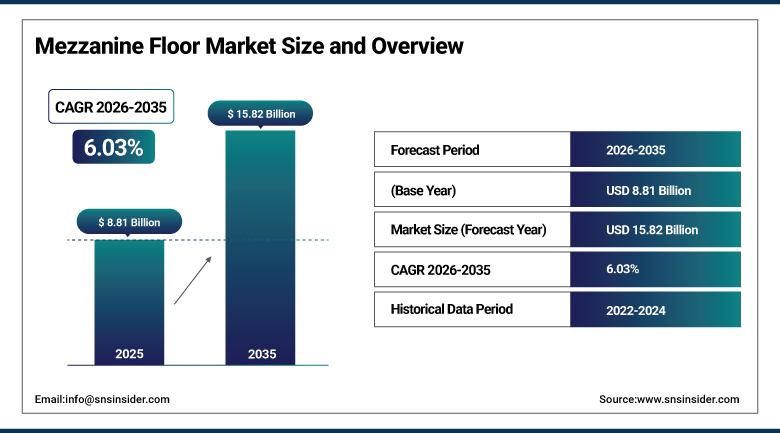
The Mezzanine Floor Market was valued at USD 8.81 billion in 2025 and is expected to reach USD 15.82 billion by 2035, growing at a CAGR of 6.03% from 2026-2035.
The mezzanine floor market is experiencing growth owing to the increased need for effective use of space in the warehouse, manufacturing facilities, and commercial spaces. The fast growth in the fields of e-commerce, logistics, and industrial automation has led to an increased demand for more space for storage and operations without the need to expand the floor area. Companies have started implementing mezzanine floor systems as a cost-effective means to utilize vertical space effectively. Urbanization and the increasing cost of industrial land are contributing to the demand for mezzanine floor solutions.
According to the United Nations Department of Economic and Social Affairs, nearly 68% of the global population is projected to live in urban areas by 2050, significantly increasing pressure on industrial and commercial real estate utilization. This rapid urban expansion is driving businesses to optimize available infrastructure through vertical space management solutions such as mezzanine floors. Increasing land scarcity and high construction costs in urban and industrial regions are further encouraging adoption of mezzanine floor systems as flexible and economical alternatives for expanding operational capacity.
To Get more information Mezzanine Floor Market - Request Free Sample Report
Mezzanine Floor Market Trends
-
Rising demand for efficient space utilization in warehouses, factories, and commercial facilities is driving the mezzanine floor market.
-
Growing adoption across logistics, manufacturing, retail, and e-commerce sectors is boosting market growth.
-
Expansion of warehousing infrastructure and distribution centers is fueling mezzanine floor installation.
-
Increasing focus on cost-effective storage expansion and operational efficiency is shaping adoption trends.
-
Advancements in modular designs, lightweight materials, and customized structural solutions are enhancing flexibility and durability.
U.S. Mezzanine Floor Market Size Outlook
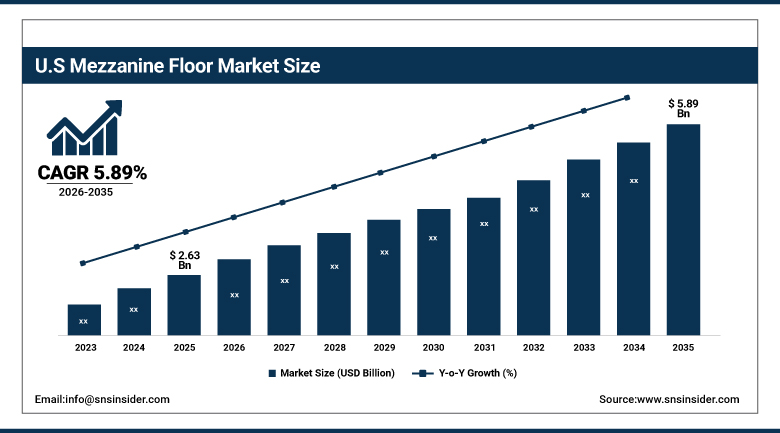
The U.S. Mezzanine Floor Market was valued at USD 2.63 billion in 2025 and is expected to reach USD 5.89 billion by 2035, growing at a CAGR of 5.89% from 2026-2035.
The U.S. mezzanine floor market is witnessing rapid growth owing to the rising need for warehouse expansion and optimizing available space. Fast-paced development in e-commerce, logistics, and warehousing activities is compelling companies to utilize vertical space for their storage requirements without needing to shift into new premises. An increased use of automation in warehouses is also contributing positively towards the adoption of mezzanine floors.
According to the U.S. Census Bureau, U.S. e-commerce sales reached more than $1.19 trillion in 2024, reflecting continued expansion of fulfillment and warehousing operations that require high-density storage systems and vertical space optimization solutions.
Mezzanine Floor Market Segment Analysis
-
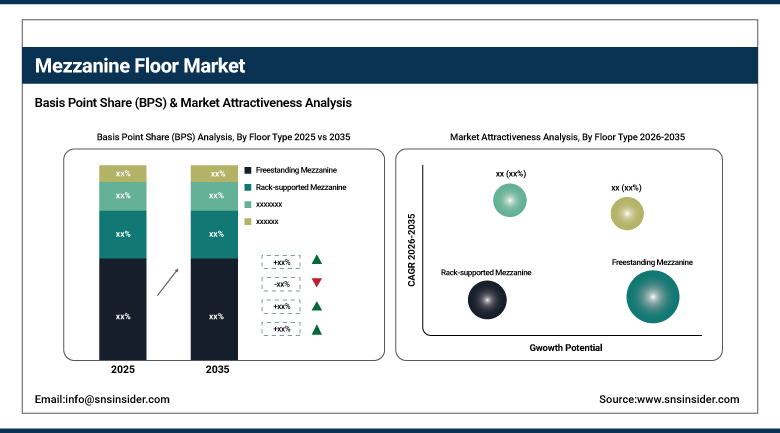
By Floor Type, freestanding mezzanine segment dominated the mezzanine floor market in 2025 with 46.20% share; rack-supported mezzanine segment is the fastest-growing (CAGR).
-
By Construction Area, indoor segment dominated the mezzanine floor market in 2025 with 72.40% share; exterior segment is the fastest-growing (CAGR).
-
By Application, manufacturing segment dominated the mezzanine floor market in 2025 with 31.80% share; e-commerce segment is the fastest-growing (CAGR).
By Floor Type, freestanding mezzanine segment dominated the mezzanine floor market in 2025, rack-supported mezzanine segment is the fastest growing
The Freestanding Mezzanine segment was dominant in the Mezzanine Floor Market in 2025 owing to their versatility, simple installation process, and expansion of the floor area without any complicated modifications. They are used by industries worldwide due to their mobility and adaptability, considering that they can be moved or modified depending on the needs of the industry. In addition, the cost efficiency and flexibility in installation of these mezzanines boost their demand. Enterprises opt for freestanding mezzanines for increasing the storage area and operational efficiency while keeping down the costs for expanding the facility.
The Rack-Supported Mezzanine Segment is witnessing fastest growth in the Mezzanine Floor Market because of the rising demand for space-efficient and cost-effective storage. These structures make use of storage racks along with elevated platforms, which enable companies to increase space usage by making optimum use of vertical space while saving on the cost of infrastructural development. The growing logistics, retail, and e-commerce industries have led to rapid demand for such mezzanine floors worldwide.
By Construction Area, indoor segment dominated the mezzanine floor market in 2025, exterior segment is the fastest growing
The indoor segment accounted for a largest market share in the Mezzanine Floor Market because of the wide utilization of mezzanine systems in warehouses, manufacturing facilities, and retail stores among others. The indoors have several benefits, such as being able to protect the system from adverse weather conditions and ensuring that operations are safer. Most businesses are using the indoors in order to increase their capacity without having to move to new premises. The increasing industrialization, rise in demand for warehouses, and need to increase efficiency indoors are contributing towards the continued adoption of mezzanine systems in the long run.
The exterior segment is currently the fastest growing segment in the Mezzanine Floor Market because of the increased need for additional floor space in businesses experiencing problems with their facilities. There is a trend towards using exterior mezzanine floors to store equipment, carry out loading processes, and expand industrial businesses. Increased construction activities and industrial system modularization fuel the growth of the market further. The main reason for the popularity of exterior mezzanine floors is the flexibility and cost-effectiveness associated with using outdoor space.
By Application, manufacturing segment dominated the mezzanine floor market in 2025, e-commerce segment is the fastest growing
The Manufacturing segment led the Mezzanine Floor Market in 2025 owing to the increasing necessity for better utilization of space, proper organization of production layout, and increased capacity of warehouses. The companies in the manufacturing sector prefer to construct mezzanine systems to obtain more workstations, platforms for the machinery, and storage areas without building new structures. The development in industrial automation and growth in manufacturing are expected to drive the demand. It helps in enhancing the efficiency in workflows and productivity, and thus is a vital part of manufacturing facilities in the coming years.
E-commerce segment is the fastest-growing in the Mezzanine Floor Market due to the rise in the rate of adoption of online shopping, growth in warehouse automation and order fulfillment, and the increasing pressure on warehouses to fulfill delivery promises. Companies in the sector are increasingly adopting mezzanine structures to increase their storage capacity and efficiency in performing picking. The growing demands by customers for fast delivery services have led to warehouse expansion and increased vertical storage space needs.
Regional Analysis
|
Region |
Major Country |
Share within Region (%) |
|---|---|---|
|
North America |
United States |
88.1% |
|
Europe |
United Kingdom |
21.3% |
|
Asia Pacific |
Australia |
7.8% |
|
Middle East & Africa |
UAE |
14.9% |
|
Latin America |
Brazil |
48.7% |
North America Mezzanine Floor Market Insights
The North America mezzanine floor market is fueled by significant growth in warehousing, e-commerce, and industrial automation in the region. More companies are now utilizing mezzanine floors in order to maximize their warehouse space and become more efficient without having to increase their facilities’ footprints. There is also an increasing amount of investment that has been seen in logistics centers, distribution centers, and smart warehouses. Another factor driving the market’s growth is the availability of advanced manufacturing operations and automated material handling solutions within the region.
Europe Mezzanine Floor Market Insights
Europe mezzanine floor market continues to experience sustained growth because of the rising need for efficient warehouse operations and industrial space optimization. The growth can be attributed to increased e-commerce activity and investments in logistics infrastructures. Industries are now incorporating mezzanine solutions to increase their operations and storage space. There are strict guidelines in place concerning the efficient use of industrial space and sustainable construction practices that have resulted in more interest in modular and flexible floor solutions. In addition to this, warehouse automation, retail distributions, and cost reduction initiatives have helped drive the market forward.
Asia Pacific Mezzanine Floor Market Insights
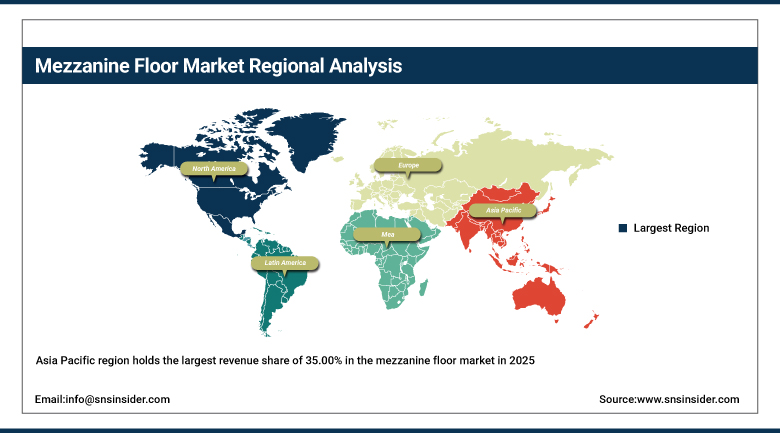
The Asia Pacific region holds the largest revenue share of 35.00% in the mezzanine floor market in 2025 and also projects the highest growth rate in terms of CAGR of around 7.78%. The leading position held by this region can be attributed to factors such as fast-paced industrialization, increasing warehousing facilities, and strong development in the e-commerce and manufacturing sectors. Increased spending on logistics facilities, warehouse facilities, and smart factories has been significantly adding to the demand for effective space utilization solutions in this region. High land prices in the industrial sector and rising urbanization have been promoting the use of mezzanine floor systems.
Get Customized Report as per Your Business Requirement - Enquiry Now
Middle East & Africa and Latin America Mezzanine Floor Market Insights
The Middle East & Africa and Latin America mezzanine floor markets are witnessing growth owing to developments in the industrial infrastructure, warehouse operations, and commercial construction projects. Investments in logistics operations, retail distribution, and manufacturing operations have increased the demand for efficient space management systems. The Middle East region is witnessing growth owing to diversification in the industrial sector and effective infrastructure projects, whereas Africa has been experiencing an increase in the number of warehouses and urbanization. The Latin American region is seeing growth because of e-commerce operations and efficient supply chain operations.
Market Dynamics
Growth Drivers: Rapid Expansion of Warehousing and E-commerce Infrastructure Increasing Demand for Space Optimization Solutions Across Industrial and Commercial Facilities Globally
The fast-paced growth in warehousing, logistics, and e-commerce has been adding to the growing need for mezzanine floor systems. Companies are trying to maximize their vertical space without shifting to bigger locations, thus using mezzanine floors as a cheap way of space utilization. Due to the increased volume of retail operations and growing inventories, warehouses have begun adopting multiple levels of storage to enhance their efficiency. Moreover, mezzanine systems have become more popular with manufacturing units as well, where there is a need to add extra production space, work, and storage space. Furthermore, rising urbanization of industries and increasing real estate costs have added to the demand for mezzanine floors.
Restraints: Stringent Building Regulations and Safety Compliance Standards Creating Operational Challenges for Mezzanine Floor Installation Projects Across Industries Worldwide
Stringent building codes and safety requirements have posed some major hurdles in mezzanine floor installations. Before installing mezzanine floors, organizations need to meet stringent building safety requirements, fire safety requirements, and occupational safety codes. The process of getting approval, conducting inspections, and meeting safety codes has made the mezzanine floor installations lengthy and complex. The varying requirements from one region to another make the process of installation harder for multinational organizations. Some of the problems that arise due to safety issues include those of structural strength, emergency access, load bearing, and safety of workers. Compliance-related issues will tend to deter organizations from installing mezzanine floor structures.
Opportunities: Growing Adoption of Automated Warehouses and Smart Logistics Facilities Creating Strong Demand for Advanced Modular Mezzanine Floor Systems Globally
Rapid penetration of automated warehouses and logistics facilities is leading to a number of growth prospects in the mezzanine floor market. Companies are focusing on the deployment of automated storage and retrieval systems, robotics, and intelligent logistics systems which make optimal use of vertical spaces in the building. The demand from e-commerce firms, third-party logistics organizations, and retail distribution centers is fueling rapid growth in the market. Moreover, the application of light-weighted materials, modular construction methods, and customization options is making installations easier and more efficient. Growth in the investment in smart logistics infrastructure globally will create a huge demand for mezzanine floor systems in the coming years.
Recent Developments:
-
2026: Kardex deepened its partnership with Rocket Solution in 2025 by acquiring a controlling stake in the company. The acquisition expanded Kardex’s standardized warehouse systems portfolio, strengthening automated storage, modular infrastructure, and high-density warehouse optimization capabilities for industrial logistics customers.
-
2025: SSI Schaefer completed a fully automated high-bay silo warehouse project for Losan Pharma in Germany during 2025. The project included automated pallet storage, conveyor systems, AGVs, SAP EWM integration, and energy-efficient warehouse infrastructure to expand pharmaceutical logistics and storage capacity.
-
2025: SSI Schaefer installed the UAE’s largest mobile racking system for deep-freeze cold rooms at Noatum Logistics’ KEZAD warehouse hub in 2024. The mezzanine-compatible storage infrastructure increased storage capacity by more than 90% while improving cold-chain logistics efficiency and warehouse density.
-
2023: Interlake Mecalux automated Manitou Group’s spare parts logistics center in France during 2023 using its Shuttle System technology. The warehouse project stored more than 20,000 containers in compact vertical space while improving picking productivity and warehouse space optimization.
-
2023: Mecalux introduced its Automated 3D Pallet Shuttle system at Logistics & Automation Madrid 2023. The solution enhanced warehouse density, automated pallet movement, and vertical storage management, helping companies modernize logistics operations and maximize facility space utilization.
Mezzanine Floor Market Key Players are:
-
Kardex Group
-
Mecalux
-
Dexion
-
Hanel Storage Systems
-
Constructor Group
-
SSI Schaefer
-
Modula
-
Bastian Solutions
-
Interlake Mecalux
-
Raymond Storage Concepts
-
Elite Storage Solutions
-
Lista International
-
Storage Solutions Group
-
Metaltech Systems
-
Knapheide Manufacturing
-
Steel King Industries
-
HSM Storage Solutions
-
Dexion UK
-
Voortman Steel Group
-
Advance Storage Products
Mezzanine Floor Market Report Scope
| Report Attributes | Details |
|---|---|
| Market Size in 2025 | USD 8.81 Billion |
| Market Size by 2035 | USD 15.82 Billion |
| CAGR | CAGR of 6.03% From 2026 to 2035 |
| Base Year | 2025 |
| Forecast Period | 2026-2035 |
| Historical Data | 2022-2024 |
| Report Scope & Coverage | Market Size, Segments Analysis, Competitive Landscape, Regional Analysis, DROC & SWOT Analysis, Forecast Outlook |
| Key Segments | • By Floor Type: Freestanding Mezzanine, Rack-supported Mezzanine, Concrete Mezzanine • By Construction Area: Indoor, Exterior • By Application: Retail, Third-Party Logistics (3PL), E-commerce, Manufacturing, Food & Beverage (F&B), Healthcare) |
| Regional Analysis/Coverage | North America (US, Canada), Europe (Germany, UK, France, Italy, Spain, Russia, Poland, Rest of Europe), Asia Pacific (China, India, Japan, South Korea, Australia, ASEAN Countries, Rest of Asia Pacific), Middle East & Africa (UAE, Saudi Arabia, Qatar, South Africa, Rest of Middle East & Africa), Latin America (Brazil, Argentina, Mexico, Colombia, Rest of Latin America). |
| Company Profiles | Kardex Group, Mecalux, Dexion, Hanel Storage Systems, Constructor Group, SSI Schaefer, Modula, Bastian Solutions, Interlake Mecalux, Raymond Storage Concepts, Elite Storage Solutions, Lista International, Storage Solutions Group, Metaltech Systems, Knapheide Manufacturing, Steel King Industries, HSM Storage Solutions, Dexion UK, Voortman Steel Group, Advance Storage Products |
Frequently Asked Questions
Asia Pacific dominated the Mezzanine Floor Market in 2025.
The Freestanding Mezzanine segment dominated the Mezzanine Floor Market in 2025.
Rapid Expansion of Warehousing and E-commerce Infrastructure Increasing Demand for Space Optimization Solutions Across Industrial and Commercial Facilities Globally.
The Mezzanine Floor Market was valued at USD 8.81 billion in 2025.
The Mezzanine Floor Market is expected to grow at a CAGR of 6.03% from 2026 to 2035.
