
Microfluidic Devices Market Report Scope & Overview:
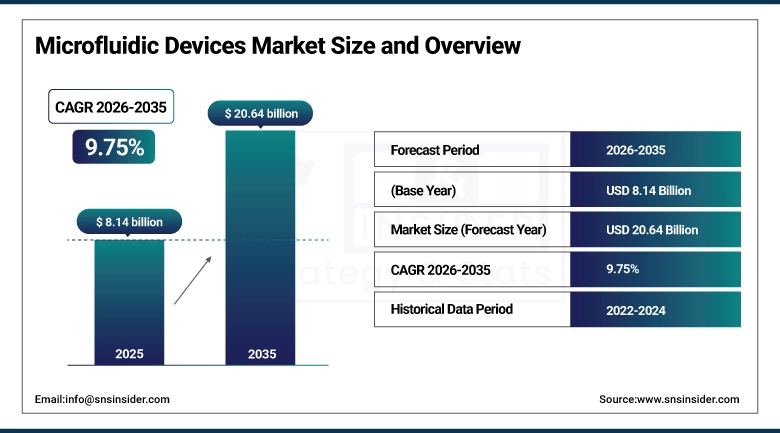
The Microfluidic Devices Market size was estimated at USD 8.14 Billion in 2025 and is expected to reach USD 20.64 Billion by 2035 and grow at a CAGR of 9.75% over the forecast period of 2026-2035..
The Microfluidic Devices Market analysis report provides details about recent product innovations and gives an overview on potential regional market shares. Growing need for quick diagnosis, point of care testing and drug development solutions and progress in lab-on-a-chip and organ-on-a-chip platforms are anticipated to promote market growth.
⮞Microfluidic device shipments reached 4.2 million units in 2025, driven by rising use in diagnostics, point-of-care testing, and drug discovery.
Microfluidic Devices Market Size and Forecast:
-
Market Size in 2025: USD 8.14 Billion
-
Market Size by 2035: USD 20.64 Billion
-
CAGR: 9.75% from 2026 to 2035
-
Base Year: 2025
-
Forecast Period: 2026–2035
-
Historical Data: 2022–2024
To Get More Information On Microfluidic Devices Market - Request Free Sample Report
Microfluidic Devices Market Trends:
-
Increasing demand for near instantaneous point-of-care testing is redefining healthcare worker and patient experiences.
-
Combining lab-on-a-chip and organ-on-a-chip systems broadens the range of experiments performed for drug discovery and research.
-
Growing number of partnerships between biotech companies and universities to drive the adoption of microfluidics solutions.
-
Recent rise in demand for low-cost and portable microfluidic devices has resulted into innovative technologies for resource poor settings.
-
The use of automatic and high throughput microfluidic platforms is revolutionising laboratory efficiency and experimental reproducibility.
-
Droplet-based microfluidics and digital microfluidic bio-analysis are advances that may facilitate highly controlled, scalable chemical and biological analysis.
U.S. Microfluidic Devices Market Insights:
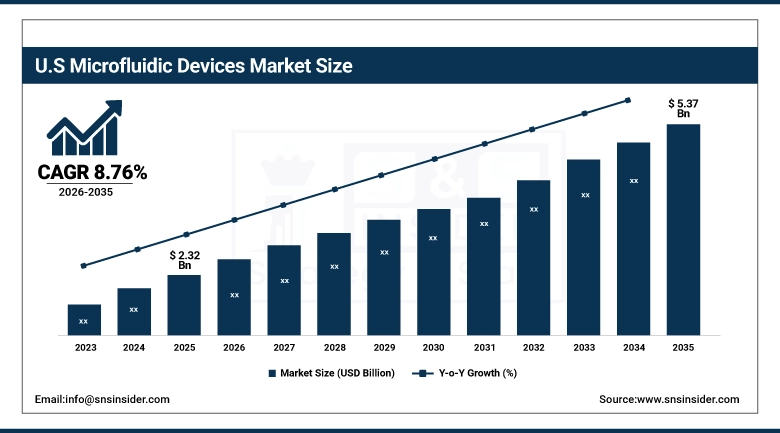
The U.S. Microfluidic Devices Market is projected to grow from USD 2.32 Billion in 2025 to USD 5.37 Billion by 2035, at a CAGR of 8.76%. Rising usage of diagnostics, personalized medicine and pharmaceutical applications, along with growing adoption of lab-on-a-chip and point-of-care testing platforms are driving the demand.
The U.S. Microfluidic Devices industry structure is based on presence of a highly sophisticated healthcare and research infrastructure. Growth in demand for rapid diagnostics, personalized medical products and point-of-care is leading innovation. Lab-on-a-chip platforms, automation and creative partnerships between biotech companies and research institutions are behind the development of microfluidics in the country.
Microfluidic Devices Market Growth Drivers:
-
Rising demand for rapid diagnostics and point-of-care testing is accelerating adoption of microfluidic devices globally.
Rising demand for rapid diagnostics and point-of-care testing is a key driver of the Microfluidic Devices Market Growth. Increasing focus on early detection of disease, quick lab results and tailored healthcare solutions is driving adoption. Growing investments from pharmaceutical and biotechnology companies and widespread adoption in hospitals and research institutes are driving integration. Increased access and productivity of microfluidic appliances are transforming the health care providing market, and promoting the market growth.
Microfluidic device revenue grew 11.2% in 2025, fueled by increasing adoption in rapid diagnostics, point-of-care testing, and pharmaceutical research.
⮞In July 2026, researchers published an integrated digital microfluidic platform combining rapid on-chip plasma separation with wash-free, multiplexed protein immunoassays, demonstrating automated sample-to-answer testing capabilities relevant to decentralized point-of-care diagnostics.
Microfluidic Devices Market Restraints:
-
High manufacturing costs and complex fabrication processes are limiting widespread adoption of microfluidic devices globally.
High manufacturing costs and complex fabrication processes are significant restraints for the Microfluidic Devices Market. Due to the high cost for production and required equipment, this technique is not approachable for small labs and emerging markets. The technical challenges of scaling and standardizing devices can delay adoption, while the requirement for highly trained personnel can drive up operational costs. Collectively, these challenges also make it tough to achieve widespread integration, impede market penetration and force organizations to weigh innovation against cost.
Microfluidic Devices Market Opportunities:
-
Expanding adoption in personalized medicine and organ-on-a-chip research offers significant opportunities for innovation and market expansion.
Growing demand for sustainable and digital luxury fashion presents a major opportunity Expanding adoption in personalized medicine and organ-on-a-chip research is creating new avenues for the Microfluidic Devices Market. Providers and investigators are demanding more personalized solutions tailored to the patient, motivating interest in novel platforms. The development of miniaturized and high-throughput automation approaches, experimental efficiency has improved. Enterprises specializing in state-of-the-art device design and accessible solutions are vying for market share, driving innovation and contributing to greater adoption across life sciences.
Personalized medicine and organ-on-a-chip solutions represented 22% of microfluidic device deployments in 2025, driven by demand for patient-specific testing and research.
⮞In March 2026, the U.S. FDA issued draft guidance outlining validation expectations for alternatives to animal testing, including organ-on-a-chip systems, organoids, and computational models, creating a clearer regulatory pathway for human-relevant drug development technologies.
Microfluidic Devices Market Segmentation Analysis:
-
By Product Type, Lab-on-a-Chip held the largest market share of 38.45% in 2025, while Droplet-Based Microfluidics is expected to grow at the fastest CAGR of 11.05% during 2026–2035.
-
By Technology, Continuous Flow dominated with a 42.18% share in 2025, while Digital microfluidics is projected to expand at the fastest CAGR of 11.43% during the forecast period.
-
By Application, Diagnostics accounted for the highest market share of 40.55% in 2025, while Organ-on-a-Chip is anticipated to record the fastest CAGR of 12.02% through 2026–2035.
-
By End User, Pharmaceutical & Biotechnology Companies held the largest share of 45.21% in 2025, while Hospitals & Clinics are expected to grow at the fastest CAGR of 11.11% during 2026–2035.
By Technology, Continuous Flow Dominates While Digital Expands Rapidly:
Continuous Flow segment dominated the market as they are sturdy, repeatable and well fit for laboratory workflows of high-throughput. They are a popular choice in pharmaceutical and diagnostic lab applications where constant sample to process is desired. Digital is the fastest growing segment, with programmable control over droplet movement, which allows precise manipulation and miniaturization. In 2025, 1.8 million digital microfluidic units were implemented, highlighting the accelerating adoption of this flexible technology.
⮞In January 2026, researchers published an AI-assisted digital microfluidic system integrating darkfield illumination, automated droplet control, and CRISPR-based Mycoplasma pneumoniae detection, demonstrating its potential for more accurate, automated on-site pathogen testing.

By Product Type, Lab-on-a-Chip Dominates While Droplet-Based Microfluidics Expands Rapidly:
Lab-on-a-Chip segment dominated the market as it can fulfil various laboratory tasks in a single micro-size device. It is used in many applications, such as in diagnostics, drug discovery and biochemical analysis, so it can serve for research institutes together with pharmaceutical companies. Droplet-Based Microfluidics is the fastest growing segment due to its exceptional accuracy in manipulating small volumes of fluids and potential for high-throughput screening. In 2025, 4.2 million microfluidic devices were deployed, reflecting this dynamic expansion.
⮞In January 2025, Sphere Fluidics launched Cyto-Mine Chroma and its Early Access Program at SLAS2025 in San Diego, introducing a next-generation picodroplet microfluidics platform for functional single-cell analysis, antibody discovery, and cell therapy research.
By Application, Diagnostics Dominates While Organ-on-a-Chip Expands Rapidly:
Diagnostics segment dominated the market owing to increasing need for rapid diagnosis of disease and efficient patient testing in hospitals and clinics. Microfluidic technologies for increased testing speed, accuracy, economic efficiency of specimens are essential interjection in health and other sectors. Organ-on-a-Chip is the fastest growing segment that provides advanced disease models for drug testing & personalized medicine. In 2025, 2.5 million microfluidic devices were used in organ-on-a-chip studies, indicating rising adoption in pharmaceutical and academic research.
⮞In June 2025, Emulate commercially launched its AVA Emulation System, an automated organ-on-a-chip platform capable of culturing, incubating, and imaging up to 96 independent Organ-Chip samples per run, supporting higher-throughput drug development and toxicity testing.
By End User, Pharmaceutical & Biotechnology Companies Dominate While Hospitals & Clinics Expand Rapidly:
Pharmaceutical and Biotechnology Companies segment dominated the market as they were the first adopters of microfluidic devices in drug discovery, high-throughput screening, biochemical analysis. They are involved in high volume applications that need stable, accurate solutions, so those are the big market volume drivers. Hospitals & Clinics is the fastest-growing segment, using microfluidics in point-of-care testing, rapid diagnostics and patient-specific solutions. In 2025, 1.2 million devices were deployed in hospital settings, reflecting the accelerating clinical adoption.
⮞In September 2025, Fluidic Sciences acquired the business and assets of Sphere Bio, combining Microfluidic Diffusional Sizing technology with picodroplet-based single-cell analysis platforms to expand applications in antibody discovery, cell line development, and biotherapeutic research.
Microfluidic Devices Market Regional Analysis:
North America Microfluidic Devices Market Insights:
The North America Microfluidic Devices Market is dominated with a 37.89% share, due to a high acceptance of microfluidic devices in diagnostic, pharmaceutical and point-of-care testing market. U.S. and Canadian companies’ increasing investment in healthcare infrastructure and R&D is making roll out possible. The focus on personalized medicine, and the use of lab-on-a-chips is helping with utility of the device and are expected to boost the North American microfluidics market, along with collaborations between research institutes and biotech companies.
⮞In April 2026, the U.S. FDA reported achieving its first-year objectives under its roadmap to reduce animal testing, advancing human-relevant drug evaluation methods, including organ-on-a-chip systems, computational models, and advanced laboratory-based testing platforms.

Get Customized Report as Per Your Business Requirement - Enquiry Now
Asia-Pacific Microfluidic Devices Market Insights:
The Asia-Pacific Microfluidic Devices Market is the fastest-growing region, projected to expand at a CAGR of 11.47% during 2026–2035. Growth is driven by growing healthcare spending, increasing demand for quick diagnostics and pharmaceutical research in China, Japan, India and South Korea. The dynamics are such that point-of-care testing, lab-on-a-chip devices and strategic partnerships between biotech companies and research institutions are rapidly driving market penetration, while domestic entrants are ramping up the regional manufacturing capabilities.
⮞In April 2025, Sphere Bio expanded its Asia-Pacific distribution network through five new partnerships, including Japan’s AS ONE Corporation, improving regional access to picodroplet microfluidics platforms and technical support for single-cell analysis and biopharmaceutical research.
Europe Microfluidic Devices Market Insights:
The Europe microfluidic devices industry was a prominent regional market in 2025 owing to the presence of cutting-edge healthcare facilities and top pharma and biotech organizations. To facilitate the penetration of diagnostics, lab-on-a-chip and organ-on-a-chip platforms in these markets are leading countries such as Germany, France and the UK. Emergence of rapid testing, personalized medicine and collaborative research across Europe is anticipated to drive demand for these systems and bolster the region’s position in the microfluidics market.
⮞In February 2025, Cambridge-based Sphere Fluidics rebranded as Sphere Bio, marking its transition toward integrated life sciences solutions and expanded commercialization of picodroplet microfluidics technologies for single-cell analysis, biologics discovery, and cell therapy development.
Latin America Microfluidic Devices Market Insights:
The Latin America Microfluidic Devices Market is on the rise, due to growth of healthcare infrastructure and biotech research in Brazil, Mexico, and Argentina. Growing need for quick diagnosis, point of care testing and laboratory advancement is fuelling the transfer. Domestic manufacturing investments, regional partnerships and technology transfer from international players continue propping up the market’s healthy trajectory.
Middle East and Africa Microfluidic Devices Market Insights:
The Middle East & Africa Microfluidic Devices Market is developing with the growing healthcare expenditure, increasing need for quick diagnostics and burgeoning biotech research. Government-led programs, lab modernization and partnerships with multinational corporations are driving adoption. Saudi Arabia, UAE and South Africa are the major markets driving this regional market growth.
Microfluidic Devices Market Competitive Landscape:
Danaher Corporation, headquartered in Washington, D.C., is a leader in life sciences, diagnostics and biotechnology. It leads the way in microfluidic devices with strategic acquisitions of Pall, Cytiva and Abcam to complement its strength in bioprocessing, genomics and lab consumables. Danaher is a world science and technology innovator committed to helping customers solve complex challenges and improving quality of life around the world, it provides a powerful set of capabilities in the areas of test and measurement, life sciences, diagnostics, environmental and applied solutions.
-
In May 2025, Danaher partnered with AstraZeneca to develop AI-powered diagnostics and computational pathology solutions, enhancing lab efficiency and accelerating targeted therapy, reinforcing Danaher’s leadership in advanced diagnostic technologies.
Thermo Fisher Scientific Inc., based in Waltham, Massachusetts, is a leading provider of scientific instruments, reagents and lab services. It has a strong hold over the microfluidic devices market with strong product portfolio comprising its brand names Thermo Scientific, Fisher Scientific, and Invitrogen along with investment in modern R&D. The company provides one of the broadest portfolios for life sciences, diagnostics and applied market laboratories and a unique role in helping you to do more to enable customers to make the world healthier, cleaner and safer.
-
In June 2025, Thermo Fisher launched Orbitrap Astral Zoom MS and Orbitrap Excedion Pro MS instruments at ASMS 2025, providing higher throughput, sensitivity, and multiplexing for biopharma, omics, and diagnostics workflows, strengthening its position in microfluidic-enabled laboratory solutions.
Agilent Technologies, headquartered in Santa Clara, California, specializes in instruments, software, consumables and services for life sciences, diagnostics and chemical analysis. It is at the forefront of microfluidics in that it has accurate analytical systems, high-throughput laboratory solutions and measurement technologies unmatched across the industry. An innovator and player in lab automation and bio-analytics with extensive reach geographically, with its powerful products, Agilent is a power-player in the pharmaceutical industry and research institutes plus clinical labs.
-
In June 2025 at HPLC, Agilent introduced InfinityLab Pro iQ LC-MS systems and Hybrid Multisampler, improving lab efficiency and sensitivity for peptides, proteins, and oligonucleotides, advancing microfluidics-enabled bioanalysis and reinforcing Agilent’s position in precision laboratory instrumentation.
Microfluidic Devices Market Key Players:
Some of the Microfluidic Devices Market Companies are:
-
Danaher Corporation
-
Thermo Fisher Scientific Inc.
-
Agilent Technologies, Inc.
-
PerkinElmer, Inc.
-
Illumina, Inc.
-
Abbott Laboratories
-
F. Hoffmann‑La Roche Ltd.
-
Bio‑Rad Laboratories, Inc.
-
Becton, Dickinson and Company (BD)
-
Fluidigm Corporation / Standard BioTools Inc.
-
Qiagen N.V.
-
IDEX Corporation
-
Dolomite Microfluidics (Blacktrace Holdings Ltd.)
-
Micronit Microtechnologies
-
Elveflow (Elvesys)
-
uFluidix Inc.
-
Sphere Fluidics Limited
-
BioMérieux
-
Cellix Ltd.
-
Fluigent SA
| Report Attributes | Details |
|---|---|
| Market Size in 2025 | USD 8.14 Billion |
| Market Size by 2035 | USD 20.64 Billion |
| CAGR | CAGR of 9.75% From 2026 to 2035 |
| Base Year | 2025 |
| Forecast Period | 2026-2035 |
| Historical Data | 2022-2024 |
| Report Scope & Coverage | Market Size, Segments Analysis, Competitive Landscape, Regional Analysis, DROC & SWOT Analysis, Forecast Outlook |
| Key Segments | • By Product Type (Lab-on-a-Chip, Micro Total Analysis System (µTAS), Droplet-Based Microfluidics, Paper-Based Microfluidics, Others) • By Technology (Continuous Flow, Droplet-Based, Digital, Others) • By Application (Drug Discovery, Diagnostics, Point-of-Care Testing, Organ-on-a-Chip, Environmental Monitoring, Others) • By End User (Pharmaceutical & Biotechnology Companies, Academic & Research Institutes, Hospitals & Clinics, Others) |
| Regional Analysis/Coverage | North America (US, Canada), Europe (Germany, UK, France, Italy, Spain, Russia, Poland, Rest of Europe), Asia Pacific (China, India, Japan, South Korea, Australia, ASEAN Countries, Rest of Asia Pacific), Middle East & Africa (UAE, Saudi Arabia, Qatar, South Africa, Rest of Middle East & Africa), Latin America (Brazil, Argentina, Mexico, Colombia, Rest of Latin America). |
| Company Profiles | Danaher Corporation, Thermo Fisher Scientific Inc., Agilent Technologies Inc., PerkinElmer Inc., Bio-Rad Laboratories Inc., Fluidigm Corporation, Illumina Inc., Abbott Laboratories, Micronit Microtechnologies B.V., Dolomite Microfluidics, uFluidix Inc., Micralyne Inc., Sphere Fluidics Limited, Elveflow, IDEX Corporation, Microfluidic ChipShop GmbH, Fluigent SA, Blacktrace Holdings Ltd., Roche Diagnostics, Becton, Dickinson and Company. |

Frequently Asked Questions
North America led with a 37.89% share in 2025, while Asia-Pacific is the fastest-growing region, expected to expand at a CAGR of 11.47% during 2026–2035.
Lab-on-a-Chip dominated with a 38.45% share in 2025, while Droplet-Based Microfluidics is projected to grow at the fastest CAGR of 11.05% during 2026–2035.
Growth is driven by increasing demand for rapid diagnostics, point-of-care testing, and lab-on-a-chip and organ-on-a-chip adoption.
The market is valued at USD 8.14 Billion in 2025 and is projected to reach USD 20.64 Billion by 2035.
The Microfluidic Devices Market is expected to grow at a CAGR of 9.75% during 2026–2035.
