
Mold Flux Market Report Scope & Overview:
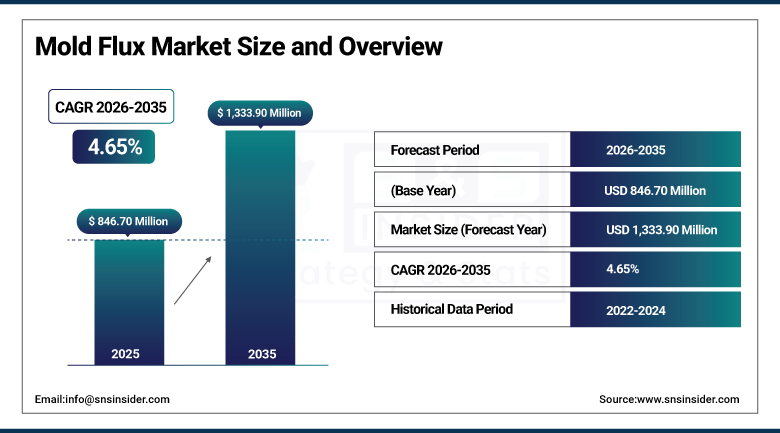
The Mold Flux Market was valued at USD 846.70 Million in 2025 and is expected to reach USD 1,333.90 Million by 2035, growing at a CAGR of 4.65% from 2026-2035.
The Mold Flux Market supplies the powders and granules that form a protective layer over molten steel inside a continuous casting mold, insulating the meniscus, moderating heat transfer and absorbing non-metallic inclusions before the strand solidifies. Caster operators replace this layer on every sequence cast, tying consumption directly to continuous casting run hours rather than to new steelmaking capacity alone. Refractory producers are widening granulated and synthetic product lines as integrated mills and electric-arc-furnace producers alike seek formulations tuned to higher casting speeds and tighter surface-quality demands. Carbon steel casting dominates by steel grade today, and the Middle East and Africa is closing the gap with Asia Pacific fastest.
The World Steel Association reported on January 23, 2026 that global crude steel production fell 2.0 percent in 2025 to 1,849.4 million tonnes, down from 1,886.8 million tonnes a year earlier. This contraction in global output increases near-term pressure on mold flux suppliers to compete on formulation performance and technical service rather than on casting volume alone.
To Get more information On Mold Flux Market - Request Free Sample Report
Mold Flux Market Trends
-
Refractory producers are widening synthetic mould powder ranges to cut reliance on fly ash supply that has grown less consistent as coal-fired power generation declines in several sourcing markets.
-
Electric-arc-furnace mills converting from blast-furnace routes are driving demand for flux formulations tuned to the different inclusion chemistry that scrap-based steelmaking produces.
-
Producers are developing carbon-free and fluoride-reduced mould powder chemistries ahead of tightening workplace and environmental rules in several major casting regions.
-
Automotive and appliance steel buyers are pushing casters toward higher-speed slab casting, which is lifting demand for flux grades engineered for faster, more uniform heat extraction.
-
Regional refractory groups in the Middle East and South Asia are adding local mould powder production to reduce lead times that imported flux from established suppliers previously required.
U.S. Mold Flux Market Outlook
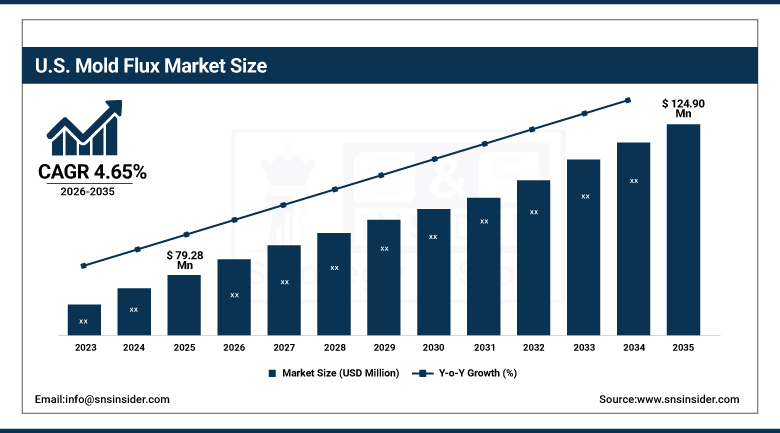
The U.S. Mold Flux Market was valued at USD 79.28 Million in 2025 and is expected to reach USD 124.90 Million by 2035, growing at a CAGR of 4.65% from 2026-2035.
The U.S. Mold Flux Market is the largest within North America. Integrated mills along the Great Lakes and electric-arc-furnace producers across the South anchor demand, buying flux formulations matched to their casting speeds and steel grades rather than a single generic product. U.S.-based refractory suppliers compete with imported granulated and synthetic powders on technical service and formulation turnaround rather than price alone, since a flux change requires validated trials before a caster will commit to a new supplier. Automotive steel demand continues to support higher-speed slab casting lines needing tightly engineered flux chemistry. Trade measures covering imported steel are indirectly supporting caster utilization and flux consumption across most producing states.
⮞The American Iron and Steel Institute reported that U.S. raw steel producers operated at a capability utilization rate of 75.7 percent for the week ending January 10, 2026, on output of 1.752 million net tons. A utilization rate of that level across the country's mills is a close proxy for how much continuous casting runtime, and with it mold flux consumption, the U.S. steel sector is generating week to week.
Mold Flux Market Segment Analysis
-
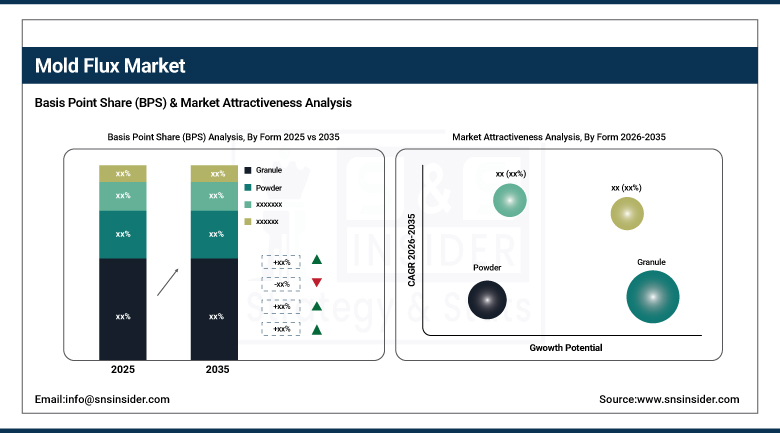
By Form, the Granule segment dominated the Mold Flux Market with approximately 70.80% share in 2025, while the Powder segment is the fastest growing with a CAGR of approximately 5.35%.
-
By Product, the Synthetic Mould Powders segment dominated the Mold Flux Market with approximately 60.40% share in 2025, while the Pre-Fused and Fritted Mould Powders segment is the fastest growing with a CAGR of approximately 3.85%.
-
By Steel Grade, the Carbon Steel segment dominated the Mold Flux Market with approximately 79.70% share in 2025, while the Alloy and Specialty Steel segment is the fastest growing with a CAGR of approximately 6.55%.
-
By Casting Application, the Slab segment dominated the Mold Flux Market with approximately 65.30% share in 2025, while the Billet segment is the fastest growing with a CAGR of approximately 5.45%.
-
By Form, the Granule segment dominated the Mold Flux Market with approximately 70.80% share in 2025, while the Powder segment is the fastest growing with a CAGR of approximately 5.35%.
-
By Product, the Synthetic Mould Powders segment dominated the Mold Flux Market with approximately 60.40% share in 2025, while the Pre-Fused and Fritted Mould Powders segment is the fastest growing with a CAGR of approximately 3.85%.
-
By Steel Grade, the Carbon Steel segment dominated the Mold Flux Market with approximately 79.70% share in 2025, while the Alloy and Specialty Steel segment is the fastest growing with a CAGR of approximately 6.55%.
-
By Casting Application, the Slab segment dominated the Mold Flux Market with approximately 65.30% share in 2025, while the Billet segment is the fastest growing with a CAGR of approximately 5.45%.
By Form, Granule Dominates the Mold Flux Market and Powder Grows Fastest
Granulated flux holds the largest form share because its free-flowing particle size feeds evenly through automatic dosing equipment on high-speed casters, cutting the manual top-up labor that fine powder often still requires on older lines. Integrated mills running multiple strands around the clock favor granule formulations for the steadier melt rate they produce once a crust forms over the mold, which keeps surface quality more consistent across a long sequence cast. Established suppliers have also spent years tuning granulation processes for specific caster speeds and grades, giving granule products a performance track record that newer powder formulations have not yet matched across most major casting operations worldwide.
Powder formulations are growing fastest as smaller casters and foundry-adjacent producers, particularly across newer regional capacity in South Asia and the Gulf, favor the lower upfront equipment cost of powder feeding systems over the dosing hardware granule handling requires. Suppliers are also developing finer, more uniform powder grades aimed at billet and bloom casters that do not run the same continuous multi-strand sequences integrated slab mills do. That combination of lower equipment cost and improving powder consistency is drawing a wider base of smaller and mid-size casters toward powder rather than granule for new line installations across several developing and established casting regions alike.
⮞The Association for Iron and Steel Technology hosted AISTech 2025 in Nashville, Tennessee in May 2025, drawing 8,313 total attendees, 722 exhibiting companies and 519 technical presentations from 40 countries. Events of this size give flux suppliers a venue to present new granule and powder formulations to caster operators evaluating a switch.
By Product, Synthetic Mould Powders Dominates the Mold Flux Market and Pre-Fused and Fritted Mould Powders Grows Fastest
Synthetic mould powders lead product-type share because manufacturers can blend their mineral inputs to a consistent specification batch after batch, a precision that naturally occurring fly ash cannot reliably match once its source coal composition shifts. Casters running tight surface-quality tolerances for automotive-grade sheet increasingly specify synthetic formulations for this batch-to-batch consistency alone, even where a fly ash-based product costs less per tonne delivered. Supply of consistent fly ash has also grown less dependable as several sourcing markets retire coal-fired generating capacity, pushing more flux producers toward synthetic inputs they can source and blend independently of that declining supply stream over time.
Pre-fused and fritted mould powders are growing fastest as casters handling peritectic and higher-carbon grades, which crack and tear more easily during solidification, specify a powder that has already been melted and reground before use so its properties stay uniform the moment it reaches the mold. That manufacturing step adds cost but removes a layer of batch-to-batch variation that unfused blended powders can still show, which matters most on the crack-prone grades where a flux failure can scrap an entire strand. Specialty and alloy steel producers adopting these demanding grades are the primary buyers driving this faster-growing product category today.
⮞The International Stainless Steel Forum reported that global stainless steel output rose 3.1 percent year-on-year in the second quarter of 2025. Growth of that pace in a steel category that leans heavily on pre-fused and fritted powder for its more crack-prone grades is a direct signal of where this faster-growing product category is finding its incremental demand.
By Steel Grade, Carbon Steel Dominates the Mold Flux Market and Alloy and Specialty Steel Grows Fastest
Carbon steel accounts for the largest steel-grade share simply because it remains the grade cast in the greatest tonnage worldwide, spanning construction rebar, structural sections and commodity flat products that consume flux on every sequence regardless of end use. Casters running carbon grades also use comparatively standardized flux chemistry across multiple product lines, letting suppliers serve this segment with fewer distinct formulations than specialty grades require. That standardization keeps per-tonne flux cost low for carbon steel producers, reinforcing carbon steel's position as the category generating the largest absolute flux volume even as higher-value grades grow faster in percentage terms year after year.
Alloy and specialty steel is growing fastest as automotive, aerospace and energy customers specify grades such as TRIP and other advanced high-strength steels that demand flux engineered for narrower thermal breakpoints and tighter inclusion absorption than commodity carbon formulations provide. Casters adding alloy and specialty capacity are working directly with flux suppliers on grade-specific trials rather than simply buying an off-the-shelf product, extending qualification timelines but building a technical relationship that keeps a caster with the same supplier once a formulation passes trial. That closer collaboration model is becoming the norm as more mills chase higher-margin specialty tonnage.
⮞Nippon Steel Corporation announced on February 3, 2025 a bid worth approximately 70.5 billion yen to fully acquire Sanyo Special Steel and bring the specialty steelmaker under full ownership. This specialty-steel acquisition by one of the world's largest integrated producers points to consolidation in alloy and specialty tonnage, which flux suppliers are serving with increasingly demanding grade-specific products.
By Casting Application, Slab Dominates the Mold Flux Market and Billet Grows Fastest
Slab casting leads by application because it serves the flat-rolled steel supply chain feeding automotive, appliance and construction sheet markets, the largest end-use pool by tonnage across nearly every major steelmaking region. Slab casters also run at higher width and speed than billet or bloom lines, consuming flux at a faster per-strand rate that keeps this application the largest buyer of flux by volume even where billet casters outnumber slab casters in total unit count. Integrated mills investing in wider, faster slab casters to serve automotive-grade sheet demand are reinforcing this application's lead further still across most of the world's major producing regions.
Billet casting is growing fastest as electric-arc-furnace mills producing long products for construction and reinforcing bar expand capacity faster than slab-focused integrated routes in several developing casting markets. These EAF-based billet casters often run smaller, more numerous strands than slab casters, and each new strand added to a mill represents another flux consumption point that scales with unit count rather than width alone. Regional infrastructure spending supporting construction-grade long products is translating directly into new billet casting capacity and the flux demand that comes with it across nearly every market adding long-product capacity today and in the years immediately ahead.
⮞The Organisation for Economic Co-operation and Development's Steel Committee warned that global steelmaking overcapacity could surpass 680 million tonnes in 2025, with new capacity additions concentrated in electric-arc-furnace and billet-focused routes in several developing markets. Capacity growth concentrated in that segment is a direct marker of where billet casting, and the flux volume tied to it, is expanding fastest.
Regional Analysis
|
Region |
Major Country |
Share within Region, 2025 (%) |
|---|---|---|
|
North America |
United States |
83.60 |
|
Europe |
Germany |
27.40 |
|
Asia Pacific |
China |
58.90 |
|
Middle East and Africa |
Saudi Arabia |
44.70 |
|
Latin America |
Brazil |
46.30 |
Asia Pacific Mold Flux Market Insights
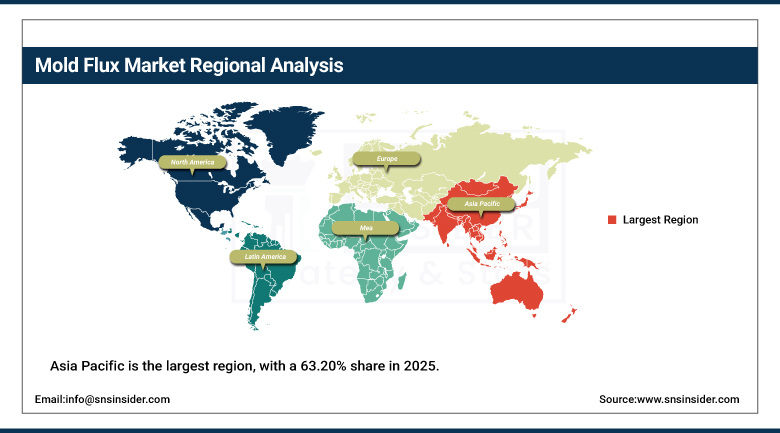
Asia Pacific is the largest region, with a 63.20% share in 2025. China anchors regional demand through the largest single national base of continuous casters in the world, spanning both integrated slab mills and a rapidly expanding electric-arc-furnace segment that each buy flux tuned to their own casting profile. India adds a fast-expanding base of new casting capacity tied to local infrastructure and automotive growth, drawing increasing flux volume from both home-market and imported suppliers. Japan and South Korea contribute a smaller but technically demanding pool of specialty and automotive-grade casting that keeps regional flux formulation standards among the most advanced worldwide.
Regional flux producers headquartered in Japan and China supply much of their home markets directly while also exporting formulated powders to smaller casting operations across Southeast Asia that have not yet built local blending capacity of their own. China's steel sector has absorbed a run of output declines through 2025 as mills curb overcapacity, which is pushing regional flux suppliers to compete harder on formulation performance for the casting runtime that remains rather than relying on sheer national output growth. A deep technical bench built up over decades continues to give regional suppliers a durable cost and formulation advantage over flux imported from outside the region.
The China Iron and Steel Association reported that member mills' daily crude steel output fell 1.3 percent in mid-December 2025 even as mill stockpiles rose over the same period. This production pattern at the world's largest steelmaking base indicates softer near-term casting runtime, which regional flux suppliers are factoring into their formulation and pricing.
Get Customized Report as per Your Business Requirement - Enquiry Now
North America Mold Flux Market Insights
North America holds an 11.20% share of the global market in 2025. The United States anchors regional demand through a mix of integrated mills and electric-arc-furnace producers that buy flux formulations matched to their own casting speed and steel grade mix rather than a single standardized product across the industry. Canada contributes through its own base of integrated and electric-arc-furnace casters, drawing on both home-market and imported flux supply depending on grade and availability. Trade measures covering imported steel across the region are indirectly supporting caster utilization, and with it flux consumption, even as broader steel demand growth across the region remains modest.
North American refractory and metallurgical-additive producers compete with imported granulated and synthetic flux on formulation turnaround and technical service rather than price alone, since switching a caster to a new supplier requires validated trials before a mill will commit at scale. Canadian steel output has come under renewed pressure from shifting cross-border trade flows, a dynamic that is prompting regional producers to diversify their customer base rather than depend on a single national market for casting volume. Investment in higher-speed slab and billet lines across both countries continues to support demand for flux engineered to tighter surface-quality tolerances across most producing states and provinces.
⮞The Canadian Steel Producers Association reported that Canada's steel output fell 15 percent in May 2026 as shifting cross-border trade flows reshaped regional trade patterns. A decline of this size in a single month adds near-term casting-volume pressure and is encouraging North American flux suppliers to diversify beyond any single national customer base.
Europe Mold Flux Market Insights
Europe is a smaller but technically demanding region, with activity concentrated in Germany, France and Italy. Germany's large automotive and specialty-steel producers drive demand for flux engineered to narrow thermal and inclusion-absorption tolerances that ordinary commodity formulations cannot reliably meet on crack-prone alloy grades. France and Italy add further specialty-casting demand through their own automotive and industrial steel bases, supporting a cluster of regional flux formulators working closely with casters on grade-specific trials across the bloc. Europe's overall steel output has fallen to a historic low, concentrating regional flux demand increasingly around specialty and automotive grades rather than commodity carbon tonnage.
European steel producers are prioritizing formulation performance and emissions compliance over casting volume growth as the region's broader steel output continues to contract, pushing flux suppliers to invest in carbon-free and fluoride-reduced chemistries ahead of tightening workplace and environmental rules. Specialty and automotive steel producers remain willing to pay a premium for flux validated against their own grade-specific trials even as commodity carbon steel casting volume softens across most of the region and shows little sign of a near-term rebound. Regional suppliers are increasingly exporting formulation expertise to casters elsewhere rather than relying solely on contracting home-market demand to sustain their businesses.
⮞The European Steel Association reported that European steel production fell 2.9 percent in 2025 to roughly 125.8 million tonnes, with a recovery not expected until 2027. This prolonged contraction is leading regional flux suppliers to lean on specialty-grade formulation work rather than commodity casting volume to sustain revenue through the downturn.
MEA & Latin America Mold Flux Market Insights
The Middle East and Africa is the fastest-growing major region, expanding at a projected CAGR of approximately 7.35% from 2026 to 2035. Saudi Arabia leads regional demand as its integrated and electric-arc-furnace steelmakers expand capacity to meet construction and infrastructure-driven local steel demand, drawing on both imported and newly established home-market flux supply. The United Arab Emirates and Oman add further electric-arc-furnace casting capacity tied to regional construction cycles and a steadily expanding downstream manufacturing base. South Africa contributes a smaller, longer-established base of casting capacity that continues to rely mainly on imported flux formulations shipped in from established producers elsewhere in the world.
Latin America adds smaller but steady demand, led by Brazil's integrated and electric-arc-furnace steel producers casting both carbon and specialty grades for local infrastructure and automotive supply chains across the country's major industrial centers. Mexico and Argentina contribute additional billet and slab casting volume tied to their own construction and automotive sectors, drawing mainly on imported flux given limited local formulation capacity of their own. Currency volatility across several countries continues to make landed flux pricing less predictable than producers in the region would prefer, even as underlying casting volume continues to grow steadily year after year across most of the region's major economies.
Saudi Arabia's Hadeed steelworks engaged IDOM in February 2026 for a front-end engineering design contract tied to a flat products expansion project at its Jubail site, part of a broader plan to raise national steel production capacity toward 10 million tonnes. This expansion program at one of the region's largest integrated steelmakers adds new casting capacity and encourages flux suppliers to establish home-market production rather than serve the region purely through imports.
Market Dynamics
Growth Drivers: Electric-arc-furnace expansion and higher-speed casting are widening flux formulation demand
The strongest driver is the continuing shift toward electric-arc-furnace steelmaking, which casts a different inclusion chemistry than blast-furnace routes and requires flux formulations tuned specifically to scrap-based melt rather than a one-size formulation carried over from integrated casting practice. Mills converting from blast-furnace to electric-arc-furnace routes are working with flux suppliers on new formulations as part of the broader conversion project, giving suppliers an opening to establish a technical relationship with a mill switching routes entirely rather than simply swapping one flux brand for another on an existing line that has not changed its underlying casting process in any meaningful way for years.
A second driver is the push toward higher-speed slab and billet casting to meet automotive and appliance demand for tighter surface-quality tolerances, which requires flux engineered for faster, more uniform heat extraction than older casting speeds demanded. Casters upgrading line speed are treating flux reformulation as part of the broader upgrade project rather than an afterthought, giving suppliers with strong technical-service capability an advantage over competitors offering only a standardized catalog product with little room for customization. That upgrade cycle is spreading from automotive-grade producers to a wider base of casters chasing similar quality gains across several adjacent end-use categories.
⮞The International Energy Agency reported that global investment in lower-emission steelmaking technology, including electric-arc-furnace conversions, continued expanding through 2025 as mills in multiple regions announced new projects. Continued investment in furnace-route conversion is driving the flux reformulation work that suppliers are now being asked to support.
Restraints: Concentrated raw-material supply and declining fly ash availability limit faster scaling
A persistent restraint is the concentration of key mineral inputs, including fluorspar, among a small number of supplying countries, which leaves flux producers exposed to import-reliance risk that a more geographically diversified input base would not have to carry in quite the same way or to the same degree. Producers in import-dependent regions have limited ability to substitute a different input on short notice once a formulation has been qualified by a caster, since requalifying a new input blend against a customer's grade-specific trial can take months rather than weeks to complete fully and satisfactorily to the caster's complete technical approval.
A second restraint is the declining consistency of fly ash supply as several sourcing markets retire coal-fired power generation, removing a traditionally low-cost flux input just as producers are also managing fluorspar supply concentration on the opposite side of their formulation mix. That dual pressure is pushing more producers toward synthetic alternatives that cost more to manufacture but do not depend on a single declining byproduct stream, slowing margin recovery for producers still carrying fly ash-based product lines through the transition period immediately ahead and into the following several budget cycles, particularly for smaller producers without the capital to retool their blending operations quickly.
⮞The U.S. Geological Survey reported that the United States remained 100 percent net import reliant for fluorspar in its 2026 mineral commodity summary, with Mexico supplying 64 percent of imports and Vietnam and China together supplying a further 22 percent. This reliance on a handful of supplying countries creates an input-concentration risk that constrains how quickly flux producers can scale new capacity with confidence.
Opportunities: Low-carbon steelmaking investment and regional capacity buildouts are opening new revenue paths
A major opportunity lies in the wave of low-carbon and electric-arc-furnace investment across Europe and beyond, which is creating fresh formulation work as mills converting to new furnace routes need flux chemistry validated against their specific melt profile rather than simply reusing an existing blast-furnace formulation. Suppliers that build deep technical relationships with mills during this conversion window stand to keep that business for years once a formulation passes qualification, since switching suppliers again afterward carries real requalification cost and risk for the caster that few mills are willing to take on without a clear and compelling reason to do so.
A second opportunity lies in establishing home-market flux production across the Middle East and South Asia, where new integrated and electric-arc-furnace capacity is outpacing local formulation supply and leaving casters more dependent on imported flux than producers in more mature markets. Global suppliers building regional blending and granulation capacity close to these fast-growing casting markets can cut the lead times that importing finished flux currently requires, capturing share from competitors still serving the region purely from distant production sites that cannot match a locally based supplier on turnaround or ongoing technical support once a caster commits to a long-term formulation relationship.
⮞ArcelorMittal confirmed in February 2026 a 1.3 billion euro investment in a new electric-arc-furnace at its Dunkirk site in France to produce lower-emission steel. This investment at a single integrated site is a furnace-route conversion project that opens new flux-formulation opportunities for suppliers able to support the transition.
Recent Developments:
-
In April 2026, Calderys inaugurated its new CAPES facility in Odisha, India, describing it as the world's largest single-site greenfield facility for refractories and steel casting fluxes, spanning forty-five acres with six planned production lines including a dedicated flux line expected online in late 2026.
-
In September 2026, RHI Magnesita confirmed it is considering a possible offer for Vesuvius plc, a leading supplier of mold flux and continuous casting consumables; the deadline for a firm offer was later extended to 24 November 2026.
-
In August 2025, Calderys inaugurated a new synthetic-powder production line at its steel casting fluxes plant in Durgapur, West Bengal, India.
Mold Flux Market Key Players
-
Vesuvius plc
-
IFGL Refractories Ltd.
-
Prosimet S.p.A.
-
Guru Corporation
-
Shinagawa Refractories Co., Ltd.
-
Krosaki Harima Corporation
-
Dynamix Casting Fluxes Pvt. Ltd.
-
Jharkhand Grind-Chem Private Limited
-
Minex Metallurgical Co., Ltd.
-
Calderys
-
Stollberg (Imerys Metalcasting)
-
Henan Longcheng Group
-
Luoyang Kefeng Metallurgical New Materials Co., Ltd.
-
Liaoning Shinagawa Hefeng Metallurgical Materials Co., Ltd.
Mold Flux Market Report Scope:
| Report Attributes | Details |
|---|---|
| Market Size in 2025 | USD 846.70 Million |
| Market Size by 2035 | USD 1,333.90 Million |
| CAGR | CAGR of 4.65% From 2026 to 2035 |
| Base Year | 2025 |
| Forecast Period | 2026-2035 |
| Historical Data | 2022-2024 |
| Report Scope & Coverage | Market Size, Segments Analysis, Competitive Landscape, Regional Analysis, DROC & SWOT Analysis, Forecast Outlook |
| Key Segments | • By Form (Powder & Granule) • By Product (Fly Ash-Based Mould Powders, Synthetic Mould Powders & Pre-Fused and Fritted Mould Powders) • By Steel Grade (Carbon Steel, Stainless Steel, Alloy and Specialty Steel & Other Grades) • By Casting Application (Slab, Billet, Bloom & Other) |
| Regional Analysis/Coverage | North America (US, Canada), Europe (Germany, UK, France, Italy, Spain, Russia, Poland, Rest of Europe), Asia Pacific (China, India, Japan, South Korea, Australia, ASEAN Countries, Rest of Asia Pacific), Middle East & Africa (UAE, Saudi Arabia, Qatar, South Africa, Rest of Middle East & Africa), Latin America (Brazil, Argentina, Mexico, Colombia, Rest of Latin America). |
| Company Profiles | Vesuvius plc, IFGL Refractories Ltd., Prosimet S.p.A., Guru Corporation, Shinagawa Refractories Co., Ltd., Krosaki Harima Corporation, Dynamix Casting Fluxes Pvt. Ltd., Jharkhand Grind-Chem Private Limited, Minex Metallurgical Co., Ltd., Calderys, Stollberg (Imerys Metalcasting), Henan Longcheng Group, Luoyang Kefeng Metallurgical New Materials Co., Ltd., Liaoning Shinagawa Hefeng Metallurgical Materials Co., Ltd. |

Frequently Asked Questions
The market includes Vesuvius, IFGL Refractories, Prosimet, Guru Corporation, Shinagawa Refractories, Krosaki Harima Corporation, Dynamix Casting Fluxes, Jharkhand Grind-Chem, Minex Metallurgical, Nippon Steel Chemical & Material, Calderys and Stollberg, among others.
The main opportunities lie in supplying flux formulations validated for new low-carbon and electric-arc-furnace conversion projects, and in establishing home-market production capacity across the Middle East and South Asia where new casting capacity is outpacing local flux supply.
The key growth factor is the continuing shift toward electric-arc-furnace steelmaking and higher-speed casting, both of which require flux formulations engineered specifically for their melt chemistry and heat-extraction profile rather than a standardized legacy product.
By steel grade, the Carbon Steel segment dominated the market with approximately 79.70% share in 2025, since it remains the grade cast in the greatest tonnage worldwide.
Asia Pacific dominated the market with approximately 63.20% share in 2025, led by China's large base of continuous casters. The Middle East and Africa is the fastest-growing region with a projected CAGR of approximately 7.35% from 2026 to 2035.
