
mRNA Therapeutics Market Report Scope & Overview:
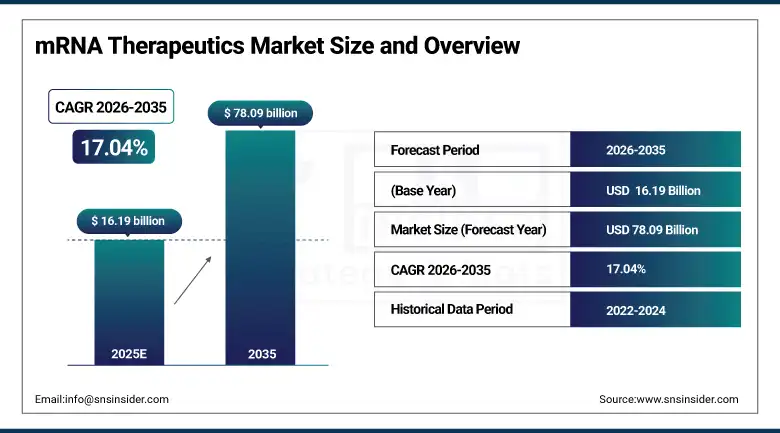
The mRNA Therapeutics Market size is estimated at USD 16.19 billion in 2025 and is expected to reach USD 78.09 billion by 2035, growing at a CAGR of 17.04% over the forecast period of 2026-2035.
The global mRNA therapeutics market trend is a growing demand for innovative vaccine technologies such as lipid nanoparticle delivery systems, self-amplifying RNA platforms, and personalized cancer immunotherapies as the growth of the market is driven by increasing investment in genetic medicine research, rapid vaccine development capabilities, and advancement in mRNA stability and delivery mechanisms. This trend is also driven by a growing adoption of precision medicine approaches and the growing focus on rare disease treatment as pharmaceutical companies become more focused on developing targeted mRNA-based therapies and are more willing to invest in next-generation sequencing and bioprocessing technologies, resulting in growth in the domestic and international market for prophylactic vaccines and therapeutic drug solutions.
For instance, in March 2024, growing clinical trial success and improved manufacturing infrastructure drove a 32% increase in mRNA therapeutic pipeline programs for biotechnology companies globally, boosting investment in genetic medicine platforms and accelerating regulatory approval timelines.
To Get more information On mRNA Therapeutics Marke - Request Free Sample Report
mRNA Therapeutics Market Trends:
-
mRNA therapeutic solutions are being adopted because healthcare providers demand rapid vaccine development platforms, personalized cancer immunotherapy, and novel treatment approaches for previously undruggable diseases.
-
Customized mRNA-based treatments targeting specific genetic mutations, tumor antigens, and rare disease pathways to improve therapeutic efficacy and patient outcomes.
-
The development of AI-powered sequence optimization, advanced lipid nanoparticle formulations, and thermostable mRNA constructs to improve the delivery efficiency and reduce cold chain requirements.
-
Self-replicating RNA platforms, circular RNA technologies, and combination immunotherapy approaches are all available to ensure sustained protein expression and enhanced immune response activation.
-
Increased demand for scalable manufacturing solutions, automated bioreactor systems and point-of-care production capabilities to help global accessibility and pandemic preparedness.
-
Collaboration between pharmaceutical companies, biotechnology firms and academic research institutions to develop next-generation mRNA platforms and improve delivery technology standards.
-
FDA, EMA and WHO promoting standards for mRNA vaccine quality control, accelerated approval pathways, adaptive clinical trial designs, and post-market surveillance requirements.
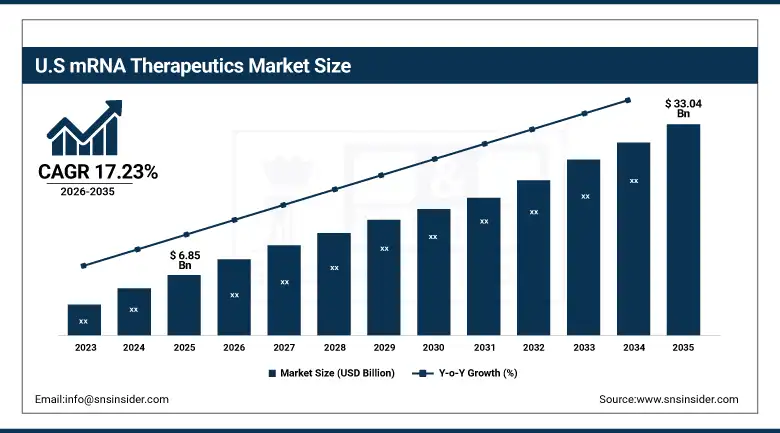
The U.S. mRNA Therapeutics Market is estimated at USD 6.85 billion in 2025 and is expected to reach USD 33.04 billion by 2035, growing at a CAGR of 17.23% from 2026-2035. The United States represents the largest market for mRNA therapeutics, primarily driven by the extensive biotechnology infrastructure, federal funding for genetic medicine research, and well-developed clinical trial networks. Government support through Operation Warp Speed legacy programs, substantial venture capital investment and increased pharmaceutical company spending on mRNA technology help to drive growth in the market. Also, the U.S. is the largest regional market in the world, due to the regulatory framework supporting expedited approvals and swift adoption of personalized medicine and cancer vaccine platforms.
mRNA Therapeutics Market Growth Drivers:
-
Breakthrough Success of COVID-19 mRNA Vaccines is Driving the mRNA Therapeutics Market Growth
Breakthrough success of COVID-19 mRNA vaccines take the center stage as a growth driver for the mRNA therapeutics market share, and are driven by the proven efficacy and safety profiles of Pfizer-BioNTech and Moderna vaccines, rapid development timelines, and global regulatory acceptance of mRNA technology platforms. These solutions for infectious disease prevention and therapeutic intervention are driving the base of the market, the penetration of prophylactic vaccine & therapeutic drug markets, and adding to the overall market share globally.
For instance, in June 2024, mRNA-based cancer vaccines and personalized immunotherapies accounted for ~58% of the total global oncology pipeline investments in genetic medicine, reflecting growing institutional confidence and expanding market share.
mRNA Therapeutics Market Restraints:
-
High Manufacturing Complexity and Cold Chain Requirements are Hampering the mRNA Therapeutics Market Growth
High manufacturing complexity & cold chain requirements of mRNA therapeutics also restrict the mRNA therapeutics market growth, as a large number of developing countries face difficulties establishing ultra-cold storage infrastructure and maintaining stringent quality control standards throughout distribution networks. This might lead to limited market access, reduced product stability, and increased cost burdens for healthcare systems. As a result, global health equity suffers, and market growth is stunted in regions where cold chain logistics are inadequate and specialized storage facilities are limited.
mRNA Therapeutics Market Opportunities:
-
Expansion into Rare Disease Treatment and Personalized Medicine Drive Future Growth Opportunities for the mRNA Therapeutics Market
The opportunity in the expansion into rare disease treatment and personalized medicine in mRNA therapeutics market is in the form of protein replacement therapies, gene editing combinations, and neoantigen-specific cancer vaccines. These solutions provide for previously untreatable genetic disorders, individualized tumor-specific immunotherapy, and targeted enzyme replacement strategies. Through enhanced treatment precision, reduced development timelines, and improved patient-specific therapeutic responses, particularly in areas with unmet medical needs, these technologies may improve clinical outcomes, decrease healthcare costs, and expand the market.
For instance, in April 2024, the FDA reported that 64% of investigational new drug applications for rare genetic diseases incorporated mRNA technology platforms, highlighting rising therapeutic innovation and increasing demand for precision genetic medicine approaches.
mRNA Therapeutics Market Segment Analysis:
-
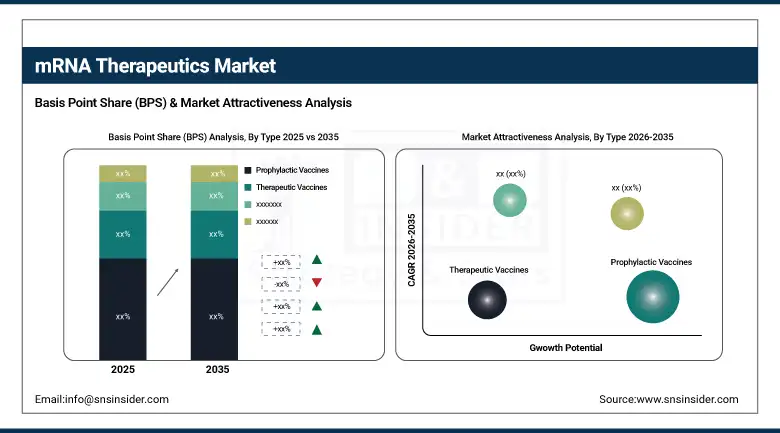
By type, prophylactic vaccines held the largest share of around 67.42% in 2025E, and the therapeutic drugs segment is expected to register the highest growth with a CAGR of 18.35%.
-
By application, infectious disease segment dominated the market with approximately 59.28% share in 2025E, while the rare genetic disease is expected to register the highest growth with a CAGR of 19.12%.
-
By end user, hospitals and clinics accounted for the leading share of nearly 64.17% in 2025E, and research organizations are expected to register the highest growth with a CAGR of 17.89%.
By Type, Prophylactic Vaccines Lead the Market, While Therapeutic Drugs Register Fastest Growth
The prophylactic vaccines segment accounted for the highest revenue share of approximately 67.42% in 2025, owing to widespread COVID-19 vaccine deployment, established regulatory pathways for infectious disease prevention, and proven commercial viability of mRNA vaccination platforms. Emerging trends, including increasing development of combination vaccines and universal flu vaccine candidates. In comparison, the therapeutic drugs segment is anticipated to achieve the highest CAGR of nearly 18.35% during the 2026–2035 period, driven by the expanding oncology pipeline, breakthrough therapy designations for rare diseases, and growing investment in protein replacement therapies. Drivers include rising clinical trial success rates, the preference for targeted genetic medicine approaches.
By Application, the Infectious Disease Segment dominates, while the Rare Genetic Disease Segment Shows Rapid Growth
By 2025, the infectious disease segment contributed the largest revenue share of 59.28% due to established COVID-19 vaccine market, ongoing pandemic preparedness initiatives and continued development of vaccines for emerging pathogens. Growing adoption of mRNA technology for influenza, respiratory syncytial virus, and cytomegalovirus prevention coupled with rapid response manufacturing capabilities, healthcare systems are increasingly investing in mRNA-based infectious disease solutions. The rare genetic disease segment is projected to grow at the highest CAGR of about 19.12% between 2026 and 2035 due to the growing need for novel treatments for previously undruggable genetic disorders and enzyme deficiency syndromes. Some of the reasons include breakthrough clinical data for methylmalonic acidemia and propionic acidemia, better access to orphan drug designations, and pharmaceutical companies' preference for high-value specialty therapeutic markets.
By End User, Hospitals and Clinics Lead, while Research Organizations Register Fastest Growth
The hospitals and clinics segment accounted for the largest share of the mRNA therapeutics market with about 64.17%, owing to their direct patient care responsibilities, vaccine administration infrastructure, and capacity for clinical trial participation. Reasons driving the hospital segment include large-scale vaccination programs and cancer immunotherapy adoption. In addition, research organizations are slated to grow at the fastest rate with a CAGR of around 17.89% throughout the forecast period of 2026–2035, as academic institutions, biotechnology companies, and pharmaceutical research centers seek advanced mRNA discovery platforms, translational medicine capabilities, and early-stage therapeutic development tools. Increased focus on neoantigen identification and personalized vaccine design contribute to their growth, while improved funding for genetic medicine research and expanded preclinical development drive continued investment.
mRNA Therapeutics Market Regional Highlights:
North America mRNA Therapeutics Market Insights:
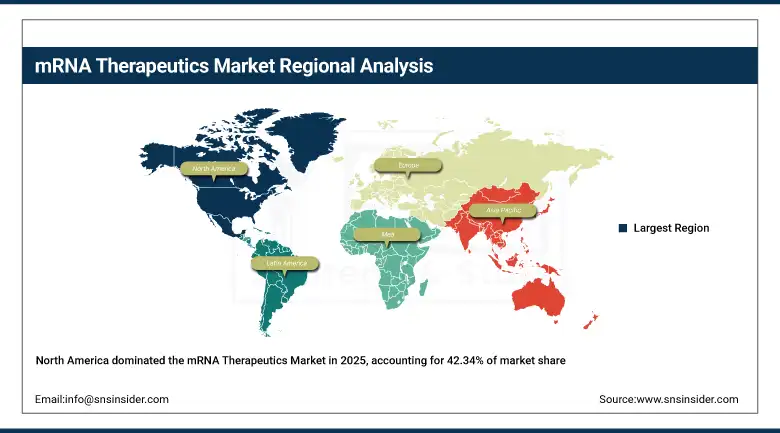
North America held the largest revenue share of over 42.34% in 2025 of the mRNA therapeutics market due to an established biotechnology ecosystem, pioneering vaccine development success, and increased venture capital funding for genetic medicine startups. Drivers include extensive intellectual property portfolios, an advanced clinical research infrastructure, growing pharmaceutical industry investment and greater acceptance of personalized medicine approaches stemming from precision oncology advances. At the same time, various government initiatives, BARDA funding for pandemic preparedness and enormous investments in mRNA manufacturing capacity from pharmaceutical giants are anchoring mRNA therapeutic development in the market, and ensuring multibillion dollar revenues around the world.
Get Customized Report as per Your Business Requirement - Enquiry Now
Asia Pacific mRNA Therapeutics Market Insights:
Asia Pacific is the fastest-growing segment in the mRNA therapeutics market with a CAGR of 18.76%, as the awareness about genetic medicine capabilities, government investment in biotechnology infrastructure, and pharmaceutical manufacturing expansion in developing nations is growing. Factors including rapid clinical trial recruitment, rising middle-class healthcare expenditure with insurance coverage expansion, and growing establishment of mRNA production facilities are stimulating the market growth. Technology transfer agreements and regional vaccine manufacturing hubs have been instrumental in improving local production capacity, especially in countries with large population bases. Public-private partnerships and regulatory framework modernization also help in advancing genetic medicine adoption and clinical development acceleration. Increase in demand in Asia Pacific region owing to rising healthcare innovation against traditional therapies and growing affordability and accessibility of regionally-produced mRNA therapeutics.
Europe mRNA Therapeutics Market Insights:
The mRNA therapeutics market in Europe is the second-dominating region after North America on account of an increase in the adoption of BioNTech and CureVac technologies, robust pharmaceutical regulatory frameworks supporting accelerated approvals, and increasing collaborative research initiatives across European Union member states. Rising implementation of national genetic medicine strategies, advanced bioprocessing capabilities, favorable government funding for mRNA technology development, and cross-border clinical trial networks are also contributing to the sustained growth of the market in leading European countries.
Latin America (LATAM) and Middle East & Africa (MEA) mRNA Therapeutics Market Insights:
In Latin America, and Middle East & Africa, the growing pharmaceutical sector investment and increase in technology transfer agreements with global mRNA manufacturers support the mRNA therapeutics market growth. The rising popularity of regional vaccine production facilities and government initiatives for pandemic preparedness, along with improving cold chain infrastructure, will aid healthcare accessibility and therapeutic innovation. The increasing biotechnology sector development and improving regulatory approval processes in these regions are continuing to encourage market growth.
mRNA Therapeutics Market Competitive Landscape:
Moderna, Inc. (est. 2010) is a leading biotechnology company that focuses on messenger RNA therapeutics and vaccine development for infectious diseases and rare genetic disorders. It uses its proprietary mRNA platform and extensive clinical pipeline to produce cutting-edge therapeutic solutions with personalized medicine applications.
-
In February 2025, it expanded its mRNA cancer vaccine portfolio with positive Phase 3 data for personalized melanoma immunotherapy, aiming to revolutionize oncology treatment and strengthen its position in the therapeutic vaccines segment across global markets.
BioNTech SE (est. 2008) is a well-known global immunotherapy company focused on mRNA-based cancer treatments, infectious disease vaccines, and protein replacement therapies. It invests in lipid nanoparticle delivery systems and individualized neoantigen platforms with the hopes of revolutionizing genetic medicine with safe, effective, and scalable mRNA therapeutic solutions.
-
In May 2024, launched an expanded clinical development program for mRNA-based rare disease treatments including methylmalonic acidemia and glycogen storage disorders, enhancing its therapeutic pipeline diversity and addressing significant unmet medical needs in genetic medicine.
Pfizer Inc. (est. 1849) is a leading global pharmaceutical corporation in the fields of vaccine development, oncology therapeutics, and genetic medicine platforms. The company's mRNA product portfolio focuses on prophylactic vaccines and therapeutic applications, and features a strong commitment to manufacturing scalability and continuous innovation to complement the strong market presence in both developed and emerging markets.
-
In September 2024, introduced next-generation combination mRNA vaccines targeting influenza and COVID-19 with improved thermostability features, strengthening pandemic preparedness capabilities and expanding market reach through reduced cold chain dependency.
mRNA Therapeutics Market Key Players:
-
Moderna, Inc.
-
BioNTech SE
-
Pfizer Inc.
-
CureVac N.V.
-
Translate Bio (Sanofi)
-
Arcturus Therapeutics Holdings Inc.
-
eTheRNA Immunotherapies
-
Argos Therapeutics
-
In-Cell-Art
-
Ethris GmbH
-
Acuitas Therapeutics
-
Precision NanoSystems (Cytiva)
-
GlaxoSmithKline plc
-
AstraZeneca plc
-
Sanofi S.A.
-
Merck & Co., Inc.
-
Novartis AG
-
Roche Holding AG
-
Eli Lilly and Company
-
Takeda Pharmaceutical Company Limited
| Report Attributes | Details |
|---|---|
| Market Size in 2025 | USD 16.19 Billion |
| Market Size by 2035 | USD 78.09 Billion |
| CAGR | CAGR of 17.04% From 2026 to 2035 |
| Base Year | 2025 |
| Forecast Period | 2026-2035 |
| Historical Data | 2022-2024 |
| Report Scope & Coverage | Market Size, Segments Analysis, Competitive Landscape, Regional Analysis, DROC & SWOT Analysis, Forecast Outlook |
| Key Segments | • By Application (Rare genetic disease, Respiratory disease, Infectious disease) • By type (Prophylactic vaccines, Therapeutic Vaccines, Therapeutic Drugs) • By end user (Hospitals and clinics, Research Organizations) |
| Regional Analysis/Coverage | North America (US, Canada, Mexico), Europe (Eastern Europe [Poland, Romania, Hungary, Turkey, Rest of Eastern Europe] Western Europe] Germany, France, UK, Italy, Spain, Netherlands, Switzerland, Austria, Rest of Western Europe]), Asia Pacific (China, India, Japan, South Korea, Vietnam, Singapore, Australia, Rest of Asia Pacific), Middle East & Africa (Middle East [UAE, Egypt, Saudi Arabia, Qatar, Rest of Middle East], Africa [Nigeria, South Africa, Rest of Africa], Latin America (Brazil, Argentina, Colombia, Rest of Latin America) |
| Company Profiles | Moderna, Inc., BioNTech SE, Pfizer Inc., CureVac N.V., Translate Bio (Sanofi), Arcturus Therapeutics Holdings Inc., eTheRNA Immunotherapies, Argos Therapeutics, In-Cell-Art, Ethris GmbH, Acuitas Therapeutics, Precision NanoSystems (Cytiva), GlaxoSmithKline plc, AstraZeneca plc, Sanofi S.A., Merck & Co., Inc., Novartis AG, Roche Holding AG, Eli Lilly and Company, Takeda Pharmaceutical Company Limited |

Frequently Asked Questions
The global mRNA Therapeutics Market is valued at USD 16.19 billion in 2025 and is projected to reach USD 78.09 billion by 2035, growing at a CAGR of 17.04% from 2026 to 2035.
Growth of the mRNA Therapeutics Market is driven by advancements in mRNA delivery technologies, rising investment in genetic medicine, and strong demand for vaccines and personalized therapies after COVID-19.
North America leads the mRNA Therapeutics Market due to strong biotechnology infrastructure, significant research funding, and rapid adoption of precision medicine technologies.
Major applications in the mRNA Therapeutics Market include infectious disease vaccines, cancer immunotherapy, and treatments for rare genetic disorders.
Key companies in the mRNA Therapeutics Market include Moderna, Inc., BioNTech SE, Pfizer Inc., and CureVac N.V..
