
Onshore Wind Energy Market Report Scope & Overview:
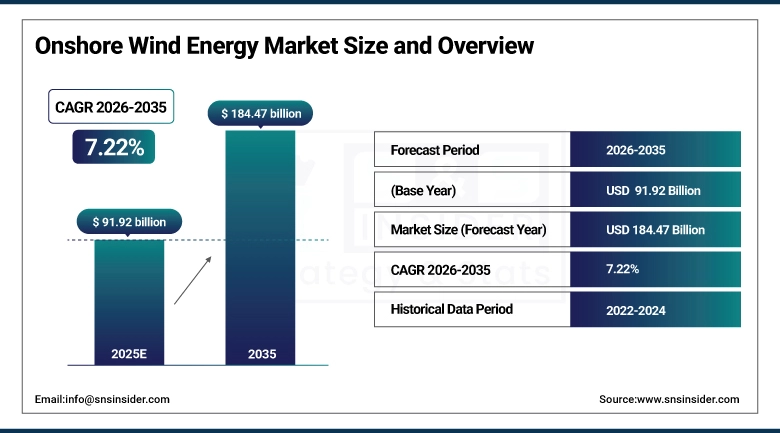
The Onshore Wind Energy Market size was valued at USD 91.92 Billion in 2025 and is projected to reach USD 184.47 Billion by 2035, growing at a CAGR of 7.22% during 2026–2035.
This has driven an increasing demand for the Onshore Wind Energy Market globally and companies with good financial status are tapping in to the new trend giving this market a backbone with government initiatives also playing a big role. Major install levels are led by advanced turbine technologies and high-capacity projects for key players such as GE Vernova, Vestas and Avangrid across multi-market spans for Europe, North America, and Asia-Pacific. The deployment is dominated by Horizontal Axis Wind Turbines while Small Wind Turbines and Direct Drive Technology segments are growing quickly. The bulk of installations are still onshore, supplemented by hybrid and repowering projects. The largest share is made up of utility-scale applications, although community-scale projects grow steadily, indicating diversification and sustainable long-term growth in the onshore wind energy sector.
In October2025 – GE Vernova awarded 252-MW order for Ialomita onshore wind project from Greenvolt in Romania, including 42 × 6.1 MW turbines GE Vernova supports nearly 120 GW of onshore turbines globally — 57,000 of them in total. Delivery of the turbines will begin in 2026.
To Get more information on Onshore Wind Energy Market - Request Free Sample Report
Onshore Wind Energy Market Trends Highlights:
-
Strong demand growth with rising global need for clean and sustainable energy driving onshore wind project investments
-
Technological advancements including improved turbine efficiency, reliability, and integration with energy storage and smart grids reducing costs and enhancing adoption
-
Policy and incentive support from government measures and renewable energy targets accelerating project development and boosting investor confidence
-
Infrastructure and regulatory challenges such as high capital expenditure, limited grid capacity, permitting delays, and community opposition constraining market expansion
-
Emerging opportunities in hybrid energy systems, small modular reactors, hydrogen, and solar integration providing avenues for diversification and long-term growth
-
Market expansion driven by increasing electricity demand, industrial energy consumption, and modernization of power systems supporting global deployment
U.S. Onshore Wind Energy Market Size Outlook:
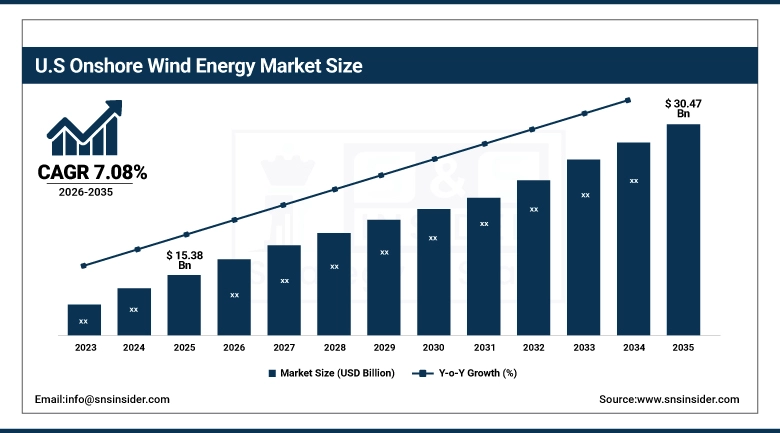
The U.S. Onshore Wind Energy Market size was valued at USD 15.38 Billion in 2025 and is projected to reach USD 30.47 Billion by 2035, growing at a CAGR of 7.08% during 2026–2035. The market growth is driven by Supportive government policies favoring clean energy, technological advancements, rising demand for sustainable power sources along with increasing new installations, capacity expansions, and high investments in the overall renewable power sector of the country are providing a boost to the market growth.
Onshore Wind Energy Market Drivers:
-
Technological Advancements and Policy Support Propel Onshore Wind Energy Growth
Increased global demand for clean and sustainable energy drives investment in onshore wind projects. Improvements in efficiency and reliability of turbines leads to reduction in operational costs and entails the manufacture and installation of large scale. Government policies, incentives and renewable energy targets contribute towards faster development of projects. Unlike years ago, wind power can be integrated with energy storage and smart grid solutions, increasing reliability and thus competitiveness. The expansion of capacity and the decrease of cost, in turn, reinforces investor confidence and this growth cycle in the market. As a result, these things all contribute to reinforcing onshore wind deployment at the regional and global scales, generating a positive loop of innovation, efficiency, and smooth low-carbon energy transition.
In October 2025, Octopus Energy partners with Ming Yang to deploy up to 6 GW of onshore wind capacity in the UK, aiming to reduce wind energy costs. The partnership will also explore solar, battery storage, and software solutions for enhanced data protection and cybersecurity.
Onshore Wind Energy Market Restraints:
-
Infrastructure Challenges and Regulatory Hurdles Limit Onshore Wind Growth
The onshore wind energy market is experiencing growth, due to the high initial capital expenditure and project financing being complex. Emerging regions with limited grid infrastructure have a higher payback to deploy projects, reducing energy accessibility and profitability. The lengthy timeline and cost associated with: regulatory uncertainties, permitting processes, and environmental compliance requirements, slow down projects. Delays in deployment can also arise from difficulties acquiring land and opposition from local communities. Such restrictions undermine investor confidence and slow the rate of expansion of the market. Thus, even if demand for renewables continue increasing, technical, financial and regulatory barriers still moderate adoption rates and limit regional capacity boosts in the onshore wind industry.
Onshore Wind Energy Market Opportunities:
-
Expanding Infrastructure and Technological Integration Create Growth Opportunities in Onshore Wind Energy
The onshore wind energy market by installation provided is vast scope opportunity due to upgrading of power grids, increasing electricity demand and hybrid energy systems. Efficiency and reliability can be enhanced via research and development (R&D) in advanced turbine technology, energy storage, and integration with distributed generation. Capacity development due to backings from regulations and government incentives for clean energy projects Emerging technologies at the margins, including small modular reactors, hydrogen, and some applications of solar provide options for diversified resource portfolios. However, the emerging infrastructure, the demand for rapid energy development, and the elements of these factors create a new market opportunity that stimulates new technology, more new work and the development and growth of onshore wind energy generation capacity in the long term.
In October 2025, Duke Energy updates its Carolinas Resource Plan, extending the use of coal and natural gas and adding nuclear and battery storage but pushing back the timing of wind to integrate to meet growing electricity demand. It focuses on maintaining reliability and affordability as regulation changes, a growing population, and increasing demand from data centers and businesses drive energy consumption.
Onshore Wind Energy Market Segment Highlights:
-
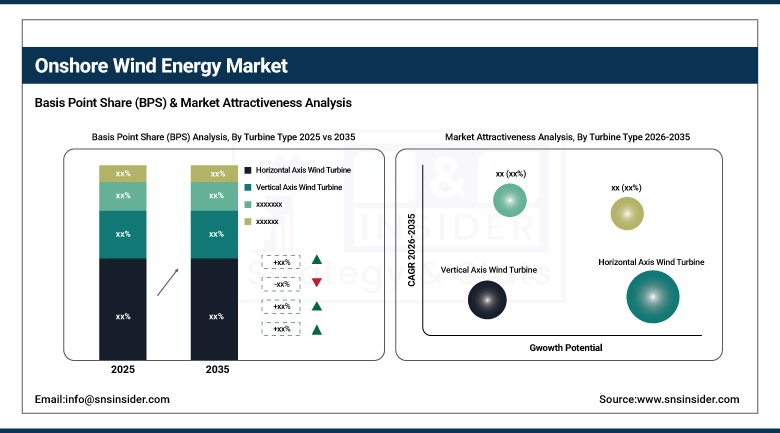
By Turbine Type: Dominant – Horizontal Axis Wind Turbine (49.38% in 2025 → 45.63% in 2035); Fastest-Growing – Small Wind Turbine (CAGR 9.03%)
-
By Technology: Dominant – Gear Drive Technology (43.25% in 2025 → 38.75% in 2035); Fastest-Growing – Direct Drive Technology (CAGR 8.18%)
-
By Installation Type: Dominant – Onshore Installations (83.13% in 2025 → 71.88% in 2035); Fastest-Growing – Repowering Installations (CAGR 15.57%)
-
By Application: Dominant – Utility Scale (69.25% in 2025→ 64.75% in 2035); Fastest-Growing – Community Scale (CAGR 9.52%)
By Turbine Type Horizontal Axis Wind Turbine Dominating and Small Wind Turbine Fastest-Growing
Horizontal Axis Wind Turbine leads the market with the highest share, reflecting its widespread adoption and efficiency in large-scale wind power generation. Meanwhile, Small Wind Turbine represents the fastest-growing segment as a result of rising number of installations for residential, community, and remote applications suggesting high growth opportunities and changing market dynamics.
By Technology, Gear Drive Technology Dominating and Direct Drive Technology Fastest-Growing
Gear Drive Technology leads the market with the highest share, reflecting its established use and reliability in wind turbines. Meanwhile, Direct Drive Technology is the fastest-growing segment, owing to high adoption of Direct Drive Technology due to the advantages of having a higher efficiency and lower maintenance, which signifies growth potential and transformation of market dynamics.
By Installation Type, Onshore Installations Dominating and Repowering Installations Fastest-Growing
Onshore Installations dominate the market, reflecting their widespread deployment and cost-effectiveness. Meanwhile, Repowering Installations looks set to be the fastest-growing segment, suggesting significant room for growth as demand for overhauling old systems with newer, higher-performance turbine components grows.
By Application, Utility Scale Dominating and Community Scale Fastest-Growing
Utility Scale projects demand the trade, as of installations that are large-capacity, large-capitalization, plus ample capital flows. At the same time Community Scale applications emerge as the fastest-growing sector, fueled by rising local energy movements and decentralized electricity generation in a prominent trend for onshore wind energy deployment.
Onshore Wind Energy Market Regional Highlights:
-
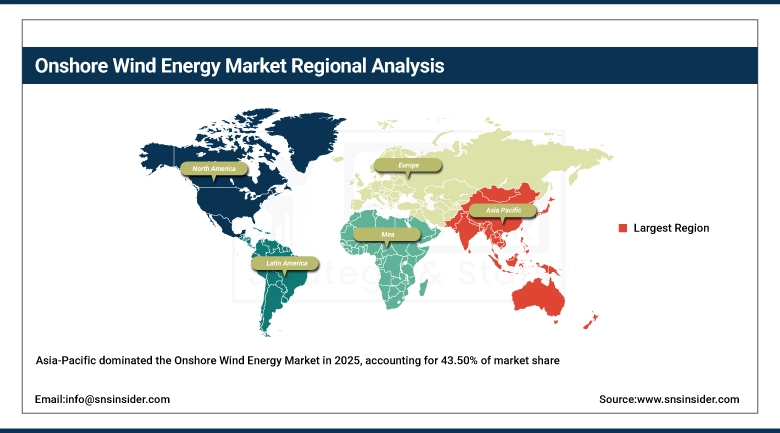
Asia-Pacific: In 2025 43.50% → 40.50%, largest share in 2025, slight decline in % (CAGR 6.45%)
-
North America: In 2025 25.25% → 27.37%, dominant region in 2035, steady growth (CAGR 8.08%)
-
Europe: In 2025 20.25% → 21.75%, moderate growth (CAGR 7.98%)
-
South America: In 2025 6.88% → 6.13%, small share, steady growth (CAGR 5.98%)
-
Middle East & Africa: In 2025 4.13% → 4.88%, fastest-growing region, (CAGR 7.54%)
Asia-Pacific Onshore Wind Energy Market Trends:
The Asia-Pacific region leads the Onshore Wind Energy market, holding the largest share which is fueled by rapid industrialization, but also because of a strong government initiative to build in renewable sectors. Capacity expansion is mainly driven by countries such as China and India, while emerging markets in Southeast Asia provide further growth to the regional domination and steer the global market towards long-term development.
Get Customized Report as per Your Business Requirement - Enquiry Now
China Onshore Wind Energy Market Insights:
China is leading in the installed and new Onshore Wind Energy project development in Asia-Pacific region. China leads the way in regional and global wind power development, buoyed by significant government support, sizable investments and expanding industries.
North America Onshore Wind Energy Market Trends:
North America Onshore Wind Energy market is the fastest-growing market as the region has been subject of a large number of government incentives, corporate renewable energy commitments, and large-scale onshore wind project developments across the U.S. and Canada. Driven by growing investments toward modern turbines and supportive policies that spur capacity expansion, North America will emerge as the prominent growth hotspot on the global front.
U.S Onshore Wind Energy Market Insights:
The United States dominates the Onshore Wind Energy market, leading in installed capacity, technological advancements, and large-scale projects, supported by government incentives and strong private-sector investments driving continued market growth.
Europe Onshore Wind Energy Market Trends:
The Europe Onshore Wind Energy market is in its emerging stage with the growth with the backing of EU renewable energy targets, government support, and highly focused on technological advancements. Increased capacity is being added mainly through countries such as, Germany, Spain, and France, while investments in modern turbines and grid infrastructure strengthen European contribution to global growth in terms of onshore power.
Germany Onshore Wind Energy Market Insights:
Germany is the leader in installed capacity, technological innovation, and large-scale projects in the Europe Onshore Wind Energy market. Strong government policies and investments sparking in growth, Germany is the main force behind wind energy development in the region.
Latin America Onshore Wind Energy Market Trends:
The Latin America Onshore Wind Energy market is expected to gain considerable growth owing to increasing supportive measures from government, upsurge in investments in renewable energy and increasing energy demand in the region. Brazil, Mexico, and Chile spearhead capacity increases, while new projects and national developments expand the region's role in sustainable wind energy progress.
Brazil Onshore Wind Energy Market Insights:
Brazil comes first in the Onshore Wind Energy market by Installed Capacity and Annual New Projects supported by strong government incentives and an optimal wind environment.
Middle East & Africa Onshore Wind Energy Market Trends:
The Middle East & Africa Onshore Wind Energy market is experiencing moderate growth, supported by government initiatives, investments in renewable energy infrastructure, and increasing demand for clean power. Countries like Egypt, Morocco, and South Africa are leading project developments, driving capacity expansion and fostering sustainable energy adoption across the region.
Egypt Onshore Wind Energy Market Insights:
Egypt dominates the onshore wind energy market in the Middle East & Africa owing to the highest installed capacity including large-scale projects such as Gabal El-Zeit. The market and regional leadership of this country are driven by strong government support for the wind energy sector, favorable wind conditions, and strategic investments in wind power infrastructure.
Onshore Wind Energy Market Competitive Landscape:
Iberdrola, S.A., established on November 1, 1992, is a Spanish multinational electric utility company headquartered in Bilbao, Spain. It was formed through the merger of Hidroeléctrica Española and Iberduero. The name "Iberdrola" is a portmanteau of "Iber" (referring to the Iberian Peninsula) and "drola" (from "hidroeléctrica," meaning hydroelectric). This reflects the company's origins in hydroelectric power generation and its focus on renewable energy sources.
-
In Feb 2025 – Avangrid, Iberdrola's U.S. subsidiary, has nearly 10,500 MW installed across 24 states, powering ~3.1 million households.The company supports 500+ jobs, contributes USD 50M+ in property taxes, and has 27 GW in its renewable energy project pipeline.
Vestas (established 1945) is a Danish wind energy company based in Aarhus that designs, manufactures, installs, and services wind turbines across the globe. Vestas is the global leader in renewable energy solutions with installed capacity for over 145 GW, world leading service agreements and local presence in more than 80 countries, helping to build a sustainable energy future.
-
In Jan 2025 – Vestas received a 384 MW order for the second phase of DTEK’s Tyligulska project, making it Ukraine’s largest wind energy project at 498 MW.The company will supply 64 turbines and provide 20-year service under AOM 5000
Onshore Wind Energy Companies are:
-
Vestas
-
GE Renewable Energy / GE Vernova
-
Goldwind / Goldwin
-
Nordex Group / Nordex
-
Enercon
-
Suzlon Energy
-
Envision Energy / Envision Group
-
Sany Renewable Energy
-
Dongfang Electric Corporation (DEC)
-
Mitsubishi Heavy Industries (MHI)
-
Doosan Heavy Industries & Construction
-
Acciona Energia
-
Shanghai Electric Wind Power
-
Sinovel Wind Group
-
TPI Composites
-
Vensys Energy
-
Clenergy
-
Iberdrola
-
United Power / Windey Energy Technology Group
| Report Attributes | Details |
|---|---|
| Market Size in 2025 | USD 91.92 Billion |
| Market Size by 2035 | USD 184.47 Billion |
| CAGR | CAGR of 7.22% From 2026 to 2035 |
| Base Year | 2025 |
| Forecast Period | 2026-2035 |
| Historical Data | 2022-2024 |
| Report Scope & Coverage | Market Size, Segments Analysis, Competitive Landscape, Regional Analysis, DROC & SWOT Analysis, Forecast Outlook |
| Key Segments | • By Turbine Type (Distributed Energy Resource, Demand Response and Mixed Asset) • By Technology (Solar Power Plants, Wind Power Plants, Hydro Power Plants, Biomass Power Plants, Gas/Thermal Power Plants) • By Installation Type (Grid Balancing & Ancillary Services, Peak Load Management, Renewable Energy Integration, Energy Trading & Optimization and Microgrid Support) • By Application (Industrial, Residential and Commercial) |
| Regional Analysis/Coverage | North America (US, Canada), Europe (Germany, UK, France, Italy, Spain, Russia, Poland, Rest of Europe), Asia Pacific (China, India, Japan, South Korea, Australia, ASEAN Countries, Rest of Asia Pacific), Middle East & Africa (UAE, Saudi Arabia, Qatar, South Africa, Rest of Middle East & Africa), Latin America (Brazil, Argentina, Mexico, Colombia, Rest of Latin America). |
| Company Profiles | Vestas, Siemens Gamesa Renewable Energy, GE Renewable Energy / GE Vernova, Goldwind / Goldwin, Nordex Group / Nordex, Enercon, Suzlon Energy, MingYang Smart Energy, Envision Energy / Envision Group, Sany Renewable Energy, Dongfang Electric Corporation (DEC), Mitsubishi Heavy Industries (MHI), Doosan Heavy Industries & Construction, Acciona Energia, Shanghai Electric Wind Power, Sinovel Wind Group, TPI Composites, Vensys Energy, Clenergy, Iberdrola, United Power / Windey Energy Technology Group. |
Frequently Asked Questions
Asia-Pacific dominated the Onshore Wind Energy Market in 2025.
The “Horizontal Axis Wind Turbine” segment dominated during the projected period.
Increasing demand for renewable energy and government incentives are driving growth in the Onshore Wind Energy Market.
The Market was valued at USD 91.92 Billion in 2025 and is projected to reach USD 184.47 Billion by 2035.
The Market is expected to grow at a CAGR of 7.22% during 2026–2035.
