
Power Line Communication Market Report Scope & Overview:
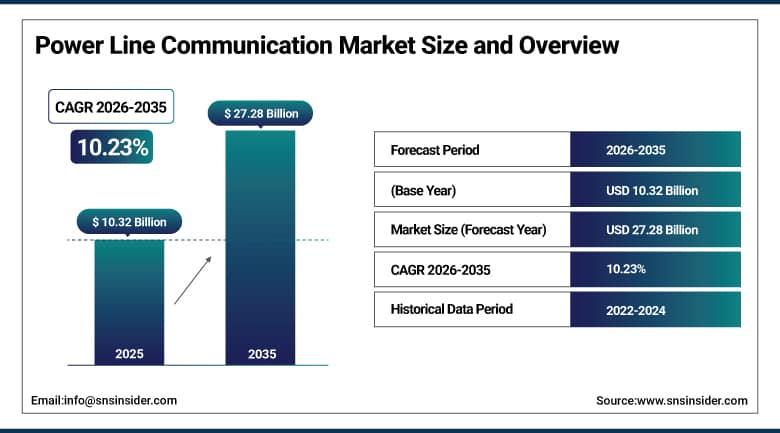
The Power Line Communication Market was valued at USD 10.32 billion in 2025 and is expected to reach USD 27.28 billion by 2035, growing at a CAGR of 10.23% from 2026–2035.
The power line communication market is witnessing strong growth in the global market owing to rising smart grid deployments. Increasing investments in advanced electricity distribution networks are boosting adoption. Growing demand for reliable data transmission through existing power infrastructure is supporting market expansion. Manufacturers are focusing on high-performance broadband and narrowband communication technologies. Rising implementation of smart metering and home automation solutions is driving innovation. Increasing use across industrial automation and utility communication networks is further accelerating market adoption.
As per the International Energy Agency Electricity 2025 and smart grids update in Europe by the year 2025, there will be a substantial growth in the demand for electricity till the year 2027, thereby increasing the requirement for digital communication in the grid systems. Over 60 percent of households in Europe have smart meters by the end of the period, with the percentage of households having smart meters being more than 80 percent in 15 European countries. The European Commission also states that most smart meters in the EU are PLC-based.
To Get More Information On Power Line Communication Market - Request Free Sample Report
Power Line Communication Market Trends:
-
Fast-paced advancement in smart grid technologies is leading to the implementation of power line communications systems that will help in real-time monitoring and efficient energy distribution networks.
-
Widespread usage of smart meters and advanced metering infrastructure is helping in facilitating data transmission through existing electrical power line networks.
-
Higher level of integration of IoT enabled smart home devices is contributing towards growing requirement for in-building communication technologies using existing electrical wiring systems.
-
Implementation of smart cities and digital infrastructures is facilitating wider usage of connected energy management and communication technologies across the world.
-
Higher investments in renewable energy installations are increasing the need for communication systems for efficient management of decentralized power generation systems.
-
The trend of adopting cost-effective communication infrastructures is leading to higher implementation of power line communication as it eliminates the requirement of additional network cable systems.
U.S. Power Line Communication Market Outlook:
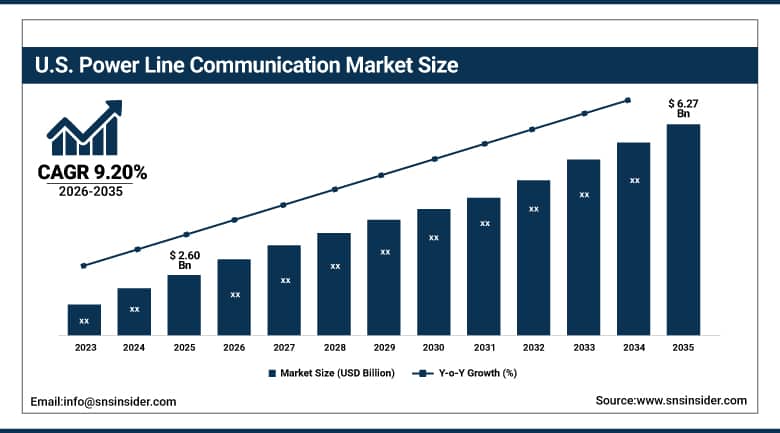
The U.S. Power Line Communication Market was valued at USD 2.60 billion in 2025 and is expected to reach around USD 6.27 billion by 2035, growing at a CAGR of 9.20% from 2026–2035.
The U.S. power line communication market is expanding steadily owing to strong investments in smart grid modernization. Increasing deployment of advanced metering infrastructure is supporting market growth. Rising demand for reliable utility communication networks is driving adoption across power distribution systems. Growth in home automation and connected energy management is further accelerating demand. Manufacturers are focusing on advanced broadband and narrowband communication technologies. Increasing use in industrial automation and smart utility applications is strengthening market penetration.
As per the EIA and DOE Grid Modernization Initiative, there were over 200 million electricity consumers in the United States by 2025 with around 130 million smart meters installed throughout the country which constitutes for over 70% of the total consumer base.
Power Line Communication Market Segment Analysis:
-
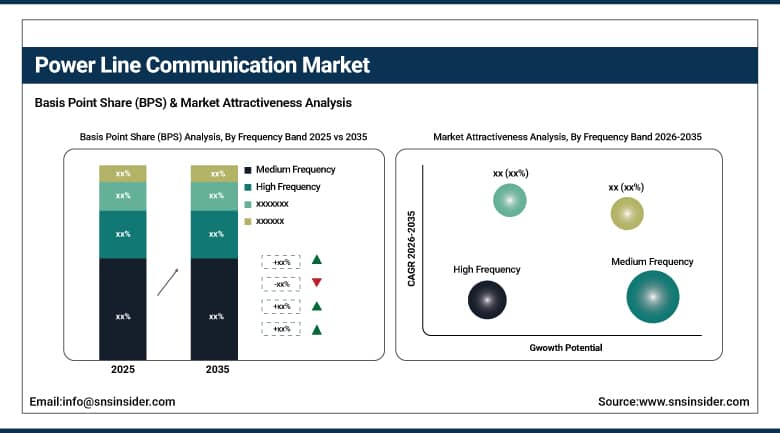
By Frequency Band, medium frequency dominated the market with 47.60% share in 2025; while high frequency is the fastest growing segment with CAGR of 13.34% during 2026 to 2035.
-
By Application, smart grid dominated the market with 39.80% share in 2025; while smart metering is the fastest growing segment with CAGR of 13.02% during 2026 to 2035.
-
By Technology, narrowband dominated the market with 68.40% share in 2025; while broadband is the fastest growing segment with CAGR of 13.51% during 2026 to 2035.
-
By End Use, industrial dominated the market with 39.20% share in 2025; while residential is the fastest growing segment with CAGR of 12.78% during 2026 to 2035.
By Frequency Band, medium frequency dominated the power line communication market, while high frequency is the fastest growing segment.
The Medium Frequency segment is likely to capture the dominated market share in terms of revenues generated by the power line communication market in 2025. This segment is widely adopted as it offers an ideal compromise between range and reliability in communication. Various utilities have installed the medium frequency solutions in smart grids as well as advanced metering infrastructure. Good compatibility with existing power distribution systems has enabled the wide adoption of the segment.
The High Frequency segment is anticipated to witness the fastest CAGR during the forecast period 2026-2035. Growing demand for high-speed data communication through intelligent energy networks is propelling the fast adoption. Widespread installation of broadband power line communication systems has created numerous opportunities for growth. Growth in home automation, charging stations for electric vehicles, and industrial applications is driving the growth of the market segment.
By Application, smart grid dominated the power line communication market, while smart metering is the fastest growing segment.
Smart Grid segment ruled the roost in the power line communication market by holding the dominated revenue share in 2025. This dominance was due to rising investments in upgrading electricity transmission and distribution infrastructures around the globe. PLC technology has been employed in various utilities for monitoring the grids, detecting faults, and conducting automated control operations. Growing integration and distribution of renewable energy along with automation added further fuel to the demand. Government-supported smart grid programs in both developed and developing countries were major contributors to market leadership.
Smart Metering is anticipated to be the fastest-growing segment at CAGR from 2026-2035. Growth in this segment is attributed to the increasing adoption of metering infrastructure in residential, commercial, and industrial electricity networks. There has been an increased usage of advanced metering infrastructure in utilities in place of basic meters for real-time billing and monitoring purposes. Increasing regulations for energy efficiency and digital transformation have led to such installations. The growing need for accurate metering information is adding impetus to the fast-paced growth.
By Technology, narrowband dominated the power line communication market, while broadband is the fastest growing segment.
Narrowband segment had captured the dominated market revenue share in power line communication market in 2025 due to its wide usage in smart metering and utility communications systems. It provides reliable communication over long distance through the existing electrical network infrastructure at a relatively low cost. Utilities are using the narrowband solution due to its applicability in grid monitoring, grid automation, and energy management. Increased investments made by governments in smart grid infrastructures have resulted in the increasing use of narrowband segment in electricity transmission infrastructure.
Broadband segment is projected to grow at the fastest CAGR during the forecast period from 2026 to 2035 owing to the growing requirement for high-speed data transfer within the connected energy infrastructure. Increased usage of home automation, industrial IoT applications, and smart buildings is driving the adoption of broadband solutions. This segment allows higher bandwidths for real-time communication and monitoring. Growth in digital utility network infrastructures and advancements in power infrastructure is providing huge opportunities for broadband solutions.
By End Use, industrial dominated the power line communication market, while residential is the fastest growing segment.
Industrial sector led the market with the dominated share of revenue in 2025. This market leadership was attributed to the extensive usage of communication systems in various industrial operations. Industries preferred power line communication due to its capabilities in monitoring, automation, and connection without extra networking expenses. Increasing investments in smart industries and energy management solutions in the industries helped increase the usage of the product. The increasing demand for reliable data transmission within these operations continued boosting the market leadership of the segment.
Residential sector will experience the fastest CAGR growth during 2026-2035. The rising installation of smart homes and energy management systems is boosting the demand for power line communications in residential markets. Smart meters, intelligent lighting, and other home automation systems are being installed in more numbers which is increasing the demand for this technology. People have started using existing electrical wiring for communication and networking purposes.
Regional Analysis:
|
Region |
Major Country |
Share within Region, 2025(%) |
|---|---|---|
|
North America |
United States |
84.70% |
|
Europe |
Germany |
24.80% |
|
Asia Pacific |
China |
36.90% |
|
Middle East & Africa |
UAE |
16.20% |
|
Latin America |
Brazil |
42.40% |
Asia Pacific Power Line Communication Market Insights.
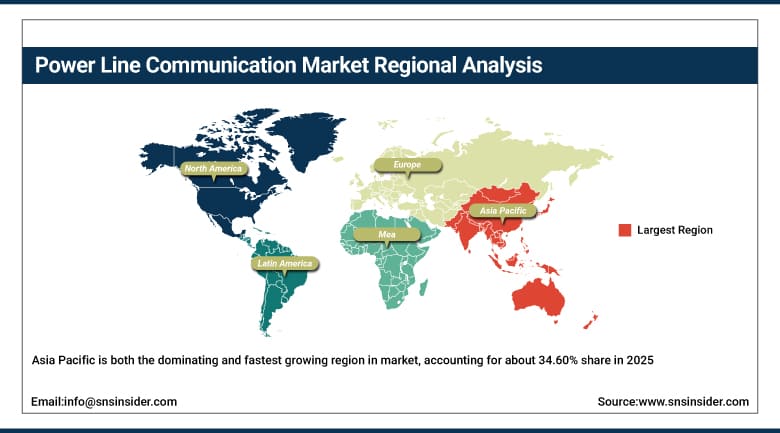
Asia Pacific is both the dominating and fastest growing region in the power line communication market, accounting for about 34.60% share in 2025 and registering a CAGR of about 11.53% during 2026–2035. The region leads due to rapid urbanization and large-scale electrification projects driving strong demand across China, India, Japan, South Korea, and Southeast Asia. Expanding smart grid infrastructure and industrial automation are boosting market growth. Increasing electricity consumption and digital utility transformation are further accelerating adoption. Growth in manufacturing hubs is supporting large scale deployment of communication networks.
As per the International Telecommunications Union 2025 ICT Infrastructure Indicators, over 55% of internet users reside in the Asia Pacific region, with fixed broadband usage at over 35% in the region and mobile broadband penetration of above 90% in the major economies. As per the ADB Energy and Smart Grids Implementation report, over 70% of utilities in East and Southeast Asia are deploying smart grid initiatives involving Advanced Metering Infrastructure.
Get Customized Report as Per Your Business Requirement - Enquiry Now
North America Power Line Communication Market Insights.
North America power line communication market is a steady region in 2025, driven by strong smart grid investments and advanced utility infrastructure. The region benefits from high digitalization of electricity networks and strong technology adoption. Increasing deployment of smart meters and grid automation systems is significantly strengthening market penetration. Expansion of industrial communication networks and energy efficiency programs is accelerating demand. A strong focus on reliable data transmission across utilities further reinforces steady growth in the market.
In accordance with the Grid Modernization Initiative by U.S. Department of Energy and smart grid deployment information provided by the Federal Energy Regulatory Commission, AMI deployment in the United States is about 75% of electricity consumers and creates the core deployment foundation for PLCS. As per Natural Resources Canada’s statistics, smart grid spending covers about 60% of provincial utilities, helping the development of digital communications within grids. According to IEA, North America represents about 25% of smart grid deployments across the world, with the growing integration of PLC into distribution automation and demand response applications in 2025.
Europe Power Line Communication Market Insights.
Europe power line communication market is characterized by steady growth in 2025 owing to strong regulatory support for smart energy systems. Key countries include Germany, France, United Kingdom, and Italy. Rising focus on energy efficiency and grid modernization is driving adoption. Increasing deployment of smart meters and renewable integration is boosting demand. Growth in industrial automation and utility digitalization is further supporting market expansion. Strict EU energy regulations are encouraging innovation in advanced communication technologies.
According to the IEA Electricity Grid Modernization Outlook, over 70% of distribution utilities in Europe have begun deploying smart meters, and around 200 million smart meters will be deployed in Europe in the year 2025. The European Committee for Electrotechnical Standardization also has reported standardization of interoperable frameworks for smart metering and communication on the PLCs in the EU member states.
Middle East & Africa and Latin America Power Line Communication Market Insights.
The Middle East & Africa along with Latin America regions are witnessing steady growth due to expanding utility infrastructure and rising electricity demand. Key contributing countries include Brazil, Mexico, UAE, Saudi Arabia, and South Africa. Increasing investments in smart grid projects are driving adoption. Growth in industrial electrification and urban development is further supporting market expansion. Rising focus on energy efficiency and grid reliability is boosting regional demand. Expanding telecom and utility convergence is strengthening adoption.
According to the International Energy Agency and regional data on utility modernization, the smart meter penetration rate in Latin America is at about 35% in the most developed countries, whereas some regions in the Middle East have penetration rates exceeding 40% in their advanced electric grid networks. According to the African Development Bank, more than 60% of Sub-Saharan African nations are adopting smart grid projects.
Market Dynamics:
Growth Drivers: Rapid expansion of smart grid infrastructure and digital utility modernization across global energy networks
The growing trend towards modernization of power grids has been resulting in the increasing use of power line communications technology in the sector. The implementation of smart meters and AMI is leading to the transfer of data in real-time using the existing power lines. There has been a huge government investment in grid automation for improving efficiency, reliability, and management of outages. The incorporation of renewable energy sources is adding to the growing demand for secure communication networks. The need for cost-effective infrastructure is driving the implementation of the technology.
As indicated in the IEA Electricity Grids and Secure Energy Transitions report and the U.S. Energy Information Administration, the deployment of smart meters in the USA was at approximately 75% of electricity users, whereas some EU member states claim that smart meter penetration has crossed 70% of households. As per the World Bank Global Electrification Database, the number of people with access to electricity worldwide was 91%, as opposed to 87% a decade ago.
Restraints: Limited standardization and compatibility issues restricting large scale deployment across global power infrastructure systems
The lack of uniform standards for communication poses problems of interoperability among various types of PLC technology. Compatibility problems with equipment add to the complications of deployment in multi-vendor networks. Upgrading of existing networks often poses a problem for utilities. The differences in regional power infrastructures complicate matters even more. The high level of dependence on the local grid design lowers the scalability of the system. All these factors contribute to delayed commercialization in some areas.
Opportunities:Expansion of smart home ecosystems and IoT driven connected devices across residential and commercial sectors globally
Fast-paced advancements in smart home technology have led to the rise in demand for in-building communication solutions. Power line communications allow for seamless connectivity in case of smart lighting, smart appliance, and smart energy management solutions by utilizing existing wiring. Higher adoption rates of IoT-driven automation solutions in commercial buildings are also contributing to the growth in this domain. The growing inclination towards energy-efficient and connected living solutions is also fostering the development of this market. Digital infrastructure in cities is also aiding the growth opportunities.
As per the ITU Measuring Digital Development 2025, there were over 5.4 billion internet users in the world accounting for about 67% of the world's population, with over 15 billion connected IoT devices being used globally. According to the OECD Digital Economy Outlook, over 70% of households in member nations have incorporated smart home devices, whereas the European Commission says that over 80% of new homes built in urban areas have digital connectivity facilities.
Recent Developments:
-
2026: Texas Instruments Incorporated continues Sherman Texas 300mm wafer fab expansion advancing analog semiconductor manufacturing capacity globally.
-
2025: Qualcomm Incorporated Snapdragon X Elite commercial rollout for Copilot+ PCs with multiple OEM laptop launches worldwide.
-
2025: STMicroelectronics N.V. advanced automotive semiconductor development focusing on next-generation power electronics and industrial IoT applications worldwide.
-
2024: Siemens AG launched Industrial Copilot initiative with Microsoft enhancing generative AI capabilities in industrial engineering workflows.
Power Line Communication Market Key Players are:
-
Qualcomm Incorporated
-
STMicroelectronics N.V.
-
Texas Instruments Incorporated
-
MaxLinear, Inc.
-
Semtech Corporation
-
Microchip Technology Incorporated
-
NXP Semiconductors N.V.
-
Broadcom Inc.
-
Renesas Electronics Corporation
-
Cypress Semiconductor Corporation
-
Hitachi, Ltd.
-
Mitsubishi Electric Corporation
-
Siemens AG
-
Schneider Electric SE
-
ABB Ltd.
-
General Electric Company
-
Huawei Technologies Co., Ltd.
-
ZTE Corporation
-
Devolo AG
-
NETGEAR, Inc.
Power Line Communication Market Report Scope:
| Report Attributes | Details |
|---|---|
| Market Size in 2025 | USD 10.32 Billion |
| Market Size by 2035 | USD 27.28 Billion |
| CAGR | CAGR of 10.23% From 2026 to 2035 |
| Base Year | 2025 |
| Forecast Period | 2026-2035 |
| Historical Data | 2022-2024 |
| Report Scope & Coverage | Market Size, Segments Analysis, Competitive Landscape, Regional Analysis, DROC & SWOT Analysis, Forecast Outlook |
| Key Segments | * By Frequency Band (Low Frequency, Medium Frequency, High Frequency) * By Application (Smart Grid, Home Automation, Telecommunications, Smart Metering) * By Technology (Narrowband, Broadband) * By End Use (Residential, Commercial, Industrial, Others) |
| Regional Analysis/Coverage | North America (US, Canada), Europe (Germany, UK, France, Italy, Spain, Russia, Poland, Rest of Europe), Asia Pacific (China, India, Japan, South Korea, Australia, ASEAN Countries, Rest of Asia Pacific), Middle East & Africa (UAE, Saudi Arabia, Qatar, South Africa, Rest of Middle East & Africa), Latin America (Brazil, Argentina, Mexico, Colombia, Rest of Latin America). |
| Company Profiles | Qualcomm Incorporated, STMicroelectronics N.V., Texas Instruments Incorporated, MaxLinear, Inc., Semtech Corporation, Microchip Technology Incorporated, NXP Semiconductors N.V., Broadcom Inc., Renesas Electronics Corporation, Cypress Semiconductor Corporation, Hitachi, Ltd., Mitsubishi Electric Corporation, Siemens AG, Schneider Electric SE, ABB Ltd., General Electric Company, Huawei Technologies Co., Ltd., ZTE Corporation, Devolo AG, NETGEAR, Inc. |
Frequently Asked Questions
The Narrowband segment dominated the market in 2025 due to smart metering, utility communication, cost effectiveness, and reliable long-distance transmission.
Asia Pacific dominated the power line communication market in 2025 due to rapid urbanization, smart grids, industrial automation, and rising electricity demand.
The power line communication market is expected to grow at a CAGR of 10.23% from 2026 to 2035.
The power line communication market was valued at USD 10.32 billion in 2025.
The Major growth factors include rising smart grid deployments, investments in advanced electricity networks, reliable data transmission demand, smart metering adoption, home automation growth, IoT integration, and industrial automation expansion globally.
