
Propionic Acid Market Report Scope & Overview:
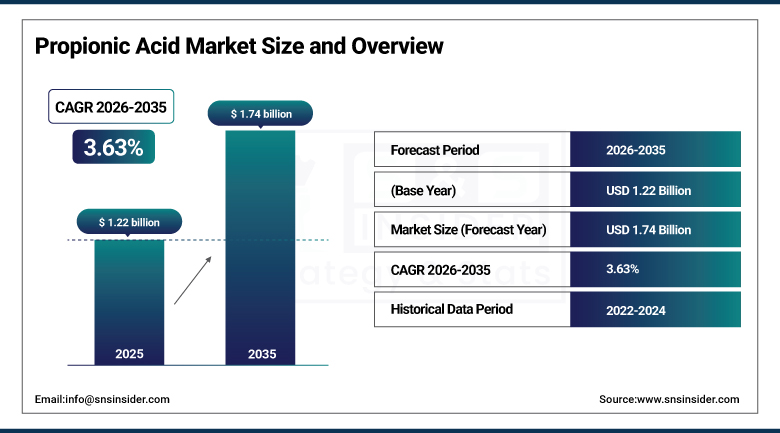
The Propionic Acid Market was valued at USD 1.22 billion in 2025 and is expected to reach USD 1.74 billion by 2035, growing at a CAGR of 3.63% from 2026–2035.
The propionic acid market is witnessing steady growth in the global market owing to the increasing demand for preservatives, animal feed additives, and specialty chemical applications worldwide. The growing need for extending shelf life and preventing microbial contamination across multiple industries is promoting the usage of propionic acid in various sectors. Investments made by organizations in food preservation, sustainable chemical production, and pharmaceutical manufacturing are contributing to market growth. Increasing developments in bio-based production technologies and advanced fermentation processes are playing a major role in driving the demand for propionic acid. Growth in livestock production activities and stringent food safety regulations are fueling the demand for Propionic Acid.
As per the OECD-FAO Agricultural Outlook for the period 2025-2034, the increasing demand for foods that are derived from animals will keep reinforcing the usage of propionic acid in the sectors associated with it. The production of agriculture and fisheries worldwide is expected to grow by 14% by 2034, whereas worldwide stock of livestock will see an increase of 7%, along with meat, milk, and egg production by 16.6%. Furthermore, global feed use is forecasted to go up by 15%.
To Get more information on Propionic Acid Market - Request Free Sample Report
Propionic Acid Market Trends:
-
Increasing adoption of propionic acid in animal feed preservation due to rising demand for safe and long shelf-life livestock nutrition products.
-
Growing usage of propionic acid in pharmaceuticals as intermediate for drug formulation and specialty chemical synthesis across global manufacturing industries.
-
Expanding agrochemical applications supporting crop protection demand, improving yield quality and reducing fungal contamination in large scale agricultural production systems.
-
Rising industrial demand in emerging economies driven by rapid chemical manufacturing expansion and increasing specialty chemical production capacities worldwide.
-
Strong shift toward bio based propionic acid supported by sustainability goals, green chemistry initiatives, and stricter environmental compliance regulations globally.
-
Advancements in fermentation and biotechnology processes improving production efficiency, reducing costs, and enabling scalable eco-friendly propionic acid manufacturing solutions.
U.S. Propionic Acid Market Size Outlook:
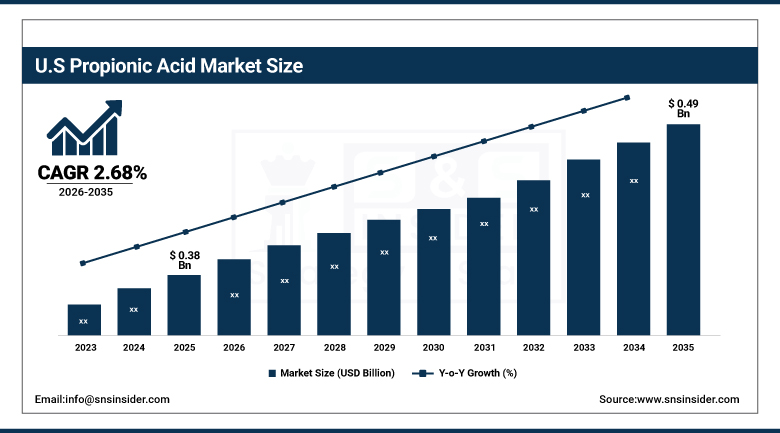
The U.S. Propionic Acid Market was valued at USD 0.38 billion in 2025 and is expected to reach around USD 0.49 billion by 2035, growing at a CAGR of 2.68% from 2026–2035.
The U.S. propionic acid market is growing consistently owing to increased demand in animal feed preservation, food additives, and specialty chemical applications. The usage of Propionic Acid in bakery preservation, livestock feed formulations, and pharmaceutical intermediates has contributed to market growth in a consistent manner. Increased spending in the development of sustainable bio-based production technologies has generated an increase in demand for environmentally friendly chemical solutions. Development of food processing, animal nutrition, and pharmaceutical manufacturing industries is further driving the demand for this product.
According to the U.S. Department of Agriculture and the U.S. Food and Drug Administration, the U.S. is supported by large food preservation applications, with the U.S. cheese production reaching a record 14.66 billion pounds in 2025, up 2.9% from 2025. Propionic acid remains an FDA-approved antimicrobial ingredient permitted under current good manufacturing practices and is widely used in bakery, dairy, and animal feed preservation to extend shelf life and control mold growth.
Propionic Acid Market Segment Analysis:
-
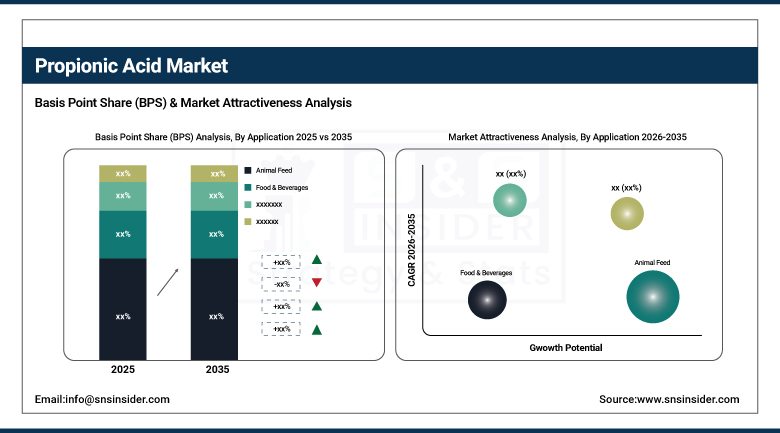
By Application, animal feed dominated the market with 42.50% share in 2025; while food & beverages are the fastest growing segment with CAGR of 6.41% during 2026 to 2035.
-
By Grade, food grade dominated the market with 56.80% share in 2025; while pharmaceutical grade is the fastest growing segment with CAGR of 8.87% during 2026 to 2035.
-
By Source, synthetic propionic acid dominated the market with 91.50% share in 2025; while bio-based propionic acid is the fastest growing segment with CAGR of 10.81% during 2026 to 2035.
By Application, animal feed dominated the propionic acid market, while food & beverages are the fastest growing segment.
Animal feed segment emerged as the leader in the Propionic Acid Market in terms of revenue share in 2025. The segment was valued highly due to high application of propionic acid as a mold inhibitor and preservative agent in livestock feed and silage. Propionic acid is known for preventing the development of fungi in livestock feeds. The growing demand for meat globally, alongside rising livestock production, drives the popularity of the product in such applications.
Food & beverages segment is estimated to register the fastest CAGR in the Propionic Acid Market between 2026 and 2035. The rising need for preserving the safety of foods along with extending their shelf life in packaged goods drives the usage of the product. The use of propionic acid has been growing in bakery foods and other packed foods as it inhibits the growth of microorganisms in foods.
By Grade, food grade dominated the propionic acid market, while pharmaceutical grade is the fastest growing segment.
The food grade segment accounted for the dominated revenue share in the Propionic Acid Market in 2025. The large revenue share can be attributed to the high usage of propionic acid in applications related to food preservation. Its application is wide across the use in bakery products and processed foods for the prevention of mold growth. Demand from the animal feed industry is another major factor driving propionic acid consumption.
The pharmaceutical grade segment will experience the fastest CAGR between 2026 and 2035. The growing demand in drug formulation and as active pharmaceutical intermediates drives the growth in this sector. The increasing investments in healthcare manufacturing along with the need for high purity for injectable drugs are among the other factors driving propionic acid demand within the pharmaceutical industry.
By Source, synthetic propionic acid dominated the propionic acid market, while bio-based propionic acid is the fastest growing segment.
The synthetic propionic acid segment held the dominated revenue share in the propionic acid market in 2025. This was primarily due to its efficient production process, cost-effective nature, and widespread availability globally in chemical manufacturing plants. The segment is largely utilized in the preservation of animal feed products, as well as in food and various industrial applications. Robust supply chains and easy availability of raw materials have helped maintain its lead in the market.
The bio-based propionic acid segment is projected to register the fastest CAGR during the forecast period, from 2026-2035. Such growth can be attributed to growing environmental consciousness and rising need for sustainable and eco-friendly alternatives. Various stringent government policies promoting carbon neutral and low-carbon production have encouraged the adoption of such alternatives. Increasing efficiencies in biotechnology and fermentation have also led to more effective production methods. Growing preferences for green chemistry in various applications are driving its growth in the Propionic Acid Market.
Regional Analysis:
|
Region |
Major Country |
Share within Region, 2025(%) |
|---|---|---|
|
North America |
United States |
86.80% |
|
Europe |
Germany |
27.50% |
|
Asia Pacific |
China |
42.00% |
|
Middle East & Africa |
UAE |
17.50% |
|
Latin America |
Brazil |
46.00% |
North America Propionic Acid Market Insights.
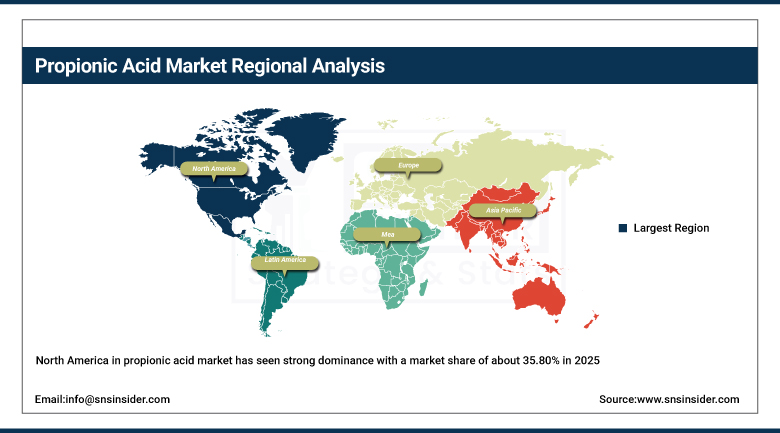
North America in propionic acid market has seen strong dominance with a market share of about 35.80% in 2025 due to advanced animal feed, food processing, and chemical manufacturing infrastructure. The region benefits from strong demand in livestock feed preservation, food additives, and pharmaceutical intermediates. Increasing demand for mold inhibitors, specialty preservatives, and high-performance chemicals is driving market expansion across the United States and Canada. Rising adoption in animal nutrition and food safety applications is further supporting market leadership. Strict regulatory standards are strengthening controlled chemical usage.
According to the U.S. Department of Agriculture and the U.S. Food and Drug Administration, North America’s propionic acid demand is strongly linked to livestock and food preservation systems, supported by the U.S. dairy herd of approximately 9.3 million milk cows and annual milk production of about 226 billion pounds in 2025. FDA classifies propionic acid as Generally Recognized as Safe for controlled food use, enabling its wide application in feed and bakery preservation systems.
Get Customized Report as per Your Business Requirement - Enquiry Now
Europe Propionic Acid Market Insights.
The Europe propionic acid market shows strong presence in 2025 due to strict food safety regulations and high demand for sustainable chemical preservation solutions. Countries like Germany, France, United Kingdom, and Italy are key contributors to demand. High focus on animal nutrition, food preservation, and pharmaceutical applications is supporting steady market growth across the region. Increasing adoption in bakery products, feed preservation, and specialty chemicals is further strengthening consumption. Expanding regulatory frameworks are driving controlled preservative usage.
According to Eurostat’s Prodcom chemical production and the European Commission’s chemicals production, the EU produced approximately 224 million tonnes of total industrial chemicals in 2024, reflecting structured manufacturing activity that directly supports intermediate organic acids such as propionic acid used in food preservation and feed applications.
As stated by the European Food Safety Authority, propionic acid and its salts are authorized feed additives under Regulation, with controlled use across livestock production systems, indicating standardized regulatory adoption across Europe in 2025.
Asia Pacific Propionic Acid Market Insights.
Asia Pacific is positioned to register the fastest CAGR growth in the market during the forecast period with a market share of about 4.74% in 2025. Rapid industrialization and food processing expansion are driving strong demand across China, India, Japan, South Korea, and Southeast Asia. Expanding livestock production, pharmaceutical manufacturing, and food preservation industries are significantly boosting adoption. Rising demand for cost effective preservatives is further accelerating market growth across the region. Large scale manufacturing supports strong regional demand outlook.
As per the OECD-FAO Agricultural Outlook 2025–2034 and FAO frameworks, Asia Pacific accounts for about 54% of projected additional global agricultural output, with India contributing nearly 40% of regional growth and China remaining a major producer base. As stated by FAO, agricultural production systems in Asia are expanding under standardized data-driven monitoring across member countries. In 2025, China’s installed propionic acid capacity is estimated above 800,000 metric tons annually, supporting food preservation and feed applications across rapidly growing agro-industrial supply chains.
Middle East & Africa and Latin America Propionic Acid Market Insights.
The Middle East & Africa and Latin America region is witnessing steady growth in the market due to rising industrial development and expanding food and agriculture sectors. Countries like Brazil, Mexico, UAE, Saudi Arabia, and South Africa are emerging as key demand centers. Increasing investments in animal nutrition, food processing, and agricultural storage are supporting market expansion. Growing need for cost effective preservation solutions is further boosting product adoption. Rising industrialization strengthens long term demand outlook across both regions.
As per the United Nations Statistics Division UN Comtrade 2025, Latin America and the Middle East & Africa are recorded as distinct reporting regions within global organic chemical trade flows, reflecting measurable import–export volumes tracked across more than 140 reporting countries.
According to UN DESA urban and agricultural consumption indicators, rising industrial food preservation demand aligns with increasing chemical utilization intensity in emerging economies.
Market Dynamics:
Growth Drivers: Expanding industrial applications and pharmaceutical usage accelerating propionic acid market growth
Growing usage of propionic acid in pharmaceuticals, agrochemicals, and specialty chemicals is significantly boosting demand. It is increasingly used as an intermediate in drug formulation and chemical synthesis. Expansion of agrochemical production is supporting higher consumption in crop protection applications. Rising industrial manufacturing activities across emerging economies are strengthening demand. Continuous innovation in chemical processing technologies is improving production efficiency. Growing investment in pharmaceutical manufacturing is also increasing usage. Expanding application base across multiple industries is supporting long term market growth.
According to the U.S. Food and Drug Administration Generally Recognized as Safe framework and the U.S. Department of Agriculture feed additive usage guidelines, propionic acid and its salts are widely permitted for food preservation and animal feed applications, supporting industrial-scale utilization in 2025. The U.S. food processing accounts for over 14.6 billion pounds of cheese production in 2025, reflecting strong downstream demand for mold-inhibiting preservatives.
Restraints: Stringent environmental regulations and health concerns over synthetic preservatives restricting propionic acid market demand
Increasing regulatory scrutiny on chemical preservatives is limiting unrestricted use of propionic acid in certain applications. Concerns regarding synthetic chemical exposure in food and feed products are influencing consumer preferences. Regulatory authorities are imposing strict usage limits in food safety applications. Compliance with environmental sustainability standards increases production complexity. Shift toward natural preservatives is gradually affecting demand. Industries are under pressure to adopt greener alternatives. These regulatory and health concerns act as key restraints for market growth.
Opportunities: Rising demand for bio based propionic acid and green chemistry solutions creating strong growth opportunities
Growing focus on sustainability and carbon reduction is creating strong opportunities for bio based propionic acid development. Advancements in fermentation and biotechnology are improving production efficiency and scalability. Increasing government support for green chemicals is encouraging industrial adoption. Food and pharmaceutical industries are shifting toward eco-friendly ingredients. Rising demand for biodegradable and renewable chemical solutions is expanding market scope. Investments in research and development are accelerating innovation. Expanding applications in sustainable packaging and feed additives further strengthen future growth potential.
According to UNEP, the global bioeconomy, which includes the bio-based process routes for chemical manufacturing involving propionic acid, has a valuation of 4-5 trillion dollars and is forecast to grow considerably due to net-zero aligned industrial policies. In addition, the OECD environmental policy framework highlights the growing use of green chemistry indicators within the member countries, leading to reductions in reliance on harmful chemicals.
Recent Developments:
-
2026: Perstorp Holding AB implemented global propionic acid price increases effective March 2026 due to raw material and energy costs.
-
2025: Dow Inc advanced circular chemical initiatives and supply chain optimization efforts supporting low-emission industrial chemical production systems globally.
-
2025: Perstorp Holding AB strengthened sustainable propionic acid portfolio using ISCC PLUS certified bio-based feedstocks and renewable sourcing methods.
-
2024: Eastman Chemical Company agreed to divest Texas City Operations to INEOS while optimizing chemical intermediates portfolio strategy.
Propionic Acid Market Key Players are:
-
BASF SE
-
Dow Inc.
-
Eastman Chemical Company
-
Perstorp Holding AB
-
OQ Chemicals GmbH
-
Sasol Limited
-
Celanese Corporation
-
Daicel Corporation
-
Merck KGaA
-
Tokyo Chemical Industry Co., Ltd.
-
Kanto Chemical Co., Inc.
-
Junsei Chemical Co., Ltd.
-
Kishida Chemical Co., Ltd.
-
Otto Chemie Pvt. Ltd.
-
Zhejiang Jianye Chemical Co., Ltd.
-
Luxi Group Co., Ltd.
-
Yancheng Huade Biological Engineering Co., Ltd.
-
Yancheng Hongtai Bioengineering Co., Ltd.
-
Shanghai Jianbei Organic Chemical Co., Ltd.
-
Qingdao Jiutai Biotechnology Co., Ltd.
Propionic Acid Market Report Scope:
| Report Attributes | Details |
|---|---|
| Market Size in 2025 | USD 1.22 Billion |
| Market Size by 2035 | USD 1.74 Billion |
| CAGR | CAGR of 3.63% From 2026 to 2035 |
| Base Year | 2025 |
| Forecast Period | 2026-2035 |
| Historical Data | 2022-2024 |
| Report Scope & Coverage | Market Size, Segments Analysis, Competitive Landscape, Regional Analysis, DROC & SWOT Analysis, Forecast Outlook |
| Key Segments | • By Application (Animal Feed, Food & Beverages, Agrochemicals, Personal Care, Pharmaceuticals, Others) • By Grade (Industrial Grade, Food Grade, Pharmaceutical Grade) • By Source (Synthetic Propionic Acid, Bio-based Propionic Acid) |
| Regional Analysis/Coverage | North America (US, Canada), Europe (Germany, UK, France, Italy, Spain, Russia, Poland, Rest of Europe), Asia Pacific (China, India, Japan, South Korea, Australia, ASEAN Countries, Rest of Asia Pacific), Middle East & Africa (UAE, Saudi Arabia, Qatar, South Africa, Rest of Middle East & Africa), Latin America (Brazil, Argentina, Mexico, Colombia, Rest of Latin America). |
| Company Profiles | BASF SE, Dow Inc., Eastman Chemical Company, Perstorp Holding AB, OQ Chemicals GmbH, Sasol Limited, Celanese Corporation, Daicel Corporation, Merck KGaA, Tokyo Chemical Industry Co., Ltd., Kanto Chemical Co., Inc., Junsei Chemical Co., Ltd., Kishida Chemical Co., Ltd., Otto Chemie Pvt. Ltd., Zhejiang Jianye Chemical Co., Ltd., Luxi Group Co., Ltd., Yancheng Huade Biological Engineering Co., Ltd., Yancheng Hongtai Bioengineering Co., Ltd., Shanghai Jianbei Organic Chemical Co., Ltd., Qingdao Jiutai Biotechnology Co., Ltd. |
Frequently Asked Questions
The propionic acid market is expected to grow at a CAGR of 3.36% from 2026 to 2035.
The propionic acid market was valued at USD 1.22 billion in 2025.
Rising demand for preservatives in animal feed, food beverages, agrochemicals, pharmaceuticals and livestock growth is driving global propionic acid demand.
The animal feed segment dominated the market in 2025 due to its extensive use as a mold inhibitor and preservative in livestock feed and silage.
North America dominated the propionic acid market due to strong livestock production, advanced food processing infrastructure and feed preservative demand.
