
Public Safety LTE Market Report Scope & Overview:
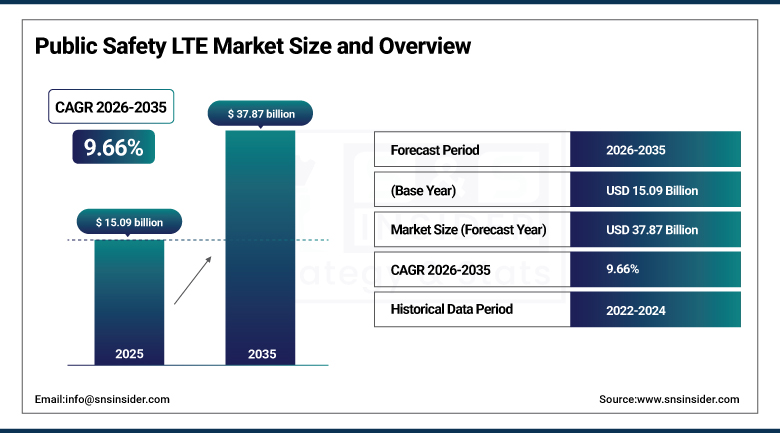
The Public Safety LTE Market was valued at USD 15.09 billion in 2025 and is expected to reach USD 37.87 billion by 2035, growing at a CAGR of 9.66% from 2026–2035.
The public safety LTE market is witnessing robust growth in the global market owing to increasing mission-critical communication requirements. Rising government investments in broadband public safety networks are accelerating deployment across emergency response agencies. Growing smart city initiatives and disaster preparedness programs are supporting market expansion. Manufacturers are focusing on secure and interoperable LTE communication solutions. Rising adoption of LTE-enabled devices and advanced network infrastructure is driving innovation. Increasing demand for reliable real-time communication during emergencies is further accelerating market adoption.
According to the First Responder Network Authority & AT&T public safety network news for 2025, the FirstNet public safety broadband network which operates on a national scale has more than 7 million public safety connections and serves 2.99 million square miles of coverage area, plus another 20,000 square miles added since the previous year. There have been 1,000 new Band 14 cell sites deployed in 46 states and Washington D.C., in 2025.
To Get more information on Public Safety LTE Market - Request Free Sample Report
Public Safety LTE Market Trends:
-
Growth in use of LTE and 5G based public safety communications system for faster responses and real time information exchange.
-
Adoption of smart city infrastructure making the emergency ecosystem smarter and better coordination among different public safety organizations.
-
Increased investments by government in next generation broadband networks in order to modernize mission critical communication systems across the globe.
-
More use of artificial intelligence and real time analysis providing better situational awareness during disasters and security events.
-
Transition from traditional narrowband communication system to the broadband LTE system for effective communication.
-
Disaster management efficiency and cross agency collaboration resulting in increased demand for robust communication infrastructure.
U.S. Public Safety LTE Market Outlook:
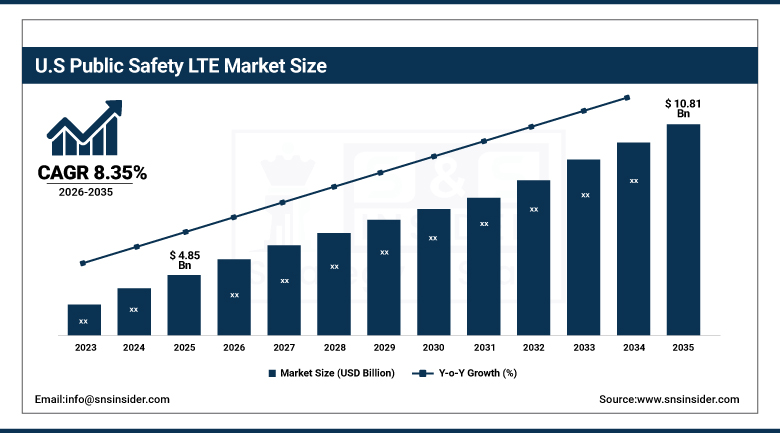
The U.S. Public Safety LTE Market was valued at USD 4.85 billion in 2025 and is expected to reach around USD 10.81 billion by 2035, growing at a CAGR of 8.35% from 2026–2035.
The U.S. public safety LTE market is expanding steadily owing to strong demand for mission-critical communication systems. Increasing modernization of public safety infrastructure is supporting market growth. Rising investments in broadband emergency networks are driving adoption across agencies. Growth in disaster response and homeland security initiatives is further accelerating demand. Manufacturers are focusing on secure LTE core networks and interoperable platforms. Increasing need for real-time, reliable communication in emergency operations is strengthening market penetration.
As per the United States Federal Communications Commission First Responder Network Authority 2025 updates, the FirstNet network spans over 2.97 million square miles of the USA, covering more than 99% of the country's population with public safety broadband services. As per the National Emergency Number Association, over 80% of the 911 call centers have been upgraded to Next Generation 911 systems that allow data to be transferred via IP networks.
Public Safety LTE Market Segment Analysis:
-
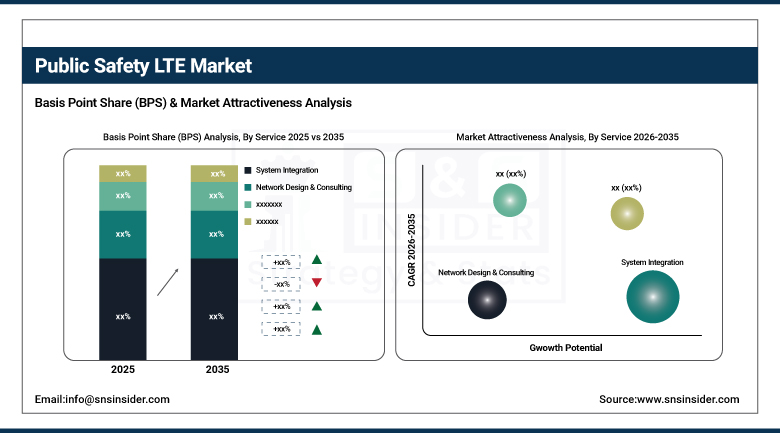
By Service, system integration dominated the market with 31.84% share in 2025; while deployment & optimization is the fastest growing segment with CAGR of 11.80% during 2026 to 2035.
-
By Technology, LTE infrastructure dominated the market with 39.72% share in 2025; while LTE applications are the fastest growing segment with CAGR of 12.22% during 2026 to 2035.
-
By Application, emergency services dominated the market with 36.51% share in 2025; while critical infrastructure protection is the fastest growing segment with CAGR of 12.89% during 2026 to 2035.
-
By End User, public safety agencies dominated the market with 34.86% share in 2025; while civil defense & disaster management authorities is the fastest growing segment with CAGR of 12.81% during 2026 to 2035.
By Service, system integration dominated the public safety LTE market, while deployment & optimization is the fastest growing segment.
The System Integration segment dominated the public safety LTE market and accounted for the dominated revenue share in 2025. The growing necessity for the integration of LTE networks with the legacy communication systems is one of the main reasons behind such dominance. Interoperable and secure communication solutions are necessary for governments and agencies. Difficult deployment scenarios and end-to-end connectivity requirement enhance the acceptance of system integration in the public safety market.
The Deployment & Optimization segment is projected to witness the fastest CAGR during 2026-2035. The constant expansion of the LTE-based public safety network across both developing and developed regions is driving the growth of this segment. Growing need for network optimization and high performance in terms of low latency and coverage enhances the demand for this segment.
By Technology, LTE infrastructure dominated the public safety LTE market, while LTE applications is the fastest growing segment.
The LTE Infrastructure segment had the dominated share of revenue in the public safety LTE market in 2025 owing to the large-scale implementation of mission critical communication networks. Significant investments by the government into upgrading the existing systems is another factor aiding its market growth. In addition, the growing demand for secure, reliable and wide coverage communication network is also boosting the segment's growth. The high adoption of core network and radio access infrastructure is propelling its growth in the public safety communication system.
The LTE Applications segment is projected to witness the fastest CAGR between 2026 and 2035 owing to the growing demand for next-gen communication software solutions. The increasing adoption of software-based solutions such as real-time data sharing, video streaming and situational awareness tools is fueling the market growth. Furthermore, the rising use of AI-enabled software and emergency response solutions is contributing to its market growth.
By Application, emergency services dominated the public safety LTE market, while critical infrastructure protection is the fastest growing segment.
The Emergency Services segment dominated the public safety LTE market and held the largest revenue share in 2025 owing to a high level of dependence on real-time communication in police, fire, and ambulance services. The growing requirement for fast response and disaster management is leading to increasing adoption of LTE solutions. Investments made by governments in building private broadband network for better security is aiding segment dominance in the public safety industry.
The Critical Infrastructure Protection segment is expected to witness the fastest CAGR during 2026-2035. Rising cyber physical threats along with the increasing significance of protecting energy, transportation, and utility networks is leading to growth of this segment. Development of smart grids and digital infrastructures is also driving the adoption of LTE solutions. Focus of governments on resilient communication solutions for critical assets and adoption of IoT along with real-time monitoring solutions is fueling the demand for Public Safety LTE solutions worldwide.
By End User, public safety agencies dominated the public safety LTE market, while civil defense & disaster management authorities are the fastest growing segment.
Public Safety Agencies segment held the dominated market share in terms of revenue in the public safety LTE market in 2025. Such high market share can be attributed to the dependence on mission critical communication systems. Rising demand for real time collaboration between police, fire, and emergency medical services is fueling demand. Funding from government for secure broadband communications and nationwide public safety LTE services is enhancing market position and continuous upgrading of technology.
The Civil Defense & Disaster Management Authorities segment is estimated to register fastest CAGR between 2026 and 2035. The growth of this segment is driven by increasing occurrence of natural disasters and climate-based emergencies. Rising importance being given by the governments for disaster management and quick response systems is contributing to the adoption of the system. Usage of LTE enabled communication services for activities such as evacuation and rescue operations is propelling demand.
Regional Analysis:
|
Region |
Major Country |
Share within Region, 2025(%) |
|---|---|---|
|
North America |
United States |
87.40% |
|
Europe |
Germany |
28.10% |
|
Asia Pacific |
China |
44.30% |
|
Middle East & Africa |
UAE |
19.20% |
|
Latin America |
Brazil |
46.50% |
North America Public Safety LTE Market Insights.
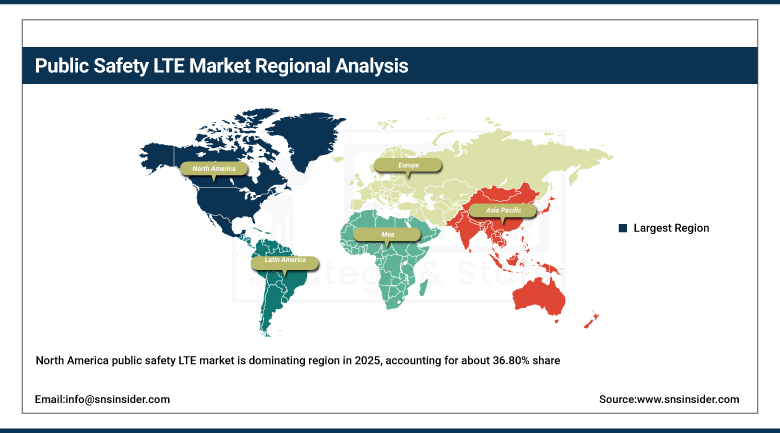
North America public safety LTE market is dominating region in 2025, accounting for about 36.80% share, driven by strong adoption of mission critical communication systems. The region benefits from advanced LTE infrastructure and high government investments in public safety networks. Increasing deployment of FirstNet and interoperable communication platforms is strengthening adoption. Rising focus on emergency response efficiency and disaster management capabilities is accelerating demand. Continuous technological upgrades are reinforcing the region’s dominant position in the market.
As per the U.S. Department of Homeland Security and First Responder Network Authority, coverage for public safety LTE in the United States has grown beyond 2.97 million square miles and supports more than 30,000 public safety and emergency services organizations by 2025. As per the broadband deployment data from the Federal Communications Commission, coverage of 5G/LTE networks is above 98% of the total the U.S. population.
Get Customized Report as per Your Business Requirement - Enquiry Now
Europe Public Safety LTE Market Insights.
Europe public safety LTE market is characterized by steady growth in 2025 owing to strong government led digital communication programs. Key countries include Germany, France, United Kingdom, and Italy. Increasing focus on cross border emergency communication is driving adoption. Rising demand for interoperable public safety networks is boosting deployment. Growth in smart city initiatives and disaster response systems is further supporting market expansion. Strict regulatory frameworks are encouraging secure LTE infrastructure development across the region.
According to the European Emergency Number Association, the 112 emergency system processes more than 300 million emergency calls each year in Europe, and thus, needs interworking and broadband enabled communication systems. As mentioned by the European Telecommunication Standard Institute, the 3GPP Mission Critical Services standards have been incorporated into the public safety communication systems of more than 25 European countries.
Asia Pacific Public Safety LTE Market Insights.
Asia Pacific is the fastest growing region in the public safety LTE market, registering a CAGR of about 10.91% during 2026 to 2035. Rapid urbanization and expanding smart city projects are driving strong adoption. Increasing government investments in digital public safety infrastructure are boosting demand. Rising frequency of natural disasters is accelerating deployment of emergency communication networks. Growth in telecom infrastructure and LTE coverage expansion is supporting large scale market growth across the region.
According to GSMA Mobile Economy Asia Pacific 2025, 4G networks continue to carry more than 65% of all mobile connections, whereas the penetration of 5G has risen to more than 50% of the population in the region in advanced nations. Additionally, ITU has reported that over 70% of the Asian Pacific countries have reserved spectrum allocation for public safety communication systems.
Middle East & Africa and Latin America Public Safety LTE Market Insights.
The Middle East & Africa along with Latin America regions are witnessing steady growth due to rising investments in public safety infrastructure. Key contributing countries include Brazil, Mexico, UAE, Saudi Arabia, and South Africa. Increasing demand for secure emergency communication systems is driving adoption. Growth in smart city initiatives and infrastructure modernization is further supporting expansion. Rising security concerns and disaster response requirements are boosting deployment of LTE based communication networks.
As per the ITU ICT Development Index 2025 report, the mobile broadband penetration is more than 85% in Latin America, whereas it averages 95% in the Middle East and 55% in Africa, showing different levels of preparedness for establishing LTE-based public safety network. According to the World Bank Digital Development datasets, the 4G LTE coverage is more than 90% of the population in Latin America and Gulf Cooperation Council, while in Sub-Saharan Africa, it is less than 60%.
Market Dynamics:
Growth Drivers: Mission critical communication modernization and rising need for real time emergency coordination systems driving LTE adoption globally
The increasing modernization of the public safety communication system is becoming one of the key factors behind the acceptance of the Public Safety LTE network. The government is upgrading its narrowband communication system with broadband communication system technology using LTE. It will provide real-time voice, video, and data exchange to emergency service providers. The growing requirement of interoperable communication within the agencies will help boost its growth. Increased emphasis on disaster management efficiency and safety is helping drive investments.
According to the International Telecommunication Union’s 2025 spectrum and broadband indicators, over 90% of the world’s population is covered by 3G or higher mobile networks, and more than 85% of the world is covered by LTE, which has become the foundation for mission critical communications. According to the U.S. First Responder Network Authority performance report for the year, FirstNet currently serves over 29,000 first responder organizations and over 5 million connections.
Restraints: Cybersecurity risks and network vulnerability concerns reducing confidence in Public Safety LTE communication system deployment worldwide
Use of digital communication network has increased the risk of cyber-attacks on the Public Safety LTE networks. Issues like data breach and security threats pose problems for the government agencies. It is difficult to ensure encrypted communication between various agencies. The failure of the network during emergencies may affect the operations. Dependence on central infrastructure makes the network vulnerable. Such security risks are hampering the adoption of this technology in some areas.
Opportunities:Expansion of 5G integration and smart city initiatives creating advanced opportunities for Public Safety LTE network development globally
Integration of 5G technology with current LTE technologies is opening up new possibilities for improved communication in public safety. With the emergence of smart cities, there is more need for better emergency management systems. There is an increased government investment in next generation broadband infrastructure that facilitates faster data exchange. The use of real-time monitoring and artificial intelligence-based analysis is facilitating situational awareness. Increased emphasis on the creation of connected emergency eco-systems is opening up new avenues for deployment.
As stated in the ITU and 3GPP global standards updates, more than 90% of nations worldwide have already undertaken initiatives on their national broadband or public safety communication modernization projects using LTE or 5G ready infrastructure by 2025.
According to World Bank Smart City indicators, there are more than 1,000 smart city projects around the world with more than 50% of them deploying real-time emergency responses and connected infrastructure systems. The European Commission further stated that MCX standards are used in more than 30 European nations with the aim of implementing interoperable public safety communications, whereas FCC has also confirmed that FirstNet LTE networks have been expanded covering more than 99% of the U.S. population.
Recent Developments:
-
2026: Ericsson advanced mission-critical communications platforms integrating 5G core, cloud and AI-driven network automation capabilities for public safety agencies.
-
2025: Cisco Systems expanded secure networking and cloud-based public safety communication infrastructure supporting first responder connectivity and digital emergency response transformation initiatives.
-
2025: Motorola Solutions expanded public safety LTE and broadband portfolio through AI-enabled command center and cloud platform enhancements.
-
2024: Nokia strengthened private wireless and mission-critical LTE solutions for emergency services through expanded global partner ecosystem deployments.
Public Safety LTE Market Key Players are:
-
Motorola Solutions, Inc.
-
Ericsson
-
Nokia Corporation
-
Huawei Technologies Co., Ltd.
-
Samsung Electronics Co., Ltd.
-
ZTE Corporation
-
Cisco Systems, Inc.
-
Airbus SE
-
Hytera Communications Corporation Limited
-
JVCKENWOOD Corporation
-
L3Harris Technologies, Inc.
-
Leonardo S.p.A.
-
Thales Group
-
Teltronic S.A.U.
-
Tait Communications
-
Sepura Limited
-
NEC Corporation
-
AT&T Inc.
-
Verizon Communications Inc.
-
Bittium Corporation
Public Safety LTE Market Report Scope:
| Report Attributes | Details |
|---|---|
| Market Size in 2025 | USD 15.09 Billion |
| Market Size by 2035 | USD 37.87 Billion |
| CAGR | CAGR of 9.66% From 2026 to 2035 |
| Base Year | 2025 |
| Forecast Period | 2026-2035 |
| Historical Data | 2022-2024 |
| Report Scope & Coverage | Market Size, Segments Analysis, Competitive Landscape, Regional Analysis, DROC & SWOT Analysis, Forecast Outlook |
| Key Segments | • By Service (Network Design & Consulting, System Integration, Deployment & Optimization, Maintenance & Lifecycle Support, Training, Others) • By Technology (LTE Infrastructure, LTE Devices, LTE Applications, LTE Core Network) • By Application (Emergency Services, Disaster Management, Transportation & Traffic Management, Critical Infrastructure Protection, Others) • By End User (Public Safety Agencies, Armed Forces, Border Security & Coast Guard, Civil Defense & Disaster Management Authorities, Critical Infrastructure Operators, Others) |
| Regional Analysis/Coverage | North America (US, Canada), Europe (Germany, UK, France, Italy, Spain, Russia, Poland, Rest of Europe), Asia Pacific (China, India, Japan, South Korea, Australia, ASEAN Countries, Rest of Asia Pacific), Middle East & Africa (UAE, Saudi Arabia, Qatar, South Africa, Rest of Middle East & Africa), Latin America (Brazil, Argentina, Mexico, Colombia, Rest of Latin America). |
| Company Profiles | Motorola Solutions, Inc., Ericsson, Nokia Corporation, Huawei Technologies Co., Ltd., Samsung Electronics Co., Ltd., ZTE Corporation, Cisco Systems, Inc., Airbus SE, Hytera Communications Corporation Limited, JVCKENWOOD Corporation, L3Harris Technologies, Inc., Leonardo S.p.A., Thales Group, Teltronic S.A.U., Tait Communications, Sepura Limited, NEC Corporation, AT&T Inc., Verizon Communications Inc., Bittium Corporation |

Frequently Asked Questions
North America dominated the public safety LTE market in 2025 due to advanced LTE infrastructure, strong government funding, and FirstNet deployment.
The emergency services segment dominated the market in 2025 due to strong reliance on real-time communication in police fire and medical response operations.
The public safety LTE market is expected to grow at a CAGR of 9.66% from 2026 to 2035.
The public safety LTE market was valued at USD 15.09 billion in 2025.
The Major growth factors include increasing mission critical communication needs, rising government investments in broadband public safety networks, expansion of smart city initiatives, growing disaster preparedness programs, adoption of LTE enabled devices, and demand for reliable real time emergency communication systems across agencies.
