
Reconstructed skin models Market Report Scope & Overview:
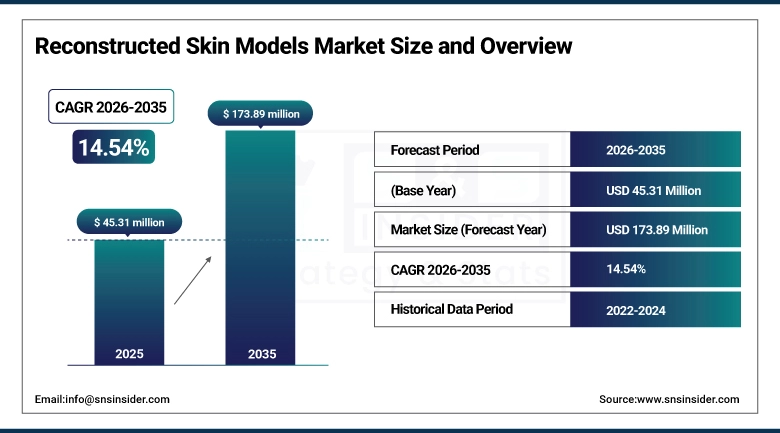
The Reconstructed Skin Models Market was valued at USD 45.31 Million in 2025 and is expected to reach USD 173.89 Million by 2035, growing at a CAGR of 14.54% from 2026–2035.
The Reconstructed Skin Models Market is growing at a fast pace due to increased regulatory restrictions on the usage of animals for testing purposes, increased demand for advanced in vitro testing solutions, and widespread adoption of bioengineered skin tissues for research purposes in the field of pharmaceuticals, cosmetics, and toxicology. The growing acceptance of alternative testing methods and advancements in tissue engineering technology are propelling growth in the market. Moreover, increased usage of reconstructed skin models for testing purposes, disease modeling, drug discovery, and personalized medicine is driving demand in the market.
SGS released a dedicated white paper on 3D reconstructed skin models, reinforcing growing industry adoption of reconstructed human epidermis (RHE) systems as validated alternatives to animal testing for dermatology, toxicology, and pharmaceutical safety assessment. The initiative highlights increasing regulatory and commercial acceptance of advanced tissue-based testing platforms.
To Get more information on Reconstructed Skin Models Market - Request Free Sample Report
Reconstructed skin models Market Trends
-
Rising adoption of reconstructed skin models as alternatives to animal testing is accelerating demand across pharmaceutical and cosmetic research applications.
-
Increasing integration of 3D bioprinting technologies is improving physiological relevance and structural complexity of engineered skin tissues.
-
Rapid adoption of microfluidic and organ-on-chip platforms is enhancing predictive accuracy in skin toxicity and disease modeling studies.
-
Growing use of disease-specific and personalized skin models is improving precision medicine and dermatological research capabilities.
-
Increasing investments in tissue engineering and regenerative medicine research are driving commercialization of advanced skin reconstruction platforms globally.
-
Rising regulatory acceptance of non-animal testing methods is expanding adoption of validated reconstructed human skin models across safety assessment workflows.
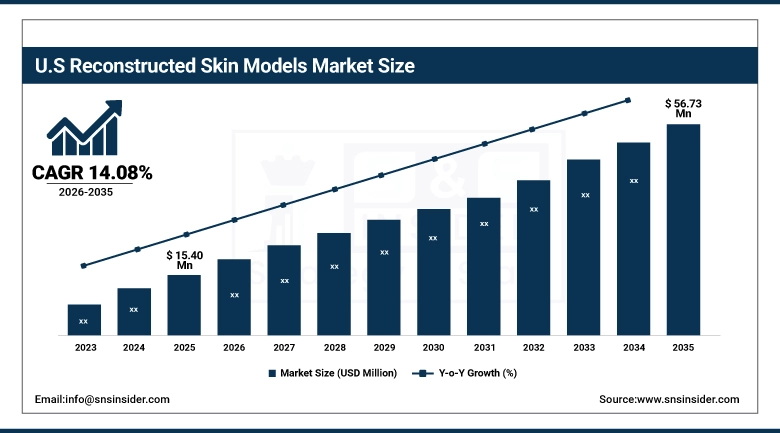
The U.S. Reconstructed Skin Models Market was valued at USD 15.40 Million in 2025 and is expected to reach around USD 56.73 Million by 2035, growing at a CAGR of 14.08% from 2026–2035.
The U.S. is currently the dominant regional market for skin substitutes owing to its well-established R&D framework in the pharmaceuticals and biotech industry, growing regulation favoring alternative testing methods instead of animal testing, and higher utilization of sophisticated in-vitro test systems. Other key drivers contributing to demand include the increased activity in dermatological studies, cosmetics safety evaluations, and toxicology tests using bioengineered tissues.
Additionally, EPISKIN and research collaborators expanded initiatives promoting reconstructed human tissue models for predictive toxicology and ethical testing innovation, while industry focus on 3D bioprinted and disease-specific skin platforms continues to accelerate next-generation model commercialization and adoption.
Reconstructed skin models Market Segment Highlights
-
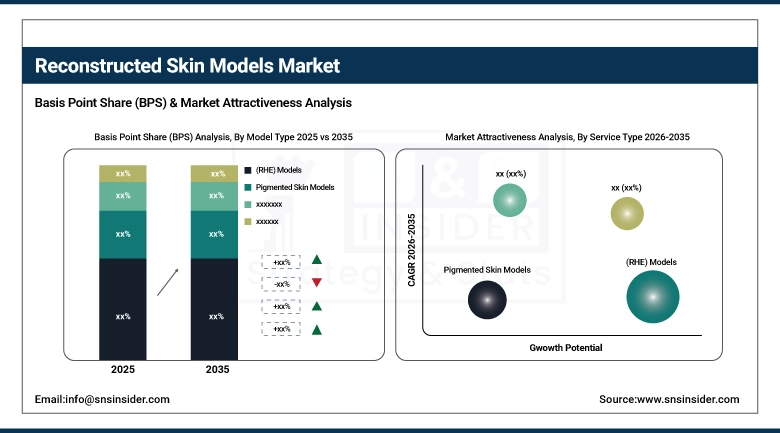
By Model Type, Reconstructed Human Epidermis (RHE) Models dominated the Reconstructed Skin Models Market with 38.36% share in 2025; Pigmented Skin Models fastest growing CAGR.
-
By Application, Skin Irritation & Corrosion Testing dominated the Reconstructed Skin Models Market with 28.84% share in 2025; Toxicity Testing fastest growing at CAGR.
-
By End User, Pharmaceutical & Biotechnology Companies dominated the Reconstructed Skin Models Market with 40.21% share in 2025; Cosmetic & Personal Care Companies fastest growing CAGR.
-
By Technology, Tissue Engineering dominated the Reconstructed Skin Models Market with 41.24% share in 2025; Cell Culture-Based Models fastest growing CAGR.
-
By Skin Source, Human Cell-Based Models dominated the Reconstructed Skin Models Market with 62.51% share in 2025; Stem Cell-Derived Models fastest growing CAGR.
By Model Type, Reconstructed Human Epidermis (RHE) Models segment dominates the Reconstructed Skin Models Market, Pigmented Skin Models expected to grow fastest
In 2025, the Reconstructed Human Epidermis (RHE) Models segment maintained its dominant position in the Reconstructed Skin Models Market, accounting for 38.36% of total revenue. This kind of leadership is mainly propelled by the vast validation of this technology within the framework of regulatory toxicological tests, the use of this technology within the safety assessment of cosmetics, and the use of this technology in dermatological research in the pharmaceutical industry. In addition, RHE models benefit from their market dominance across global testing laboratories and research institutes.
From 2026 to 2035, the Pigmented Skin Models segment is projected to record the highest CAGR. This rapid growth is driven by increasing demand for advanced skin tone–inclusive testing platforms, rising focus on ethnic variability in dermatological research, and expanding cosmetic product personalization trends.
By Application, Skin Irritation & Corrosion Testing segment dominates the Reconstructed Skin Models Market, Toxicity Testing expected to grow fastest
In 2025, the Skin Irritation & Corrosion Testing segment held the largest share of 28.84%, Backed by its mandatory usage within the chemical regulation process for chemicals, cosmetics, and personal care formulations. The presence of strong regulations on both the North American and European continents, together with the growing trend to replace in vivo tests, has further strengthened this sector's position.
The Toxicity Testing segment is expected to register the highest CAGR during the 2026–2035 forecast period. The growth factors contributing to this market include increased demand for predictive in vitro toxicology, increased use during early drug discovery and higher acceptability from regulators using methods without animals. Improvements in 3D tissue engineering and organotypic models have increased the efficacy of predictions, hence faster adoption in the pharma and biotech industries.
By End User, Pharmaceutical & Biotechnology Companies segment dominates the Reconstructed Skin Models Market, Cosmetic & Personal Care Companies expected to grow fastest
In 2025, the Pharmaceutical & Biotechnology Companies segment dominated the market with a 40.21% share, motivated by the widespread utilization of reconstructed skin systems in drug discovery, dermatological investigations, and safety pharmacology assessments. Robust R&D expenditure, together with growing regulatory pressures to conduct fewer animal tests, have further strengthened its application in large pharmaceutical pipelines and contract research networks.
From 2026 to 2035, the Cosmetic & Personal Care Companies segment is projected to witness the highest CAGR. This growth is supported by rising consumer demand for cruelty-free and ethically tested products, increasing premium skincare innovation, and expanding global regulations restricting animal testing in cosmetics.
By Technology, Tissue Engineering segment dominates the Reconstructed Skin Models Market, Cell Culture-Based Models segment expected to grow fastest
In 2025, the Tissue Engineering segment maintained its dominant position in the Reconstructed Skin Models Market, accounting for 41.24% of total revenue. The primary drivers behind such a type of leadership stem from its robust scientific basis as far as standardized protocols for 3D skin reconstruction go, high reproducibility rates in lab tests, and broad approval for use in cosmetic safety and chemical tests. The constant improvements made to biomaterials and extracellular matrix simulation make this form of leadership even more reliable.
From 2026 to 2035, the Cell Culture-Based Models segment is projected to record the highest CAGR.
By Skin Source, Human Cell-Based Models segment dominates the Reconstructed Skin Models Market, Stem Cell-Derived Models segment expected to grow fastest
In 2025, the Human Cell-Based Models segment held the largest share of 62.51%, The above dominance is due to its backing by the strong preference of regulations on human-relevant test systems, high physiological relevance, and wide usage in reconstructed human epidermis and whole thickness skin. The dominance above is further enhanced due to its growing adoption in cosmetic safety testing as well as pharmaceutical dermatological research which relies heavily on the fidelity of human cells.
From 2026 to 2035, the Stem Cell-Derived Models segment is projected to register the highest CAGR.
Reconstructed skin models Market Regional Analysis
|
Region |
Major Country |
Share within Region (%) |
|---|---|---|
|
North America |
United States |
80.45% |
|
Europe |
Germany |
28.78% |
|
Asia Pacific |
China |
34.95% |
|
Middle East & Africa |
UAE |
42.26% |
|
Latin America |
Brazil |
41.29% |
North America Reconstructed Skin Models Market Insights
North America held the dominant position in the global Reconstructed Skin Models Market with 42.24% revenue share in 2025, supported by its highly sophisticated biotechnology environment, robust pharmaceutical research & development spendings, and early embrace of alternate non-animal testing systems. The area is well-served by its rich contract research organization (CRO) base, well-developed cosmetics testing laboratories, and extensive use of 3D tissue engineering and organotypic skin models in preclinical research processes. In vitro testing system acceptance on the regulatory front and close ties between industrial and academic research institutions further bolster regional prominence.
Leading biotech companies and CROs in the U.S. have expanded partnerships with reconstructed human tissue developers to strengthen next-generation predictive toxicology platforms, particularly for cosmetic and dermatology applications.
Increased collaboration between pharmaceutical firms and 3D bioprinting technology providers is accelerating commercialization of advanced full-thickness and disease-specific skin models.
Get Customized Report as per Your Business Requirement - Enquiry Now
Asia Pacific Reconstructed Skin Models Market Insights
The Asia Pacific region is projected to register the highest CAGR of 15.89% from 2026–2035, motivated by the fast-growing development of infrastructure related to biotechnology, the trend of outsourcing pharmaceutical companies, and advances in the application of in vitro test systems. Countries like China, Japan, India, South Korea, and Singapore are coming up as important players, with China and India being the frontrunners owing to the large growth in CROs and drug discovery.
Major pharmaceutical outsourcing hubs in India are increasingly integrating 3D skin models into CRO workflows, improving speed and accuracy of preclinical testing services.
In addition, growing collaborations between global pharmaceutical companies and Asia-based research organizations, along with rising investment in 3D bioprinting and tissue engineering platforms, are accelerating deployment of reconstructed skin models across toxicity testing and disease modeling applications.
Europe Reconstructed Skin Models Market Insights
The European region was an important player in the global market because of the robust regulatory framework that ensured the safety of cosmetic products using various tests, higher use of ethical testing methods, and developed life sciences sector. Some of the European countries that had become the key adopters of reconstructed skins models included Germany, France, the UK, and the Netherlands owing to their stringent compliance under animal testing bans.
European research institutes and biotech companies are increasingly entering cross-border collaborations to standardize reconstructed skin model validation protocols under evolving non-animal testing regulations.
Several cosmetic testing firms have expanded investments in advanced 3D epidermis platforms to comply with strict EU regulatory frameworks and strengthen cruelty-free product pipelines.
Latin America, Middle East & Africa (LAMEA) Reconstructed Skin Models Market Insights
The LAMEA market for Reconstructed Skin Models is experiencing sustainable growth, facilitated by the progressive development of healthcare research facilities, greater use of innovative techniques in cosmetic testing, and increased involvement in international pharmaceutical research communities. Nations like Brazil, Mexico, UAE, Saudi Arabia, and South Africa have emerged as significant players in this domain, with Brazil and the UAE becoming central nodes of innovation and dissemination.
Brazil’s cosmetic industry has expanded adoption of reconstructed skin models through partnerships with international testing solution providers to meet global regulatory standards. Regional research labs are gradually upgrading to advance in vitro testing systems, improving participation in global pharmaceutical and dermatology research programs.
The UAE has strengthened its position as a regional biotech hub through investments in advanced laboratory infrastructure supporting tissue engineering and predictive toxicology research. Saudi Arabia is increasingly funding healthcare innovation programs that encourage adoption of ethical testing alternatives, including reconstructed skin models for cosmetic safety evaluation.
Reconstructed skin models Market Growth Drivers:
-
Rising regulatory acceptance of non-animal testing methods and growing adoption of predictive in vitro skin models are driving strong demand for reconstructed skin models across pharmaceutical, cosmetic, and chemical safety testing industries globally.
The driving force behind the market development of Reconstructed Skin Models Market is the worldwide trend towards adopting more ethical, human-relevant, and technically superior testing approaches that have replaced animal testing methods. The growing regulatory compliance for in vitro tests by various regulatory bodies like the European regulatory agency framework (REACH), United States Food and Drug Administration, and Organization for Economic Co-operation and Development is increasing the use of reconstructed human epidermis, thick skin models, and 3D skin bioprinting techniques.
Additionally, strategic innovation initiatives by leading biotech and tissue engineering companies such as EPISKIN, MatTek Corporation, and reconstructed tissue solution providers are advancing 3D bioprinting, stem-cell derived skin systems, and organ-on-chip integration. These developments are strengthening the long-term commercialization of next-generation skin models, enabling more accurate disease modeling, personalized dermatology research, and high-throughput toxicological screening across global life sciences industries.
Reconstructed skin models Market Restraints:
-
High complexity in developing biologically accurate, standardized, and reproducible reconstructed skin models is limiting scalability and increasing production costs across the global market
The major constraint in the Reconstructed Skin Models Market is the complexity involved in developing reliable and physiologically accurate reconstructed skin tissues to satisfy varying regulatory standards. The creation of more advanced products such as thick skin, pigmented skin, and disease models demands high-level cell culture, quality control procedures, and tissue engineering technology. Biological material variability and accurate mimicry of skin functions contribute to the difficulties in mass-producing skin models. Moreover, the lack of uniformity within the regulations of different countries and variation in validating methodologies for in vitro tests hinder the commercialization process. These obstacles collectively result in escalating R&D expenses and slower adoption rates, especially in developing nations.
Reconstructed skin models Market Opportunities:
-
Expansion of advanced biotechnology research, personalized medicine, and alternative testing ecosystems is creating strong opportunities for next-generation reconstructed skin models across pharmaceutical, cosmetic, and toxicology applications
One of the key growth opportunities in the Reconstructed Skin Models Market is the fast pace at which precision-based life sciences research is moving, wherein there is a greater tendency to use the reconstructed skin models in various stages of drug discovery, dermatological development, and safety evaluation. As there is an increased emphasis on personalizing medicine and conducting preclinical studies that mimic human biology, there is greater scope for more sophisticated models such as skin models that have diseases, stem cell-based reconstructed skin, and bioprinted skin models.
Recent Developments:
-
2026: EPISKIN (L’Oréal group) expanded its reconstructed human epidermis production capacity in Europe, strengthening supply for cosmetic safety and regulatory testing demand while improving batch standardization and scalability of 3D skin models used in irritation and corrosion testing workflows.
-
2026: MatTek Corporation enhanced its EpiDerm and full-thickness skin model platforms by integrating improved high-throughput compatibility features, supporting faster toxicology screening and increased adoption across pharmaceutical and CRO-based preclinical testing pipelines in North America.
-
2025: Charles River Laboratories expanded its in vitro dermatology testing services by incorporating advanced reconstructed skin models into its toxicology portfolio, improving predictive safety assessment capabilities for drug candidates and chemical compounds.
-
2025: Organovo Holdings advanced its 3D bioprinted skin tissue development program, focusing on next-generation disease-specific skin models aimed at improving accuracy in wound healing research and personalized dermatological applications.
Reconstructed skin models Market Key Players
Some of the Reconstructed skin models Market Companies
-
EPISKIN SA (SkinEthic / L'Oréal)
-
MatTek Corporation
-
Genoskin SA
-
Japan Tissue Engineering Co., Ltd. (J-TEC)
-
BICO Group AB
-
Phenion GmbH & Co. KG
-
LabSkin
-
ZenBio Inc.
-
Alcyomics Ltd.
-
CellSystems GmbH
-
Organovo Holdings Inc.
-
Epithelix Sàrl
-
Creative Bioarray
-
Sterlab S.r.l.
-
TissUse GmbH
-
CUTISS AG
-
InSphero AG
-
Hµrel Corporation
-
CN Bio Innovations Ltd.
-
Patient Analog Inc.
Reconstructed skin models Market Report Scope:
| Report Attributes | Details |
|---|---|
| Market Size in 2025 | USD 45.31 Million |
| Market Size by 2035 | USD 173.89 Million |
| CAGR | CAGR of 14.54% From 2026 to 2035 |
| Base Year | 2025 |
| Forecast Period | 2026-2035 |
| Historical Data | 2022-2024 |
| Report Scope & Coverage | Market Size, Segments Analysis, Competitive Landscape, Regional Analysis, DROC & SWOT Analysis, Forecast Outlook |
| Key Segments | • By Model Type (Reconstructed Human Epidermis (RHE) Models, Full Thickness Skin Models (FTSM), Pigmented Skin Models, Disease-Specific Skin Models, 3D Bioprinted Skin Models, Others) • By Application (Skin Irritation & Corrosion Testing, Toxicity Testing, Cosmetic Product Testing, Drug Discovery & Development, Wound Healing Studies, Others) • By End User (Pharmaceutical & Biotechnology Companies, Cosmetic & Personal Care Companies, Contract Research Organizations (CROs), Academic & Research Institutes, Regulatory Testing Laboratories) • By Technology (Tissue Engineering, 3D Bioprinting, Cell Culture-Based Models, Microfluidic / Organ-on-Chip Models) • By Skin Source (Human Cell-Based Models, Animal Cell-Based Models, Stem Cell-Derived Models) |
| Regional Analysis/Coverage | North America (US, Canada), Europe (Germany, UK, France, Italy, Spain, Russia, Poland, Rest of Europe), Asia Pacific (China, India, Japan, South Korea, Australia, ASEAN Countries, Rest of Asia Pacific), Middle East & Africa (UAE, Saudi Arabia, Qatar, South Africa, Rest of Middle East & Africa), Latin America (Brazil, Argentina, Mexico, Colombia, Rest of Latin America). |
| Company Profiles | EPISKIN SA (SkinEthic / L'Oréal), MatTek Corporation, Genoskin SA, Japan Tissue Engineering Co., Ltd. (J-TEC), BICO Group AB, Phenion GmbH & Co. KG, LabSkin, ZenBio Inc., Alcyomics Ltd., CellSystems GmbH, Organovo Holdings Inc., Epithelix Sàrl, Creative Bioarray, Sterlab S.r.l., TissUse GmbH, CUTISS AG, InSphero AG, Hµrel Corporation, CN Bio Innovations Ltd., Patient Analog Inc. |
Frequently Asked Questions
North America dominated the Reconstructed skin models Market in 2025.
The Reconstructed Human Epidermis (RHE) Models segment dominated the Reconstructed skin models Market in 2025.
Rising regulatory acceptance of non-animal testing methods and accelerating adoption of predictive in vitro skin models is the primary growth driver of the Reconstructed Skin Models Market.
The Reconstructed skin models Market was valued at USD 45.31 Million in 2025.
The Reconstructed skin models Market is expected to grow at a CAGR of 14.54% from 2026 to 2035.
