
Refrigerator Market Report Scope & Overview:
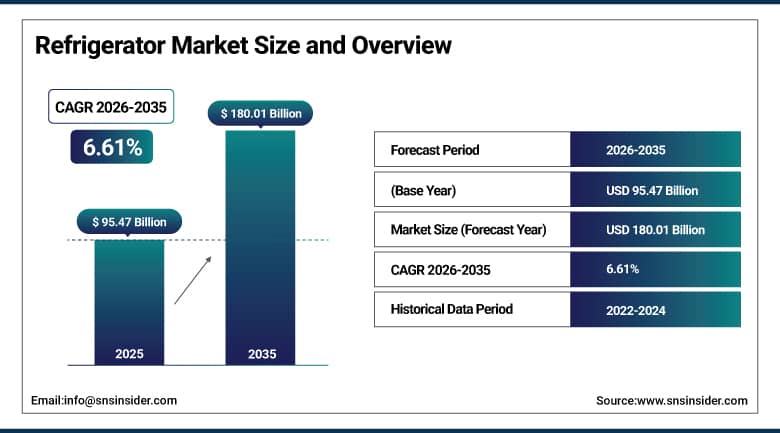
Refrigerator Market was valued at USD 95.47 billion in 2025 and is expected to reach USD 180.01 billion by 2035, growing at a CAGR of 6.61% from 2026-2035.
The Refrigerator Market demonstrates strong growth due to growing consumer demand for products that ensure energy efficiency, smart features, and environmentally friendly cooling. Continuous advancements in inverter technology, intelligent IoT-based solutions, integration with artificial intelligence, and frost-free technologies result in the development of advanced capabilities within various product lines like top-freezer, bottom-freezer, side-by-side, French-door, and mini-refrigerators. Growing environmental concerns related to carbon emissions, increased electricity prices, and sustainability initiatives contribute to ongoing growth in demand for advanced refrigerator solutions.
To illustrate, the U.S. Department of Energy stated that approximately 14% of household electricity consumption was linked to fridges with millions of new units being purchased each year because of increasingly strict energy efficiency regulations. Moreover, in its projections, the Environmental Protection Agency expects a significant increase in sales of ENERGY STAR-certified appliances in the U.S. by 2025, showing consumers' willingness to switch to sustainable cooling solutions.
Thus, the growing environmental concerns increase demand for next-generation energy-efficient fridges. At the same time, various agencies have been implementing policies that will facilitate the adoption of advanced cooling solutions. For instance, in 2024, the EPA approved the application of more sustainable cooling agents with low global warming potentials.
To Get More Information On Refrigerator Market - Request Free Sample Report
Refrigerator Market Trends
-
Smart connectivity has become common, with AI-powered inventory management, voice activation, and mobile applications for monitoring.
-
Energy savings remain the most important trend, with inverters and environmentally friendly refrigerants receiving legislative and consumer backing.
-
Premiumization continues to gain momentum, with customers opting for French Door, Side-by-Side, and premium built-in units.
-
E-commerce logistics have changed the nature of the market, with digital platforms speeding up the growth in developing economies.
-
Regulatory policies in Europe, North America, and Asia-Pacific are encouraging companies to use low-GWP refrigerants and sustainable materials.
-
Fast-growing economies, such as India, Brazil, and Southeast Asia, have experienced fast adoption rates due to increasing electrification and urbanization.
-
Customization with the help of modular storage, reversible freezers, and aesthetic customization (colors, designs) is becoming more popular.
-
Wellness and hygiene functions, like antibacterial lining, air filtration, and humidity management, have become key differentiators for premium products.
U.S. Refrigerator Market was valued at USD 32.30 billion in 2025 and is expected to reach USD 64.94 billion by 2035, growing at a CAGR of 8.07% from 2026-2035.
The United States of America Refrigerator Market constitutes the largest market segment globally owing to the highly advanced consumer population, efficient retail chain, and presence of prominent appliance companies like Whirlpool, GE Appliances, Electrolux, and Samsung. Positive government policies including ENERGY STAR certification programs and incentives for efficient appliances also make a significant contribution in the rise in use of the appliances in homes, businesses, and institutions. The increasing presence of smart home technologies and growing e-commerce sites also add up in making the United States of America one of the global leaders in refrigerator market segments.
It is noteworthy here that according to the Department of Energy (United States of America), around 42% of the domestic energy consumption occurs through appliances, which includes refrigerators. This indicates the existence of a growing consumer population looking for more energy-efficient and smart refrigeration products.

Refrigerator Market Segment Highlights
-
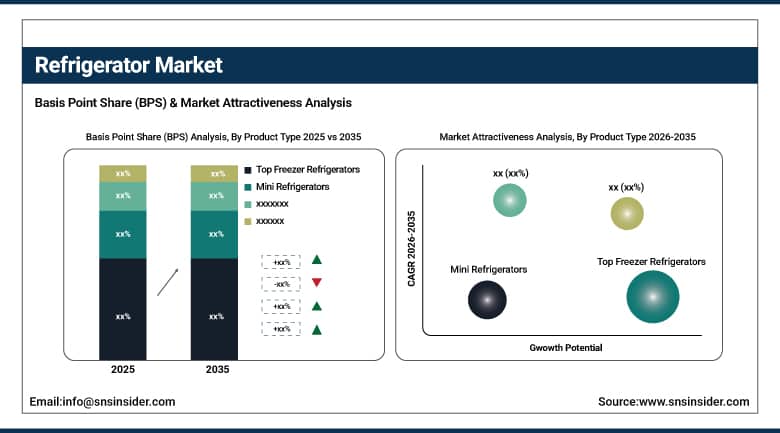
By Product Type, Top Freezer Refrigerators dominated the Refrigerator Market with 29.58% share in 2025; French Door Refrigerators fastest growing (CAGR).
-
By Technology, Inverter Refrigerators dominated the Refrigerator Market with 35.41% share in 2025; Smart/IoT-enabled Refrigerators fastest growing (CAGR).
-
By End User, Residential dominated the Refrigerator Market with 64.11% share in 2025; Healthcare & Laboratories fastest growing (CAGR).
-
By Distribution Channel, Supermarkets & Hypermarkets dominated the Refrigerator Market with 34.72% share in 2025; Online/E-commerce fastest growing (CAGR).
Refrigerator Market Segment Analysis
By Product Type, Top Freezer Refrigerators Dominated the Refrigerator Market, French Door Refrigerators Expected to Grow Fastest
For the year 2025, the Top Freezer Refrigerators category holds the leadership position in the Refrigerator market, contributing close to 29.58% to the revenue share. The leadership of the segment is because of the availability of affordable prices, energy-efficient technology, small sizes, and wide use among households. The Top Freezer Refrigerators are widely preferred due to the effective cooling capacity, low-cost maintenance, and space-efficient design.
During the forecast period of 2026 to 2035, the fastest CAGR will be witnessed by the French Door Refrigerators segment. With increased consumer preference for high-end kitchen appliances, large storage capacity, modern cooling technologies, and smart features, the demand for French Door Refrigerators will increase rapidly. Increasing urbanization and rising disposable incomes have led to growing preferences for sophisticated kitchen appliances among consumers.
By Technology, Inverter Refrigerators Dominated the Refrigerator Market, Smart/IoT-enabled Refrigerators Expected to Grow Fastest
The Inverter Refrigerators segment led the Refrigerator Market in 2025, contributing around 35.41% of market revenue. The dominance of this segment is fueled by rising global trends of energy-efficient home appliance purchases and regulations that encourage energy-saving devices. Inverter refrigerators offer higher temperature stability, reduced electricity use, reduced noise levels, and longer lifespans for compressors than standard refrigeration units.
During 2026-2035, the Smart/IoT-enabled Refrigerators segment will see the highest CAGR growth. The rise in smart home installations, connectivity between devices, and artificial intelligence-powered homes will greatly contribute to the proliferation of smart refrigerators. Modern-day consumers are increasingly seeking functions such as remote monitoring, voice assistant capability, food management, maintenance reminders, and energy-saving abilities.
By End User, Residential Segment Dominated the Refrigerator Market, Healthcare & Laboratories Expected to Grow Fastest
The Residential Segment was the leading contributor to the Refrigerator Market in 2025, representing about 64.11% of the market revenue. Household demand, growing urban populations, and rising appliance ownership in developing countries contribute significantly to the leading position held by the residential segment. Refrigerators have evolved into necessities in households in all economic strata due to their ability to preserve food, improve quality of life, and reduce energy consumption.
Between 2026 and 2035, the Healthcare & Laboratories Segment is expected to grow at the highest CAGR. The growing demand for temperature-controlled storage facilities for vaccines, biologics, medications, blood, and laboratory reagents has propelled the healthcare sector to adopt state-of-the-art refrigeration technologies. Biotechnology research, pharmaceutical production, and vaccination campaigns have created immense demand for precision refrigeration solutions.
By Distribution Channel, Supermarkets & Hypermarkets Dominated the Refrigerator Market, Online/E-commerce Expected to Grow Fastest
In 2025, the Supermarkets & Hypermarkets segment was the market leader in the Refrigerator Market, holding about 34.72% of the total market share. This segment remains dominant owing to its wide variety of products, good brand reputation, price competitiveness, and in-store demonstration facilities. Most customers often visit physical stores when buying refrigerators since it enables them to check out the size, storage space, design, and energy efficiency of the appliance.
From 2026 to 2035, it is projected that the Online/E-commerce sector will register the highest CAGR. The fast digitization process, increase in internet usage, and growing confidence of consumers in buying appliances online have resulted in high growth of the e-commerce segment in selling refrigerators.
Refrigerator Market Regional Analysis
|
Region |
Major Country |
Share within Region (%) |
|---|---|---|
|
North America |
United States |
29.48% |
|
Europe |
Germany |
20.25% |
|
Asia Pacific |
China |
41.58% |
|
Middle East & Africa |
UAE |
3.92% |
|
Latin America |
Brazil |
4.77% |
Asia Pacific Refrigerator Market Insights
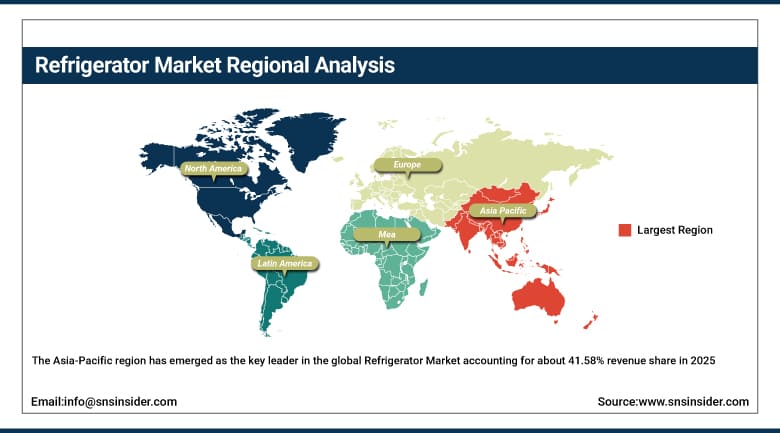
The Asia-Pacific region has emerged as the key leader in the global Refrigerator Market accounting for about 41.58% revenue share in 2025, and not only that, but the region has emerged as the fastest-growing region with a CAGR of 7.01%. Urbanization, increased disposable incomes, and demand for efficient refrigerators with smart technology have driven growth in this region, specifically in China, India, and Southeast Asia. This is due to a well-established manufacturing base, competitive pricing, and increased adoption in residential and commercial sectors because of the rise in middle-income households. In Asia-Pacific, China holds dominant share in the regional market, and this is supported by strong production capacity in China, initiatives for green appliances by the government, and rise in e-commerce channels.
Governments in the Asia-Pacific region have increasingly tightened energy-efficiency standards and implemented programs for sustainability, such as strict appliance labeling norms, and use of eco-friendly refrigerants. For instance, BEE India has upgraded the star-rating system for refrigerators, and China has adopted low-GWP refrigerants owing to its climate commitments.
Get Customized Report as Per Your Business Requirement - Enquiry Now
North America Refrigerator Market Insights
North America region is expected to witness a consistent growth in the forecast period of 2026 to 2035, attributed to the coming together of the matured consumer base, demand for premium/smart products, and favorable government policies for energy-efficient equipment. In North America, the US is estimated to account for nearly of the overall regional revenue, owing to the increased adoption of Internet of Things (IoT) equipped refrigerators, widespread adoption of ENERGY STAR schemes, and expansion in online channels of distribution. The rest of the revenue is expected to come from Canada, thanks to increased electrification rates, consumer inclination towards environment-friendly chilling options, and higher penetration of global brands. The growth in North America is also supported by high levels of disposable income and sustainable consumer awareness.
In Canada, the National Resources Canada has harmonized its appliance efficiency standards in accordance with those of the US. Moreover, it promotes eco-friendly refrigerants and provides rebates on efficient appliance purchases.
Europe Refrigerator Market Insights
Europe is the region with the Third highest market revenue share in the global Refrigerator Market, representing steady in 2025. The main factors contributing to this include an experienced user base, government investment in sustainable technologies, and the presence of efficient regulatory frameworks, ensuring the approval of products by means of CE marking schemes. For example, countries like Germany, the UK, France, and the Netherlands boast advanced retail and manufacturing centers where energy-saving, inverter, and smart refrigerators are widely used.
To support the claim above, one may refer to the investment by the European Commission through its Horizon Europe program in digitalization, smart homes, and eco-cooling solutions as parts of its sustainability investment plan. Another supporting point includes the EU Ecodesign and Energy Labeling Regulations, enacted fully in 2021. These regulations helped increase quality and efficiency standards in European refrigerators, thus increasing the customer’s confidence in certified products.
Middle East & Africa and Latin America Refrigerator Market Insights
Middle East & Africa and Latin America regions have been witnessing steady growth in the Refrigerator Market. This growth can be attributed to increased investments in retail infrastructure, enhanced electrification rates, and increasing awareness regarding energy-efficient home appliances among consumers. The UAE, Saudi Arabia, and South Africa are leading the MEA market. Both the Saudi Arabian government's vision (AIM) and the UAE government's vision (National Agenda) have enabled significant investments in renewable technologies and home appliances.
In Brazil, the national regulatory body ANVISA has simplified the appliance certification process. This has shortened the product development life cycle for manufacturers of new cooling systems. Consequently, the adoption of energy-efficient refrigerators is on the rise.
Refrigerator Market Growth Drivers:
-
The increasing trend among consumers in favor of appliances with high levels of energy efficiency, smart functionality, green coolants, and sleek design is behind the worldwide adoption of next-generation refrigerators.
It cannot be denied that the changing consumer attitudes in the form of going beyond the acceptance of old, inefficient refrigerators to seeking products with smart functionalities and sustainability is the biggest structural factor propelling the industry's growth. This is because today's consumers not only wish to lower their utility bills, but they also want to have an appliance that integrates easily into their smart home environment, minimizes the ecological footprint of the device through its use of low-GWP coolants, and offers cutting-edge technologies such as AI cooling and modular storage capacity. Manufacturers and sellers alike are making investments to meet the rising demand for next-gen products.
According to the International Energy Agency (IEA), all household appliances consume approximately 30% of total electricity use globally, which makes the large and growing number of consumers who will buy next-gen refrigerators quite clear.
Refrigerator Market Restraints:
-
The high capital investments involved in the development of smart and inverter refrigerators pose a significant hurdle to market expansion, especially among small business owners and consumers in developing countries.
The considerable financial obstacles that arise during the purchase, installation, and maintenance of the latest refrigerators constitute a considerable impediment to market expansion. In particular, the expenses incurred while purchasing smart and IoT refrigerators typically include not only the cost of the product itself but also additional costs of software licensing and specialized services. The cost may even increase if the consumer possesses a fully developed smart home network, a stable power supply system, and an environmentally friendly refrigeration process.
Refrigerator Market Opportunities:
-
Faster development of smart refrigerators that are compact and cost-effective is generating new ways for growth and expansion in various sectors such as the residential sector, commercial segment, and emerging economies.
The future trends of the market for refrigerators will focus on ensuring easy access for consumers to highly efficient technologies through innovations in technology, cost-cutting measures, and automated functions. The trend involves the production of smaller refrigerators that have lower costs and include mini and modular models that are designed for use by smaller families and in hospitality and commercial environments. There has been an increased uptake of Internet-of-Things enabled smart refrigerators, intelligent cooling solutions enhanced by AI technology, and applications that can monitor and control the functionalities of cooling systems remotely.
Recent Developments:
-
2026: Haier Released the Lumière French Door Smart Refrigerator Line with Wi-Fi, motion sensors, and compartment conversion capabilities for use by premium customers in Asia and Europe. In addition to this, Haier introduced the HRF-578TBGU1 Inverter Digital Refrigerator which included anti-bacterial sterilization (T-ABT), humidity adjustment, and up to 60% reduced energy usage.
-
2026: Samsung Revealed the Bespoke AI Refrigerator Family Hub at CES, utilizing Gemini artificial intelligence by Google to recognize and inventory foods stored in the appliance. The company also unveiled Zero Clearance French door design with narrow door hinges, offering larger capacity French door refrigerator models in its Bespoke and Family hub collections with FlexZone drawers, SmartThings AI Energy Mode.
-
2026: LG Unveiled new Essential Series refrigerators (225L–276L) featuring Smart Inverter Compressors, Convertible Dairy Mode, and Turbo Fresh Zone. Introduced premium French Door and Side-by-Side refrigerators (574L–790L) featuring InstaView Door-in-Door, Hygiene Fresh+, and AI ThinQ Wi-Fi capability. Further developed its India-centric Make-in-India program by introducing its Essential Series refrigerators in 22 countries in Asia, the Middle East, and Africa.
-
2026: Whirlpool Introduced revolutionary refrigerators capable of producing nugget ice at KBIS. Also offered French Door and Counter-Depth refrigerators along with other advanced features. Premium brands of Whirlpool such as KitchenAid and JennAir released their refrigerator columns that feature built-in cameras and luxury finishes. Launched the largest portfolio refresh in over a decade by updating 30% of its product line with innovative designs and technologies, such as inverter refrigerators for fast cooling and freshness preservation.
Refrigerator Market Key Players
Some of the Refrigerator Market Companies
-
Haier
-
Samsung
-
LG
-
Whirlpool
-
Electrolux
-
Bosch
-
Panasonic
-
Hisense
-
Midea
-
Sharp
-
GE Appliances
-
Siemens
-
Hitachi
-
Toshiba
-
Vestel
-
Arçelik
-
Daewoo
-
Gorenje
-
Liebherr
-
Smeg
Refrigerator Market Report Scope:
| Report Attributes | Details |
|---|---|
| Market Size in 2025 | USD 95.47 Billion |
| Market Size by 2035 | USD 180.01 Billion |
| CAGR | CAGR of 6.61% From 2026 to 2035 |
| Base Year | 2025 |
| Forecast Period | 2026-2035 |
| Historical Data | 2022-2024 |
| Report Scope & Coverage | Market Size, Segments Analysis, Competitive Landscape, Regional Analysis, DROC & SWOT Analysis, Forecast Outlook |
| Key Segments | • By Product Type (Top Freezer Refrigerators, Bottom Freezer Refrigerators, Side-by-Side Refrigerators, French Door Refrigerators, Mini Refrigerators, Others), • By Technology (Inverter Refrigerators, Non-Inverter Refrigerators, Smart/IoT-enabled Refrigerators, Frost-Free Refrigerators, Direct Cool Refrigerators, Others), • By End User (Residential, Commercial, Hospitality, Healthcare & Laboratories, Industrial Food Storage, Others), • By Distribution Channel (Supermarkets & Hypermarkets, Specialty Stores, Online/E-commerce, Brand Outlets, Others) |
| Regional Analysis/Coverage | North America (US, Canada), Europe (Germany, UK, France, Italy, Spain, Russia, Poland, Rest of Europe), Asia Pacific (China, India, Japan, South Korea, Australia, ASEAN Countries, Rest of Asia Pacific), Middle East & Africa (UAE, Saudi Arabia, Qatar, South Africa, Rest of Middle East & Africa), Latin America (Brazil, Argentina, Mexico, Colombia, Rest of Latin America). |
| Company Profiles | Haier, Samsung, LG, Whirlpool, and Electrolux, followed closely by Bosch, Panasonic, Hisense, Midea, and Sharp. Other strong players include GE Appliances, Siemens, Hitachi, Toshiba, Vestel, Arçelik, Daewoo, Gorenje, Liebherr, Kelvinator, Smeg. |
Frequently Asked Questions
Asia-Pacific dominated the Refrigerator Market in 2025.
The Top Freezer Refrigerators segment dominated the Refrigerator Market in 2025.
The major growth factor driving the Market is the rising consumer demand for energy-efficient, smart, and eco-friendly appliances. Increasing urbanization, higher disposable incomes, and lifestyle shifts toward premium and connected home solutions are fueling adoption.
The Refrigerator Market was valued at USD 95.47 billion in 2025.
The Refrigerator Market is expected to grow at a CAGR of 6.61% from 2026 to 2035.
