
Robotic De-Nesting Systems Market Report Scope & Overview:
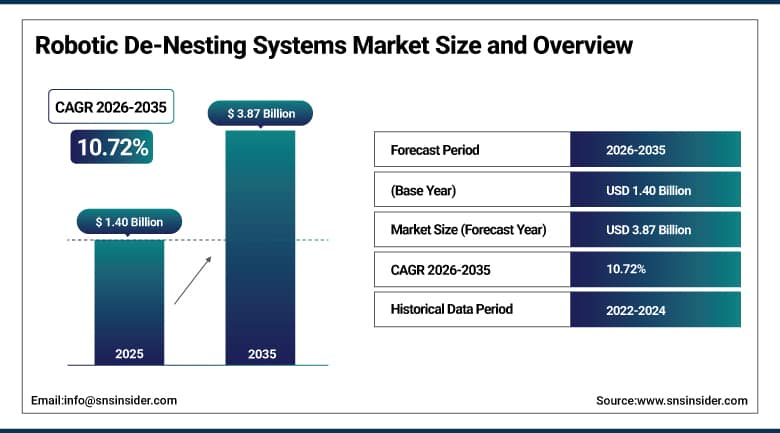
The Robotic De-Nesting Systems Market was valued at USD 1.40 billion in 2025 and is expected to reach USD 3.87 billion by 2035, growing at a CAGR of 10.72% from 2026–2035.
The robotic de-nesting systems market is witnessing steady growth in the global market owing to increasing industrial automation adoption. Rising demand for high-speed packaging and material handling is supporting market expansion. Manufacturers are focusing on intelligent robotic integration and precision handling capabilities. Growing labor shortages and operational efficiency requirements are accelerating automation investments. Increasing adoption across food processing, pharmaceuticals, and logistics facilities is further driving market growth.
As stated by the IFR in its World Robotics 2025 report, the annual number of industrial robot installations stood at 542,000, which is expected to rise to 575,000 by 2025. The drive toward industrial automation is propelled by factors such as labor shortages and safety policies noted by the International Labour Organization. As a result, based on the results provided by the Annual Business Survey conducted by the U.S. Census Bureau, the application of advanced manufacturing technologies continues to increase, largely favoring high-speed handling applications and robotic de-nesting systems.
To Get More Information On Robotic De-Nesting Systems Market - Request Free Sample Report
Robotic De-Nesting Systems Market Trends
-
Integration of artificial intelligence and machine vision has increased the efficiency, flexibility, object recognition capabilities, and productivity of robotic de-nesting processes.
-
Adoption of technologies of Industry 4.0 has led to the smooth incorporation of robotic de-nesting processes into automated manufacturing and packaging production lines.
-
Increasing investment in smart factories has led to an increase in the use of intelligent robotic de-nesting technology.
-
Labor shortage has encouraged the adoption of robotic de-nesting systems in place of repetitive manual handling processes.
-
Flexible automation has been demanded as companies require robots that can handle different objects in various forms of packaging.
-
Applications of robotic de-nesting processes have expanded from food processing, pharmaceuticals, logistics, to manufacturing.
U.S. Robotic De-Nesting Systems Market Outlook
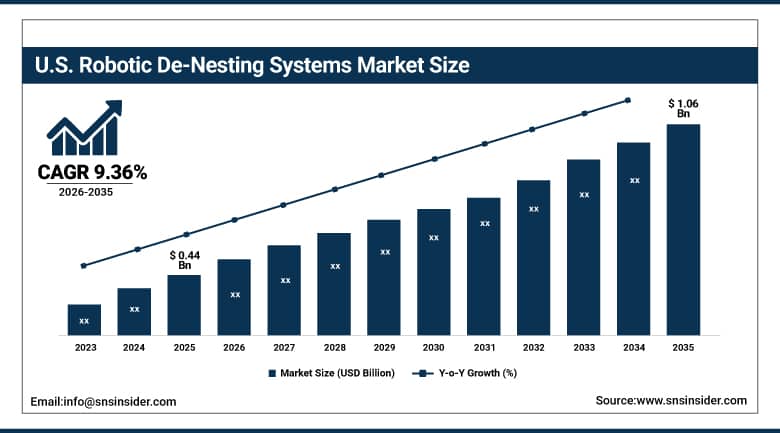
The U.S. Robotic De-Nesting Systems Market was valued at USD 0.44 billion in 2025 and is expected to reach around USD 1.06 billion by 2035, growing at a CAGR of 9.36% from 2026–2035.
The U.S. robotic de-nesting systems market is expanding steadily owing to strong industrial automation investments. Increasing adoption of robotic packaging solutions is supporting market growth. Rising demand for labor-efficient manufacturing and material handling is driving deployment across production facilities. Growth in food processing and pharmaceutical manufacturing is further accelerating demand. Manufacturers are focusing on intelligent vision systems and flexible robotic automation platforms. Increasing investments in smart factories and warehouse automation are strengthening market penetration.
As per the preliminary 2025 statistics by the International Federation of Robotics, there was an increase of 11% in industrial robot deployments year on year to 38,000 in the USA, boosted by a 30% spike in their adoption in the food industry. The country attained a level of 307 robots per 10,000 manufacturing workers, standing at the eighth position worldwide.
Robotic De-Nesting Systems Market Segment Analysis
-
By Product Type, automatic robotic de-nesting systems dominated the market with 68.45% share in 2025; while semi-automatic robotic de-nesting systems is the fastest growing segment with CAGR of 12.99% during 2026 to 2035.
-
By Application, food and beverage dominated the market with 39.80% share in 2025; while pharmaceuticals are the fastest growing segment with CAGR of 13.97% during 2026 to 2035.
-
By Distribution Channel, direct sales dominated the market with 59.70% share in 2025; while online sales are the fastest growing segment with CAGR of 19.64% during 2026 to 2035.
-
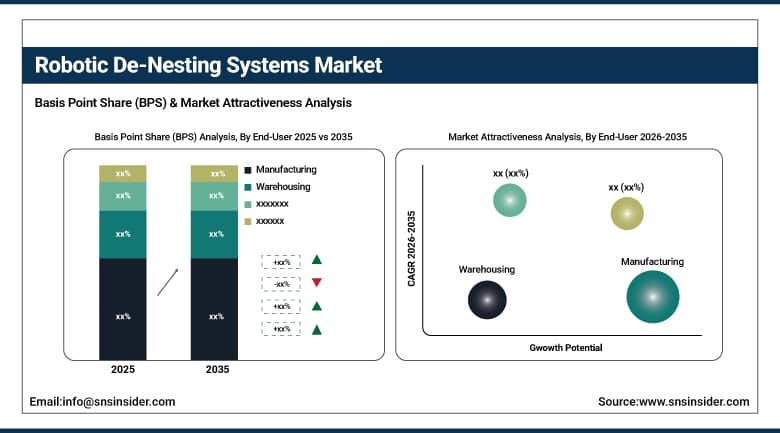
By End-User, manufacturing dominated the market with 57.85% share in 2025; while warehousing is the fastest growing segment with CAGR of 17.33% during 2026 to 2035.
By End-User, manufacturing dominated the robotic de-nesting systems market, while warehousing is the fastest growing segment.
Manufacturing segment accounted for the dominated market share in terms of revenue in 2025. The rising application of automated manufacturing lines in the industry fueled the growth of robotic de-nesting systems. Robotic de-nesting systems improved efficiency by decreasing manual handling, minimizing downtime, and ensuring smooth product flow. Increasing investment in smart factory and automation solutions further propelled the adoption of these systems. Continuous emphasis on efficiency, quality management, and labor cost reduction played a crucial role in driving the segment.
Warehouse segment is estimated to witness the fastest CAGR during the forecast period. The growing establishment of e-commerce fulfillment centers increased the investments made in automated material handling solutions. Robotic de-nesting systems ensured faster processing of items and efficient movement of inventory with less dependency on manual work force. Increasing warehouse modernization and use of intelligent logistics solutions is likely to drive the adoption of these systems during the forecast period.
By Product Type, automatic robotic de-nesting systems dominated the robotic de-nesting systems market, while semi-automatic robotic de-nesting systems is the fastest growing segment.
Automatic robotic de-nesting systems segment held the leading position in terms of revenue share in the robotic de-nesting systems market in 2025. The segment's dominance can be attributed to its wide usage in high volume manufacturing and packaging activities involving automation. These solutions provide better speed, accuracy, and consistency in performing repeated de-nesting activities. Increased spending on smart factories and labor-saving programs have boosted the demand for these systems. The benefits of increased efficiency along with low risk of product damage ensured their extensive usage.
Semi-Automatic Robotic De-Nesting Systems segment is forecasted to register the fastest CAGR between 2026 and 2035. The increasing demand from small and medium-sized enterprises is driving their adoption among manufacturers. The ability to offer automation advantages at relatively lower capital investment costs than fully automated systems is enabling their wider adoption. The growing preference for flexible manufacturing is helping expand the market.
By Application, food and beverage dominated the robotic de-nesting systems market, while pharmaceuticals are the fastest growing segment.
Food & Beverages is the leading segment of the robotic de-nesting systems market with the dominated revenue share in 2025. Robotic de-nesting systems became popular due to higher volume production and continuous operations in packaging. Hygiene, speed, and precision were crucial factors in ensuring better efficiency and less labor dependency. The rising investment in automation in food packaging processes and stricter food safety regulations have led to a significant adoption rate in all manufacturing plants around the globe.
The Pharmaceuticals segment will witness the fastest CAGR from 2026-2035. There is growing need for contamination free and sterile manufacturing in pharmaceutical facilities that is resulting in the increasing deployment of robotic de-nesting systems. The manufacturers are focusing on automation of packaging processes for greater accuracy and traceability. There are high growth prospects of injectables and biologics which is driving the adoption of robotic de-nesting systems.
By Distribution Channel, direct sales dominated the robotic de-nesting systems market, while online sales are the fastest growing segment.
The Direct Sales segment accounted for the dominated revenue share in the robotic de-nesting systems market in 2025 due to the higher preference among large companies for customized integration of systems and technical advice by automation suppliers. Automation systems that require complex engineering design and installation were sold via direct sales because of the need for technical support during implementation and maintenance periods. The strong relations between automation suppliers and their industrial clients also favored direct sales in the manufacturing sector.
The Online Sales segment is expected to witness the fastest growth rate during the forecast period. There is an increase in the number of digital platforms for procurement where it becomes easy for industrial clients to compare equipment specifications and buy. Small and medium enterprises are increasingly using online platforms for procurement owing to convenience and competitive prices. Increased use of digital catalogs and demonstration videos for technical advice by automation suppliers is promoting the digital sales of systems worldwide.
Regional Analysis
|
Region |
Major Country |
Share within Region, 2025(%) |
|---|---|---|
|
North America |
United States |
84.60% |
|
Europe |
Germany |
24.60% |
|
Asia Pacific |
China |
41.80% |
|
Middle East & Africa |
UAE |
17.20% |
|
Latin America |
Brazil |
46.10% |
North America Robotic De-Nesting Systems Market Insights.
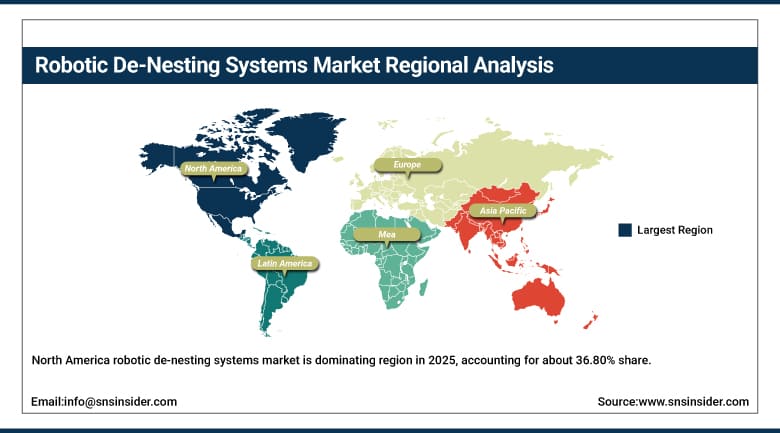
North America robotic de-nesting systems market is dominating region in 2025, accounting for about 36.80% share, driven by strong adoption across food processing and industrial automation. The region benefits from advanced manufacturing infrastructure and early implementation of robotic technologies. Increasing investments in smart factories are significantly strengthening market penetration. Expansion of automated packaging operations is accelerating demand. A strong focus on operational efficiency and labor optimization further reinforces the region's dominant position in the market.
As per the International Federation of Robotics’ World Robotics 2025 report, 34,164 industrial robots were deployed in the U.S., constituting 68% of the total 50,077 robots installed in the Americas region. With regards to industry and labor statistics, advancements in automation technology keep evolving to cater for labor shortages and productivity demands. This exact information on manufacturing performance leads to increased usage of fast material handling and robot de-nesting systems in North American packaging facilities.
Get Customized Report as Per Your Business Requirement - Enquiry Now
Europe Robotic De-Nesting Systems Market Insights.
Europe robotic de-nesting systems market is characterized by stable growth in 2025 owing to strong industrial automation adoption. Key countries include Germany, France, United Kingdom, and Italy. Rising investments in intelligent manufacturing systems are driving adoption. Increasing focus on production efficiency and workplace automation is boosting demand. Growth in food processing and pharmaceutical industries is further supporting market expansion. Strict manufacturing quality standards are encouraging innovation in robotic de-nesting technologies.
According to the International Federation of Robotics World Robotics 2025 report, European industrial robot installations stabilized at 85,000 units, capturing a 16% share of the global market. Within this region, the European Union commanded 80% of total installations, with Germany leading at a 32% market share by deploying 26,982 units. Supported by a 3% annual regional growth average, these foundational automation increases heavily accelerate the cross-industry integration of high-speed robotic de-nesting systems throughout continental packaging lines.
Asia Pacific Robotic De-Nesting Systems Market Insights.
Asia Pacific is the fastest growing region in the robotic de-nesting systems market, registering a CAGR of about 12.35% during 2026–2035. Rapid industrialization and expanding manufacturing capacity are driving strong demand across China, India, Japan, South Korea, and Southeast Asia. Increasing investments in factory automation are boosting market growth. Rising labor shortages and production efficiency requirements are further accelerating adoption. Growth in packaging and logistics infrastructure is supporting large scale market expansion.
According to the International Federation of Robotics World Robotics 2025 report, Asia commanded 74% of all new industrial robot deployments, with global installations projected to grow 6% to 575,000 units. China, Japan, and the Republic of Korea lead regional automation, supported by national smart factory policies from the Ministry of Industry and Information Technology and related agencies. These expanding installation metrics directly drive the deployment of robotic de-nesting systems across Asia-Pacific production lines.
Middle East & Africa and Latin America Robotic De-Nesting Systems Market Insights.
The Middle East & Africa along with Latin America regions are witnessing steady growth due to increasing industrial automation and manufacturing modernization. Key contributing countries include Brazil, Mexico, UAE, Saudi Arabia, and South Africa. Rising investments in automated packaging facilities are driving adoption. Growth in food processing and logistics industries is further supporting market expansion. Increasing foreign investments and industrial development initiatives are boosting regional demand.
According to the International Federation of Robotics World Robotics 2025 report, global industrial robot installations reached 542,076 units, with 2025 projections rising 6% to 575,000 units. Asia commands 74% of these new deployments, while Mexico added 5,600 units, directing 63% of its installations into the automotive sector. These expanding automation baselines across Latin America and emerging markets directly stimulate regional adoption of robotic de-nesting systems to handle high-throughput sorting, feeding, and packaging operations.
Market Dynamics
Growth Drivers: Rising adoption of industrial automation and smart manufacturing is accelerating demand for intelligent Robotic De-Nesting Systems across production facilities
Automation has become an important tool for increasing efficiency in the manufacturing process by automating the repetitive processes of handling goods. Robots de-nesting ensures constant product separation without any delays and mistakes in the process. Increasing use of Industry 4.0 technology solutions increases the need for their integration into the automated manufacturing process line. Many businesses are investing in robotics to increase efficiency and ensure that the quality of products remains unchanged. Labor shortages in manufacturing have increased the need for automation. Global expansion of smart factories is ensuring the continued demand for robots de-nesting systems.
As per the findings of the International Federation of Robotics World Robotics 2025, there have been 4,663,773 industrial robots operating globally along with 542,076 annual installations in the factories. At the same time, as mentioned by the OECD Digital Economy Outlook, the companies are working hard to incorporate smart automation systems with vision and artificial intelligence capabilities. The increase in these implementation benchmarks is leading to the development of high-speed robotic de-nesting systems.
Restraints: Limited availability of skilled robotics professionals is creating operational challenges for efficient deployment and long-term system maintenance
Efficient running of robotic de-nesting systems requires skilled manpower that is able to program, supervise, and maintain such automated systems. There have been many cases where there are few professionals in terms of robotics and automation in most manufacturing firms in various regions. It takes quite a lot of money and time to train staff in using the advanced robotic systems. Technical problems may lead to disruption of production if there are no skilled people to offer assistance.
Opportunities: Advancements in artificial intelligence and machine vision technologies are enabling smarter robotic de-nesting capabilities across multiple industries
The use of artificial intelligence and machine vision technologies has revolutionized robotic de-nesting systems via enhanced capabilities of object recognition and adaptability. Contemporary robotic systems can handle products that have various forms, materials, and packaging arrangements. Automation systems that are smart and offer flexibility without increasing errors are being designed by companies. Customized manufacturing processes require more sophisticated robotic systems to be used by organizations. Future advancements in robotics are predicted to create significant growth prospects in the fields of food processing, pharmaceuticals, logistics, and manufacturing.
As per the report of the International Federation of Robotics, World Robotics 2025, the number of robots in operation globally stood at 4,664,000. At the same time, the new ISO 10218:2025 standards lay down the new safety and cybersecurity standards for advanced industrial robot cells. The new stringent safety standards and AI-based machine vision technologies speed up the adoption of the intelligent robotic de-nesting systems.
Recent Developments
-
2026: FANUC America launched its CRX-3iA collaborative welder and R-2000/E series industrial robots featuring maintenance-free architecture.
-
2025: Yaskawa Electric Corporation expanded its FIELD system basic package and upgraded smart digital twin manager integration capabilities.
-
2025: KUKA partnered with Dassault Systèmes to integrate advanced 3DEXPERIENCE virtual twin capabilities into its open digital ecosystem.
-
2024: FANUC introduced its updated R-50iA robot controller generation featuring high-frequency digital streaming and modern cybersecurity protocols.
Robotic De-Nesting Systems Market Players are:
-
ABB Ltd.
-
FANUC Corporation
-
KUKA AG
-
Yaskawa Electric Corporation
-
Kawasaki Heavy Industries, Ltd.
-
Mitsubishi Electric Corporation
-
DENSO Corporation
-
Stäubli International AG
-
Universal Robots A/S
-
Omron Corporation
-
Epson Robots
-
Schneider Electric SE
-
ATS Corporation
-
Bastian Solutions, LLC
-
JLS Automation
-
BluePrint Automation (BPA)
-
Quest Industrial LLC
-
Sidel Group
-
BW Integrated Systems
-
Premier Tech Systems and Automation
Robotic De-Nesting Systems Market Report Scope:
| Report Attributes | Details |
|---|---|
| Market Size in 2025 | USD 1.40 Billion |
| Market Size by 2035 | USD 3.87 Billion |
| CAGR | CAGR of 10.72% From 2026 to 2035 |
| Base Year | 2025 |
| Forecast Period | 2026-2035 |
| Historical Data | 2022-2024 |
| Report Scope & Coverage | Market Size, Segments Analysis, Competitive Landscape, Regional Analysis, DROC & SWOT Analysis, Forecast Outlook |
| Key Segments | • By Product Type (Automatic Robotic De-Nesting Systems, Semi-Automatic Robotic De-Nesting Systems) • By Application (Food and Beverage, Pharmaceuticals, Packaging, Automotive, Electronics, Others) • By Distribution Channel (Direct Sales, Distributors, Online Sales, Others) • By End-User (Manufacturing, Logistics, Warehousing, Others) |
| Regional Analysis/Coverage | North America (US, Canada), Europe (Germany, UK, France, Italy, Spain, Russia, Poland, Rest of Europe), Asia Pacific (China, India, Japan, South Korea, Australia, ASEAN Countries, Rest of Asia Pacific), Middle East & Africa (UAE, Saudi Arabia, Qatar, South Africa, Rest of Middle East & Africa), Latin America (Brazil, Argentina, Mexico, Colombia, Rest of Latin America). |
| Company Profiles | ABB Ltd., FANUC Corporation, KUKA AG, Yaskawa Electric Corporation, Kawasaki Heavy Industries, Ltd., Mitsubishi Electric Corporation, DENSO Corporation, Stäubli International AG, Universal Robots A/S, Omron Corporation, Epson Robots, Schneider Electric SE, ATS Corporation, Bastian Solutions, LLC, JLS Automation, BluePrint Automation (BPA), Quest Industrial LLC, Sidel Group, BW Integrated Systems, Premier Tech Systems and Automation |
Frequently Asked Questions
The major growth factors include increasing industrial automation, high-speed packaging demand, labor shortages, smart factory investments, artificial intelligence and machine vision integration, and expanding adoption across food processing, pharmaceuticals, logistics, and manufacturing industries.
The robotic de-nesting systems market was valued at USD 1.40 billion in 2025.
The robotic de-nesting systems market is expected to grow at a CAGR of 10.72% from 2026 to 2035.
The automatic robotic de-nesting systems dominated the market in 2025 due to high automation adoption, precision, speed, efficiency, and labor savings.
North America dominated the robotic de-nesting systems market in 2025 due to advanced automation, smart manufacturing investments, and strong packaging demand.
