
Solar-powered Security Camera Market Report Scope & Overview:
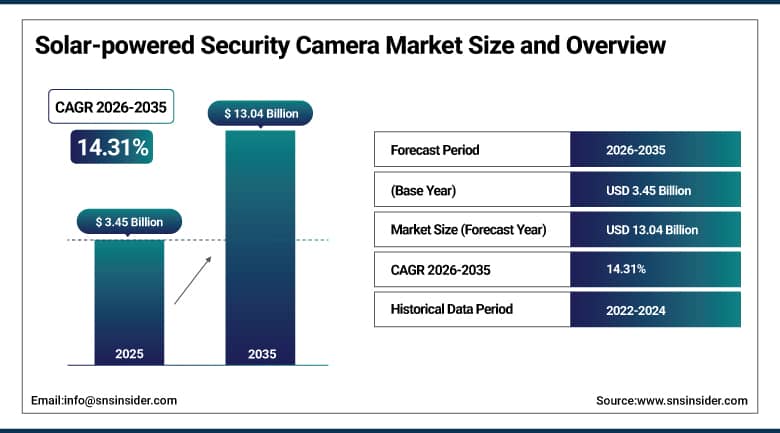
The Solar-powered Security Camera Market was valued at USD 3.45 Billion in 2025 and is projected to reach USD 13.04 Billion by 2035, expanding at a CAGR of 14.31% during the forecast period 2026–2035.
Solar energy-driven security camera industry is witnessing steady expansion due to rising adoption of surveillance technology without electricity grid connection, increasing usage of alternative energy sources, and rising investments in smart security network infrastructure in residential, commercial, industrial, and agriculture domains. Companies and individuals are adopting such type of security surveillance system as an effective way to monitor remote locations, construction areas, storage facilities, farms, transport infrastructure, and important public assets which cannot be accessed using traditional electric power supply. The integration of artificial intelligence, cloud connectivity, battery energy storage, motion detection, wireless communication and remote monitoring platform greatly increases efficiency of surveillance process while decreasing operating expenses and ecological footprint.
Between 2025-2026 years, there was a number of leading surveillance technology producers who presented new generation of solar energy-driven security cameras featuring AI-integrated intelligent motion detection, cloud video management systems, large lithium batteries capacity and wireless communication.
To Get More Information On Solar-powered Security Camera Market - Request Free Sample Report
Solar-powered Security Camera Market Trends
-
Increasing deployment of solar-powered surveillance systems for remote infrastructure, construction sites, agricultural facilities, and smart city projects.
-
Growing integration of artificial intelligence for intelligent motion detection, facial recognition, object classification, and real-time threat identification.
-
Rising adoption of cloud-connected video surveillance platforms enabling remote monitoring, centralized storage, and predictive security analytics.
-
Expanding utilization of wireless connectivity technologies including Wi-Fi, 4G/LTE, 5G, and IoT communication for uninterrupted surveillance operations.
-
Increasing investments in sustainable security infrastructure driven by renewable energy initiatives, energy efficiency goals, and smart infrastructure development.
The U.S. Solar-powered Security Camera Market Size Outlook
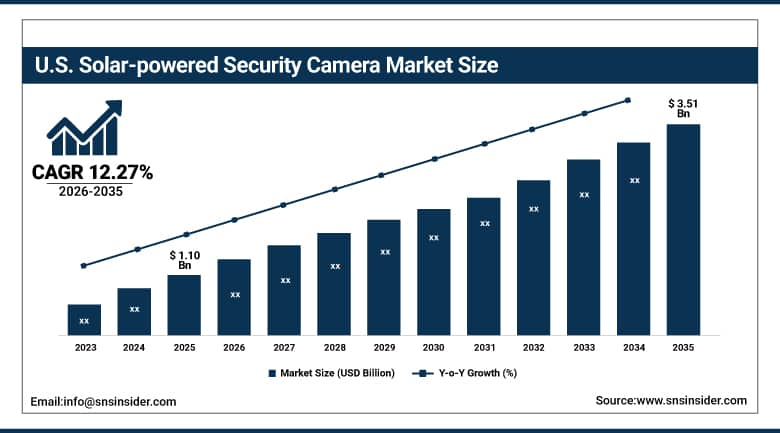
The U.S. Solar-powered Security Camera Market was valued at USD 1.10 billion in 2025 and is expected to reach approximately USD 3.51 billion by 2035, expanding at a CAGR of 12.27% during 2026–2035.
The US is likely to remain as the front-runner in the global solar powered security camera market due to high adoption rates of smart homes, rising investments in commercial surveillance, adoption of renewable energy solutions, and installation of intelligent security systems in households, industries, utility sites, transportation networks, and critical infrastructure. Business firms and consumers are adopting solar powered security cameras in order to lower down their installation cost and offer more flexible operation as well as surveillance in off-grid areas and areas that are tough to wire up. The growing adoption of AI based analysis, cloud-based video management, wireless technology, and battery-based surveillance systems is further boosting the market growth.
In 2026, several security technology firms based in the US have diversified their product range through launching artificial intelligence based solar powered security cameras having high resolution imaging capability, cloud video storage, intelligent event detection, 5G connectivity, and better battery management system.
Solar-powered Security Camera Market Segment Analysis
-
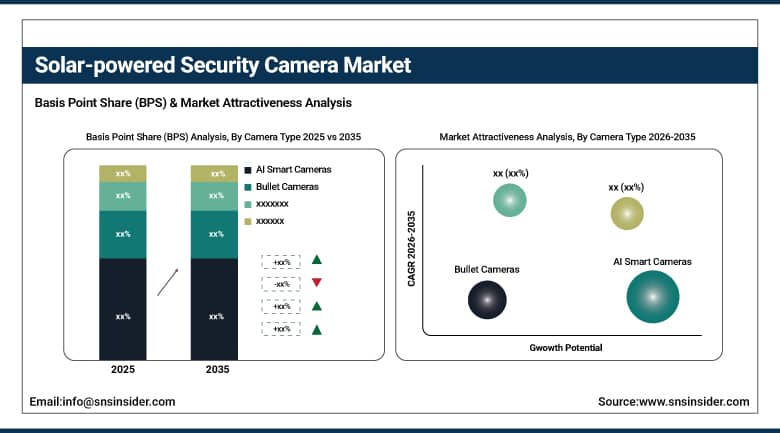
By Camera Type, AI smart cameras dominated the market with 33.00% share in 2025, and are projected to witness the fastest growth with 16.19% CAGR during the forecast period.
-
By Connectivity, Wi-Fi dominated the market with 42.00% share in 2025, while 5G is projected to witness the fastest growth with 25.28% CAGR during the forecast period.
-
By Storage, cloud storage dominated the market with 46.00% share in 2025, and is projected to witness the fastest growth with 17.58% CAGR during the forecast period.
-
By End User, residential dominated the market with 31.00% share in 2025, while agriculture is projected to witness the fastest growth with 15.96% CAGR during the forecast period.
By Camera Type, AI smart cameras dominated and are also the fastest-growing segment.
The AI Smart Cameras segment accounted for the largest market share of 33.00% in 2025, and is expected to experience the highest CAGR of 16.19% during the forecast period. The fast penetration of artificial intelligence into the surveillance system has enhanced the threat detection capability, facial recognition, human and vehicle classification, behavior analysis, and live event monitoring. AI powered solar security cameras reduce false alarms by making the difference between humans, animals, and environmental motion, along with providing intelligent alerts from the applications via cloud connections.
From 2025–2026, various companies operating in the surveillance technology have launched next generation AI enabled solar cameras with features such as object recognition, intelligent intrusion detection, adaptive night vision, and automated security analytics for smart security application. The segment is expected to continue with the highest growth rate due to rising investments in smart city, AI driven video surveillance and intelligent perimeter security. Various organizations are replacing their conventional surveillance systems with AI powered systems which can predict, monitor incidents, report events in real time and help in decision making.
By Connectivity, Wi-Fi dominated the market, while 5G is projected to witness the fastest growth.
Wi-Fi generated the highest market share of 42.00% in 2025, owing to its ubiquity, cost-effectiveness, easy installation process, and easy integrality with smart home eco-systems and business surveillance systems. Wi-Fi enabled solar surveillance cameras enable the secure wireless connectivity, remote access and cloud integration and mobile notifications without necessitating any extensive cabling networks. Homeowners, retail stores, colleges and offices are preferring Wi-Fi integrated surveillance systems as they are easy to deploy and can be integrated easily with broadband networks. During 2025-2026, various vendors introduced the advanced Wi-Fi enabled solar surveillance cameras, which are equipped with AI analytics, ultra-HD video streaming and remote monitoring capabilities.
5G generated the highest CAGR of 25.28% in 2025–2030 owing to the rapid global deployment of new generation of mobile communication technologies. 5G connectivity offers low latency, higher bandwidth, faster video transmission and real time processing of high resolution surveillance data and thus it can be used effectively in large scale industrial plants, transport infrastructure, smart cities and remote monitoring. The combination of 5G with AI driven surveillance and IoT eco-system increases the performance efficiency of security systems. During 2026, multiple security technology companies expanded their 5G-enabled solar surveillance portfolios supporting intelligent analytics, cloud connectivity, and uninterrupted remote security monitoring.
By Storage, Cloud Storage dominated and is also the fastest-growing segment.
Cloud Storage dominated the market with the highest market share of 46.00% in 2025 and would be exhibiting the highest CAGR of 17.58% during the forecast period. Growing demands for centralized video management, safe data backup, remote access, and scalable surveillance system have led to an increasing trend for cloud storage in both residential, commercial, and industrial security applications. Users can access live and recorded videos on the go using cloud-based platforms, with the capability to perform AI-driven analytics, automated software update, cyber security measures, and disaster recovery. Organizations have shown more interest in moving towards the use of cloud storage surveillance systems to improve their operations and ease the management of their infrastructures.
In 2025-2026, many cloud security solution providers have upgraded their video surveillance systems with features including AI-powered search, cloud encryption, automated event classification, and intelligent evidence management. Cloud Storage is expected to hold the position of the fastest-growing storage option, as organizations are adopting the use of subscription-based surveillance systems and hybrid clouds in great numbers. Continuous improvements in cyber security, scalable cloud infrastructure, and intelligent video analytics will increase market adoption even further.
Regional Analysis
|
Region |
Major Country |
Share within Region, 2025 (%) |
|---|---|---|
|
North America |
United States |
94.00% |
|
Europe |
Germany |
24.00% |
|
Asia Pacific |
China |
31.00% |
|
Middle East & Africa |
UAE |
6.00% |
|
Latin America |
Brazil |
5.00% |
North America Solar-powered Security Camera Market Insights
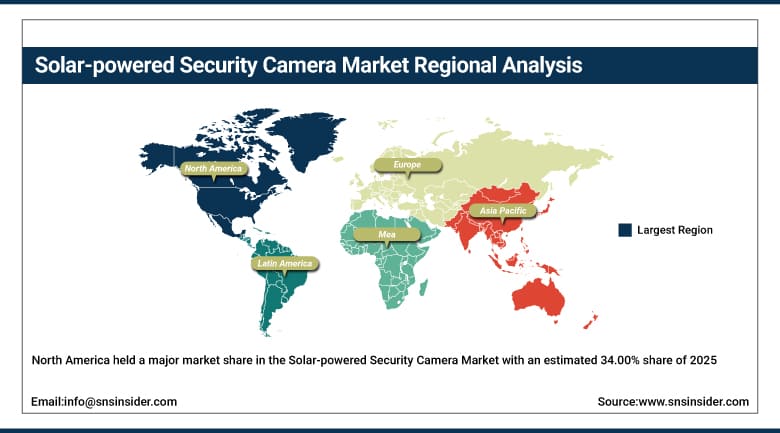
North America held a major market share in the Solar-powered Security Camera Market with an estimated 34.00% share of total global revenues in 2025 and was the biggest regional market. Market dominance will be fueled by wide acceptance of smart home devices, deployment of AI-enabled surveillance systems at a fast pace, rising investments in the development of renewable energy infrastructure, and the need for off-grid security systems in residential, commercial, industrial, and public infrastructural domains. Installation of solar-powered security cameras is becoming common among organizations and homeowners for reducing wiring costs, achieving flexibility in installation, and enhancing remote surveillance features.
In the period between 2025–2026, some of the security technology companies of North America augmented their range of AI-powered solar surveillance systems by introducing cloud-connected cameras with video analytics and threat detection features.
Get Customized Report as Per Your Business Requirement - Enquiry Now
Europe Solar-powered Security Camera Market Insights
Europe keeps showing its ability to grow in terms of the market through increased investment in renewable energy usage, smart cities projects, digital security systems, and environmentally friendly surveillance technology in countries such as Germany, the UK, France, Italy, Spain, among other European nations. The increase in the implementation of solar-powered security cameras in transportation infrastructure, public places, industrial sites, and critical infrastructure for the purpose of securing these areas as well as meeting carbon emissions targets is seen by governments and commercial firms. The demand for wireless monitoring systems, intelligent video analytics, and cloud-based surveillance systems continues to support the growth of the market. Modernization of urban infrastructure and smart public safety schemes also contribute to creating favorable growth prospects for manufacturers.
In the year 2026, various European surveillance solution providers launched security cameras that were solar-powered and had artificial intelligence.
Asia Pacific Solar-powered Security Camera Market Insights
The Asia Pacific region is expected to witness the highest CAGR of 16.97%, owing to fast-paced urbanization, growth in the development of smart cities, increased development of renewable energy infrastructures, and increased investments in digital surveillance technology in China, India, Japan, South Korea, Australia, and countries in Southeast Asia. Residential construction, industrial development, and the development of transportation infrastructure are creating more demands for wireless solar power-driven surveillance systems. Renewable energy initiatives by the government and advancements in surveillance technology for ensuring public safety are boosting the market growth in the region. Increased usage of artificial intelligence-driven surveillance systems, cloud-based video management system, and fast-speed wireless communications are adding up to the potential of the market.
Between 2025 and 2026, several companies from the Asia Pacific region have launched the next-generation security cameras powered by solar power and incorporating artificial intelligence, cloud connectivity, battery storage, and 5G wireless communication technologies for remote surveillance.
Middle East & Africa and Latin America Solar-powered Security Camera Market Insights
Middle East & Africa region has witnessed constant growth owing to the rise in investment in advanced infrastructures, renewable energy projects, border security, oil and gas, transportation, and urban surveillance in the UAE, Saudi Arabia, South Africa, and other neighboring regions. The adoption of solar-based surveillance system is gaining momentum because it is used in remote areas where regular electric infrastructure is not available as a reliable and cost-efficient solution. Public safety initiatives, and critical infrastructure security programs in the governments keep supporting the market demand.
The region of Latin America has been growing at a consistent pace on account of the increase in the use of renewable energy technology, public safety initiatives, and expansion in commercial infrastructure, and growing demands for affordable wireless surveillance in Brazil, Mexico, Argentina, and Chile. Solar-based security camera solutions are gaining traction in residential, farming, and commercial establishments to monitor the periphery and reduce electricity consumption and installation costs. During 2025 to 2026, many organizations in Latin America and Middle East have adopted AI-enabled solar surveillance systems along with cloud-based video management and intelligent motion detection.
Market Dynamics
Growth Drivers: Growing deployment of off-the-grid surveillance systems and use of renewable energy-based security solutions.
One of the key factors driving the growth of Solar-Powered Security Camera market is the increasing need for reliable surveillance in off-the-grid settings. Individual consumers, businesses, industries, agricultural firms, and governmental agencies are now utilizing solar powered security cameras in order to ensure that their systems are independent of any traditional electrical system but still capable of providing uninterrupted surveillance. This type of technology eliminates the cost of installing elaborate electrical wires and ensures 24/7 operations through the use of integrated solar panels along with battery storage systems.
The usage of artificial intelligence, video management using cloud servers, wireless communication, and intelligent motion detection allows further improving the process of surveillance through proactive threat detection and remote monitoring. Investments in smart cities, renewable energy solutions, protection of critical infrastructure, and intelligent transportation systems also drive the market forward. Over 2025-2026, there were a number of leading players from the surveillance industry launching solar-powered security cameras using AI and edge analytics, cloud connection, advanced photovoltaic technology and battery management.
Restraints: Performance constraints due to low sun radiation and high initial installation cost.
Even though the market is growing at a rapid pace, solar-powered security cameras still encounter problems related to weather fluctuations, lack of sunshine seasonally, and relatively high initial cost of installation in comparison with regular wired security systems. Constant operation of the camera depends on the availability of energy provided by the solar panel and stored by batteries, which can be negatively impacted by persistent bad weather, snow, or shadowed installation sites.
Companies implementing wide-area surveillance solutions need to spend money on high-capacity batteries, sophisticated solar panels, wireless communication system, and smart power management system, thus increasing the total cost of the project. Moreover, maintaining constant video quality, reliable connection, and battery performance within harsh outdoor conditions requires regular maintenance and optimization of the system. In 2026, manufacturers paid much attention to improving photovoltaic technology, power management algorithms, energy storage capacity, and hybrid energy sources.
Opportunities: Growth of AI-based smart surveillance and cloud-enabled security ecosystem.
The fast development of artificial intelligence, cloud computing, Internet of Things (IoT), and next-generation wireless communication technologies brings considerable growth opportunities for the solar power security camera market. The AI-based security systems offer object recognition, face identification, behavior analysis, perimeter security, anomaly detection, and proactive threat assessment functionalities without increasing the number of false alerts and enhancing system productivity. Cloud-based platforms allow centralized device management, real-time video streaming, automatic software updating, and secure cloud data storage for widely distributed surveillance systems.
The growing usage of smart cities, intelligent transportation systems, green energy plants, and precision farming adds to the growth opportunities of the market. Integration with 5G, edge computing, and cyber security solutions can drive the adoption of the technology in both enterprise and public sector applications. In 2025–2026, several major surveillance companies launched their AI-based surveillance systems that integrate solar-power cameras, edge AI, real-time analytics, and remote fleet management.
Recent Developments
-
2026: Reolink expanded its solar-powered security camera portfolio with AI-enabled models featuring intelligent person and vehicle detection, enhanced battery efficiency, and improved cloud connectivity for residential and commercial surveillance applications.
-
2026: Arlo Technologies, Inc. introduced upgraded solar charging accessories and AI-powered wireless security cameras supporting advanced motion analytics, cloud video management, and extended off-grid operation.
-
2025: EZVIZ launched next-generation solar-powered smart cameras integrating high-resolution imaging, intelligent night vision, cloud storage compatibility, and enhanced energy-efficient solar charging technology.
-
2025: eufy Security expanded its renewable energy surveillance solutions by introducing solar-powered cameras with edge AI processing, local and cloud storage options, and intelligent threat detection designed for smart home and small business security applications.
Solar-powered Security Camera Market Key Players are:
-
Hikvision Digital Technology Co., Ltd.
-
Hangzhou EZVIZ Network Co., Ltd.
-
Arlo Technologies, Inc.
-
Reolink Innovation Limited
-
eufy Security (Anker Innovations)
-
Ring LLC (Amazon.com, Inc.)
-
Lorex Technology Inc.
-
Axis Communications AB
-
Bosch Security Systems
-
Dahua Technology Co., Ltd.
-
TP-Link Technologies Co., Ltd.
-
Shenzhen VSTARCAM Technology Co., Ltd.
-
ZOSI Technology Co., Ltd.
-
Defender Cameras Inc.
-
Ubiquiti Inc.
-
Swann Communications Pty Ltd.
-
Blink (Amazon.com, Inc.)
-
SOLIOM
-
SEHMUA
-
Ctronics Technology Co., Ltd.
Solar-powered Security Camera Market:
| Report Attributes | Details |
|---|---|
| Market Size in 2025 | USD 3.45 Billion |
| Market Size by 2035 | USD 13.14 Billion |
| CAGR | CAGR of 14.31% From 2026 to 2035 |
| Base Year | 2025 |
| Forecast Period | 2026-2035 |
| Historical Data | 2022-2024 |
| Report Scope & Coverage | Market Size, Segments Analysis, Competitive Landscape, Regional Analysis, DROC & SWOT Analysis, Forecast Outlook |
| Key Segments | • By Camera Type (Bullet Cameras, Dome Cameras, PTZ Cameras, AI Smart Cameras) • By Connectivity (Wi-Fi, 4G/LTE, 5G, LoRaWAN & Others) • By Storage (Local Storage, Cloud Storage, Hybrid Storage) • By End User (Residential, Commercial, Industrial, Agriculture, Others) |
| Regional Analysis/Coverage | North America (US, Canada), Europe (Germany, UK, France, Italy, Spain, Russia, Poland, Rest of Europe), Asia Pacific (China, India, Japan, South Korea, Australia, ASEAN Countries, Rest of Asia Pacific), Middle East & Africa (UAE, Saudi Arabia, Qatar, South Africa, Rest of Middle East & Africa), Latin America (Brazil, Argentina, Mexico, Colombia, Rest of Latin America). |
| Company Profiles | Hikvision Digital Technology Co., Ltd., Hangzhou EZVIZ Network Co., Ltd., Arlo Technologies, Inc., Reolink Innovation Limited, eufy Security (Anker Innovations), Ring LLC (Amazon.com, Inc.), Lorex Technology Inc., Axis Communications AB, Bosch Security Systems, Dahua Technology Co., Ltd., TP-Link Technologies Co., Ltd., Shenzhen VSTARCAM Technology Co., Ltd., ZOSI Technology Co., Ltd., Defender Cameras Inc., Ubiquiti Inc., Swann Communications Pty Ltd., Blink (Amazon.com, Inc.), SOLIOM, SEHMUA, Ctronics Technology Co., Ltd. |
Frequently Asked Questions
The market is expected to expand at a CAGR of 14.31% during the forecast period.
The market is projected to reach USD 13.14 Billion by 2035.
The Solar-powered Security Camera Market was valued at USD 3.45 Billion in 2025.
Asia Pacific is projected to register the fastest CAGR of 16.97% during 2026–2035.
