
Space Battery Market Report Scope & Overview:
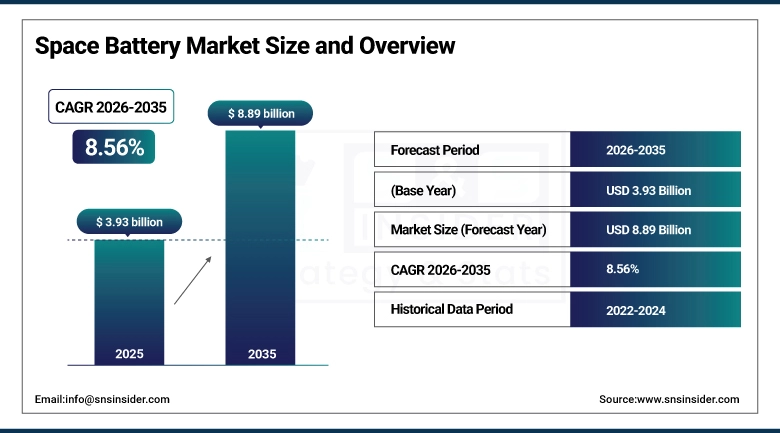
The Space Battery Market size was valued at USD 3.93 Billion in 2025 and is projected to reach USD 8.89 Billion by 2035, growing at a CAGR of 8.56% during 2026-2035.
The Space Battery Market is in growth stage due to the increase in the number of satellite launches, the expansion of commercial space missions, the rise in the demand for reliable energy storage in harsh space conditions, the development in Lithium-Ion and Solid-State Batteries, and the high investments by the government and private sectors in the exploration of deep space, the development of defense technologies, and the establishment of global communication infrastructure.
To Get more information on Space Battery Market - Request Free Sample Report
Key Space Battery Market Trends
-
Rapid shift toward lithium-ion and next-generation solid-state batteries for higher energy density and longer mission life
-
Increasing commercial satellite constellations (LEO mega-constellations) driving high-volume battery demand
-
Growing focus on lightweight, compact, and radiation-resistant battery designs for deep space missions
-
Rising private sector participation and space commercialization, boosting innovation and investment in advanced battery technologies
U.S. Space Battery Market Size Outlook:
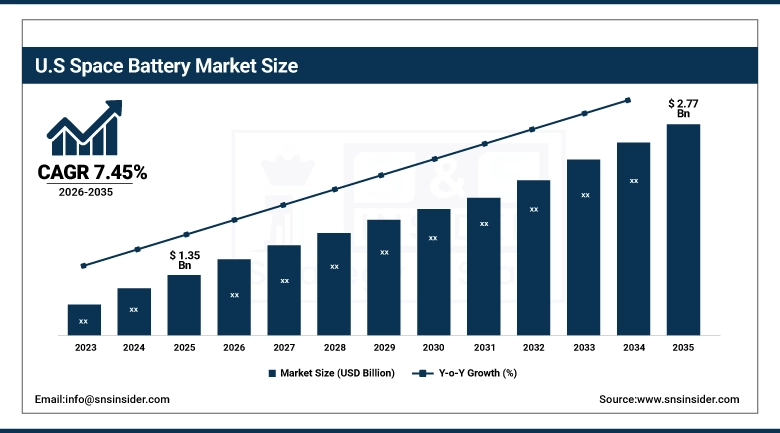
The U.S. Space Battery Market size was valued at USD 1.35 Billion in 2025 and is projected to reach USD 2.77 Billion by 2035, growing at a CAGR of 7.45% during 2026-2035. The U.S. Space Battery Market is fueled by an increase in satellite launches, an expansion in defense space programs, and an increase in private sector involvement. Technological advancements in lithium-ion batteries and the need for dependable and lightweight battery systems are propelling the U.S. Space Battery Market.
Space Battery Market Growth Drivers:
-
Expanding Satellite Constellations and Advanced Energy Storage Technologies Accelerate Space Battery Market Growth Globally
The Space Battery Market has been observing a high growth rate because of the rapid deployment rate of satellites, especially in low Earth orbit (LEO) for communication, navigation, and Earth observation. Government-led space exploration initiatives and military modernization plans are also contributing to the growth. Continuous improvements in lithium-ion and emerging technologies in solid-state batteries are enhancing the energy density, lifetime, and safety of the batteries. Furthermore, the requirement for reliable, lightweight, and compact power sources for long-duration missions and autonomous missions is also driving the growth. Increased cooperation between government and private sectors in the space industry is also positively affecting the growth.
Space Battery Market Restraints:
-
High Development Costs and Extreme Space Environment Challenges Limit Market Expansion Potential Globally
Despite the promising growth prospects, there are significant challenges in the Space Battery Market. The development, testing, and certification of space battery technology are extremely costly and time-consuming processes. This poses a significant challenge for new entrants in the market. Space battery technology has to perform under harsh environmental conditions such as high temperatures, radiation, and vacuum. There are limited opportunities for maintenance or replacement in space. This poses significant complexity to battery technology. Stringent regulatory standards and safety considerations are significant challenges for space battery technology. These factors are creating challenges for innovation, posing risks to operations, and slowing down technology advancements in the market.
Space Battery Market Opportunities:
-
Rising Private Space Investments and Deep Space Missions Create New Growth Opportunities Worldwide
The rise in participation by space companies and the commercialization of space activities are providing tremendous opportunities for the Space Battery Market. New opportunities are opening up for space tourism, bases on the moon, and exploration of Mars, which demand highly advanced, robust, and efficient battery technology. Increasing investments are being made in new battery technology, which is expected to revolutionize battery technology in the coming years. Miniaturization of satellites and electronics is providing opportunities for battery technology as well. Increasing international collaborations and space activities by developing countries are adding to the opportunities for the Space Battery Market.
Space Battery Market Segment Analysis
-
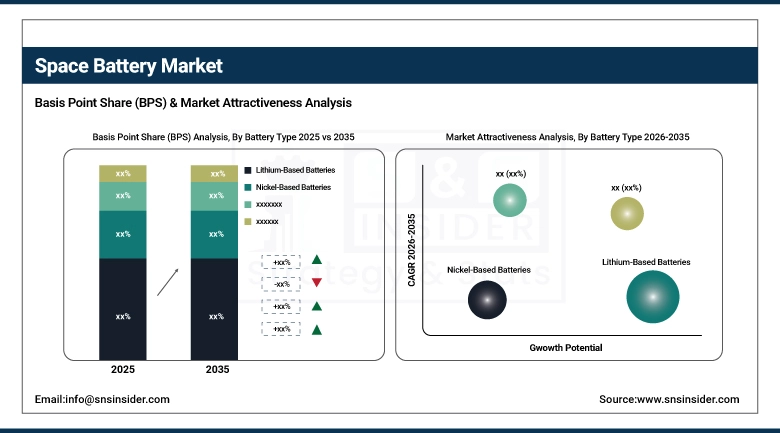
By Battery Type, Lithium-Based Batteries dominated with 54.38% in 2025, and Solid-State & Other Advanced Batteries are expected to grow at the fastest CAGR of 10.99% from 2026 to 2035.
-
By Platform / Application, Satellites dominated with 61.84% in 2025, and Spacecraft & Space Stations are expected to grow at the fastest CAGR of 9.94% from 2026 to 2035.
-
By Battery Function, Secondary (Rechargeable) Batteries dominated with 68.92% in 2025, and Secondary Batteries are also expected to grow at the fastest CAGR of 9.16% from 2026 to 2035.
-
By End-User, Government Space Agencies dominated with 49.73% in 2025, and Commercial Space Companies are expected to grow at the fastest CAGR of 11.12% from 2026 to 2035.
By Battery Type, Lithium-Based Batteries Lead Space Battery Market While Solid-State and Advanced Chemistries Set for Fastest Growth 2026 to 2035
Lithium-ion batteries are currently at the top of the market due to their high energy density, light weight, and proven track record for reliability in a variety of space missions. These types of batteries are commonly used in satellites and spacecraft where efficiency and performance are vital. However, solid-state and other types of battery technology are now picking up momentum due to their improved safety features, longer life span, and resistance to harsh temperature and radiation conditions. More innovations in these types of battery technology are expected to increase their performance capabilities.
By Platform and Application, Satellites Lead While Spacecraft and Space Stations Show Fastest Growth in Space Battery Market 2026 to 2035
Satellites form the biggest segment in the market, as they require continuous and efficient power supply for communication, navigation, Earth observation, and defense applications. Additionally, the growth in the number of satellite launches across the globe has boosted the demand for efficient and reliable battery systems. On the other hand, spacecraft and space stations exhibit a high growth rate owing to the growth in deep space exploration and long-duration human spaceflight missions. Increased investments in the exploration of the moon, Mars, and other orbital infrastructure development also contribute to the growth in the demand for efficient energy storage devices.
By Battery Function, Secondary Rechargeable Batteries Dominate and Maintain Fastest Growth in Space Battery Market While Primary Batteries Decline in Share Through 2035
The largest share of this segment is taken up by secondary batteries, which can be recharged. These batteries are useful for long-duration missions, as they can be charged for continuous power supply. Satellites and space vehicles make use of such batteries, as charge-discharge cycles are required for efficient operation. The batteries are efficient for a longer period, making them the most widely used for most modern space vehicles. The developments in secondary batteries, which can work under extreme conditions, are also contributing to the growth of this segment.
By End-User, Government Space Agencies Lead Space Battery Market While Commercial Space Companies Show Fastest Growth 2026 to 2035
Government agencies have a major share in the market due to their robust financial support, existing infrastructure, and consistent efforts in executing various missions related to space exploration, defense, and research. However, the commercial sector is growing with high potential due to the increased rate of investment by various organizations and the expansion of satellites. In addition, the commercialization of space activities, including space tourism, is boosting the demand for novel and high-performance batteries.
North America Space Battery Market Insights
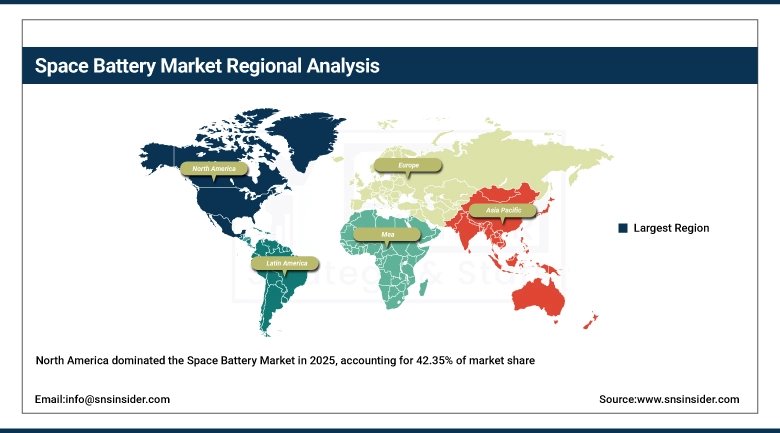
North America held a 42.35% share at USD 1.66 Billion in 2025, growing at a CAGR of 7.89% through 2035. North America holds the largest share in the Space Battery Market with high government investments, advanced space infrastructure, and the presence of key aerospace and defense companies. The region is witnessing the launch of satellites into space, military space programs, and deep space exploration activities. The investments by private space companies in the market are growing, which is fueling the demand for the market. The technological advancements in lithium-ion battery technology are providing improved capabilities in terms of reliability. The cooperation between government organizations and private companies is driving the market in the region.
Get Customized Report as per Your Business Requirement - Enquiry Now
U.S. Space Battery Market Insights
The United States leads the North American region in the space battery market. The reasons for this leadership position include the presence of robust NASA programs, high levels of defense spending, and the presence of top-notch private space companies. The frequent launches of satellites and the development of new technologies in the region contribute to the growth of the space battery market.
Europe Space Battery Market Insights
Europe held 27.64% of the global market at USD 1.08 Billion in 2025, CAGR 7.94% through 2035. ESA's program portfolio the Copernicus Earth observation constellation, Galileo navigation system, Juice Jupiter mission, and Hera asteroid mission provides a sustained government procurement base for space batteries, with Saft's French manufacturing operations the primary qualified supplier for the majority of ESA prime contractor programs. Europe's commercial satellite sector, led by Airbus Defence & Space, Thales Alenia Space, and OHB, generates additional demand on a per-program basis for both GEO telecom satellites and LEO Earth observation platforms. Germany's VARTA AG, while primarily a consumer and industrial battery producer, has maintained a space-grade specialty capability that serves niche scientific satellite programs.
Germany Space Battery Market Insights
Germany was the leading country in the European Space Battery Market in 2025. This is because it had a robust aerospace industry and was actively involved in various space missions. It was supported by the government and had developed various innovations in battery technology.
Asia Pacific Space Battery Market Insights
Asia Pacific is the fastest-growing region at a CAGR of 10.48% through 2035, valued at USD 0.87 Billion in 2025. Japan, China, India, and South Korea are running national space programs that are expanding in scope and budget simultaneously, which is unusual typically budget cycles mean one or two countries are active while others are in trough years. JAXA's Lunar Exploration Program, the HTV-X cargo vehicle for ISS resupply, and Japan's commercial space sector including ispace's second lunar lander attempt after the 2023 crash landing all represent battery procurement on Japanese domestic supply chains anchored by GS Yuasa and Panasonic. China's space battery demand is arguably the least visible externally but almost certainly the largest in the region: CNSA's Tiangong station, the Tianwen Mars program, the Chang'e lunar series, and a classified military satellite program that SpaceTrack data shows launching dozens of new spacecraft annually all represent sustained demand serviced by domestic producers including CALT and state-owned battery manufacturers. India's ISRO, following the Chandrayaan-3 successful lunar south pole landing in August 2023, is building on that success with a Venus orbiter, a follow-on Mars mission, and an expanded launch vehicle program that creates fresh battery procurement across multiple platforms.
Japan Space Battery Market Insights
The Asia Pacific Space Battery Market was dominated by Japan in 2025, owing to its high capabilities in space technology, satellite manufacturing, and innovation in battery technology. Government initiatives and participation in international space missions also contributed to the dominance in the Asia Pacific region.
Latin America (LATAM) and Middle East & Africa (MEA) Space Battery Market Insights
Latin America held a 4.12% share at USD 0.16 Billion in 2025, growing at 8.37% CAGR through 2035. Brazil's AEB space agency and the Brazilian satellite program anchored by the SGDC-2 telecommunications satellite and ongoing participation in the international cubesat community represent the primary demand sources. Mexico, Argentina, and Colombia are developing national satellite capabilities with government support, creating early-stage but growing battery procurement activity. The Middle East & Africa held a 3.71% share at USD 0.15 Billion, CAGR 8.08%, where the UAE's Mohammed Bin Rashid Space Centre has established the region's most ambitious space program. The Hope Mars orbiter, still operational as of early 2025, and the EOS-SAT Earth observation constellation program demonstrate that UAE space ambitions have moved from aspiration to operational reality. Saudi Arabia's space commission, which launched its first astronauts aboard Axiom Mission 2 in 2023 and has announced LEO and lunar program ambitions, adds a second regional center of growing space battery procurement.
Competitive Landscape for Space Battery Market:
EaglePicher Technologies, with its headquarters in Joplin, Missouri, is the oldest and most entrenched supplier of space batteries in the U.S. With flight heritage going back to Explorer 1 in 1958 and continuing through the recent launches of Perseverance, Webb, and Artemis missions, the company offers lithium-ion, silver-zinc, nickel-hydrogen, and thermal batteries for satellite, spacecraft, launch vehicle, and missile missions.
-
In 2024, EaglePicher received contract awards for battery systems on multiple NASA CLPS lunar lander missions including Firefly Aerospace's Blue Ghost lander, which successfully touched down on the lunar surface in March 2025 and became only the second private spacecraft to achieve a successful lunar landing, with EaglePicher battery systems powering the lander through descent, landing, and initial surface operations before lunar sunset ended the mission.
Saft Groupe S.A., a wholly owned subsidiary of TotalEnergies located in Paris, is the primary space battery supplier in Europe and the main qualified source for ESA programs and European satellite prime contractors. The VES (Very High Energy Space) range of lithium-ion cells is qualified on the majority of active European GEO and LEO government satellites, and the facility in Bordeaux is operated under the clean room standards required for space-grade manufacturing.
- In 2025, Saft announced completion of qualification testing for its next-generation MPS (Modular Power System) lithium-ion battery for ESA's PLATO exoplanet hunting telescope, scheduled for launch in 2026, with the battery system designed to maintain charge-discharge performance over a six-year science mission at L2 orbit where thermal conditions differ significantly from the LEO environment most qualification databases reflect.
Space Battery Companies are:
-
Saft Groupe S.A.
-
GS Yuasa Corporation
-
EnerSys
-
Arotech Corporation
-
Mitsubishi Electric Corporation
-
Toshiba Corporation
-
BYD Company Limited
-
Panasonic Corporation
-
Ultralife Corporation
-
VARTA AG
-
ABSL Space Products
-
Sion Power Corporation
-
Plug Power Inc.
-
Lockheed Martin Corporation
-
Northrop Grumman Corporation
-
Raytheon Technologies Corporation
-
Tadiran Batteries Ltd.
-
Maxell Holdings Ltd.
| Report Attributes | Details |
|---|---|
| Market Size in 2025 | USD 3.93 Billion |
| Market Size by 2035 | USD 8.89 Billion |
| CAGR | CAGR of 8.56% From 2026 to 2035 |
| Base Year | 2025 |
| Forecast Period | 2026-2035 |
| Historical Data | 2022-2024 |
| Report Scope & Coverage | Market Size, Segments Analysis, Competitive Landscape, Regional Analysis, DROC & SWOT Analysis, Forecast Outlook |
| Key Segments | • By Battery Type (Lithium-Based Batteries, Nickel-Based Batteries, Silver-Zinc Batteries, and Solid-State & Other Advanced Batteries) • By Platform / Application (Satellites, Spacecraft & Space Stations, Launch Vehicles, and Space Probes & Rovers) • By Battery Function (Primary (Non-Rechargeable) Batteries, Secondary (Rechargeable) Batteries, and Reserve Batteries) • By End-User (Government Space Agencies, Commercial Space Companies, Defense & Military, and Research & Academic Institutions) |
| Regional Analysis/Coverage | North America (US, Canada), Europe (Germany, UK, France, Italy, Spain, Russia, Poland, Rest of Europe), Asia Pacific (China, India, Japan, South Korea, Australia, ASEAN Countries, Rest of Asia Pacific), Middle East & Africa (UAE, Saudi Arabia, Qatar, South Africa, Rest of Middle East & Africa), Latin America (Brazil, Argentina, Mexico, Colombia, Rest of Latin America). |
| Company Profiles | EaglePicher Technologies, Saft Groupe S.A., GS Yuasa Corporation, EnerSys, Arotech Corporation, Mitsubishi Electric Corporation, Toshiba Corporation, Exide Technologies, BYD Company Limited, Panasonic Corporation, Ultralife Corporation, VARTA AG, ABSL Space Products, Sion Power Corporation, Plug Power Inc., Lockheed Martin Corporation, Northrop Grumman Corporation, Raytheon Technologies Corporation, Tadiran Batteries Ltd., Maxell Holdings Ltd. |

Frequently Asked Questions
North America dominated the Space Battery Market in 2025 with a 42.35% share.
Lithium-Based Batteries dominated the Space Battery Market with a 54.38% share in 2025, while Solid-State & Other Advanced Batteries are growing fastest at a CAGR of 10.99% from 2026 to 2035.
Rising satellite launches, expanding space exploration missions, growing commercial space activities, and advancements in high-performance battery technologies are the key drivers of the Space Battery Market.
The Space Battery Market size was USD 3.93 Billion in 2025 and is expected to reach USD 8.89 Billion by 2035.
The Space Battery Market is expected to grow at a CAGR of 8.56% from 2026-2035.
