
Synthetic Glycerol Market Report Scope & Overview:
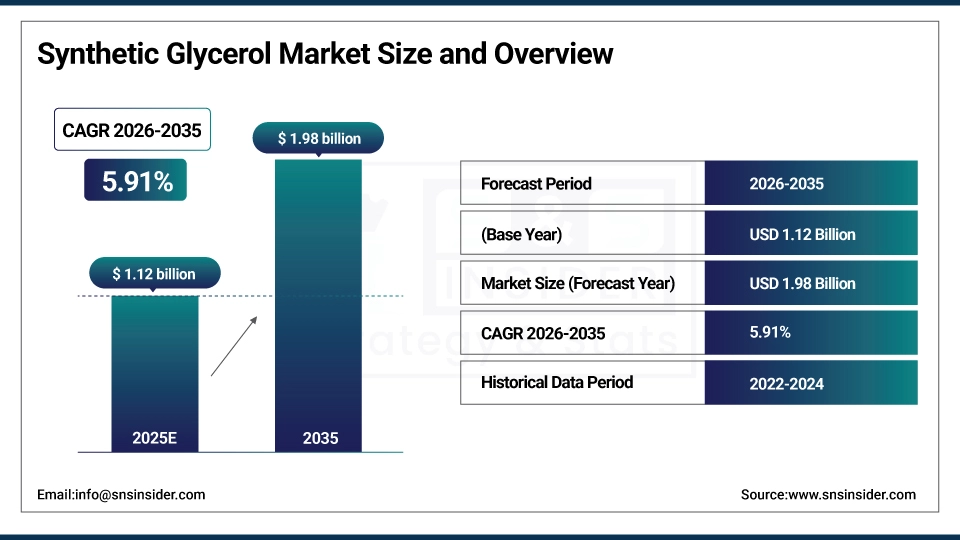
The Synthetic Glycerol Market size is valued at USD 1.12 Billion in 2025 and is projected to reach USD 1.98 Billion by 2035, growing at a CAGR of 5.91% during the forecast period 2026–2035.
The Synthetic Glycerol Market analysis report assesses production trends, quality improvements, and application efficiency in various industries. Growing emphasis on sustainable, high-purity, and multifunctional glycerol, along with innovation in manufacturing processes and regulatory compliance, is expected to drive steady growth through 2026–2035.
The Synthetic Glycerol Market served millions in 2025, driven by rising demand for high-purity, sustainable, and multifunctional glycerol.
To Get more information on Synthetic Glycerol Market - Request Free Sample Report
Synthetic Glycerol Market Trends:
-
Rising emphasis on sustainable and biodegradable ingredients is driving demand for high-purity synthetic glycerol in green formulations.
-
Increasing use in pharmaceuticals, cosmetics, and food products is promoting consistent production and quality optimization.
-
Growing preference for multifunctional and non-toxic chemical alternatives is encouraging innovation in glycerol manufacturing processes.
-
Expansion of eco-conscious consumer markets is boosting adoption of glycerol-based solutions in personal care and industrial applications.
-
Advances in process efficiency and purification technologies are enhancing product consistency, shelf-life, and application versatility.
-
Wider availability through chemical and specialty distributors is accelerating adoption in niche and emerging markets.
U.S. Synthetic Glycerol Market Insights:
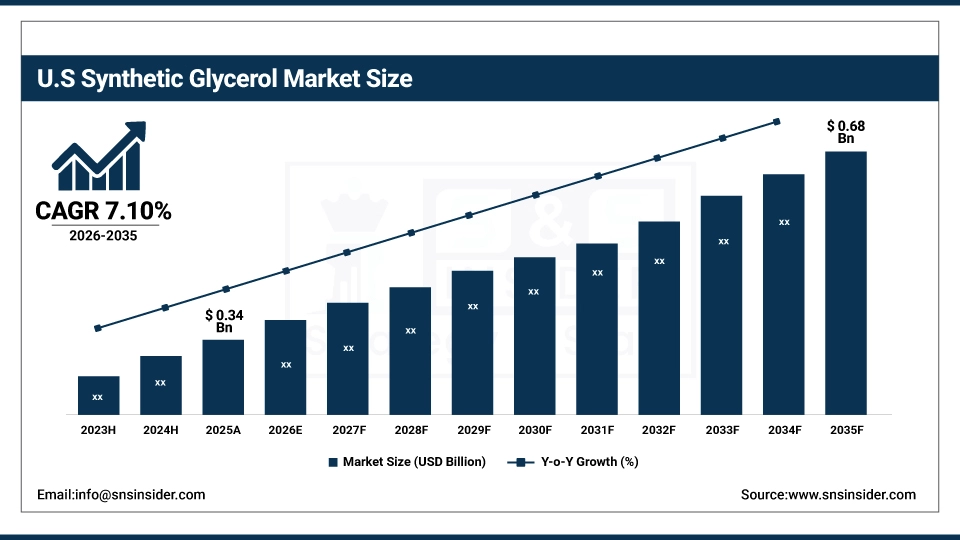
The U.S. Synthetic Glycerol Market is projected to grow from USD 0.34 Billion in 2025 to USD 0.68 Billion by 2035, at a CAGR of 7.10%. Rising demand for high-purity and bio-based glycerol, expanding pharmaceutical and personal care production, growing adoption of sustainable formulations, and strict regulatory compliance drive the US market, supported by advanced manufacturing and increasing eco-friendly ingredient awareness.
Synthetic Glycerol Market Growth Drivers:
-
Growing demand for sustainable, high-purity glycerol is fueling innovation across pharmaceuticals, cosmetics, and industrial applications.
One of the important factors responsible for the growth of the Synthetic Glycerol Market is the growing requirement for sustainable and high purity glycerol. This growing use, combined with the need for consistent, high-quality production throughout pharmaceuticals, cosmetics, and industrial applications, is driving the demand for fermenters. In order to comply with regulations and consumer demands, manufacturers are putting their money in cleaner, greener processes. Higher demand for multifunctional, non-toxic, and biodegradable formulations is promoting innovations in the products whereas increased shares through distributors aid continuous adoption aiding long-range market expansion and development.
Over 70% of manufacturers in 2025 increased synthetic glycerol purchases to meet growing demand for high-purity, sustainable formulations.
Synthetic Glycerol Market Restraints:
-
Fluctuating raw material prices and high production costs limit adoption of premium, high-purity synthetic glycerol.
Synthetic Glycerol Market growth is restrained due to the fluctuating raw material prices and high production costs. As a result, many manufacturers use lower-cost, crude or glycerol by-products, preventing further adoption of premium, high-purity alternatives. Higher operational costs from production-heavy processes reduce the desire to switch. Compliance with regulator and purification requirements add to cost pressures. A few fundamental factors impede the large-scale market adoption of green multi-functional synthetic glycerol owing to highly cost-sensitive industrial buyers who largely treat them as commodity products and have limited institutional incentives to upgrade or change the formulation.
Synthetic Glycerol Market Opportunities:
-
Rising demand for eco-friendly and multifunctional formulations presents opportunities for high-purity, sustainable synthetic glycerol adoption.
Gains in demand for ecological and multi-functional formulations is one of the prominent factor building strong ground for the Synthetic Glycerol Market. Application of high-purity glycerol is growing in the sustainable, safe and versatile industrial sectors including food, cosmetology, and pharmacy. This rising trend can be leveraged by manufacturers in providing purified and non-toxic yet bio-degradable glycerol solutions to maximize the product performance. Innovations coupled with wide array of industrial applications, and growth in consumer inclination towards green and health-centric products to ultimately drive long term adoption of premium synthetic glycerol formulations.
Over 60% of manufacturers in 2025 increased procurement of high-purity synthetic glycerol to meet rising demand for sustainable, multifunctional formulations.
Synthetic Glycerol Market Segmentation Analysis:
-
By Production Process, Epichlorohydrin (ECH) route held the largest market share of 38% in 2025, while Bio-based synthetic routes are expected to grow at the fastest CAGR of 7.75% during 2026–2035.
-
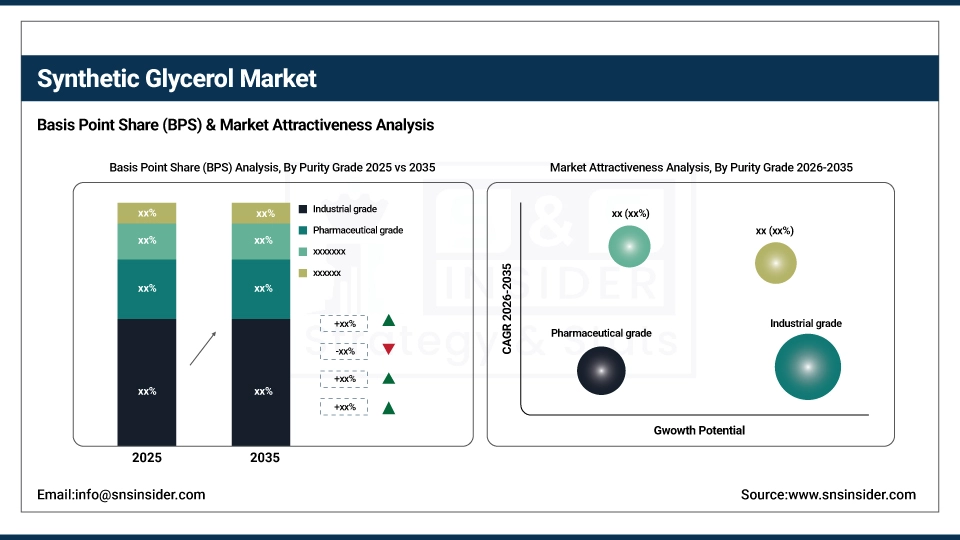
By Purity Grade, Industrial grade dominated with a 43% share in 2025, whereas Pharmaceutical grade is anticipated to expand at the fastest CAGR of 7.99% through the forecast period.
-
By Application, Personal care & cosmetics accounted for the highest market share of 24% in 2025, while Pharmaceuticals & medical formulations are projected to grow at the fastest CAGR of 7.74% during 2026–2035.
-
By End-Use, Chemical & polymer manufacturing held the largest share of 24% in 2025, whereas Pharmaceuticals & healthcare are expected to grow at the fastest CAGR of 7.44% through the forecast period.
-
By Functionality, Humectant & moisture retention captured the leading share of 29% in 2025, while Solvent & carrier agent is projected to expand at the fastest CAGR of 7.60% during 2026–2035.
-
By Distribution Channel, Chemical distributors accounted for the largest share of 49% in 2025, whereas Online / specialty chemical platforms are anticipated to record the fastest CAGR of 8.17% throughout the forecast period.
By Purity Grade, Industrial Grade Dominated While Pharmaceutical Grade Fastest Growing:
Industrial Grade (segment) held the largest market share owing to high consumption of industrial grade in bulk chemicals, polymer intermediates and industrial fluids. Over 3.8 million tons of industrial-grade glycerol was supplied in 2025. The demand from the emerging economies was high further strengthening the production and distribution.
Pharmaceutical Grade has the highest growth due to its high-purity applications used in medicines and cosmetic formulations. The production amounted to almost 900,000 tons in 2025, partly due to increasing investments in purification processes and the development of regulations to produce safe as well as high-quality glycerol for sensitive applications.
By Production Process, Epichlorohydrin (ECH) Route Dominated While Bio-Based Synthetic Routes Fastest Growing:
The Epichlorohydrin (ECH) route account for the largest share of 55% of the total market due to the reproducible pathway on an industrial scale and the availability of various synthesized ECH for pharmaceuticals, cosmetics and chemical intermediates. In 2025, justified by a strong industrial demand, over 5.2 million tons of ECH-based glycerol were produced.
The fastest growing segment of the segment are Bio-based Synthetic as sustainability and chemical production with low environmental impact becomes a priority. As of 2025, the production of bio-based glycerol reached almost 1.1 million tons, attributed to green manufacturing efforts and growing consumer demand for biodegradable components.
By Application, Personal Care & Cosmetics Dominated While Pharmaceuticals & Medical Formulations Fastest Growing:
The Personal Care & Cosmetics segment led the market owing to its widespread use of glycerol in lotions, creams, and toiletries as humectants and moisturizers. In 2025, consumption exceeded 2.7 milions tons. The growth is due to the increasing consumer preferences for natural and sustainable skincare products.
Demand for drug formulations, syrups, and injectable carriers has made Pharmaceuticals & Medical Formulations the fastest growing segment. This growth was led by healthcare products for which a total of about 950,000 tons of glycerol were used in 2025, supported by the ageing population, the adopted trend of functional medicine, and the rising requirement for non-toxic, high-purity ingredients.
By End-Use, Chemical & Polymer Manufacturing Dominated While Pharmaceuticals & Healthcare Fastest Growing:
This market was dominated by the Chemical & Polymer Manufacturing segment, with large volumes of glycerol-based resins, coatings, and polyurethanes produced. In industry, more than 3.1 million tons were consumed as of 2025. Industrial glycerol consumption is further bolstered by increasing demand for sustainable materials.
Glycerol is a significant element in drug formulations, vaccine carriers and medical devices thus pharmaceutical & healthcare is the most dominating segment. As a result, consumption reached ~1.0 million tons in 2025, boosted by growth in pharmaceutical manufacturing, medical research, and the trend towards increasingly high-purity synthetic ingredients in sensitive health care applications.
By Functionality, Humectant & Moisture Retention Dominated While Solvent & Carrier Agent Fastest Growing:
Humectant & Moisture Retention segment held the largest market share primarily because they find a wide range of applications in skincare, personal care, and food products. In 2025, a total of 2.9 million tons were used in order to maintain the textural, shelf-life and hydration characteristics of the product. Demand is also accelerated by increasing consumer preference for natural and safe ingredients.
Solvent & Carrier Agent is the fastest-growing segment as high-purity glycerol is ideal for various uses such as drug formulations, chemical synthesis, and flavor extraction. Innovation in pharmaceuticals, nutraceuticals and specialty chemicals needing safe, efficient carrier solutions consumed approximately 950,000 tons in 2025.
By Distribution Channel, Chemical Distributors Dominated While Online / Specialty Chemical Platforms Fastest Growing:
The market for Chemical Distributors was the largest for more than 3.3 million tons of glycerol supplied in 2025 owing to the presence of well-established supply chains, tendency of bulk delivery and stable industrial relationships, who provide manufacturers with technical support, timely logistics and product uniformity to adequately cater them for large-scale production and quality needs.
The largest channel growth is seen in online and specialty chemical platforms, as manufacturers are looking for more direct access, customization and smaller-volume orders. Nearly 850,000 tons were acquired in 2025 via specialty and digital platforms thanks to quick e-commerce adoption, high-purity formulations in specialist industries, and reduced procurement cycles for niche sectors.
Synthetic Glycerol Market Regional Analysis:
Asia-Pacific Synthetic Glycerol Market Insights:
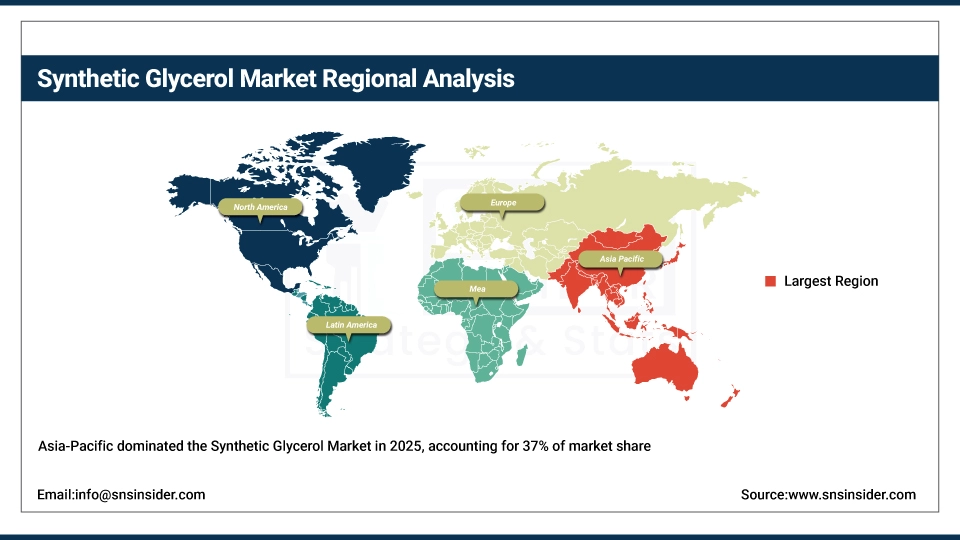
The Global Synthetic Glycerol Market is dominated by Asia-Pacific, accounting for 37% share in 2025, driven by large-scale chemical, pharmaceutical, and personal care production, strong industrial infrastructure, and well-established supply chains. Industrial-grade glycerol enables high-volume manufacturing for domestic and export markets. The fastest growing region is also Asia-Pacific, expected to register a CAGR of 7.25%, fueled by rising adoption of high-purity and bio-based glycerol in pharmaceuticals, cosmetics, and specialty chemicals, alongside expansion of sustainable production, increasing local manufacturing, and supportive regulations that boost long-term market growth.
Get Customized Report as per Your Business Requirement - Enquiry Now
China Synthetic Glycerol Market Insights:
The China Synthetic Glycerol Market is fueled by large-scale chemical, pharmaceutical, and personal care production, rising demand for high-purity and sustainable glycerol, and expanding local manufacturing. Increasing adoption of bio-based and multifunctional glycerol, along with technological innovations and strong supply chains, makes China a key contributor to Asia-Pacific market growth.
North America Synthetic Glycerol Market Insights:
Increasing demand for high purity and bio-based glycerol led to the growth of the North America Synthetic Glycerol Market, especially in pharmaceuticals, personal care and specialty chemical applications. Overseas producers are more concentrated on creating high-grade, eco-friendly glycerol for pharmaceutical formulations, cosmetics and for industrial use in US and Canada. Regional growth is supported by Strong regulatory compliance, developed chemical manufacturing system, due to rise demand of bio based materials like base extending agent and green manufacturing process. Two major trends influencing the growth of the market are the increasing level of innovation in purification technologies and the rising demand for sustainable chemicals.
U.S. Synthetic Glycerol Market Insights:
The U.S. Synthetic Glycerol Market is driven by rising pharmaceutical and personal care production, growing demand for high-purity and bio-based glycerol, and expanding specialty chemical applications. Adoption of sustainable formulations, technological advancements in purification, and compliance with stringent safety and environmental regulations will position the U.S. as a key regional market.
Europe Synthetic Glycerol Market Insights:
The Europe Synthetic Glycerol Market is driven by developed chemical and pharmaceutical industries, strict regulatory requirements, increased need for high purity glycerin, and bio-based glycerin. Manufacturers in Germany, France, and the UK target specialty grade, sustainable glycerol for pharmaceuticals, personal care and specialty chemicals, etc, ensuring quality and reliability. The growing use of eco-friendly formulations, growing use in industrial applications, and also getting importance of safety and sustainability along with consistency of products are the important factors responsible for the growth and dominance of the Europe market.
Germany Synthetic Glycerol Market Insights:
Germany is a key market in the European Synthetic Glycerol landscape, supported by advanced chemical and pharmaceutical industries. Focus on high-purity and sustainable glycerol, precision-grade production, regulatory compliance, and growing adoption in personal care and specialty chemicals drive market growth, innovation, and long-term modernization.
Latin America Synthetic Glycerol Market Insights:
The Latin America Synthetic Glycerol Market is expanding as pharmaceutical, personal care, and specialty chemical production grows. Rising demand in Brazil, Mexico, and Argentina, along with increasing adoption of high-purity and bio-based glycerol, coupled with local manufacturing and sustainable formulation initiatives, is driving regional production volumes and steady market growth across developing economies.
Middle East and Africa Synthetic Glycerol Market Insights:
The Middle East & Africa Synthetic Glycerol Market is expanding due to growing pharmaceutical, personal care, and specialty chemical production. Increasing local glycerol manufacturing in Saudi Arabia, the UAE, and South Africa, coupled with rising adoption of high-purity and sustainable formulations, supportive regulations, and investment in chemical infrastructure, continues to strengthen regional production capacity and market growth.
Synthetic Glycerol Market Competitive Landscape:
Solvay S.A. - Solvay is a Brussels-based multinational corporation that serves chemicals and advanced materials, with the high-purity synthetic glycerol and chemical intermediates for pharmaceuticals, personal care, and industrial applications. Mitsubishi Electric's extensive R&D capabilities coupled with sustainable production and wide portfolio of products have the ability to provide customized solutions across various industries. Solvay has proven track record of long-standing relationships with chemical manufacturers, well-established supply chain infrastructure, and focus on quality and environmental compliance to remain market leader. Its leadership and market presence are further reinforced by continuous innovation and strategic partnerships.
-
In September 2025, Solvay S.A. launched Augeo Clean Multi and Hexylene Glycol, bio-based glycerin-derived solvents for personal and pet care applications, offering low odor, high solubility, and accelerated biodegradability, strengthening its position in sustainable formulation solutions.
Dow Inc– One of the top multinational chemical company that provide high-quality synthetic glycerol, solvents and polymer intermediates. This superiority arises from its advanced manufacturing technologies, broad distribution networks, and large practice in chemicals production. Meeting choices for the pharmaceutical, personal care, and Industrial wishes of businesses, Dow gives you a necessary dedication to sustainability, reformulation innovation, and stringent quality requirements. Due to its longstanding, intimate customer relationships, continual process improvement, and investment in research and development (R&D), Dow has established itself as a credible, major chemical and glycerol supplier.
-
In November 2025, Dow Inc. introduced four innovative personal care ingredients like DOWSIL FC‑5012 ID Resin Gum, DEXCARE CD‑2 Polymer, DOWSIL CB‑2251 Fluid, and ACUDYNE™ 2000 Polymer which is expanding its sustainable skincare, haircare, and cosmetics portfolio, reinforcing its leadership in performance-driven chemical solutions.
Hexion Inc. specializes in thermoset resins, chemical intermediates, and specialty chemicals, including high-purity synthetic glycerol for industrial and personal care applications. The company dominates the market through innovation in formulation technology, reliable production capabilities, and a wide-reaching distribution network. Hexion’s focus on sustainable manufacturing, adherence to strict quality and safety standards, and strong partnerships with chemical processors and manufacturers have reinforced its market leadership. Consistent product performance and industry expertise make Hexion a preferred supplier across multiple regions and applications.
-
In May 2025, Hexion Inc. unveiled SmartQuality, an AI-powered manufacturing quality platform, providing real-time production insights, enhanced consistency, and improved efficiency for wood panel production, strengthening its market leadership in advanced chemical and process technology solutions.
Synthetic Glycerol Market Key Players:
-
Solvay S.A.
-
Dow Inc.
-
Hexion Inc.
-
BASF SE
-
Formosa Plastics Corporation
-
Olin Corporation
-
Spolchemie (Spolek pro Chemickou a Hutní Výrobu)
-
Sumitomo Chemical Co., Ltd.
-
Kashima Chemical Co., Ltd.
-
Meghmani Finechem Ltd.
-
Epigral Limited
-
Shandong Haili Chemical Industry Co., Ltd.
-
Samsung Fine Chemicals
-
Lonza Group AG
-
Kao Corporation
-
Vantage Specialty Chemicals
-
Nof Corporation
-
Spectrum Chemical Manufacturing Corp.
| Report Attributes | Details |
|---|---|
|
Market Size in 2025 |
USD 1.12 Billion |
|
Market Size by 2035 |
USD 1.98 Billion |
|
CAGR |
CAGR of 5.91% From 2026 to 2035 |
|
Base Year |
2025 |
|
Forecast Period |
2026-2035 |
|
Historical Data |
2022-2024 |
|
Report Scope & Coverage |
Market Size, Segments Analysis, Competitive Landscape, Regional Analysis, DROC & SWOT Analysis, Forecast Outlook |
|
Key Segments |
• By Production Process (Epichlorohydrin (ECH) Route, Propylene-Based Synthesis, Petrochemical Derivative Processes, Bio-Based Synthetic Routes) |
|
Regional Analysis/Coverage |
North America (US, Canada), Europe (Germany, UK, France, Italy, Spain, Russia, Poland, Rest of Europe), Asia Pacific (China, India, Japan, South Korea, Australia, ASEAN Countries, Rest of Asia Pacific), Middle East & Africa (UAE, Saudi Arabia, Qatar, South Africa, Rest of Middle East & Africa), Latin America (Brazil, Argentina, Mexico, Colombia, Rest of Latin America). |
|
Company Profiles |
Solvay S.A., Dow Inc., Hexion Inc., BASF SE, Formosa Plastics Corporation, Olin Corporation, Aditya Birla Chemicals, Spolchemie (Spolek pro Chemickou a Hutní Výrobu), Sumitomo Chemical Co., Ltd., Kashima Chemical Co., Ltd., Meghmani Finechem Ltd., Epigral Limited, Shandong Haili Chemical Industry Co., Ltd., Samsung Fine Chemicals, Lonza Group AG, Kao Corporation, Stepan Company, Vantage Specialty Chemicals, Nof Corporation, Spectrum Chemical Manufacturing Corp. |

Frequently Asked Questions
High production costs, raw material fluctuations, and regulatory compliance constraints.
Local chemical production, industrial infrastructure, regulations, and adoption of sustainable formulations.
Growing demand for eco-friendly, multifunctional, and sustainable glycerol solutions.
Pharmaceuticals, cosmetics, food & beverage, chemical manufacturing, and personal care.
Rising demand for high-purity, bio-based glycerol in pharmaceuticals, cosmetics, and industrial applications.
